SME network facilitator
Module 2: Communication for co-operation
Time What for
(Learning aims)
What
(Learning content)
How
(Methods)
How
(Instruments, mate-
rials)
Who
(Actors,
partners)
Date to be specified Duration at least 8 hours better:
14 to 16 hour
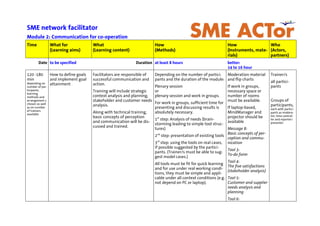
120 -180
min
depending on
number of par-
ticipants,
learning
methods and
arrangement s
chosen as well
as on number
of trainers
available
How to define goals
and implement goal
attainment
Facilitators are responsible of
successful communication and
action.
Training will include strategic
context analysis and planning,
stakeholder and customer needs
analysis.
Along with technical training,
basic concepts of perception
and communication will be dis-
cussed and trained.
Depending on the number of partici-
pants and the duration of the module:
Plenary session
or
plenary session and work in groups.
For work in groups, sufficient time for
presenting and discussing results is
absolutely necessary.
1st
step: Analysis of needs (brain-
storming leading to simple tool struc-
tures)
2nd
step: presentation of existing tools
3rd
step: using the tools on real cases,
if possible suggested by the partici-
pants. (Trainer/s must be able to sug-
gest model cases.)
All tools must be fit for quick learning
and for use under real working condi-
tions, they must be simple and appli-
cable under all context conditions (e.g.
not depend on PC or laptop).
Moderation material
and flip charts
If work in groups,
necessary space or
number of rooms
must be available.
If laptop-based,
MindManager and
projector should be
available
Message 8:
Basic concepts of per-
ception and commu-
nication
Tool 3:
To-do form
Tool 4:
The five satisfactions
(stakeholder analysis)
Tool 5:
Customer and supplier
needs analysis and
planning
Tool 6:
Trainer/s
all partici-
pants
Groups of
participants,
each with partici-
pants as modera-
tor, time control-
ler and reporter/
presenter
SME network facilitator
Module 2: Communication for co-operation
Time What for
(Learning aims)
What
(Learning content)
How
(Methods)
How
(Instruments, mate-
rials)
Who
(Actors,
partners)
Case studies
15 min Break
120-180
min
depending on
number of par-
ticipants,
learning
methods and
arrangement s
chosen as well
as on number
of trainers
available
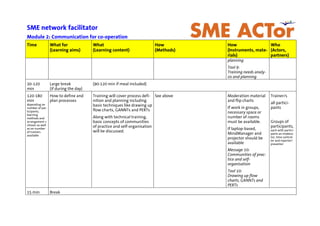
How to define tasks
and competence
needs and how to or-
ganise critical task
implementation
Training will cover task-specific
context analysis and planning,
task analysis and planning,
competence analysis and plan-
ning.
Along with technical training,
basic concepts of competence
and learning will be discussed
and trained.
See above Moderation material
and flip charts
If work in groups,
necessary space or
number of rooms
must be available.
If laptop-based,
MindManager and
projector should be
available
Message 9:
Basic concepts of
learning and compe-
tence
Tool 5:
Customer and supplier
needs analysis and
planning
Tool 7:
Customer and supplier
process analysis and
planning
Tool 8:
Spatial throughput or
process analysis and
Trainer/s
all partici-
pants
Groups of
participants,
each with partici-
pants as modera-
tor, time control-
ler and reporter/
presenter
SME network facilitator
Module 2: Communication for co-operation
Time What for
(Learning aims)
What
(Learning content)
How
(Methods)
How
(Instruments, mate-
rials)
Who
(Actors,
partners)
planning
Tool 9:
Training needs analy-
sis and planning
30-120
min
Large break
(if during the day)
(90-120 min if meal included)
120-180
min
depending on
number of par-
ticipants,
learning
methods and
arrangement s
chosen as well
as on number
of trainers
available
How to define and
plan processes
Training will cover process defi-
nition and planning including
basic techniques like drawing up
flow charts, GANNTs and PERTs
Along with technical training,
basic concepts of communities
of practice and self-organisation
will be discussed.
See above Moderation material
and flip charts
If work in groups,
necessary space or
number of rooms
must be available.
If laptop-based,
MindManager and
projector should be
available
Message 10:
Communities of prac-
tice and self-
organisation
Tool 10:
Drawing up flow
charts, GANNTs and
PERTs
Trainer/s
all partici-
pants
Groups of
participants,
each with partici-
pants as modera-
tor, time control-
ler and reporter/
presenter
15 min Break
SME network facilitator
Module 2: Communication for co-operation
Time What for
(Learning aims)
What
(Learning content)
How
(Methods)
How
(Instruments, mate-
rials)
Who
(Actors,
partners)
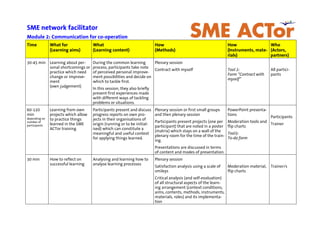
30-45 min Learning about per-
sonal shortcomings or
practice which need
change or improve-
ment
(own judgement)
During the common learning
process, participants take note
of perceived personal improve-
ment possibilities and decide on
which to tackle first.
In this session, they also briefly
present first experiences made
with different ways of tackling
problems or situations.
Plenary session
Contract with myself Tool 2:
Form “Contract with
myself”
All partici-
pants
60-120
min
depending on
number of
participants
Learning from own
projects which allow
to practice things
learned in the SME
ACTor training
Participants present and discuss
progress reports on own pro-
jects in their organisations of
origin (running or to be initial-
ised) which can constitute a
meaningful and useful context
for applying things learned.
Plenary session or first small groups
and then plenary session
Participants present projects (one per
participant) that are noted in a poster
(matrix) which stays on a wall of the
plenary room for the time of the train-
ing.
Presentations are discussed in terms
of content and modes of presentation.
PowerPoint presenta-
tions
Moderation tools and
flip charts
Tool3:
To-do form
Participants
Trainer
30 min How to reflect on
successful learning
Analysing and learning how to
analyse learning processes
Plenary session
Satisfaction analysis using a scale of
smileys
Critical analysis (and self-evaluation)
of all structural aspects of the learn-
ing arrangement (context conditions,
aims, contents, methods, instruments,
materials, roles) and its implementa-
tion
Moderation material,
flip charts
Trainer/s
Module 2: Communication for co-operation

Module 2: Communication for co-operation

  • 1.
    SME network facilitator Module2: Communication for co-operation Time What for (Learning aims) What (Learning content) How (Methods) How (Instruments, mate- rials) Who (Actors, partners) Date to be specified Duration at least 8 hours better: 14 to 16 hour 120 -180 min depending on number of par- ticipants, learning methods and arrangement s chosen as well as on number of trainers available How to define goals and implement goal attainment Facilitators are responsible of successful communication and action. Training will include strategic context analysis and planning, stakeholder and customer needs analysis. Along with technical training, basic concepts of perception and communication will be dis- cussed and trained. Depending on the number of partici- pants and the duration of the module: Plenary session or plenary session and work in groups. For work in groups, sufficient time for presenting and discussing results is absolutely necessary. 1st step: Analysis of needs (brain- storming leading to simple tool struc- tures) 2nd step: presentation of existing tools 3rd step: using the tools on real cases, if possible suggested by the partici- pants. (Trainer/s must be able to sug- gest model cases.) All tools must be fit for quick learning and for use under real working condi- tions, they must be simple and appli- cable under all context conditions (e.g. not depend on PC or laptop). Moderation material and flip charts If work in groups, necessary space or number of rooms must be available. If laptop-based, MindManager and projector should be available Message 8: Basic concepts of per- ception and commu- nication Tool 3: To-do form Tool 4: The five satisfactions (stakeholder analysis) Tool 5: Customer and supplier needs analysis and planning Tool 6: Trainer/s all partici- pants Groups of participants, each with partici- pants as modera- tor, time control- ler and reporter/ presenter
  • 2.
    SME network facilitator Module2: Communication for co-operation Time What for (Learning aims) What (Learning content) How (Methods) How (Instruments, mate- rials) Who (Actors, partners) Case studies 15 min Break 120-180 min depending on number of par- ticipants, learning methods and arrangement s chosen as well as on number of trainers available How to define tasks and competence needs and how to or- ganise critical task implementation Training will cover task-specific context analysis and planning, task analysis and planning, competence analysis and plan- ning. Along with technical training, basic concepts of competence and learning will be discussed and trained. See above Moderation material and flip charts If work in groups, necessary space or number of rooms must be available. If laptop-based, MindManager and projector should be available Message 9: Basic concepts of learning and compe- tence Tool 5: Customer and supplier needs analysis and planning Tool 7: Customer and supplier process analysis and planning Tool 8: Spatial throughput or process analysis and Trainer/s all partici- pants Groups of participants, each with partici- pants as modera- tor, time control- ler and reporter/ presenter
  • 3.
    SME network facilitator Module2: Communication for co-operation Time What for (Learning aims) What (Learning content) How (Methods) How (Instruments, mate- rials) Who (Actors, partners) planning Tool 9: Training needs analy- sis and planning 30-120 min Large break (if during the day) (90-120 min if meal included) 120-180 min depending on number of par- ticipants, learning methods and arrangement s chosen as well as on number of trainers available How to define and plan processes Training will cover process defi- nition and planning including basic techniques like drawing up flow charts, GANNTs and PERTs Along with technical training, basic concepts of communities of practice and self-organisation will be discussed. See above Moderation material and flip charts If work in groups, necessary space or number of rooms must be available. If laptop-based, MindManager and projector should be available Message 10: Communities of prac- tice and self- organisation Tool 10: Drawing up flow charts, GANNTs and PERTs Trainer/s all partici- pants Groups of participants, each with partici- pants as modera- tor, time control- ler and reporter/ presenter 15 min Break
  • 4.
    SME network facilitator Module2: Communication for co-operation Time What for (Learning aims) What (Learning content) How (Methods) How (Instruments, mate- rials) Who (Actors, partners) 30-45 min Learning about per- sonal shortcomings or practice which need change or improve- ment (own judgement) During the common learning process, participants take note of perceived personal improve- ment possibilities and decide on which to tackle first. In this session, they also briefly present first experiences made with different ways of tackling problems or situations. Plenary session Contract with myself Tool 2: Form “Contract with myself” All partici- pants 60-120 min depending on number of participants Learning from own projects which allow to practice things learned in the SME ACTor training Participants present and discuss progress reports on own pro- jects in their organisations of origin (running or to be initial- ised) which can constitute a meaningful and useful context for applying things learned. Plenary session or first small groups and then plenary session Participants present projects (one per participant) that are noted in a poster (matrix) which stays on a wall of the plenary room for the time of the train- ing. Presentations are discussed in terms of content and modes of presentation. PowerPoint presenta- tions Moderation tools and flip charts Tool3: To-do form Participants Trainer 30 min How to reflect on successful learning Analysing and learning how to analyse learning processes Plenary session Satisfaction analysis using a scale of smileys Critical analysis (and self-evaluation) of all structural aspects of the learn- ing arrangement (context conditions, aims, contents, methods, instruments, materials, roles) and its implementa- tion Moderation material, flip charts Trainer/s