Tool D12Six thinking hats
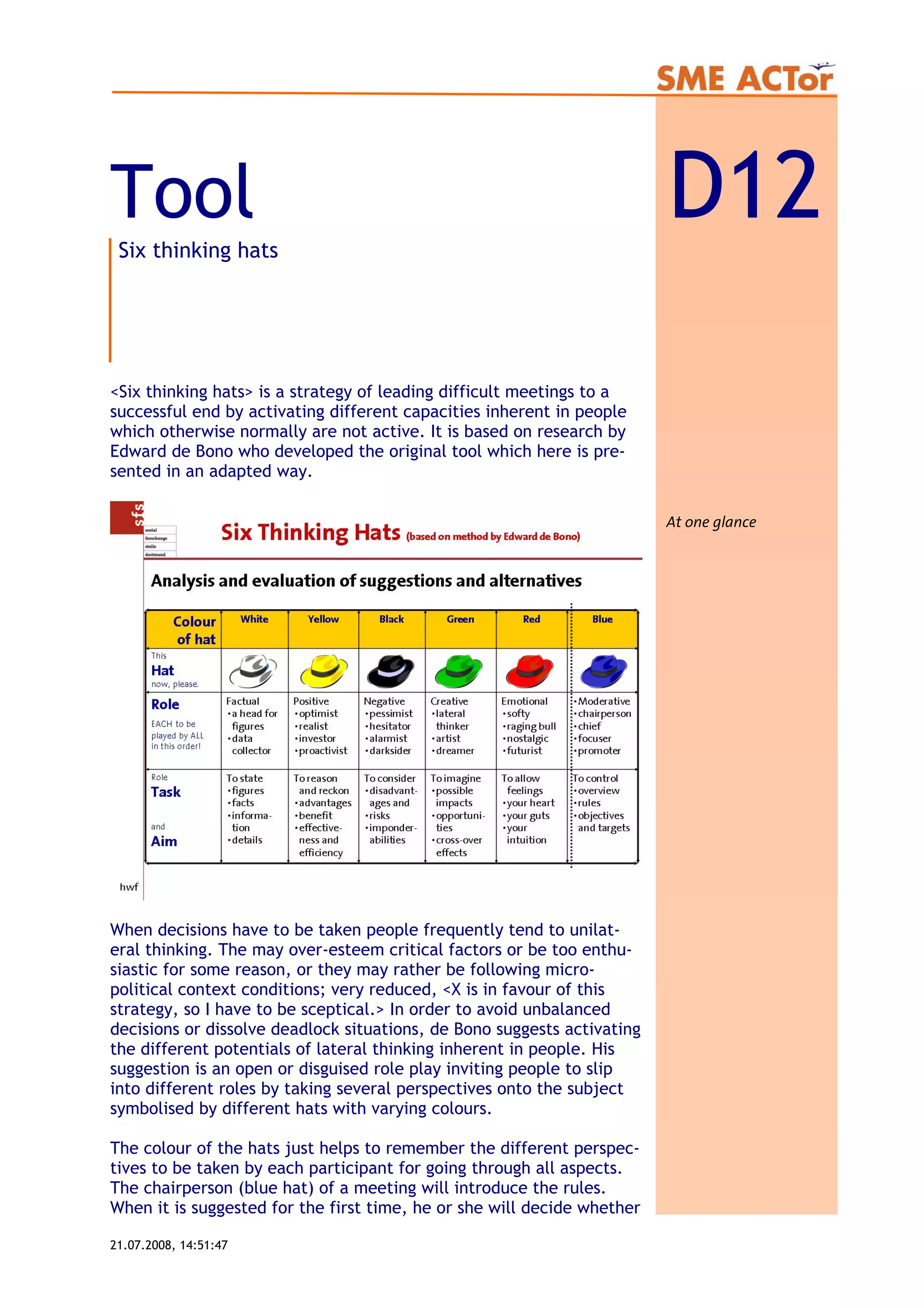
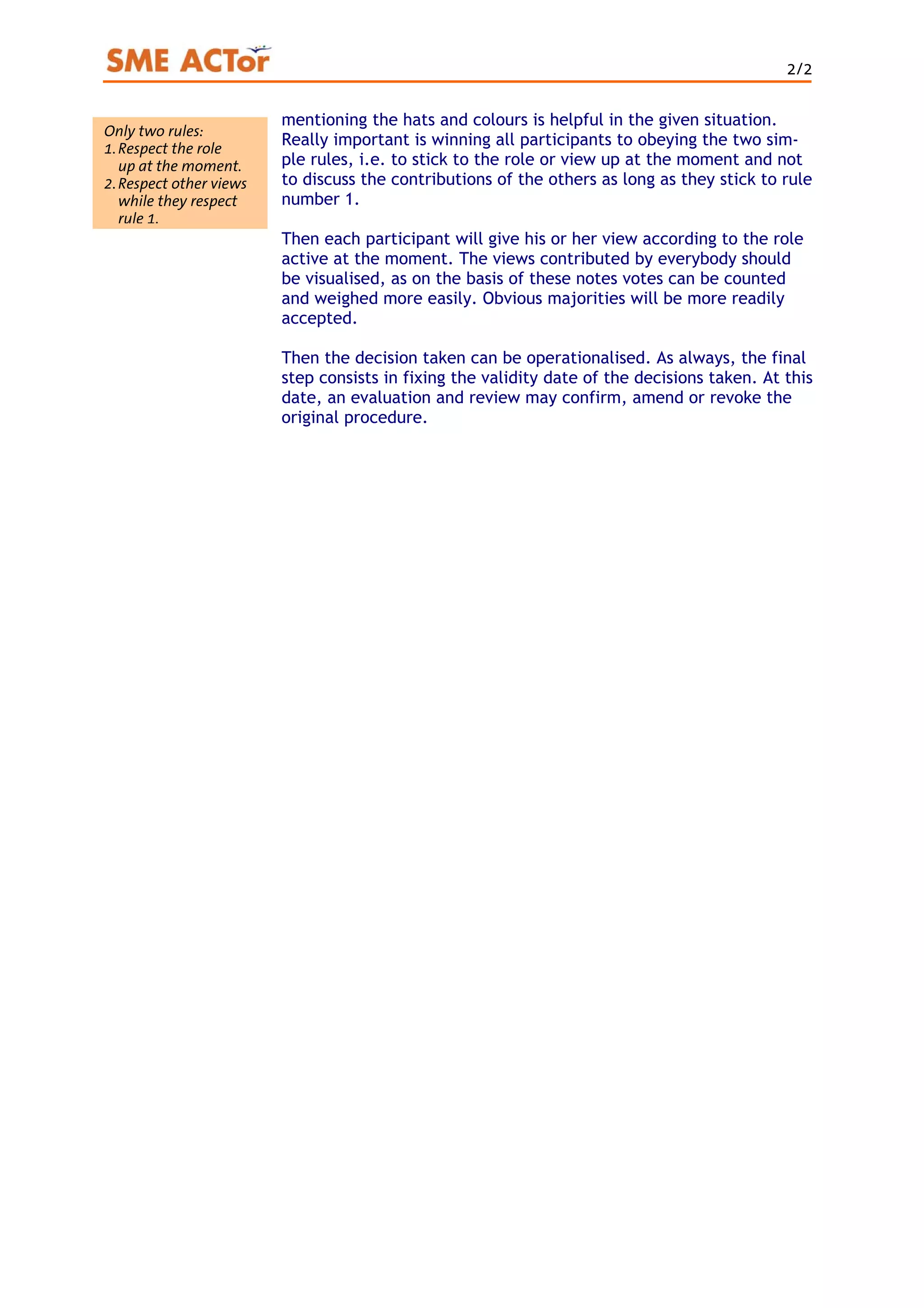
<Six thinking hats> is a strategy of leading difficult meetings to a
successful end by activating different capacities inherent in people
which otherwise normally are not active. It is based on research by
Edward de Bono who developed the original tool which here is pre-
sented in an adapted way.
At one glance
When decisions have to be taken people frequently tend to unilat-
eral thinking. The may over-esteem critical factors or be too enthu-
siastic for some reason, or they may rather be following micro-
political context conditions; very reduced, <X is in favour of this
strategy, so I have to be sceptical.> In order to avoid unbalanced
decisions or dissolve deadlock situations, de Bono suggests activating
the different potentials of lateral thinking inherent in people. His
suggestion is an open or disguised role play inviting people to slip
into different roles by taking several perspectives onto the subject
symbolised by different hats with varying colours.
The colour of the hats just helps to remember the different perspec-
tives to be taken by each participant for going through all aspects.
The chairperson (blue hat) of a meeting will introduce the rules.
When it is suggested for the first time, he or she will decide whether
21.07.2008, 14:51:47
2/2
mentioning the hats and colours is helpful in the given situation.
Really important is winning all participants to obeying the two sim-
ple rules, i.e. to stick to the role or view up at the moment and not
to discuss the contributions of the others as long as they stick to rule
number 1.
Only two rules:
1.Respect the role
up at the moment.
2.Respect other views
while they respect
rule 1.
Then each participant will give his or her view according to the role
active at the moment. The views contributed by everybody should
be visualised, as on the basis of these notes votes can be counted
and weighed more easily. Obvious majorities will be more readily
accepted.
Then the decision taken can be operationalised. As always, the final
step consists in fixing the validity date of the decisions taken. At this
date, an evaluation and review may confirm, amend or revoke the
original procedure.

D12 Six thinking hats

  • 1.
    Tool D12Six thinkinghats <Six thinking hats> is a strategy of leading difficult meetings to a successful end by activating different capacities inherent in people which otherwise normally are not active. It is based on research by Edward de Bono who developed the original tool which here is pre- sented in an adapted way. At one glance When decisions have to be taken people frequently tend to unilat- eral thinking. The may over-esteem critical factors or be too enthu- siastic for some reason, or they may rather be following micro- political context conditions; very reduced, <X is in favour of this strategy, so I have to be sceptical.> In order to avoid unbalanced decisions or dissolve deadlock situations, de Bono suggests activating the different potentials of lateral thinking inherent in people. His suggestion is an open or disguised role play inviting people to slip into different roles by taking several perspectives onto the subject symbolised by different hats with varying colours. The colour of the hats just helps to remember the different perspec- tives to be taken by each participant for going through all aspects. The chairperson (blue hat) of a meeting will introduce the rules. When it is suggested for the first time, he or she will decide whether 21.07.2008, 14:51:47
  • 2.
    2/2 mentioning the hatsand colours is helpful in the given situation. Really important is winning all participants to obeying the two sim- ple rules, i.e. to stick to the role or view up at the moment and not to discuss the contributions of the others as long as they stick to rule number 1. Only two rules: 1.Respect the role up at the moment. 2.Respect other views while they respect rule 1. Then each participant will give his or her view according to the role active at the moment. The views contributed by everybody should be visualised, as on the basis of these notes votes can be counted and weighed more easily. Obvious majorities will be more readily accepted. Then the decision taken can be operationalised. As always, the final step consists in fixing the validity date of the decisions taken. At this date, an evaluation and review may confirm, amend or revoke the original procedure.