Module 2
Buyer’s Behavior
Consumer and organizational buyer
behavior: distinguishing features,
consumer buying decision process and
determinants, recent developments in
organizational buying.
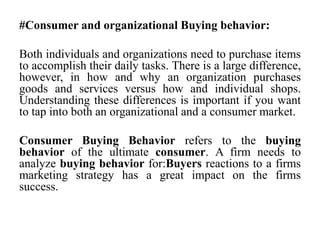
#Consumer and organizational Buying behavior:
Both individuals and organizations need to purchase items
to accomplish their daily tasks. There is a large difference,
however, in how and why an organization purchases
goods and services versus how and individual shops.
Understanding these differences is important if you want
to tap into both an organizational and a consumer market.
Consumer Buying Behavior refers to the buying
behavior of the ultimate consumer. A firm needs to
analyze buying behavior for:Buyers reactions to a firms
marketing strategy has a great impact on the firms
success.
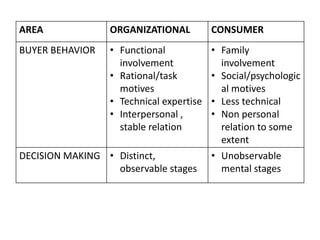
AREA ORGANIZATIONAL CONSUMER
BUYER BEHAVIOR • Functional
involvement
• Rational/task
motives
• Technical expertise
• Interpersonal ,
stable relation
• Family
involvement
• Social/psychologic
al motives
• Less technical
• Non personal
relation to some
extent
DECISION MAKING • Distinct,
observable stages
• Unobservable
mental stages
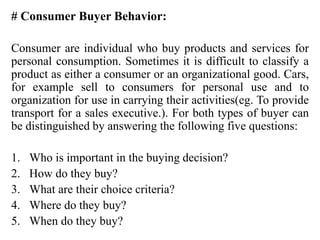
# Consumer Buyer Behavior:
Consumer are individual who buy products and services for
personal consumption. Sometimes it is difficult to classify a
product as either a consumer or an organizational good. Cars,
for example sell to consumers for personal use and to
organization for use in carrying their activities(eg. To provide
transport for a sales executive.). For both types of buyer can
be distinguished by answering the following five questions:
1. Who is important in the buying decision?
2. How do they buy?
3. What are their choice criteria?
4. Where do they buy?
5. When do they buy?
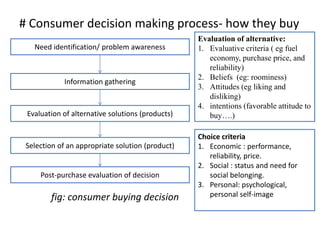
# Consumer decision making process- how they buy
fig: consumer buying decision
Need identification/ problem awareness
Information gathering
Evaluation of alternative solutions (products)
Selection of an appropriate solution (product)
Post-purchase evaluation of decision
Evaluation of alternative:
1. Evaluative criteria ( eg fuel
economy, purchase price, and
reliability)
2. Beliefs (eg: roominess)
3. Attitudes (eg liking and
disliking)
4. intentions (favorable attitude to
buy….)
Choice criteria
1. Economic : performance,
reliability, price.
2. Social : status and need for
social belonging.
3. Personal: psychological,
personal self-image
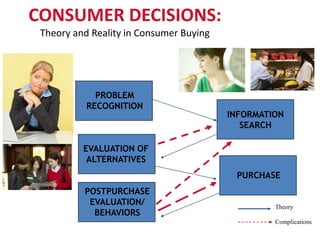
CONSUMER DECISIONS:
Theory and Reality in Consumer Buying
INFORMATION
SEARCH
PROBLEM
RECOGNITION
EVALUATION OF
ALTERNATIVES
PURCHASE
POSTPURCHASE
EVALUATION/
BEHAVIORS
Theory
Complications
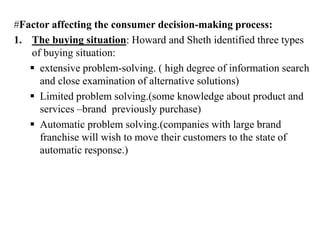
#Factor affecting the consumer decision-making process:
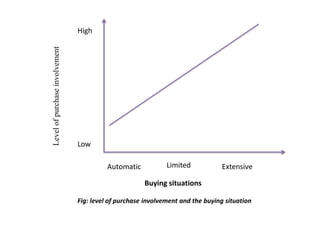
1. The buying situation: Howard and Sheth identified three types
of buying situation:
 extensive problem-solving. ( high degree of information search
and close examination of alternative solutions)
 Limited problem solving.(some knowledge about product and
services –brand previously purchase)
 Automatic problem solving.(companies with large brand
franchise will wish to move their customers to the state of
automatic response.)
Automatic Limited Extensive
Buying situations
Fig: level of purchase involvement and the buying situation
Levelofpurchaseinvolvement
High
Low
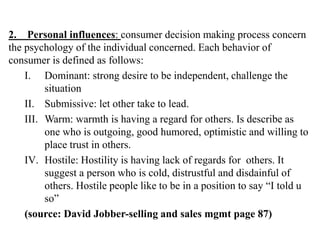
2. Personal influences: consumer decision making process concern
the psychology of the individual concerned. Each behavior of
consumer is defined as follows:
I. Dominant: strong desire to be independent, challenge the
situation
II. Submissive: let other take to lead.
III. Warm: warmth is having a regard for others. Is describe as
one who is outgoing, good humored, optimistic and willing to
place trust in others.
IV. Hostile: Hostility is having lack of regards for others. It
suggest a person who is cold, distrustful and disdainful of
others. Hostile people like to be in a position to say “I told u
so”
(source: David Jobber-selling and sales mgmt page 87)
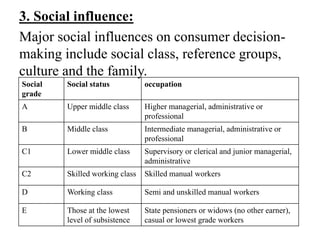
3. Social influence:
Major social influences on consumer decision-
making include social class, reference groups,
culture and the family.
Social
grade
Social status occupation
A Upper middle class Higher managerial, administrative or
professional
B Middle class Intermediate managerial, administrative or
professional
C1 Lower middle class Supervisory or clerical and junior managerial,
administrative
C2 Skilled working class Skilled manual workers
D Working class Semi and unskilled manual workers
E Those at the lowest
level of subsistence
State pensioners or widows (no other earner),
casual or lowest grade workers
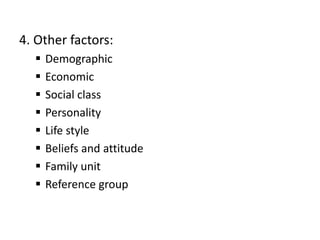
4. Other factors:
 Demographic
 Economic
 Social class
 Personality
 Life style
 Beliefs and attitude
 Family unit
 Reference group
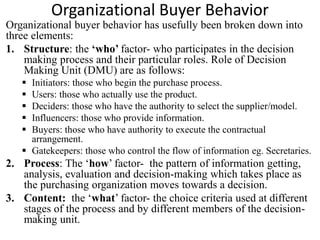
Organizational Buyer Behavior
Organizational buyer behavior has usefully been broken down into
three elements:
1. Structure: the ‘who’ factor- who participates in the decision
making process and their particular roles. Role of Decision
Making Unit (DMU) are as follows:
 Initiators: those who begin the purchase process.
 Users: those who actually use the product.
 Deciders: those who have the authority to select the supplier/model.
 Influencers: those who provide information.
 Buyers: those who have authority to execute the contractual
arrangement.
 Gatekeepers: those who control the flow of information eg. Secretaries.
2. Process: The ‘how’ factor- the pattern of information getting,
analysis, evaluation and decision-making which takes place as
the purchasing organization moves towards a decision.
3. Content: the ‘what’ factor- the choice criteria used at different
stages of the process and by different members of the decision-
making unit.
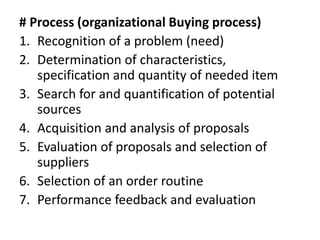
# Process (organizational Buying process)
1. Recognition of a problem (need)
2. Determination of characteristics,
specification and quantity of needed item
3. Search for and quantification of potential
sources
4. Acquisition and analysis of proposals
5. Evaluation of proposals and selection of
suppliers
6. Selection of an order routine
7. Performance feedback and evaluation
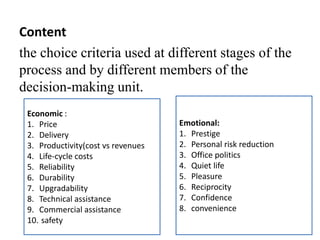
Content
the choice criteria used at different stages of the
process and by different members of the
decision-making unit.
Economic :
1. Price
2. Delivery
3. Productivity(cost vs revenues
4. Life-cycle costs
5. Reliability
6. Durability
7. Upgradability
8. Technical assistance
9. Commercial assistance
10. safety
Emotional:
1. Prestige
2. Personal risk reduction
3. Office politics
4. Quiet life
5. Pleasure
6. Reciprocity
7. Confidence
8. convenience
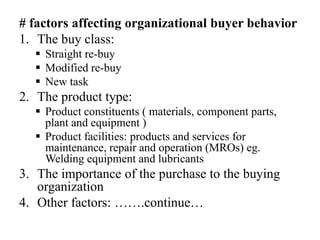
# factors affecting organizational buyer behavior
1. The buy class:
 Straight re-buy
 Modified re-buy
 New task
2. The product type:
 Product constituents ( materials, component parts,
plant and equipment )
 Product facilities: products and services for
maintenance, repair and operation (MROs) eg.
Welding equipment and lubricants
3. The importance of the purchase to the buying
organization
4. Other factors: …….continue…
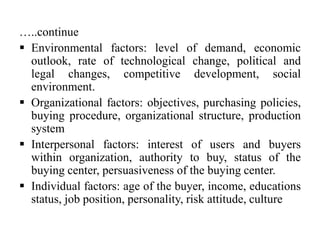
…..continue
 Environmental factors: level of demand, economic
outlook, rate of technological change, political and
legal changes, competitive development, social
environment.
 Organizational factors: objectives, purchasing policies,
buying procedure, organizational structure, production
system
 Interpersonal factors: interest of users and buyers
within organization, authority to buy, status of the
buying center, persuasiveness of the buying center.
 Individual factors: age of the buyer, income, educations
status, job position, personality, risk attitude, culture
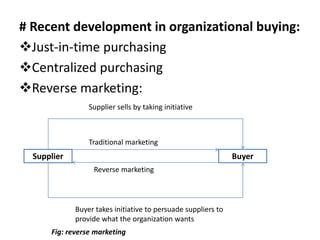
# Recent development in organizational buying:
Just-in-time purchasing
Centralized purchasing
Reverse marketing:
BuyerSupplier
Supplier sells by taking initiative
Traditional marketing
Buyer takes initiative to persuade suppliers to
provide what the organization wants
Reverse marketing
Fig: reverse marketing
Leasing:
• financial lease: is a longer term agreement that is
fully amortized over the term of contract , lease
payment in total-usually exceed the purchase
price of the item.
• Operating lease: is for a shorter period of time, is
cancellable and not completely amortized.
Operating lease rates are usually higher than
financial lease. It sometimes called as rental
agreement

Module 2 buyer's behavior

  • 1.
    Module 2 Buyer’s Behavior Consumerand organizational buyer behavior: distinguishing features, consumer buying decision process and determinants, recent developments in organizational buying.
  • 2.
    #Consumer and organizationalBuying behavior: Both individuals and organizations need to purchase items to accomplish their daily tasks. There is a large difference, however, in how and why an organization purchases goods and services versus how and individual shops. Understanding these differences is important if you want to tap into both an organizational and a consumer market. Consumer Buying Behavior refers to the buying behavior of the ultimate consumer. A firm needs to analyze buying behavior for:Buyers reactions to a firms marketing strategy has a great impact on the firms success.
  • 3.
    AREA ORGANIZATIONAL CONSUMER BUYERBEHAVIOR • Functional involvement • Rational/task motives • Technical expertise • Interpersonal , stable relation • Family involvement • Social/psychologic al motives • Less technical • Non personal relation to some extent DECISION MAKING • Distinct, observable stages • Unobservable mental stages
  • 4.
    # Consumer BuyerBehavior: Consumer are individual who buy products and services for personal consumption. Sometimes it is difficult to classify a product as either a consumer or an organizational good. Cars, for example sell to consumers for personal use and to organization for use in carrying their activities(eg. To provide transport for a sales executive.). For both types of buyer can be distinguished by answering the following five questions: 1. Who is important in the buying decision? 2. How do they buy? 3. What are their choice criteria? 4. Where do they buy? 5. When do they buy?
  • 5.
    # Consumer decisionmaking process- how they buy fig: consumer buying decision Need identification/ problem awareness Information gathering Evaluation of alternative solutions (products) Selection of an appropriate solution (product) Post-purchase evaluation of decision Evaluation of alternative: 1. Evaluative criteria ( eg fuel economy, purchase price, and reliability) 2. Beliefs (eg: roominess) 3. Attitudes (eg liking and disliking) 4. intentions (favorable attitude to buy….) Choice criteria 1. Economic : performance, reliability, price. 2. Social : status and need for social belonging. 3. Personal: psychological, personal self-image
  • 6.
    CONSUMER DECISIONS: Theory andReality in Consumer Buying INFORMATION SEARCH PROBLEM RECOGNITION EVALUATION OF ALTERNATIVES PURCHASE POSTPURCHASE EVALUATION/ BEHAVIORS Theory Complications
  • 7.
    #Factor affecting theconsumer decision-making process: 1. The buying situation: Howard and Sheth identified three types of buying situation:  extensive problem-solving. ( high degree of information search and close examination of alternative solutions)  Limited problem solving.(some knowledge about product and services –brand previously purchase)  Automatic problem solving.(companies with large brand franchise will wish to move their customers to the state of automatic response.)
  • 8.
    Automatic Limited Extensive Buyingsituations Fig: level of purchase involvement and the buying situation Levelofpurchaseinvolvement High Low
  • 9.
    2. Personal influences:consumer decision making process concern the psychology of the individual concerned. Each behavior of consumer is defined as follows: I. Dominant: strong desire to be independent, challenge the situation II. Submissive: let other take to lead. III. Warm: warmth is having a regard for others. Is describe as one who is outgoing, good humored, optimistic and willing to place trust in others. IV. Hostile: Hostility is having lack of regards for others. It suggest a person who is cold, distrustful and disdainful of others. Hostile people like to be in a position to say “I told u so” (source: David Jobber-selling and sales mgmt page 87)
  • 10.
    3. Social influence: Majorsocial influences on consumer decision- making include social class, reference groups, culture and the family. Social grade Social status occupation A Upper middle class Higher managerial, administrative or professional B Middle class Intermediate managerial, administrative or professional C1 Lower middle class Supervisory or clerical and junior managerial, administrative C2 Skilled working class Skilled manual workers D Working class Semi and unskilled manual workers E Those at the lowest level of subsistence State pensioners or widows (no other earner), casual or lowest grade workers
  • 11.
    4. Other factors: Demographic  Economic  Social class  Personality  Life style  Beliefs and attitude  Family unit  Reference group
  • 12.
    Organizational Buyer Behavior Organizationalbuyer behavior has usefully been broken down into three elements: 1. Structure: the ‘who’ factor- who participates in the decision making process and their particular roles. Role of Decision Making Unit (DMU) are as follows:  Initiators: those who begin the purchase process.  Users: those who actually use the product.  Deciders: those who have the authority to select the supplier/model.  Influencers: those who provide information.  Buyers: those who have authority to execute the contractual arrangement.  Gatekeepers: those who control the flow of information eg. Secretaries. 2. Process: The ‘how’ factor- the pattern of information getting, analysis, evaluation and decision-making which takes place as the purchasing organization moves towards a decision. 3. Content: the ‘what’ factor- the choice criteria used at different stages of the process and by different members of the decision- making unit.
  • 13.
    # Process (organizationalBuying process) 1. Recognition of a problem (need) 2. Determination of characteristics, specification and quantity of needed item 3. Search for and quantification of potential sources 4. Acquisition and analysis of proposals 5. Evaluation of proposals and selection of suppliers 6. Selection of an order routine 7. Performance feedback and evaluation
  • 14.
    Content the choice criteriaused at different stages of the process and by different members of the decision-making unit. Economic : 1. Price 2. Delivery 3. Productivity(cost vs revenues 4. Life-cycle costs 5. Reliability 6. Durability 7. Upgradability 8. Technical assistance 9. Commercial assistance 10. safety Emotional: 1. Prestige 2. Personal risk reduction 3. Office politics 4. Quiet life 5. Pleasure 6. Reciprocity 7. Confidence 8. convenience
  • 15.
    # factors affectingorganizational buyer behavior 1. The buy class:  Straight re-buy  Modified re-buy  New task 2. The product type:  Product constituents ( materials, component parts, plant and equipment )  Product facilities: products and services for maintenance, repair and operation (MROs) eg. Welding equipment and lubricants 3. The importance of the purchase to the buying organization 4. Other factors: …….continue…
  • 16.
    …..continue  Environmental factors:level of demand, economic outlook, rate of technological change, political and legal changes, competitive development, social environment.  Organizational factors: objectives, purchasing policies, buying procedure, organizational structure, production system  Interpersonal factors: interest of users and buyers within organization, authority to buy, status of the buying center, persuasiveness of the buying center.  Individual factors: age of the buyer, income, educations status, job position, personality, risk attitude, culture
  • 17.
    # Recent developmentin organizational buying: Just-in-time purchasing Centralized purchasing Reverse marketing: BuyerSupplier Supplier sells by taking initiative Traditional marketing Buyer takes initiative to persuade suppliers to provide what the organization wants Reverse marketing Fig: reverse marketing
  • 18.
    Leasing: • financial lease:is a longer term agreement that is fully amortized over the term of contract , lease payment in total-usually exceed the purchase price of the item. • Operating lease: is for a shorter period of time, is cancellable and not completely amortized. Operating lease rates are usually higher than financial lease. It sometimes called as rental agreement