Posgrado en CLIL e innovación en el aula
de inglés de Educación Primaria
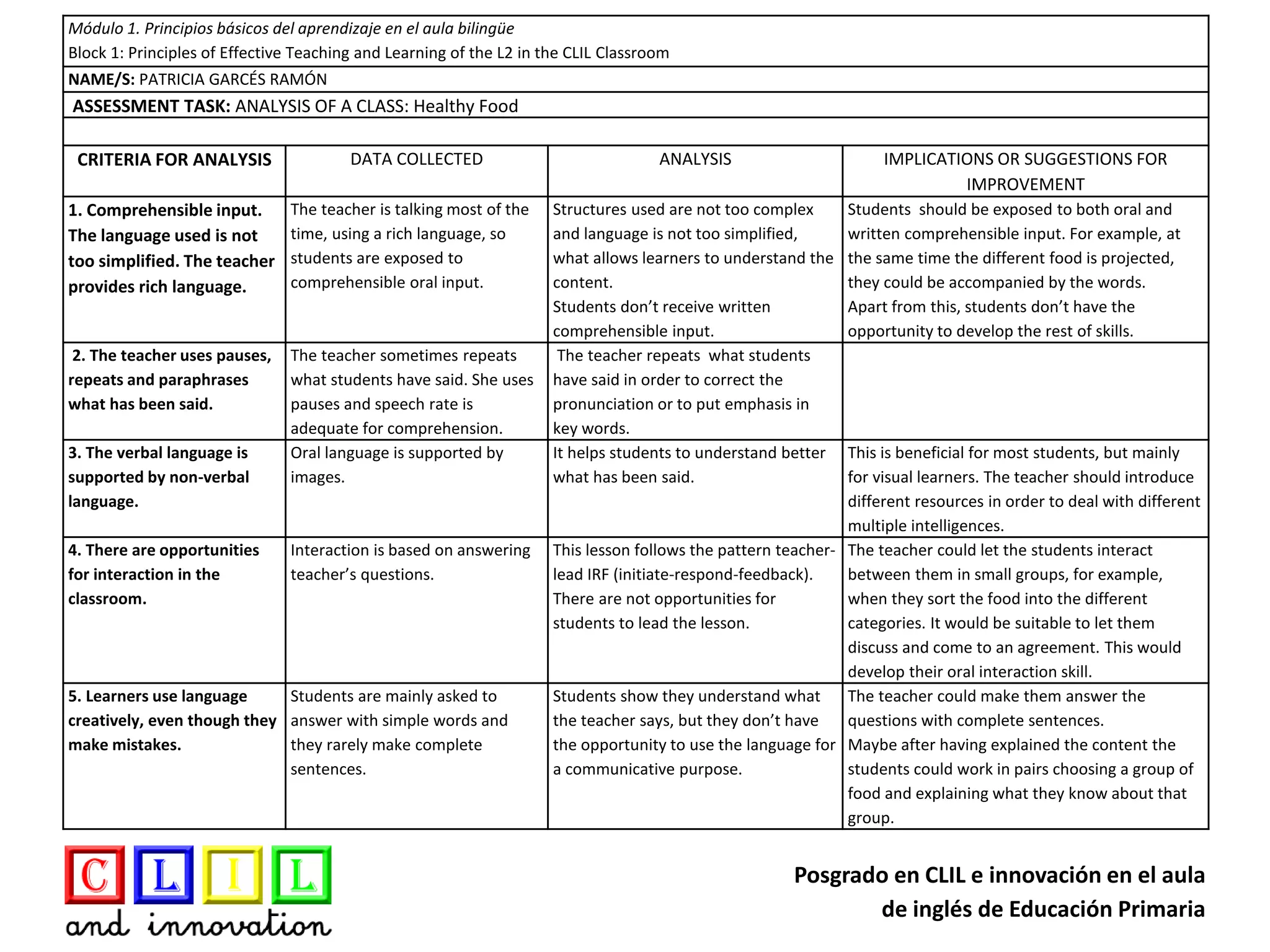
Módulo 1. Principios básicos del aprendizaje en el aula bilingüe
Block 1: Principles of Effective Teaching and Learning of the L2 in the CLIL Classroom
NAME/S: PATRICIA GARCÉS RAMÓN
ASSESSMENT TASK: ANALYSIS OF A CLASS: Healthy Food
CRITERIA FOR ANALYSIS DATA COLLECTED ANALYSIS IMPLICATIONS OR SUGGESTIONS FOR
IMPROVEMENT
1. Comprehensible input.
The language used is not
too simplified. The teacher
provides rich language.
The teacher is talking most of the
time, using a rich language, so
students are exposed to
comprehensible oral input.
Structures used are not too complex
and language is not too simplified,
what allows learners to understand the
content.
Students don’t receive written
comprehensible input.
Students should be exposed to both oral and
written comprehensible input. For example, at
the same time the different food is projected,
they could be accompanied by the words.
Apart from this, students don’t have the
opportunity to develop the rest of skills.
2. The teacher uses pauses,
repeats and paraphrases
what has been said.
The teacher sometimes repeats
what students have said. She uses
pauses and speech rate is
adequate for comprehension.
The teacher repeats what students
have said in order to correct the
pronunciation or to put emphasis in
key words.
3. The verbal language is
supported by non-verbal
language.
Oral language is supported by
images.
It helps students to understand better
what has been said.
This is beneficial for most students, but mainly
for visual learners. The teacher should introduce
different resources in order to deal with different
multiple intelligences.
4. There are opportunities
for interaction in the
classroom.
Interaction is based on answering
teacher’s questions.
This lesson follows the pattern teacher-
lead IRF (initiate-respond-feedback).
There are not opportunities for
students to lead the lesson.
The teacher could let the students interact
between them in small groups, for example,
when they sort the food into the different
categories. It would be suitable to let them
discuss and come to an agreement. This would
develop their oral interaction skill.
5. Learners use language
creatively, even though they
make mistakes.
Students are mainly asked to
answer with simple words and
they rarely make complete
sentences.
Students show they understand what
the teacher says, but they don’t have
the opportunity to use the language for
a communicative purpose.
The teacher could make them answer the
questions with complete sentences.
Maybe after having explained the content the
students could work in pairs choosing a group of
food and explaining what they know about that
group.
Posgrado en CLIL e innovación en el aula
de inglés de Educación Primaria
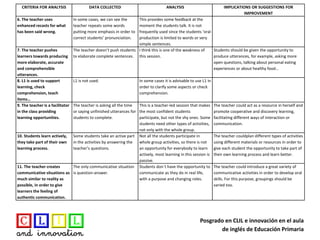
CRITERIA FOR ANALYSIS DATA COLLECTED ANALYSIS IMPLICATIONS OR SUGGESTIONS FOR
IMPROVEMENT
6. The teacher uses
enhanced recasts for what
has been said wrong.
In some cases, we can see the
teacher repeats some words
putting more emphasis in order to
correct students’ pronunciation.
This provides some feedback at the
moment the students talk. It is not
frequently used since the students ‘oral
production is limited to words or very
simple sentences.
7. The teacher pushes
learners towards producing
more elaborate, accurate
and comprehensible
utterances.
The teacher doesn’t push students
to elaborate complete sentences.
I think this is one of the weakness of
this session.
Students should be given the opportunity to
produce utterances, for example, asking more
open questions, talking about personal eating
experiences or about healthy food…
8. L1 is used to support
learning, check
comprehension, teach
items…
L1 is not used. In some cases it is advisable to use L1 in
order to clarify some aspects or check
comprehension.
9. The teacher is a facilitator
in the class providing
learning opportunities.
The teacher is asking all the time
or saying unfinished utterances for
students to complete.
This is a teacher-led session that makes
the most confident students
participate, but not the shy ones. Some
students need other types of activities,
not only with the whole group.
The teacher could act as a resource in herself and
promote cooperative and discovery learning,
facilitating different ways of interaction or
communication.
10. Students learn actively,
they take part of their own
learning process.
Some students take an active part
in the activities by answering the
teacher’s questions.
Not all the students participate in
whole group activities, so there is not
an opportunity for everybody to learn
actively, most learning in this session is
passive.
The teacher couldplan different types of activities
using different materials or resources in order to
give each student the opportunity to take part of
their own learning process and learn better.
11. The teacher creates
communicative situations as
much similar to reality as
possible, in order to give
learners the feeling of
authentic communication.
The only communicative situation
is question-answer.
Students don´t have the opportunity to
communicate as they do in real life,
with a purpose and changing roles.
The teacher could introduce a great variety of
communicative activities in order to develop oral
skills. For this purpose, groupings should be
varied too.

Module 1. Block 1.

  • 1.
    Posgrado en CLILe innovación en el aula de inglés de Educación Primaria Módulo 1. Principios básicos del aprendizaje en el aula bilingüe Block 1: Principles of Effective Teaching and Learning of the L2 in the CLIL Classroom NAME/S: PATRICIA GARCÉS RAMÓN ASSESSMENT TASK: ANALYSIS OF A CLASS: Healthy Food CRITERIA FOR ANALYSIS DATA COLLECTED ANALYSIS IMPLICATIONS OR SUGGESTIONS FOR IMPROVEMENT 1. Comprehensible input. The language used is not too simplified. The teacher provides rich language. The teacher is talking most of the time, using a rich language, so students are exposed to comprehensible oral input. Structures used are not too complex and language is not too simplified, what allows learners to understand the content. Students don’t receive written comprehensible input. Students should be exposed to both oral and written comprehensible input. For example, at the same time the different food is projected, they could be accompanied by the words. Apart from this, students don’t have the opportunity to develop the rest of skills. 2. The teacher uses pauses, repeats and paraphrases what has been said. The teacher sometimes repeats what students have said. She uses pauses and speech rate is adequate for comprehension. The teacher repeats what students have said in order to correct the pronunciation or to put emphasis in key words. 3. The verbal language is supported by non-verbal language. Oral language is supported by images. It helps students to understand better what has been said. This is beneficial for most students, but mainly for visual learners. The teacher should introduce different resources in order to deal with different multiple intelligences. 4. There are opportunities for interaction in the classroom. Interaction is based on answering teacher’s questions. This lesson follows the pattern teacher- lead IRF (initiate-respond-feedback). There are not opportunities for students to lead the lesson. The teacher could let the students interact between them in small groups, for example, when they sort the food into the different categories. It would be suitable to let them discuss and come to an agreement. This would develop their oral interaction skill. 5. Learners use language creatively, even though they make mistakes. Students are mainly asked to answer with simple words and they rarely make complete sentences. Students show they understand what the teacher says, but they don’t have the opportunity to use the language for a communicative purpose. The teacher could make them answer the questions with complete sentences. Maybe after having explained the content the students could work in pairs choosing a group of food and explaining what they know about that group.
  • 2.
    Posgrado en CLILe innovación en el aula de inglés de Educación Primaria CRITERIA FOR ANALYSIS DATA COLLECTED ANALYSIS IMPLICATIONS OR SUGGESTIONS FOR IMPROVEMENT 6. The teacher uses enhanced recasts for what has been said wrong. In some cases, we can see the teacher repeats some words putting more emphasis in order to correct students’ pronunciation. This provides some feedback at the moment the students talk. It is not frequently used since the students ‘oral production is limited to words or very simple sentences. 7. The teacher pushes learners towards producing more elaborate, accurate and comprehensible utterances. The teacher doesn’t push students to elaborate complete sentences. I think this is one of the weakness of this session. Students should be given the opportunity to produce utterances, for example, asking more open questions, talking about personal eating experiences or about healthy food… 8. L1 is used to support learning, check comprehension, teach items… L1 is not used. In some cases it is advisable to use L1 in order to clarify some aspects or check comprehension. 9. The teacher is a facilitator in the class providing learning opportunities. The teacher is asking all the time or saying unfinished utterances for students to complete. This is a teacher-led session that makes the most confident students participate, but not the shy ones. Some students need other types of activities, not only with the whole group. The teacher could act as a resource in herself and promote cooperative and discovery learning, facilitating different ways of interaction or communication. 10. Students learn actively, they take part of their own learning process. Some students take an active part in the activities by answering the teacher’s questions. Not all the students participate in whole group activities, so there is not an opportunity for everybody to learn actively, most learning in this session is passive. The teacher couldplan different types of activities using different materials or resources in order to give each student the opportunity to take part of their own learning process and learn better. 11. The teacher creates communicative situations as much similar to reality as possible, in order to give learners the feeling of authentic communication. The only communicative situation is question-answer. Students don´t have the opportunity to communicate as they do in real life, with a purpose and changing roles. The teacher could introduce a great variety of communicative activities in order to develop oral skills. For this purpose, groupings should be varied too.