How can I improve the class
interaction with my students
in English?
Abstract
Speaking English is usually considered for the students as an
ability very difficult to learn and practice at school. In the EFL class they
prefer to use their L1 to interact with their teacher and classmates.
For this reason, this action research is focused on the increase of the
communication between the students and the teacher in English in a
Chilean school with students at the age of 11 years old.
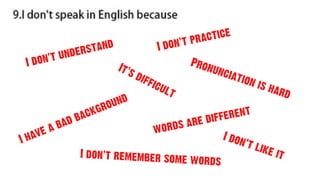
The results showed that one of the most important factor is the lack of
confidence, practice and knowledge of this vocabulary.
Giving them the tools and creating an eye-catching project with the
students is possible to change this situation and make a change in the
life of your students learning a new language.
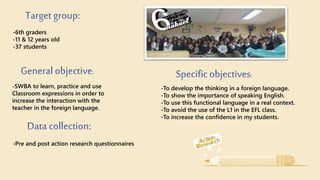
-6th graders
-11 & 12 years old
-37 students
-SWBA to learn, practice and use
Classroom expressions in order to
increase the interaction with the
teacher in the foreign language.
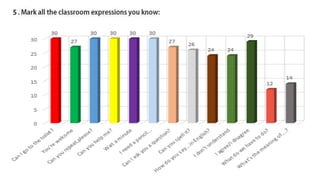
-Pre and post action research questionnaires
-To develop the thinking in a foreign language.
-To show the importance of speaking English.
-To use this functional language in a real context.
-To avoid the use of the L1 in the EFL class.
-To increase the confidence in my students.
Students need to receive a clear and
comprehensible input to face the silent
period stage. Teachers must understand
that oral production is one of the most
difficult abilities to develop especially
in the school where students don’t have a
real need to speak like in an ESL context.
We must prepare them to speak through
several activities from easy tasks until
oral presentations.
´Given the same amount of comprehensible input, the child's silent period in second
language acquisition may turn out to be longer than the average adult silent period for
other reasons.
What I am suggesting here is that the silent period in child second language
acquisition would not be as long if more of the input the child hears is comprehensible.’
(Principles and Practice in Second Language Acquisition, Stephen Krashen 1982)
*…children acquiring a second language in a natural, informal linguistic environment may say very little
for several months following their first exposure to the second language.’
Students love English in the school, they
enjoy doing oral presentations about their
interests, they like singing or playing
games, however, they don’t use English
to ask requests, ask for information or
express their feelings using this foreign
language.
Hypothesis:
Students don’t ask questions in the English class due to the fact that they feel
shy to make mistakes in front to the class and also because they don’t have the
habit of speaking in the foreign language naturally.
‘To be able to speak fluently in a foreign language requires a lot
of practice. Speaking practice starts with practicing and drilling
set phrases and repeating models. A great deal of time in
language classrooms is often spent on these repetitive exercises.’
(Ana Maria Pinter, Teaching Young Language Learners.2006)
Students in the school develop in the
traditional teaching-learning
process a lot of grammar exercises but
only a little amount of practice developing
real speaking interaction. There are many
reasons to explain this situation: for
instance, the quantity of students, the
class time, the pressure to fulfill the
syllabus among other things.
Five Principles for Teaching Beginners
Principle 1: Focus on Meaningful and Relevant Content
The main focus should be on language that the learners can use
quickly for their purposes rather than on too much grammar
explanation or on words that are not directly useful.
(I. S. P. Nation and J. Newton, Teaching ESL/EFL Listening and
Speaking. 2009)
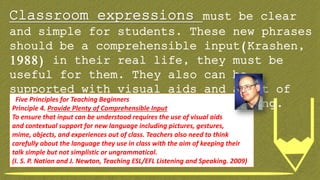
Classroom expressions must be clear
and simple for students. These new phrases
should be a comprehensible input(Krashen,
1988) in their real life, they must be
useful for them. They also can be
supported with visual aids and a lot of
repetition, practice and role playing.Five Principles for Teaching Beginners
Principle 4. Provide Plenty of Comprehensible Input
To ensure that input can be understood requires the use of visual aids
and contextual support for new language including pictures, gestures,
mime, objects, and experiences out of class. Teachers also need to think
carefully about the language they use in class with the aim of keeping their
talk simple but not simplistic or ungrammatical.
(I. S. P. Nation and J. Newton, Teaching ESL/EFL Listening and Speaking. 2009)
Planed actions:
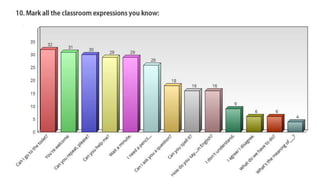
1. Apply a questionnaire to see if my students have problems speaking English June 2nd
15 minutes
2. Present the results of the survey to my students. June 3rd
20 minutes
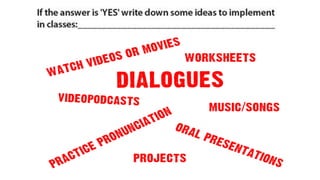
3. Present videos to my students in order to show them the importance of speaking English.
Teach them some useful Classroom language expressions.
Create a Classroom Language bookmark
June 10th
90 minutes
4. Practice the phrases and create a video using them. June 17th
45 minutes
5. Apply a new questionnaire to see if my students learned and used the new vocabulary.
Watch the final video made by all the class.
June 23rd
45 minutes
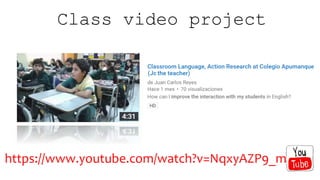
https://www.youtube.com/watch?v=NqxyAZP9_ms
Class video project
Reflection/Conclusion
Students in the adolescence face different changes proper to this stage. Most of them are
shy kids that are worried about their image so they try to avoid uncomfortable situations
in front of their classmates. This aspect is also connected by the silent period since some
students don’t feel confident speaking a different language since they can make many
mistakes particularly in pronunciation.
On the other hand, students don’t manage much classroom language for many reasons
such as: the syllabus doesn’t cover this content, the amount of students makes more
difficult the development of the speaking abilities and most of the activities are focused
on listening, reading or just grammar exercises more than communicative tasks and
functional language.
As teachers we should consider that apart from teaching vocabulary and grammar
contents we must take into account the functional language that we can develop with
our students in order to use it in real life. We have to give them the tools to interact in
English in the future even though it is a difficult goal and also it is necessary to create a
safe class environment so as to increase their attitude and confidence.
References
*Krashen, S.(1982) Principles and Practice in Second Language Acquisition.
Pergamon Press Inc.
*Pinter, A.(2006) Teaching Young Language Learners.
Oxford Handbooks for Language Teachers Series.
*I. S. P. Nation, and Newton, J.(2009) Teaching ESL/EFL Listening and Speaking.
Routledge NY.
Jc's action research

Jc's action research

  • 1.
    How can Iimprove the class interaction with my students in English?
  • 2.
    Abstract Speaking English isusually considered for the students as an ability very difficult to learn and practice at school. In the EFL class they prefer to use their L1 to interact with their teacher and classmates. For this reason, this action research is focused on the increase of the communication between the students and the teacher in English in a Chilean school with students at the age of 11 years old. The results showed that one of the most important factor is the lack of confidence, practice and knowledge of this vocabulary. Giving them the tools and creating an eye-catching project with the students is possible to change this situation and make a change in the life of your students learning a new language.
  • 3.
    -6th graders -11 &12 years old -37 students -SWBA to learn, practice and use Classroom expressions in order to increase the interaction with the teacher in the foreign language. -Pre and post action research questionnaires -To develop the thinking in a foreign language. -To show the importance of speaking English. -To use this functional language in a real context. -To avoid the use of the L1 in the EFL class. -To increase the confidence in my students.
  • 4.
    Students need toreceive a clear and comprehensible input to face the silent period stage. Teachers must understand that oral production is one of the most difficult abilities to develop especially in the school where students don’t have a real need to speak like in an ESL context. We must prepare them to speak through several activities from easy tasks until oral presentations. ´Given the same amount of comprehensible input, the child's silent period in second language acquisition may turn out to be longer than the average adult silent period for other reasons. What I am suggesting here is that the silent period in child second language acquisition would not be as long if more of the input the child hears is comprehensible.’ (Principles and Practice in Second Language Acquisition, Stephen Krashen 1982) *…children acquiring a second language in a natural, informal linguistic environment may say very little for several months following their first exposure to the second language.’
  • 5.
    Students love Englishin the school, they enjoy doing oral presentations about their interests, they like singing or playing games, however, they don’t use English to ask requests, ask for information or express their feelings using this foreign language. Hypothesis: Students don’t ask questions in the English class due to the fact that they feel shy to make mistakes in front to the class and also because they don’t have the habit of speaking in the foreign language naturally. ‘To be able to speak fluently in a foreign language requires a lot of practice. Speaking practice starts with practicing and drilling set phrases and repeating models. A great deal of time in language classrooms is often spent on these repetitive exercises.’ (Ana Maria Pinter, Teaching Young Language Learners.2006)
  • 6.
    Students in theschool develop in the traditional teaching-learning process a lot of grammar exercises but only a little amount of practice developing real speaking interaction. There are many reasons to explain this situation: for instance, the quantity of students, the class time, the pressure to fulfill the syllabus among other things. Five Principles for Teaching Beginners Principle 1: Focus on Meaningful and Relevant Content The main focus should be on language that the learners can use quickly for their purposes rather than on too much grammar explanation or on words that are not directly useful. (I. S. P. Nation and J. Newton, Teaching ESL/EFL Listening and Speaking. 2009)
  • 7.
    Classroom expressions mustbe clear and simple for students. These new phrases should be a comprehensible input(Krashen, 1988) in their real life, they must be useful for them. They also can be supported with visual aids and a lot of repetition, practice and role playing.Five Principles for Teaching Beginners Principle 4. Provide Plenty of Comprehensible Input To ensure that input can be understood requires the use of visual aids and contextual support for new language including pictures, gestures, mime, objects, and experiences out of class. Teachers also need to think carefully about the language they use in class with the aim of keeping their talk simple but not simplistic or ungrammatical. (I. S. P. Nation and J. Newton, Teaching ESL/EFL Listening and Speaking. 2009)
  • 8.
    Planed actions: 1. Applya questionnaire to see if my students have problems speaking English June 2nd 15 minutes 2. Present the results of the survey to my students. June 3rd 20 minutes 3. Present videos to my students in order to show them the importance of speaking English. Teach them some useful Classroom language expressions. Create a Classroom Language bookmark June 10th 90 minutes 4. Practice the phrases and create a video using them. June 17th 45 minutes 5. Apply a new questionnaire to see if my students learned and used the new vocabulary. Watch the final video made by all the class. June 23rd 45 minutes
  • 16.
  • 23.
    Reflection/Conclusion Students in theadolescence face different changes proper to this stage. Most of them are shy kids that are worried about their image so they try to avoid uncomfortable situations in front of their classmates. This aspect is also connected by the silent period since some students don’t feel confident speaking a different language since they can make many mistakes particularly in pronunciation. On the other hand, students don’t manage much classroom language for many reasons such as: the syllabus doesn’t cover this content, the amount of students makes more difficult the development of the speaking abilities and most of the activities are focused on listening, reading or just grammar exercises more than communicative tasks and functional language. As teachers we should consider that apart from teaching vocabulary and grammar contents we must take into account the functional language that we can develop with our students in order to use it in real life. We have to give them the tools to interact in English in the future even though it is a difficult goal and also it is necessary to create a safe class environment so as to increase their attitude and confidence.
  • 24.
    References *Krashen, S.(1982) Principlesand Practice in Second Language Acquisition. Pergamon Press Inc. *Pinter, A.(2006) Teaching Young Language Learners. Oxford Handbooks for Language Teachers Series. *I. S. P. Nation, and Newton, J.(2009) Teaching ESL/EFL Listening and Speaking. Routledge NY.