지식기반실학생연구원송 유 화
The LC' Network Development and MARC Standards Office     developed in 2002 for a bibliographic element set that may be used for a variety of purposes, and particularly for library applications. As an XML schema It is intended to be able to carry selected data from MARC 21. It includes a subset of MARC fields uses language-based tags rather than numeric ones, in some cases regrouping elements from the MARC 21 bibliographic format. As of June 2009 this schema is in its third version (version 3.3). The standard is maintained by the MODS Editorial Committee of the Library of Congress . Intro
Jenn Riley, Indiana University, ChairJoe  Altimus, Arizona State UniversityJan Ashton, British Library Ann Caldwell, Brown UniversityJohn Chapman, OCLCRebecca Guenther, Library of CongressBill Leonard, Library and Archives CanadaSally McCallum, Library of CongressTerry Reese, Oregon State University Sarah Shreeves, University of Illinois/Urbana-ChampaignJon Stroop, Princeton University Robin Wendler, Harvard University Interact with other metadata efforts and standards where there is synergy (e.g. MARC, Dublin Core, METS, and PREMIS)Current MODS Editorial Committee Membership
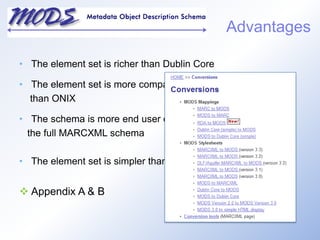
The element set is richer than Dublin Core The element set is more compatible with library data    than ONIXThe schema is more end user oriented than    the full MARCXML schema The element set is simpler than the full MARC format Appendix A & BAdvantages
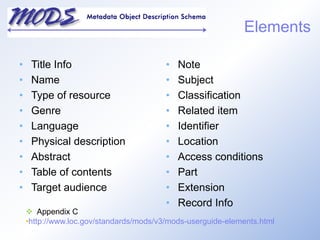
ElementsTitle Info
Name
Type of resource
Genre
Language
Physical description

Mods0210

  • 1.
  • 2.
    The LC' NetworkDevelopment and MARC Standards Office developed in 2002 for a bibliographic element set that may be used for a variety of purposes, and particularly for library applications. As an XML schema It is intended to be able to carry selected data from MARC 21. It includes a subset of MARC fields uses language-based tags rather than numeric ones, in some cases regrouping elements from the MARC 21 bibliographic format. As of June 2009 this schema is in its third version (version 3.3). The standard is maintained by the MODS Editorial Committee of the Library of Congress . Intro
  • 3.
    Jenn Riley, IndianaUniversity, ChairJoe  Altimus, Arizona State UniversityJan Ashton, British Library Ann Caldwell, Brown UniversityJohn Chapman, OCLCRebecca Guenther, Library of CongressBill Leonard, Library and Archives CanadaSally McCallum, Library of CongressTerry Reese, Oregon State University Sarah Shreeves, University of Illinois/Urbana-ChampaignJon Stroop, Princeton University Robin Wendler, Harvard University Interact with other metadata efforts and standards where there is synergy (e.g. MARC, Dublin Core, METS, and PREMIS)Current MODS Editorial Committee Membership
  • 4.
    The element setis richer than Dublin Core The element set is more compatible with library data than ONIXThe schema is more end user oriented than the full MARCXML schema The element set is simpler than the full MARC format Appendix A & BAdvantages
  • 5.
  • 6.
  • 7.
  • 8.
  • 9.
  • 10.