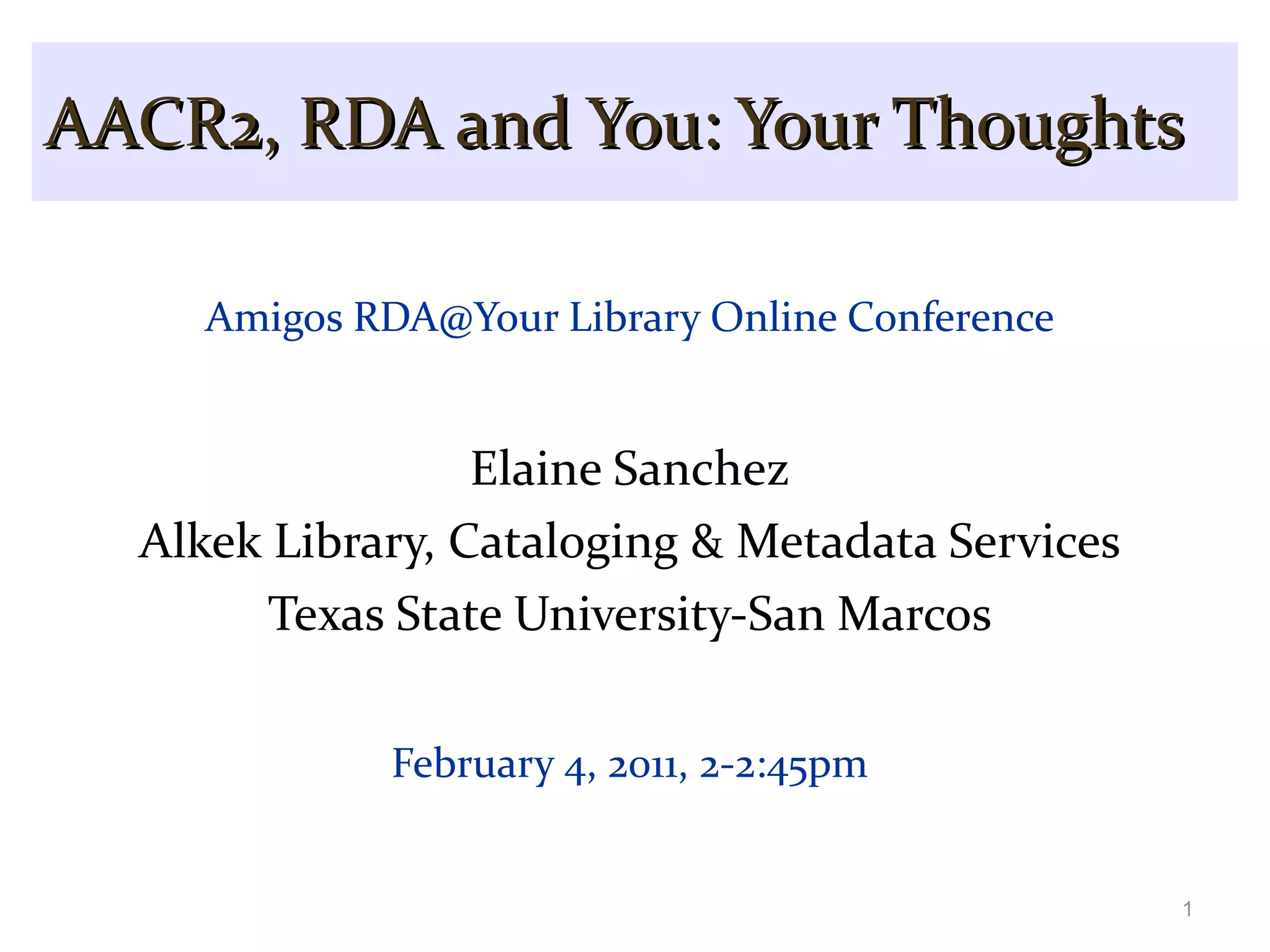
AACR2, RDA and You: Your Thoughts Amigos RDA@Your Library Online Conference Elaine Sanchez Alkek Library, Cataloging & Metadata Services Texas State University-San Marcos February 4, 2011, 2-2:45pm
Acknowledgments Libraries Unlimited/ABC-Clio for use of tables and data from  Conversations with Catalogers in the 21 st  Century  (Santa Barbara, Calif. : Libraries Unlimited, c2011) SurveyMonkey for table graphics
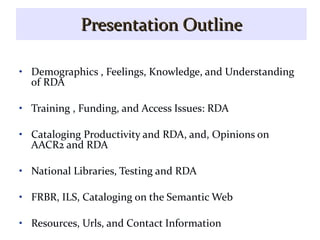
Presentation Outline Demographics , Feelings, Knowledge, and Understanding of RDA Training , Funding, and Access Issues: RDA Cataloging Productivity and RDA, and, Opinions on AACR2 and RDA National Libraries, Testing and RDA FRBR, ILS, Cataloging on the Semantic Web Resources, Urls, and Contact Information
Background, Disclaimers, What You   can Do Survey purpose and respondents: “You” and “Your” Top-level analysis only I’m a cataloger, not a survey-designer or statistician Analyze the results for  yourself  (link to survey data at the end of this presentation)
Demographics and Feelings about RDA
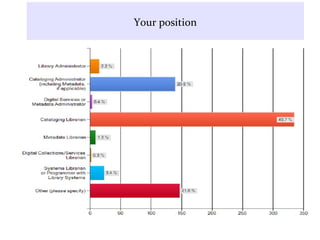
Your position
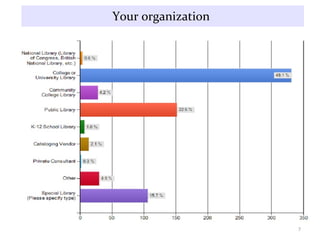
Your organization
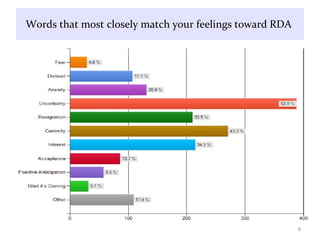
Words that most closely match your feelings toward RDA
Knowledge and Understanding of RDA
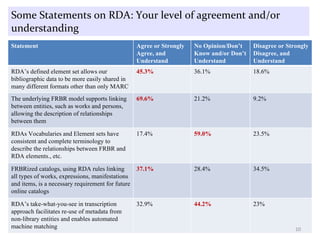
Some Statements on RDA: Your level of agreement and/or understanding Statement Agree or Strongly Agree, and Understand No Opinion/Don’t Know and/or Don’t Understand Disagree or Strongly Disagree, and Understand RDA’s defined element set allows our bibliographic data to be more easily shared in many different formats other than only MARC 45.3% 36.1% 18.6% The underlying FRBR model supports linking between entities, such as works and persons, allowing the description of relationships between them 69.6% 21.2% 9.2% RDAs Vocabularies and Element sets have consistent and complete terminology to describe the relationships between FRBR and RDA elements., etc. 17.4% 59.0% 23.5% FRBRized catalogs, using RDA rules linking all types of works, expressions, manifestations and items, is a necessary requirement for future online catalogs 37.1% 28.4% 34.5% RDA’s take-what-you-see in transcription approach facilitates re-use of metadata from non-library entities and enables automated machine matching 32.9% 44.2% 23%
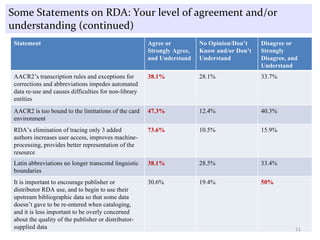
Some Statements on RDA: Your level of agreement and/or understanding (continued) Statement Agree or Strongly Agree, and Understand No Opinion/Don’t Know and/or Don’t Understand Disagree or Strongly Disagree, and Understand AACR2’s transcription rules and exceptions for corrections and abbreviations impedes automated data re-use and causes difficulties for non-library entities 38.1% 28.1% 33.7% AACR2 is too bound to the limitations of the card environment 47.3% 12.4% 40.3% RDA’s elimination of tracing only 3 added authors increases user access, improves machine-processing, provides better representation of the resource 73.6% 10.5% 15.9% Latin abbreviations no longer transcend linguistic boundaries 38.1% 28.5% 33.4% It is important to encourage publisher or distributor RDA use, and to begin to use their upstream bibliographic data so that some data doesn’t gave to be re-entered when cataloging, and it is less important to be overly concerned about the quality of the publisher or distributor-supplied data 30.6% 19.4% 50%
Training, Funding, and Access Issues: RDA
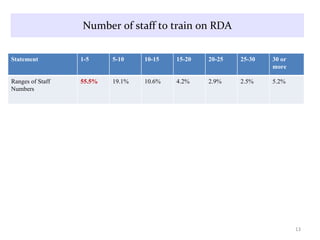
Number of staff to train on RDA Statement 1-5 5-10 10-15 15-20 20-25 25-30 30 or more Ranges of Staff Numbers 55.5% 19.1% 10.6% 4.2% 2.9% 2.5% 5.2%
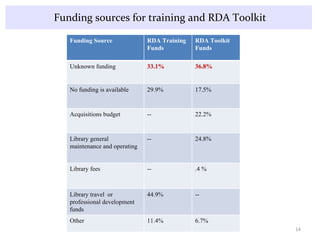
Funding sources for training and RDA Toolkit Funding Source RDA Training Funds RDA Toolkit Funds Unknown funding 33.1% 36.8% No funding is available 29.9% 17.5% Acquisitions budget -- 22.2% Library general maintenance and operating -- 24.8% Library fees -- .4 % Library travel  or professional development funds 44.9% -- Other 11.4% 6.7%
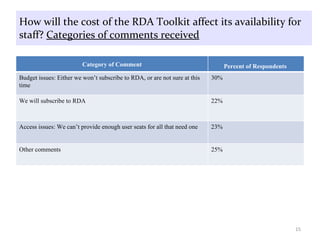
How will the cost of the RDA Toolkit affect its availability for staff?  Categories of comments received Category of Comment Percent of Respondents  Budget issues: Either we won’t subscribe to RDA, or are not sure at this time 30% We will subscribe to RDA 22% Access issues: We can’t provide enough user seats for all that need one 23% Other comments 25%
Cataloging Productivity and   RDA
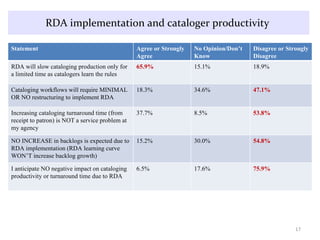
RDA implementation and cataloger productivity  Statement Agree or Strongly Agree No Opinion/Don’t Know Disagree or Strongly Disagree RDA will slow cataloging production only for a limited time as catalogers learn the rules 65.9% 15.1% 18.9% Cataloging workflows will require MINIMAL  OR NO restructuring to implement RDA 18.3% 34.6% 47.1% Increasing cataloging turnaround time (from receipt to patron) is NOT a service problem at my agency 37.7% 8.5% 53.8% NO INCREASE in backlogs is expected due to RDA implementation (RDA learning curve WON’T increase backlog growth) 15.2% 30.0% 54.8% I anticipate NO negative impact on cataloging productivity or turnaround time due to RDA 6.5% 17.6% 75.9%
Opinions on AACR2   and RDA
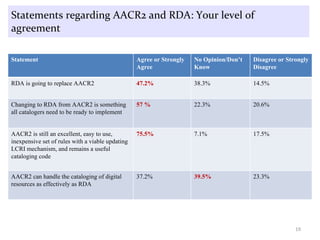
Statements regarding AACR2 and RDA: Your level of agreement Statement Agree or Strongly Agree No Opinion/Don’t Know Disagree or Strongly Disagree RDA is going to replace AACR2 47.2% 38.3% 14.5% Changing to RDA from AACR2 is something all catalogers need to be ready to implement 57 % 22.3% 20.6% AACR2 is still an excellent, easy to use, inexpensive set of rules with a viable updating LCRI mechanism, and remains a useful cataloging code 75.5% 7.1% 17.5% AACR2 can handle the cataloging of digital resources as effectively as RDA 37.2% 39.5% 23.3%
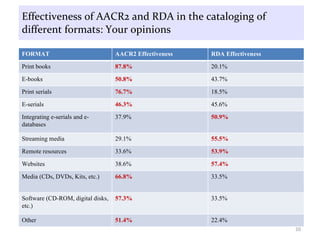
Effectiveness of AACR2 and RDA in the cataloging of different formats: Your opinions FORMAT AACR2 Effectiveness RDA Effectiveness Print books 87.8% 20.1% E-books 50.8% 43.7% Print serials 76.7% 18.5% E-serials 46.3% 45.6% Integrating e-serials and e-databases 37.9% 50.9% Streaming media 29.1% 55.5% Remote resources 33.6% 53.9% Websites 38.6% 57.4% Media (CDs, DVDs, Kits, etc.) 66.8% 33.5% Software (CD-ROM, digital disks, etc.) 57.3% 33.5% Other 51.4% 22.4%
RDA rules that differ from AACR2, and selected workarounds: Your level of acceptance Statement Would Accept/Consider  Accepting No Opinion/Don’t Know Won’t Accept Accept RDA  O.T./N.T. changes. Globally fix the O.T./N.T. differences to be implemented by RDA  in your online catalog 57.9% 39% 3.1% Map the new MARC fields 336 (content type) 337 (media type) 338 (carrier type) to a modified 245 $h [GMD] 53.3% 38.3% 8.4% Don’t use or map the 336-338 fields and instead  insert usual 245 $h[GMD] 32.5% 50.3% 17.2% Use the new MARC 336-338 fields as is, once online catalog displays allow  this 59.4% 37.3% 3.3% Adjust to spelled out Department as per RDA  (instead of Dept. as per AACR2 LC practice) 73.9% 15.4% 10.8% Use or add  spelled out words, instead of AACR2 abbreviations 76.4% 14.2% 9.4% Use RDA rule of main entry for treaties under the first country to appear on source 57.6% 39.3% 3.1% Follow the dissolution of the rule of 3 added entries and add as many as found 81.4% 11.8% 6.8%
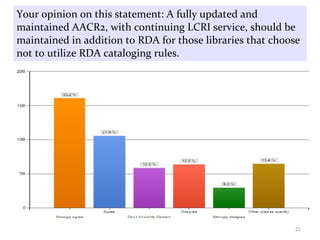
Your opinion on this statement: A fully updated and maintained AACR2, with continuing LCRI service, should be maintained in addition to RDA for those libraries that choose not to utilize RDA cataloging rules.
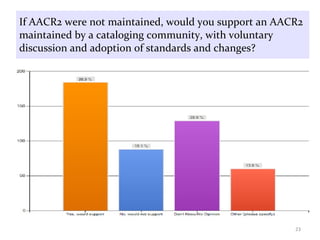
If AACR2 were not maintained, would you support an AACR2 maintained by a cataloging community, with voluntary discussion and adoption of standards and changes?
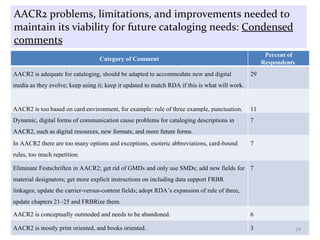
AACR2 problems, limitations, and improvements needed to maintain its viability for future cataloging needs:  Condensed comments Category of Comment Percent   of Respondents  AACR2 is adequate for cataloging, should be adapted to accommodate new and digital media as they evolve; keep using it; keep it updated to match RDA if this is what will work. 29 AACR2 is too based on card environment, for example: rule of three example, punctuation. 11 Dynamic, digital forms of communication cause problems for cataloging descriptions in AACR2, such as digital resources, new formats, and more future forms. 7 In AACR2 there are too many options and exceptions, esoteric abbreviations, card-bound rules, too much repetition. 7 Eliminate Festschriften in AACR2; get rid of GMDs and only use SMDs; add new fields for material designators; get more explicit instructions on including data support FRBR linkages; update the carrier-versus-content fields; adopt RDA’s expansion of rule of three, update chapters 21–25 and FRBRize them. 7 AACR2 is conceptually outmoded and needs to be abandoned. 6 AACR2 is mostly print oriented, and books oriented. 3
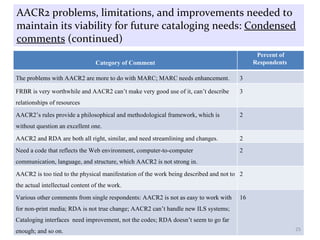
AACR2 problems, limitations, and improvements needed to maintain its viability for future cataloging needs:  Condensed comments  (continued) Category of Comment Percent of Respondents  The problems with AACR2 are more to do with MARC; MARC needs enhancement. 3 FRBR is very worthwhile and AACR2 can’t make very good use of it, can’t describe relationships of resources 3 AACR2’s rules provide a philosophical and methodological framework, which is without question an excellent one. 2 AACR2 and RDA are both all right, similar, and need streamlining and changes. 2 Need a code that reflects the Web environment, computer-to-computer communication, language, and structure, which AACR2 is not strong in. 2 AACR2 is too tied to the physical manifestation of the work being described and not to the actual intellectual content of the work. 2 Various other comments from single respondents: AACR2 is not as easy to work with for non-print media; RDA is not true change; AACR2 can’t handle new ILS systems; Cataloging interfaces  need improvement, not the codes; RDA doesn’t seem to go far enough; and so on. 16
National Libraries, Testing, and RDA
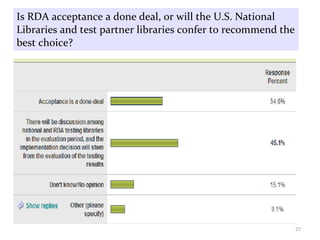
Is RDA acceptance a done deal, or will the U.S. National Libraries and test partner libraries confer to recommend the best choice?
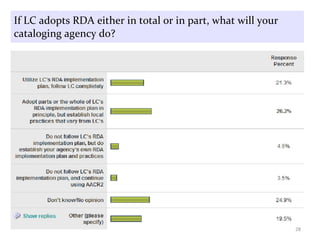
If LC adopts RDA either in total or in part, what will your cataloging agency do?
FRBR and ILS
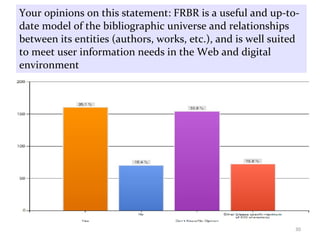
Your opinions on this statement: FRBR is a useful and up-to-date model of the bibliographic universe and relationships between its entities (authors, works, etc.), and is well suited to meet user information needs in the Web and digital environment
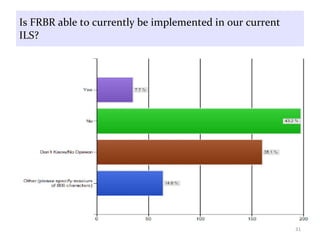
Is FRBR able to currently be implemented in our current ILS?
Cataloging on the Semantic Web
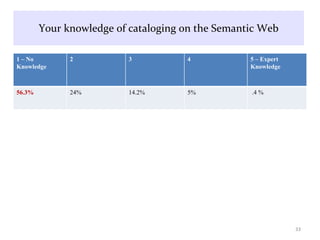
Your knowledge of cataloging on the Semantic Web 1 – No Knowledge 2 3 4 5 – Expert Knowledge 56.3% 24% 14.2% 5% .4 %
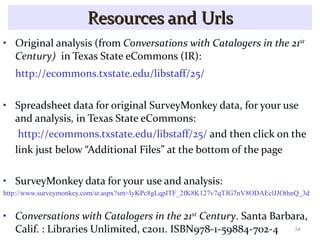
Resources and Urls Original analysis (from  Conversations with Catalogers in the 21 st  Century)   in Texas State eCommons (IR): http://ecommons.txstate.edu/libstaff/25/ Spreadsheet data for original SurveyMonkey data, for your use and analysis, in Texas State eCommons:  http://ecommons.txstate.edu/libstaff/25/  and then click on the  link just below “Additional Files” at the bottom of the page SurveyMonkey data for your   use and analysis: http://www.surveymonkey.com/sr.aspx?sm=lyKPc8gLqpITF_2fK8K127v7qTJG7nV8ODAEclJJOthnQ_3d Conversations with Catalogers in the 21 st  Century . Santa Barbara, Calif. : Libraries Unlimited, c2011. ISBN978-1-59884-702-4
Thank you! Questions? Contact information Elaine Sanchez Head, Cataloging & Metadata Services Alkek Library Texas State University 601 University Dr. San Marcos, TX 78666 email:  [email_address] telephone: 512-245-3005

RDA, AACR2 and You: Your Thoughts - E. Sanchez

  • 1.
    AACR2, RDA andYou: Your Thoughts Amigos RDA@Your Library Online Conference Elaine Sanchez Alkek Library, Cataloging & Metadata Services Texas State University-San Marcos February 4, 2011, 2-2:45pm
  • 2.
    Acknowledgments Libraries Unlimited/ABC-Cliofor use of tables and data from Conversations with Catalogers in the 21 st Century (Santa Barbara, Calif. : Libraries Unlimited, c2011) SurveyMonkey for table graphics
  • 3.
    Presentation Outline Demographics, Feelings, Knowledge, and Understanding of RDA Training , Funding, and Access Issues: RDA Cataloging Productivity and RDA, and, Opinions on AACR2 and RDA National Libraries, Testing and RDA FRBR, ILS, Cataloging on the Semantic Web Resources, Urls, and Contact Information
  • 4.
    Background, Disclaimers, WhatYou can Do Survey purpose and respondents: “You” and “Your” Top-level analysis only I’m a cataloger, not a survey-designer or statistician Analyze the results for yourself (link to survey data at the end of this presentation)
  • 5.
  • 6.
  • 7.
  • 8.
    Words that mostclosely match your feelings toward RDA
  • 9.
  • 10.
    Some Statements onRDA: Your level of agreement and/or understanding Statement Agree or Strongly Agree, and Understand No Opinion/Don’t Know and/or Don’t Understand Disagree or Strongly Disagree, and Understand RDA’s defined element set allows our bibliographic data to be more easily shared in many different formats other than only MARC 45.3% 36.1% 18.6% The underlying FRBR model supports linking between entities, such as works and persons, allowing the description of relationships between them 69.6% 21.2% 9.2% RDAs Vocabularies and Element sets have consistent and complete terminology to describe the relationships between FRBR and RDA elements., etc. 17.4% 59.0% 23.5% FRBRized catalogs, using RDA rules linking all types of works, expressions, manifestations and items, is a necessary requirement for future online catalogs 37.1% 28.4% 34.5% RDA’s take-what-you-see in transcription approach facilitates re-use of metadata from non-library entities and enables automated machine matching 32.9% 44.2% 23%
  • 11.
    Some Statements onRDA: Your level of agreement and/or understanding (continued) Statement Agree or Strongly Agree, and Understand No Opinion/Don’t Know and/or Don’t Understand Disagree or Strongly Disagree, and Understand AACR2’s transcription rules and exceptions for corrections and abbreviations impedes automated data re-use and causes difficulties for non-library entities 38.1% 28.1% 33.7% AACR2 is too bound to the limitations of the card environment 47.3% 12.4% 40.3% RDA’s elimination of tracing only 3 added authors increases user access, improves machine-processing, provides better representation of the resource 73.6% 10.5% 15.9% Latin abbreviations no longer transcend linguistic boundaries 38.1% 28.5% 33.4% It is important to encourage publisher or distributor RDA use, and to begin to use their upstream bibliographic data so that some data doesn’t gave to be re-entered when cataloging, and it is less important to be overly concerned about the quality of the publisher or distributor-supplied data 30.6% 19.4% 50%
  • 12.
    Training, Funding, andAccess Issues: RDA
  • 13.
    Number of staffto train on RDA Statement 1-5 5-10 10-15 15-20 20-25 25-30 30 or more Ranges of Staff Numbers 55.5% 19.1% 10.6% 4.2% 2.9% 2.5% 5.2%
  • 14.
    Funding sources fortraining and RDA Toolkit Funding Source RDA Training Funds RDA Toolkit Funds Unknown funding 33.1% 36.8% No funding is available 29.9% 17.5% Acquisitions budget -- 22.2% Library general maintenance and operating -- 24.8% Library fees -- .4 % Library travel or professional development funds 44.9% -- Other 11.4% 6.7%
  • 15.
    How will thecost of the RDA Toolkit affect its availability for staff? Categories of comments received Category of Comment Percent of Respondents Budget issues: Either we won’t subscribe to RDA, or are not sure at this time 30% We will subscribe to RDA 22% Access issues: We can’t provide enough user seats for all that need one 23% Other comments 25%
  • 16.
  • 17.
    RDA implementation andcataloger productivity Statement Agree or Strongly Agree No Opinion/Don’t Know Disagree or Strongly Disagree RDA will slow cataloging production only for a limited time as catalogers learn the rules 65.9% 15.1% 18.9% Cataloging workflows will require MINIMAL OR NO restructuring to implement RDA 18.3% 34.6% 47.1% Increasing cataloging turnaround time (from receipt to patron) is NOT a service problem at my agency 37.7% 8.5% 53.8% NO INCREASE in backlogs is expected due to RDA implementation (RDA learning curve WON’T increase backlog growth) 15.2% 30.0% 54.8% I anticipate NO negative impact on cataloging productivity or turnaround time due to RDA 6.5% 17.6% 75.9%
  • 18.
  • 19.
    Statements regarding AACR2and RDA: Your level of agreement Statement Agree or Strongly Agree No Opinion/Don’t Know Disagree or Strongly Disagree RDA is going to replace AACR2 47.2% 38.3% 14.5% Changing to RDA from AACR2 is something all catalogers need to be ready to implement 57 % 22.3% 20.6% AACR2 is still an excellent, easy to use, inexpensive set of rules with a viable updating LCRI mechanism, and remains a useful cataloging code 75.5% 7.1% 17.5% AACR2 can handle the cataloging of digital resources as effectively as RDA 37.2% 39.5% 23.3%
  • 20.
    Effectiveness of AACR2and RDA in the cataloging of different formats: Your opinions FORMAT AACR2 Effectiveness RDA Effectiveness Print books 87.8% 20.1% E-books 50.8% 43.7% Print serials 76.7% 18.5% E-serials 46.3% 45.6% Integrating e-serials and e-databases 37.9% 50.9% Streaming media 29.1% 55.5% Remote resources 33.6% 53.9% Websites 38.6% 57.4% Media (CDs, DVDs, Kits, etc.) 66.8% 33.5% Software (CD-ROM, digital disks, etc.) 57.3% 33.5% Other 51.4% 22.4%
  • 21.
    RDA rules thatdiffer from AACR2, and selected workarounds: Your level of acceptance Statement Would Accept/Consider Accepting No Opinion/Don’t Know Won’t Accept Accept RDA O.T./N.T. changes. Globally fix the O.T./N.T. differences to be implemented by RDA in your online catalog 57.9% 39% 3.1% Map the new MARC fields 336 (content type) 337 (media type) 338 (carrier type) to a modified 245 $h [GMD] 53.3% 38.3% 8.4% Don’t use or map the 336-338 fields and instead insert usual 245 $h[GMD] 32.5% 50.3% 17.2% Use the new MARC 336-338 fields as is, once online catalog displays allow this 59.4% 37.3% 3.3% Adjust to spelled out Department as per RDA (instead of Dept. as per AACR2 LC practice) 73.9% 15.4% 10.8% Use or add spelled out words, instead of AACR2 abbreviations 76.4% 14.2% 9.4% Use RDA rule of main entry for treaties under the first country to appear on source 57.6% 39.3% 3.1% Follow the dissolution of the rule of 3 added entries and add as many as found 81.4% 11.8% 6.8%
  • 22.
    Your opinion onthis statement: A fully updated and maintained AACR2, with continuing LCRI service, should be maintained in addition to RDA for those libraries that choose not to utilize RDA cataloging rules.
  • 23.
    If AACR2 werenot maintained, would you support an AACR2 maintained by a cataloging community, with voluntary discussion and adoption of standards and changes?
  • 24.
    AACR2 problems, limitations,and improvements needed to maintain its viability for future cataloging needs: Condensed comments Category of Comment Percent of Respondents AACR2 is adequate for cataloging, should be adapted to accommodate new and digital media as they evolve; keep using it; keep it updated to match RDA if this is what will work. 29 AACR2 is too based on card environment, for example: rule of three example, punctuation. 11 Dynamic, digital forms of communication cause problems for cataloging descriptions in AACR2, such as digital resources, new formats, and more future forms. 7 In AACR2 there are too many options and exceptions, esoteric abbreviations, card-bound rules, too much repetition. 7 Eliminate Festschriften in AACR2; get rid of GMDs and only use SMDs; add new fields for material designators; get more explicit instructions on including data support FRBR linkages; update the carrier-versus-content fields; adopt RDA’s expansion of rule of three, update chapters 21–25 and FRBRize them. 7 AACR2 is conceptually outmoded and needs to be abandoned. 6 AACR2 is mostly print oriented, and books oriented. 3
  • 25.
    AACR2 problems, limitations,and improvements needed to maintain its viability for future cataloging needs: Condensed comments (continued) Category of Comment Percent of Respondents The problems with AACR2 are more to do with MARC; MARC needs enhancement. 3 FRBR is very worthwhile and AACR2 can’t make very good use of it, can’t describe relationships of resources 3 AACR2’s rules provide a philosophical and methodological framework, which is without question an excellent one. 2 AACR2 and RDA are both all right, similar, and need streamlining and changes. 2 Need a code that reflects the Web environment, computer-to-computer communication, language, and structure, which AACR2 is not strong in. 2 AACR2 is too tied to the physical manifestation of the work being described and not to the actual intellectual content of the work. 2 Various other comments from single respondents: AACR2 is not as easy to work with for non-print media; RDA is not true change; AACR2 can’t handle new ILS systems; Cataloging interfaces need improvement, not the codes; RDA doesn’t seem to go far enough; and so on. 16
  • 26.
  • 27.
    Is RDA acceptancea done deal, or will the U.S. National Libraries and test partner libraries confer to recommend the best choice?
  • 28.
    If LC adoptsRDA either in total or in part, what will your cataloging agency do?
  • 29.
  • 30.
    Your opinions onthis statement: FRBR is a useful and up-to-date model of the bibliographic universe and relationships between its entities (authors, works, etc.), and is well suited to meet user information needs in the Web and digital environment
  • 31.
    Is FRBR ableto currently be implemented in our current ILS?
  • 32.
    Cataloging on theSemantic Web
  • 33.
    Your knowledge ofcataloging on the Semantic Web 1 – No Knowledge 2 3 4 5 – Expert Knowledge 56.3% 24% 14.2% 5% .4 %
  • 34.
    Resources and UrlsOriginal analysis (from Conversations with Catalogers in the 21 st Century) in Texas State eCommons (IR): http://ecommons.txstate.edu/libstaff/25/ Spreadsheet data for original SurveyMonkey data, for your use and analysis, in Texas State eCommons: http://ecommons.txstate.edu/libstaff/25/ and then click on the link just below “Additional Files” at the bottom of the page SurveyMonkey data for your use and analysis: http://www.surveymonkey.com/sr.aspx?sm=lyKPc8gLqpITF_2fK8K127v7qTJG7nV8ODAEclJJOthnQ_3d Conversations with Catalogers in the 21 st Century . Santa Barbara, Calif. : Libraries Unlimited, c2011. ISBN978-1-59884-702-4
  • 35.
    Thank you! Questions?Contact information Elaine Sanchez Head, Cataloging & Metadata Services Alkek Library Texas State University 601 University Dr. San Marcos, TX 78666 email: [email_address] telephone: 512-245-3005