Modes of Documentary
What are the ‘modes’ of
documentary?
• Modes are a way of categorizing different
types of documentary
• We can put them in groups based on how they
present ‘the truth’, how they interact with the
subject of the documentary etc…
History
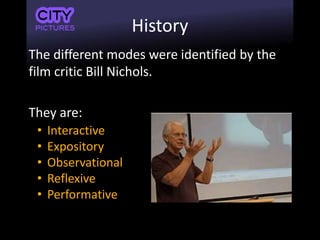
The different modes were identified by the
film critic Bill Nichols.
They are:
• Interactive
• Expository
• Observational
• Reflexive
• Performative
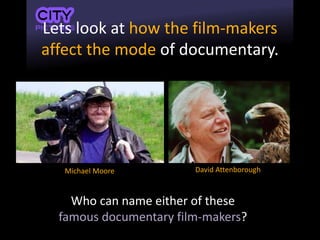
Lets look at how the film-makers
affect the mode of documentary.
Who can name either of these
famous documentary film-makers?
Michael Moore David Attenborough
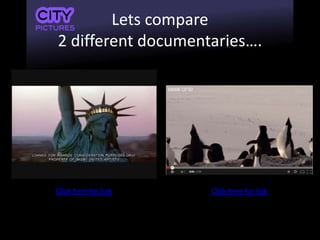
Lets compare
2 different documentaries….
Click here for link Click here for link
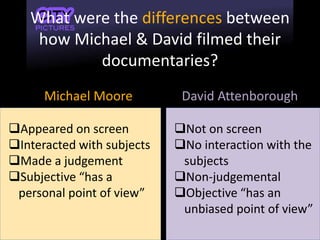
What were the differences between
how Michael & David filmed their
documentaries?
Michael Moore David Attenborough
Appeared on screen
Interacted with subjects
Made a judgement
Subjective “has a
personal point of view”
Not on screen
No interaction with the
subjects
Non-judgemental
Objective “has an
unbiased point of view”
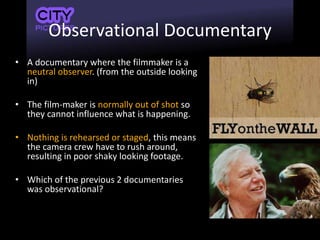
Observational Documentary
• A documentary where the filmmaker is a
neutral observer. (from the outside looking
in)
• The film-maker is normally out of shot so
they cannot influence what is happening.
• Nothing is rehearsed or staged, this means
the camera crew have to rush around,
resulting in poor shaky looking footage.
• Which of the previous 2 documentaries
was observational?
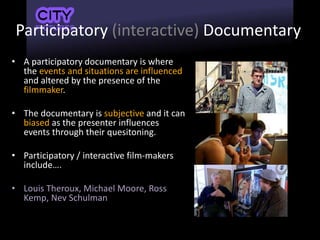
Participatory (interactive) Documentary
• A participatory documentary is where
the events and situations are influenced
and altered by the presence of the
filmmaker.
• The documentary is subjective and it can
biased as the presenter influences
events through their quesitoning.
• Participatory / interactive film-makers
include….
• Louis Theroux, Michael Moore, Ross
Kemp, Nev Schulman
Expository Documentary
• Voice over from an
authoritative person (referred
to as voice of god)
• Persuasive narration
• Argues its point of view
• Different from observational as
it has a specific point of view
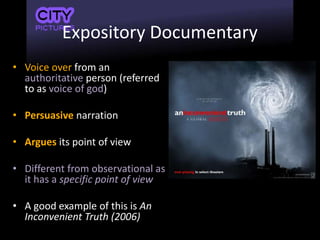
• A good example of this is An
Inconvenient Truth (2006)
Reflexive Documentary
• The mode uses footage and
information that will lead
viewers to a specific outcome
and therefore (essentially)
forces the viewer to come a
certain opinion.
• One sided, biased, and therefore
ubalanced.
• This documentary can’t show
‘the truth’ only one persons
version of the truth
• Accepts that documentary can’t
be *real* in the true sense.
Lets watch the video on moodle
Performative Documentary
• About the experiences of the film-maker.
The film-maker is the subject.
• The film-maker is often on screen and
provides a voiceover
• Biased, subjective and very personal to
the film-maker.
• Very similar to participatory
documentary, but perfomative
documentaries are much more
subjective and only presents the truth
according to the documentarian.
Task
Working in pairs research the documentary
format you have been given.
Write up a definition, explaining its features
using examples you find on YouTube. What are
its good points and bad points?
Upload this to the documentary modes forum
on Moodle.
Task 2
Write a magazine article on all the documentary
formats using the online site Joomag
http://www.joomag.com/
You will need to sign up to the site, which is free.

Modes of documentary

  • 1.
  • 2.
    What are the‘modes’ of documentary? • Modes are a way of categorizing different types of documentary • We can put them in groups based on how they present ‘the truth’, how they interact with the subject of the documentary etc…
  • 3.
    History The different modeswere identified by the film critic Bill Nichols. They are: • Interactive • Expository • Observational • Reflexive • Performative
  • 4.
    Lets look athow the film-makers affect the mode of documentary. Who can name either of these famous documentary film-makers? Michael Moore David Attenborough
  • 5.
    Lets compare 2 differentdocumentaries…. Click here for link Click here for link
  • 6.
    What were thedifferences between how Michael & David filmed their documentaries? Michael Moore David Attenborough Appeared on screen Interacted with subjects Made a judgement Subjective “has a personal point of view” Not on screen No interaction with the subjects Non-judgemental Objective “has an unbiased point of view”
  • 7.
    Observational Documentary • Adocumentary where the filmmaker is a neutral observer. (from the outside looking in) • The film-maker is normally out of shot so they cannot influence what is happening. • Nothing is rehearsed or staged, this means the camera crew have to rush around, resulting in poor shaky looking footage. • Which of the previous 2 documentaries was observational?
  • 8.
    Participatory (interactive) Documentary •A participatory documentary is where the events and situations are influenced and altered by the presence of the filmmaker. • The documentary is subjective and it can biased as the presenter influences events through their quesitoning. • Participatory / interactive film-makers include…. • Louis Theroux, Michael Moore, Ross Kemp, Nev Schulman
  • 9.
    Expository Documentary • Voiceover from an authoritative person (referred to as voice of god) • Persuasive narration • Argues its point of view • Different from observational as it has a specific point of view • A good example of this is An Inconvenient Truth (2006)
  • 10.
    Reflexive Documentary • Themode uses footage and information that will lead viewers to a specific outcome and therefore (essentially) forces the viewer to come a certain opinion. • One sided, biased, and therefore ubalanced. • This documentary can’t show ‘the truth’ only one persons version of the truth • Accepts that documentary can’t be *real* in the true sense. Lets watch the video on moodle
  • 11.
    Performative Documentary • Aboutthe experiences of the film-maker. The film-maker is the subject. • The film-maker is often on screen and provides a voiceover • Biased, subjective and very personal to the film-maker. • Very similar to participatory documentary, but perfomative documentaries are much more subjective and only presents the truth according to the documentarian.
  • 12.
    Task Working in pairsresearch the documentary format you have been given. Write up a definition, explaining its features using examples you find on YouTube. What are its good points and bad points? Upload this to the documentary modes forum on Moodle.
  • 13.
    Task 2 Write amagazine article on all the documentary formats using the online site Joomag http://www.joomag.com/ You will need to sign up to the site, which is free.