Documentary
Making
Power point by: Aneeqa Fareed
Table of Contents:
• Documentary
• What is a Documentary?
• Objectives of documentary
• Historical origin
• Modes of Documentary
• Subjectivity & Objectivity in documentary
• Styles of Documentaries
• Elements of documentary
• Audience’s expectations
• Conclusion
Documentary
A documentary is a factual film or programme
about the real world.
It is a motion picture that shapes and interprets
factual material for the purpose of education or
entertainment.
Mostly a documentary is:
 Non-Fiction
 About the real world
 Un-staged
 Based on observation rather than intervention
 Informative and Educational
What is a Documentary?
• Documentaries do not present us with real life instead
they construct a particular version of the real world
• Documentaries use specific film techniques to inform,
convince and persuade, as a means to position
viewers to respond in specific ways
• Documentaries mediate meaning, they stand between
the subject and the viewer, providing some version or
interpretation of the subject
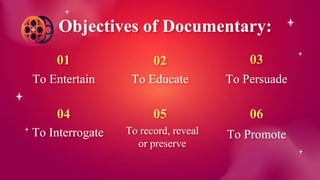
To Entertain
01
To Educate
02
To Persuade
03
To Interrogate
04
To Promote
05
To record, reveal
or preserve
06
Objectives of Documentary:
Historical origin of
Documentary
Historical origin of Documentary
• The first documentary was made by the Lumiere brothers in 1895.
Their documentaries featured unedited clips which capturedlife
around them. They were named “Actualities”
• The famous documentary made by Lumiere brothers was “Un
Train Arrivee” made in 1895.
• The more familiar documentary format began with “Nanook of
the North” made by Robert Flaherty in 1922.
• The word documentary was coined by John Grierson
Historical origin of Documentary
• 1920’s Russia – Dziga Vertov used his group and created a series
of educational newsreels called the Kino-Eye during the Russian
revolution
• 1926 – the first recorded mention of the term documentary by
John Grierson to describe non-fiction film
• 1930’s and 1940’s – the documentary becomes the valueable
propaganda tool for govrnments such as Nzi Germany, America
and Britain, especially during WWII
• Nightmail(1936) began as an informational film about the mail
Train from London to Edinburg.
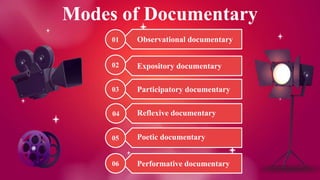
Modes of Documentary
01
02
06
03
04
05
Observational documentary
Expository documentary
Participatory documentary
Reflexive documentary
Poetic documentary
Performative documentary
Observational Documentary
• Observational documentary creates impression of events unfolding
naturally in front of camera
Expository Documentary
It is a mode of documentary that speaks directly to the viewer, often in
the form of an authoritative commentary employing voiceover or titles,
proposing a strong argument or point of view.
• This type of documentary id probably the most familiar to
audiences.
• It informs the audience about a happening or thing which they are
not familiar with.
• It explains what is happening in a direct address to the audience
Participatory Documentary
Participatory documentary believes it is impossible for the act of film
making to not influence the events that are being filmed.
Instead they emulate the approach of the anthropologist: participant-
observation
Reflexive Documentary
It involves the process of making a documentary being subject of the
documentary.
• Camera and crew are acknowledged, sometimes even part of the action.
• these types of documentaries draw attention to their own
constructedness.
• They recognize that even though they are documenting real events they
are still making a film.
Poetic Documentary
It is a mode of documentary that has a topic which is personal to the
people involved, usually the presenter.
• It emphasizes some aspects of the person’s life and presents them via
music, camera shots and angles and the editing.
• It can be quite artistic in a way it is presented.
• Music is key as it develops the mood and the tone of the story being
told including the message and values hidden within.
• The poetic documentary first appeared in the 1920’s.
Performative Documentary
This type of documentary focuses on subjective experience and emotional
response to the world.
This can be personal, experimental and unconventional.
Subjectivity Objectivity
Subjectivity is when
your opinion will
show through in the
documentary and
the general opinion
or stereotype.
Objectivity is when
you explore both
sides of an
argument in the
documentary and
not just one side.
Styles of documentary:
 Travel/ Adventure
 Diacritic form (like a diary)
 Fly-on-the-wall(camera as
observer)
 Docu-soaps
 Investigateive
 Docu-drama
 Personal
 propaganda
Elements of documentary:
 Images: people, places, things, text, etc.
 Sound: narration, voices, music, sound
effects, background sounds(nats)
 Edits: The integration of images and
sound
Audience’s Expectations:
 What we see and hear is grounded,
in some way in real world
 The notion of objectivity,
impartiality, fairness in
representation
 That the audience wants to learn
something
Any Question?
Thank you!

Guide to Documentary making slides..pptx

  • 1.
  • 2.
    Table of Contents: •Documentary • What is a Documentary? • Objectives of documentary • Historical origin • Modes of Documentary • Subjectivity & Objectivity in documentary • Styles of Documentaries • Elements of documentary • Audience’s expectations • Conclusion
  • 3.
    Documentary A documentary isa factual film or programme about the real world. It is a motion picture that shapes and interprets factual material for the purpose of education or entertainment. Mostly a documentary is:  Non-Fiction  About the real world  Un-staged  Based on observation rather than intervention  Informative and Educational
  • 4.
    What is aDocumentary? • Documentaries do not present us with real life instead they construct a particular version of the real world • Documentaries use specific film techniques to inform, convince and persuade, as a means to position viewers to respond in specific ways • Documentaries mediate meaning, they stand between the subject and the viewer, providing some version or interpretation of the subject
  • 5.
    To Entertain 01 To Educate 02 ToPersuade 03 To Interrogate 04 To Promote 05 To record, reveal or preserve 06 Objectives of Documentary:
  • 6.
  • 7.
    Historical origin ofDocumentary • The first documentary was made by the Lumiere brothers in 1895. Their documentaries featured unedited clips which capturedlife around them. They were named “Actualities” • The famous documentary made by Lumiere brothers was “Un Train Arrivee” made in 1895. • The more familiar documentary format began with “Nanook of the North” made by Robert Flaherty in 1922. • The word documentary was coined by John Grierson
  • 8.
    Historical origin ofDocumentary • 1920’s Russia – Dziga Vertov used his group and created a series of educational newsreels called the Kino-Eye during the Russian revolution • 1926 – the first recorded mention of the term documentary by John Grierson to describe non-fiction film • 1930’s and 1940’s – the documentary becomes the valueable propaganda tool for govrnments such as Nzi Germany, America and Britain, especially during WWII • Nightmail(1936) began as an informational film about the mail Train from London to Edinburg.
  • 9.
    Modes of Documentary 01 02 06 03 04 05 Observationaldocumentary Expository documentary Participatory documentary Reflexive documentary Poetic documentary Performative documentary
  • 10.
    Observational Documentary • Observationaldocumentary creates impression of events unfolding naturally in front of camera Expository Documentary It is a mode of documentary that speaks directly to the viewer, often in the form of an authoritative commentary employing voiceover or titles, proposing a strong argument or point of view. • This type of documentary id probably the most familiar to audiences. • It informs the audience about a happening or thing which they are not familiar with. • It explains what is happening in a direct address to the audience
  • 11.
    Participatory Documentary Participatory documentarybelieves it is impossible for the act of film making to not influence the events that are being filmed. Instead they emulate the approach of the anthropologist: participant- observation Reflexive Documentary It involves the process of making a documentary being subject of the documentary. • Camera and crew are acknowledged, sometimes even part of the action. • these types of documentaries draw attention to their own constructedness. • They recognize that even though they are documenting real events they are still making a film.
  • 12.
    Poetic Documentary It isa mode of documentary that has a topic which is personal to the people involved, usually the presenter. • It emphasizes some aspects of the person’s life and presents them via music, camera shots and angles and the editing. • It can be quite artistic in a way it is presented. • Music is key as it develops the mood and the tone of the story being told including the message and values hidden within. • The poetic documentary first appeared in the 1920’s. Performative Documentary This type of documentary focuses on subjective experience and emotional response to the world. This can be personal, experimental and unconventional.
  • 13.
    Subjectivity Objectivity Subjectivity iswhen your opinion will show through in the documentary and the general opinion or stereotype. Objectivity is when you explore both sides of an argument in the documentary and not just one side.
  • 14.
    Styles of documentary: Travel/ Adventure  Diacritic form (like a diary)  Fly-on-the-wall(camera as observer)  Docu-soaps  Investigateive  Docu-drama  Personal  propaganda
  • 15.
    Elements of documentary: Images: people, places, things, text, etc.  Sound: narration, voices, music, sound effects, background sounds(nats)  Edits: The integration of images and sound
  • 16.
    Audience’s Expectations:  Whatwe see and hear is grounded, in some way in real world  The notion of objectivity, impartiality, fairness in representation  That the audience wants to learn something
  • 17.
  • 18.