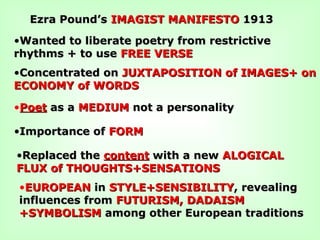
Ezra Pound’sEzra Pound’s IMAGIST MANIFESTOIMAGIST MANIFESTO 19131913
•Wanted to liberate poetry from restrictiveWanted to liberate poetry from restrictive
rhythms + to userhythms + to use FREE VERSEFREE VERSE
•Concentrated onConcentrated on JUXTAPOSITION of IMAGES+ onJUXTAPOSITION of IMAGES+ on
ECONOMY of WORDSECONOMY of WORDS
•PoetPoet as aas a MEDIUMMEDIUM not a personalitynot a personality
•Importance ofImportance of FORMFORM
•Replaced theReplaced the contentcontent with a newwith a new ALOGICALALOGICAL
FLUX of THOUGHTS+SENSATIONSFLUX of THOUGHTS+SENSATIONS
•EUROPEANEUROPEAN inin STYLE+SENSIBILITYSTYLE+SENSIBILITY, revealing, revealing
influences frominfluences from FUTURISM, DADAISMFUTURISM, DADAISM
+SYMBOLISM+SYMBOLISM among other European traditionsamong other European traditions
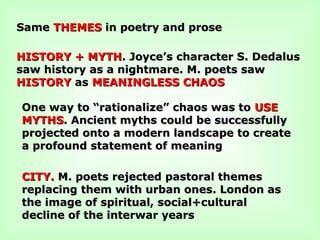
SameSame THEMESTHEMES in poetry and prosein poetry and prose
HISTORY + MYTHHISTORY + MYTH. Joyce’s character S. Dedalus. Joyce’s character S. Dedalus
saw history as a nightmare. M. poets sawsaw history as a nightmare. M. poets saw
HISTORYHISTORY asas MEANINGLESS CHAOSMEANINGLESS CHAOS
One way to “rationalize” chaos was toOne way to “rationalize” chaos was to USEUSE
MYTHSMYTHS. Ancient myths could be successfully. Ancient myths could be successfully
projected onto a modern landscape to createprojected onto a modern landscape to create
a profound statement of meaninga profound statement of meaning
CITY.CITY. M. poets rejected pastoral themesM. poets rejected pastoral themes
replacing them with urban ones. London asreplacing them with urban ones. London as
the image of spiritual, social+culturalthe image of spiritual, social+cultural
decline of the interwar yearsdecline of the interwar years
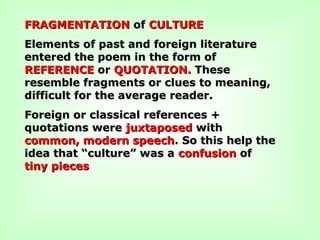
FRAGMENTATIONFRAGMENTATION ofof CULTURECULTURE
Elements of past and foreign literatureElements of past and foreign literature
entered the poem in the form ofentered the poem in the form of
REFERENCEREFERENCE oror QUOTATION.QUOTATION. TheseThese
resemble fragments or clues to meaning,resemble fragments or clues to meaning,
difficult for the average reader.difficult for the average reader.
Foreign or classical references +Foreign or classical references +
quotations werequotations were juxtaposedjuxtaposed withwith
common, modern speechcommon, modern speech. So this help the. So this help the
idea that “culture” was aidea that “culture” was a confusionconfusion ofof
tiny piecestiny pieces
FRAGMENTATIONFRAGMENTATION ofof SELFSELF
““I” was replaced by a fragmented, unstable,I” was replaced by a fragmented, unstable,
unreliable SELF, not dominated by “will”,unreliable SELF, not dominated by “will”,
but by instinctbut by instinct
FRAGMENTATIONFRAGMENTATION ofof SELFSELF
““I” was replaced by a fragmented, unstable,I” was replaced by a fragmented, unstable,
unreliable SELF, not dominated by “will”,unreliable SELF, not dominated by “will”,
but by instinctbut by instinct

Modernist poetry

  • 2.
    Ezra Pound’sEzra Pound’sIMAGIST MANIFESTOIMAGIST MANIFESTO 19131913 •Wanted to liberate poetry from restrictiveWanted to liberate poetry from restrictive rhythms + to userhythms + to use FREE VERSEFREE VERSE •Concentrated onConcentrated on JUXTAPOSITION of IMAGES+ onJUXTAPOSITION of IMAGES+ on ECONOMY of WORDSECONOMY of WORDS •PoetPoet as aas a MEDIUMMEDIUM not a personalitynot a personality •Importance ofImportance of FORMFORM •Replaced theReplaced the contentcontent with a newwith a new ALOGICALALOGICAL FLUX of THOUGHTS+SENSATIONSFLUX of THOUGHTS+SENSATIONS •EUROPEANEUROPEAN inin STYLE+SENSIBILITYSTYLE+SENSIBILITY, revealing, revealing influences frominfluences from FUTURISM, DADAISMFUTURISM, DADAISM +SYMBOLISM+SYMBOLISM among other European traditionsamong other European traditions
  • 3.
    SameSame THEMESTHEMES inpoetry and prosein poetry and prose HISTORY + MYTHHISTORY + MYTH. Joyce’s character S. Dedalus. Joyce’s character S. Dedalus saw history as a nightmare. M. poets sawsaw history as a nightmare. M. poets saw HISTORYHISTORY asas MEANINGLESS CHAOSMEANINGLESS CHAOS One way to “rationalize” chaos was toOne way to “rationalize” chaos was to USEUSE MYTHSMYTHS. Ancient myths could be successfully. Ancient myths could be successfully projected onto a modern landscape to createprojected onto a modern landscape to create a profound statement of meaninga profound statement of meaning CITY.CITY. M. poets rejected pastoral themesM. poets rejected pastoral themes replacing them with urban ones. London asreplacing them with urban ones. London as the image of spiritual, social+culturalthe image of spiritual, social+cultural decline of the interwar yearsdecline of the interwar years
  • 4.
    FRAGMENTATIONFRAGMENTATION ofof CULTURECULTURE Elementsof past and foreign literatureElements of past and foreign literature entered the poem in the form ofentered the poem in the form of REFERENCEREFERENCE oror QUOTATION.QUOTATION. TheseThese resemble fragments or clues to meaning,resemble fragments or clues to meaning, difficult for the average reader.difficult for the average reader. Foreign or classical references +Foreign or classical references + quotations werequotations were juxtaposedjuxtaposed withwith common, modern speechcommon, modern speech. So this help the. So this help the idea that “culture” was aidea that “culture” was a confusionconfusion ofof tiny piecestiny pieces
  • 5.
    FRAGMENTATIONFRAGMENTATION ofof SELFSELF ““I”was replaced by a fragmented, unstable,I” was replaced by a fragmented, unstable, unreliable SELF, not dominated by “will”,unreliable SELF, not dominated by “will”, but by instinctbut by instinct
  • 6.
    FRAGMENTATIONFRAGMENTATION ofof SELFSELF ““I”was replaced by a fragmented, unstable,I” was replaced by a fragmented, unstable, unreliable SELF, not dominated by “will”,unreliable SELF, not dominated by “will”, but by instinctbut by instinct