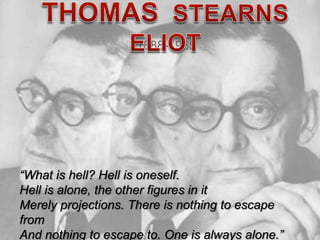
1888-1965
“What is hell? Hell is oneself.
Hell is alone, the other figures in it
Merely projections. There is nothing to escape
from
And nothing to escape to. One is always alone.”
BIOGRAPHY
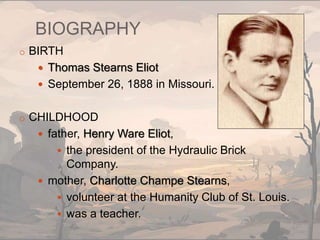
o BIRTH
 Thomas Stearns Eliot
 September 26, 1888 in Missouri.
o CHILDHOOD
 father, Henry Ware Eliot,
 the president of the Hydraulic Brick
Company.
 mother, Charlotte Champe Stearns,
 volunteer at the Humanity Club of St. Louis.
 was a teacher.
BIOGRAPHY
o EDUCATION
 attended Harvard University
 left with masters and undergraduate degrees.
 returned to Harvard to receive a doctorate degree
in philosophy.
 1915 married first wife, Vivienne Haigh-Wood
 1917 began working at Lloyd’s Bank in London
 1925 left the bank
 1927 converted to Anglicanism
 1933 separated from Vivienne
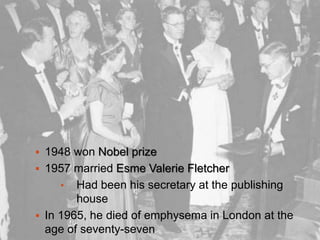
 1948 won Nobel prize
 1957 married Esme Valerie Fletcher
• Had been his secretary at the publishing
house
 In 1965, he died of emphysema in London at the
age of seventy-seven
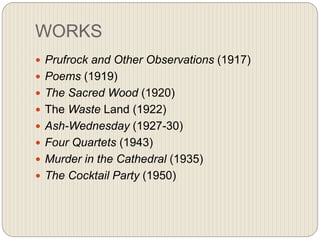
WORKS
 Prufrock and Other Observations (1917)
 Poems (1919)
 The Sacred Wood (1920)
 The Waste Land (1922)
 Ash-Wednesday (1927-30)
 Four Quartets (1943)
 Murder in the Cathedral (1935)
 The Cocktail Party (1950)
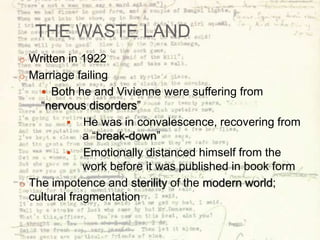
THE WASTE LAND
o Written in 1922
o Marriage failing
 Both he and Vivienne were suffering from
“nervous disorders”
 He was in convalescence, recovering from
a “break-down”
 Emotionally distanced himself from the
work before it was published in book form
o The impotence and sterility of the modern world;
cultural fragmentation
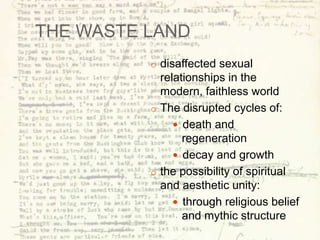
THE WASTE LAND
o disaffected sexual
relationships in the
modern, faithless world
o The disrupted cycles of:
 death and
regeneration
 decay and growth
o the possibility of spiritual
and aesthetic unity:
 through religious belief
and mythic structure
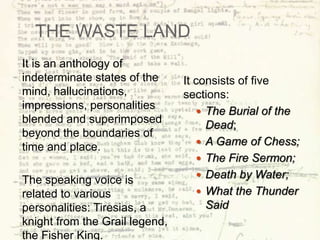
THE WASTE LAND
It is an anthology of
indeterminate states of the
mind, hallucinations,
impressions, personalities
blended and superimposed
beyond the boundaries of
time and place.
The speaking voice is
related to various
personalities: Tiresias, a
knight from the Grail legend,
the Fisher King.
It consists of five
sections:
 The Burial of the
Dead;
 A Game of Chess;
 The Fire Sermon;
 Death by Water;
 What the Thunder
Said
STYLE
o Association of ideas
o Past and present are simultaneous
o Mythical method
o Subjective esperiences made universal
o Use of juxtaposition
o Quoations from different languages and literary
works
o Fragmentation
o Techique of implication
STYLE
o Objective correlative
o Repetition of words, images and phrases
o Disconnected images/symbols
o Highly expressive meter
o Rhythm of free verses
o Metaphysical whimsical images/whims
o Flexible tone
MAJOR MOTIFS, IMAGES,
SYMBOLS
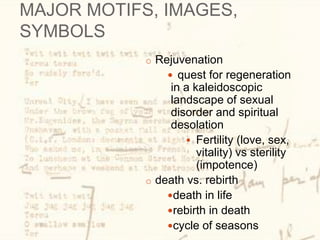
o Rejuvenation
 quest for regeneration
in a kaleidoscopic
landscape of sexual
disorder and spiritual
desolation
 Fertility (love, sex,
vitality) vs sterility
(impotence)
o death vs. rebirth
death in life
rebirth in death
cycle of seasons
MAJOR MOTIFS, IMAGES,
SYMBOLS
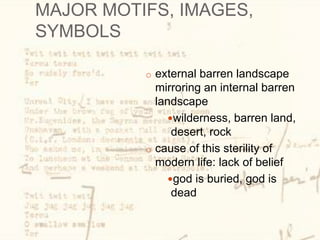
o external barren landscape
mirroring an internal barren
landscape
wilderness, barren land,
desert, rock
o cause of this sterility of
modern life: lack of belief
god is buried, god is
dead
COMPLEXITY AND AMBIGUITY
OF THE POEM
o Double/conflicting meanings
water: life, death, rebirth;
rock: sterility and hope
o Stumbling blocks
many allusions, vague in origin
Exploration on the nature of life, of modern
world, complexity of experience
symbols are not two-dimensional, thin, but rich in
meaning; the poem was not meant to be a
didactic allegory
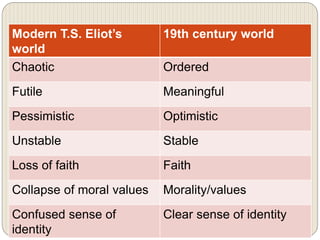
Modern T.S. Eliot’s
world
19th century world
Chaotic Ordered
Futile Meaningful
Pessimistic Optimistic
Unstable Stable
Loss of faith Faith
Collapse of moral values Morality/values
Confused sense of
identity
Clear sense of identity
OBJECTIVE CORRELATIVE
For Eliot, the “objective correlative” is a pattern of
objects, events, actions, or a situation that can serve
effectively to awaken in the reader an emotional
response without being a direct statement of that
subjective emotion.
“Here is no water but only rock
Rock and no water and the sandy road
The road winding above among the mountains Which
are mountains of rock without water.”
(What the Thunder Said)

Thomas Stearns Eliot

  • 1.
    1888-1965 “What is hell?Hell is oneself. Hell is alone, the other figures in it Merely projections. There is nothing to escape from And nothing to escape to. One is always alone.”
  • 2.
    BIOGRAPHY o BIRTH  ThomasStearns Eliot  September 26, 1888 in Missouri. o CHILDHOOD  father, Henry Ware Eliot,  the president of the Hydraulic Brick Company.  mother, Charlotte Champe Stearns,  volunteer at the Humanity Club of St. Louis.  was a teacher.
  • 3.
    BIOGRAPHY o EDUCATION  attendedHarvard University  left with masters and undergraduate degrees.  returned to Harvard to receive a doctorate degree in philosophy.  1915 married first wife, Vivienne Haigh-Wood  1917 began working at Lloyd’s Bank in London  1925 left the bank  1927 converted to Anglicanism  1933 separated from Vivienne
  • 4.
     1948 wonNobel prize  1957 married Esme Valerie Fletcher • Had been his secretary at the publishing house  In 1965, he died of emphysema in London at the age of seventy-seven
  • 5.
    WORKS  Prufrock andOther Observations (1917)  Poems (1919)  The Sacred Wood (1920)  The Waste Land (1922)  Ash-Wednesday (1927-30)  Four Quartets (1943)  Murder in the Cathedral (1935)  The Cocktail Party (1950)
  • 6.
    THE WASTE LAND oWritten in 1922 o Marriage failing  Both he and Vivienne were suffering from “nervous disorders”  He was in convalescence, recovering from a “break-down”  Emotionally distanced himself from the work before it was published in book form o The impotence and sterility of the modern world; cultural fragmentation
  • 7.
    THE WASTE LAND odisaffected sexual relationships in the modern, faithless world o The disrupted cycles of:  death and regeneration  decay and growth o the possibility of spiritual and aesthetic unity:  through religious belief and mythic structure
  • 8.
    THE WASTE LAND Itis an anthology of indeterminate states of the mind, hallucinations, impressions, personalities blended and superimposed beyond the boundaries of time and place. The speaking voice is related to various personalities: Tiresias, a knight from the Grail legend, the Fisher King. It consists of five sections:  The Burial of the Dead;  A Game of Chess;  The Fire Sermon;  Death by Water;  What the Thunder Said
  • 9.
    STYLE o Association ofideas o Past and present are simultaneous o Mythical method o Subjective esperiences made universal o Use of juxtaposition o Quoations from different languages and literary works o Fragmentation o Techique of implication
  • 10.
    STYLE o Objective correlative oRepetition of words, images and phrases o Disconnected images/symbols o Highly expressive meter o Rhythm of free verses o Metaphysical whimsical images/whims o Flexible tone
  • 11.
    MAJOR MOTIFS, IMAGES, SYMBOLS oRejuvenation  quest for regeneration in a kaleidoscopic landscape of sexual disorder and spiritual desolation  Fertility (love, sex, vitality) vs sterility (impotence) o death vs. rebirth death in life rebirth in death cycle of seasons
  • 12.
    MAJOR MOTIFS, IMAGES, SYMBOLS oexternal barren landscape mirroring an internal barren landscape wilderness, barren land, desert, rock o cause of this sterility of modern life: lack of belief god is buried, god is dead
  • 13.
    COMPLEXITY AND AMBIGUITY OFTHE POEM o Double/conflicting meanings water: life, death, rebirth; rock: sterility and hope o Stumbling blocks many allusions, vague in origin Exploration on the nature of life, of modern world, complexity of experience symbols are not two-dimensional, thin, but rich in meaning; the poem was not meant to be a didactic allegory
  • 14.
    Modern T.S. Eliot’s world 19thcentury world Chaotic Ordered Futile Meaningful Pessimistic Optimistic Unstable Stable Loss of faith Faith Collapse of moral values Morality/values Confused sense of identity Clear sense of identity
  • 15.
    OBJECTIVE CORRELATIVE For Eliot,the “objective correlative” is a pattern of objects, events, actions, or a situation that can serve effectively to awaken in the reader an emotional response without being a direct statement of that subjective emotion. “Here is no water but only rock Rock and no water and the sandy road The road winding above among the mountains Which are mountains of rock without water.” (What the Thunder Said)