Poetry Project
Avery Carter
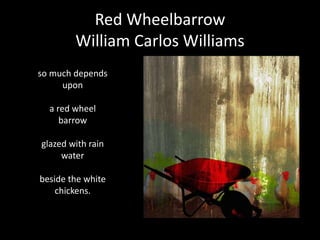
Red Wheelbarrow
William Carlos Williams
so much depends
upon
a red wheel
barrow
glazed with rain
water
beside the white
chickens.
Imagism
• William Carlos Williams’ poem “Red
Wheelbarrow” is a perfect example of the style of
the literary movement Imagism, which began in
1913 (ten years before Williams wrote this
poem.) The wheelbarrow is a precise image that
seems to make a total poetic statement, which is
the definition of Imagism. The poem is filled with
concrete images such as white chickens and a
mysterious red wheelbarrow glazed with
rainwater.
Symbolists
• Why does so much depend on a
wheelbarrow? We don’t know, and that’s part
of the intrigue that makes you read and
reread the poem to try to fathom the
unfathomable. Like other poets in his time,
Williams was also influenced by symbolists
who used images to “hint at the dark and
confused unity of an inexpressible reality,”
according to the text.
Form and meaning
• The red wheelbarrow seems to be connected to a
larger plan or purpose, which is only hinted at in
the poem. It’s an image that you can imagine
having meaning in all sorts of ways. The poem
also has no punctuation for a reason. Williams’
intentions were not just to make the poem flow
better. The form of the poem is connected to the
meaning of it. It’s as if he’s freeing the words
from the constrictions of commas and periods
while building a vivid picture.
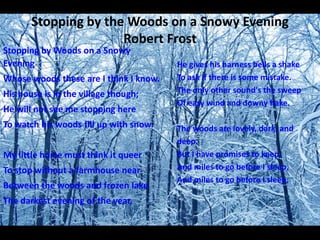
Stopping by the Woods on a Snowy Evening
Robert Frost
Stopping by Woods on a Snowy
Evening
Whose woods these are I think I know.
His house is in the village though;
He will not see me stopping here
To watch his woods fill up with snow.
My little horse must think it queer
To stop without a farmhouse near
Between the woods and frozen lake
The darkest evening of the year.
He gives his harness bells a shake
To ask if there is some mistake.
The only other sound's the sweep
Of easy wind and downy flake.
The woods are lovely, dark, and
deep.
But I have promises to keep,
And miles to go before I sleep,
And miles to go before I sleep.
Snowy evening
• Robert Frost is clearly influenced by the
literary movement imagism in his poem
“Stopping by the Woods on a Snowy Evening.”
He paints a very plain picture of a scene with a
horse, farmhouse, woods and snow. However,
the image isn’t the whole poem as it is with
William Carlos Williams’ “Red Wheelbarrow.”
Frost harnesses the images to capture a
feeling about appreciating nature and the tug
and pull of forces.
Mystery
• The woods represent something that is
appealing and dangerous in the poem. He’s
kind of mesmerized by them, but he rejects
their call to fulfill his other duties. Unlike
Williams, Frost uses punctuation and rhyme in
his poem. It’s a more traditional poem, and it
has resonance because of its air of mystery.

Poetryprez

  • 1.
  • 2.
    Red Wheelbarrow William CarlosWilliams so much depends upon a red wheel barrow glazed with rain water beside the white chickens.
  • 3.
    Imagism • William CarlosWilliams’ poem “Red Wheelbarrow” is a perfect example of the style of the literary movement Imagism, which began in 1913 (ten years before Williams wrote this poem.) The wheelbarrow is a precise image that seems to make a total poetic statement, which is the definition of Imagism. The poem is filled with concrete images such as white chickens and a mysterious red wheelbarrow glazed with rainwater.
  • 4.
    Symbolists • Why doesso much depend on a wheelbarrow? We don’t know, and that’s part of the intrigue that makes you read and reread the poem to try to fathom the unfathomable. Like other poets in his time, Williams was also influenced by symbolists who used images to “hint at the dark and confused unity of an inexpressible reality,” according to the text.
  • 5.
    Form and meaning •The red wheelbarrow seems to be connected to a larger plan or purpose, which is only hinted at in the poem. It’s an image that you can imagine having meaning in all sorts of ways. The poem also has no punctuation for a reason. Williams’ intentions were not just to make the poem flow better. The form of the poem is connected to the meaning of it. It’s as if he’s freeing the words from the constrictions of commas and periods while building a vivid picture.
  • 6.
    Stopping by theWoods on a Snowy Evening Robert Frost Stopping by Woods on a Snowy Evening Whose woods these are I think I know. His house is in the village though; He will not see me stopping here To watch his woods fill up with snow. My little horse must think it queer To stop without a farmhouse near Between the woods and frozen lake The darkest evening of the year. He gives his harness bells a shake To ask if there is some mistake. The only other sound's the sweep Of easy wind and downy flake. The woods are lovely, dark, and deep. But I have promises to keep, And miles to go before I sleep, And miles to go before I sleep.
  • 7.
    Snowy evening • RobertFrost is clearly influenced by the literary movement imagism in his poem “Stopping by the Woods on a Snowy Evening.” He paints a very plain picture of a scene with a horse, farmhouse, woods and snow. However, the image isn’t the whole poem as it is with William Carlos Williams’ “Red Wheelbarrow.” Frost harnesses the images to capture a feeling about appreciating nature and the tug and pull of forces.
  • 8.
    Mystery • The woodsrepresent something that is appealing and dangerous in the poem. He’s kind of mesmerized by them, but he rejects their call to fulfill his other duties. Unlike Williams, Frost uses punctuation and rhyme in his poem. It’s a more traditional poem, and it has resonance because of its air of mystery.