What is Modernism in Literature?
NAME : HARIYANI KISHAN .R
ROLL NO: 17
PAPER : 9 THE MODERNIST LITERATURE
SUBMITTED:S.B.GARDI DEPARTMENT
OF ENGLISH M.K.BHAVNAGAR
UNIVERSITY
BATCH :2015’17
Email Id :kishanhariyani1992@gmail.com
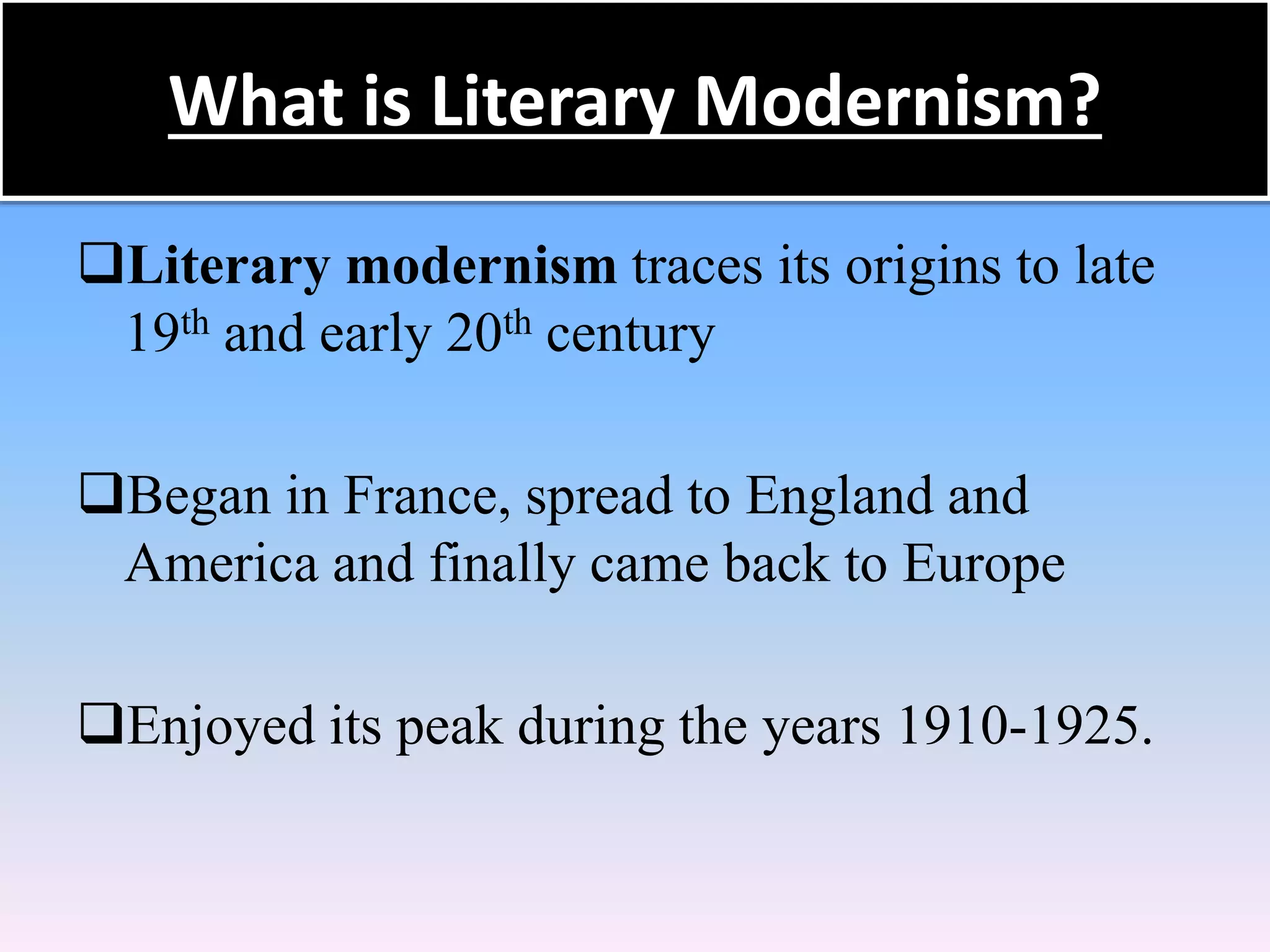
What is Literary Modernism?
Literary modernism traces its origins to late
19th and early 20th century
Began in France, spread to England and
America and finally came back to Europe
Enjoyed its peak during the years 1910-1925.
Modernism as a movement
Modernism as a movement can be recognized not only
in literature but also in
• The sciences
• Philosophy
• Psychology
• Anthropology
• Painting
• Music
• Sculpture
• Architecture
Influential thinkers
Physicist Einstein on Relativity (1905)
Physicist Planck on Quantum Theory (1900)
Psychologist Freud on the Unconscious (The
Interpretation of Dreams, 1900)
Psychologist Jung on Collective Unconscious
Linguist De Saussure on Language
Anthropologist Frazer on Primitive Cultures
Artistic and Literary Movements
• Imagism:
• Symbolism:
• Vorticism:
• Expressionism:
• Futurism:
• Dadaism
History of Modernism in Literature
Emerging fields of psychology and sociology
Advancements in science and technology
Ambiguous situation after World-War I
Increase in population and expansion of cities
It was in these tumultuous times that the
Cultural Revolution, known as Modernism.
Decay of Character and Hero

Psychological theories of Sigmund
Freud created an impact on modernist
writers
 Writers found that the traditional method
of portraying characters was erroneous
Characteristic Of Modernist Literature:
Modern story does not follow a Chronological
order
Modern stories do not have a beginning or
end
Modernist literature requires an Active reader
Decay Of Plot
Stress on Individual
Individual is more important for modernist
writers than society
In a modern story, there are no universally
accepted values of social conduct
Realism
Modern stories are realistic
For writers, there is no such thing
as absolute truth; everything is
relative.
Modernist literature is a portrayal
of life as it is.
Thematic features
Focus on form rather than meaning
Breaking down of limitation of space
and time
Borrowings from other cultures and
languages
Unconventional use of metaphor
Formal features of narrative
• Lack of traditional chronological narrative
(discontinuous narrative)
• Break of narrative frames (fragmentation)
• Moving from one level of narrative to another
• Use of interior monologue technique
• Use of the stream of consciousness technique
• Focus on a character's consciousness and
subconscious
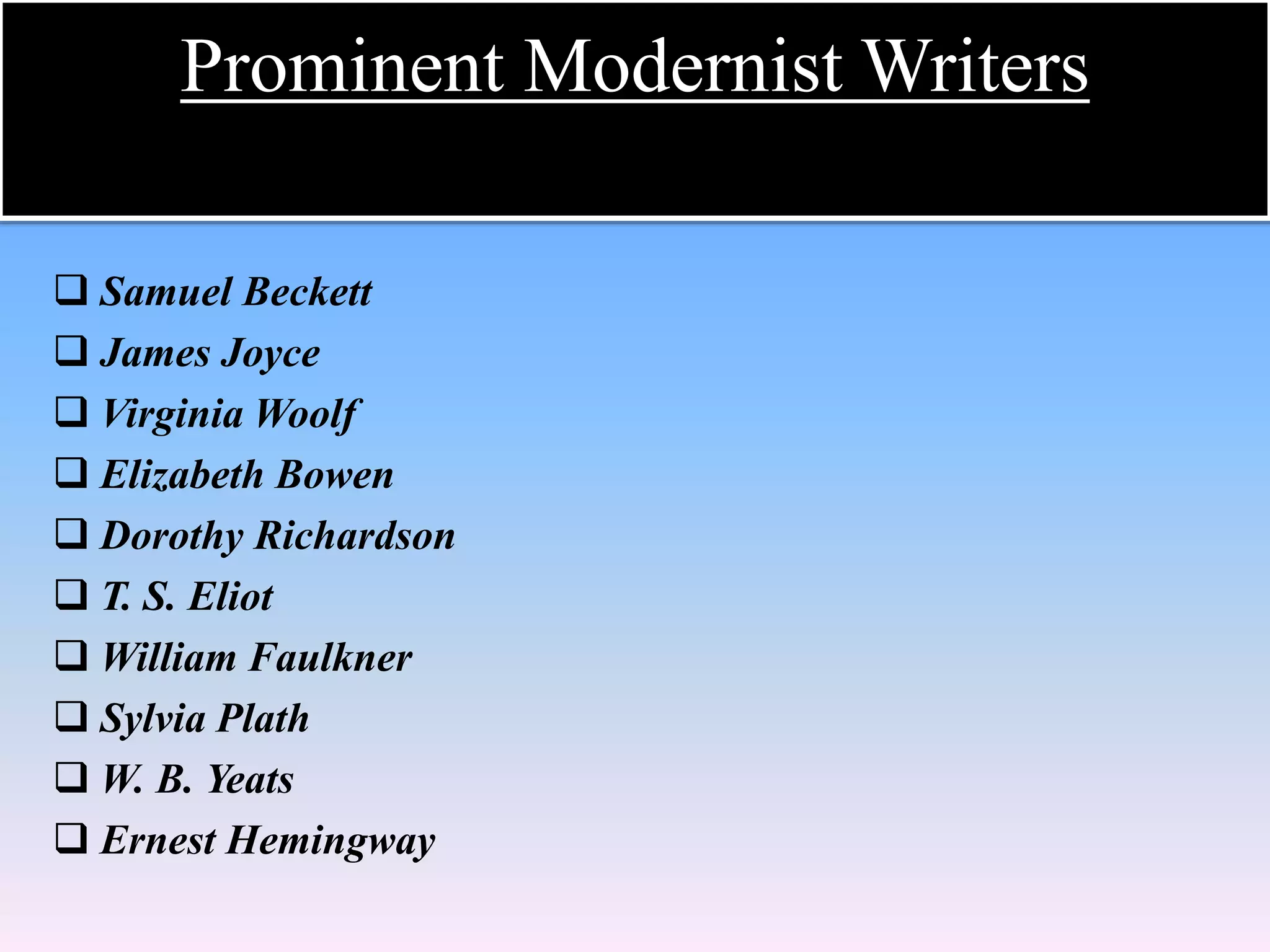
Prominent Modernist Writers
 Samuel Beckett
 James Joyce
 Virginia Woolf
 Elizabeth Bowen
 Dorothy Richardson
 T. S. Eliot
 William Faulkner
 Sylvia Plath
 W. B. Yeats
 Ernest Hemingway
Work Cited:
Related Articles:
http://www.brighthubeducation.com/high-school-
english-lessons/29453-modernism-in-literature/
http://www.online-
literature.com/periods/modernism.php
http://www.online-
literature.com/periods/modernism.php
http://www.slideshare.net/ciaffaroni/modernism-in-
literature-1082251
Modernism in a Literature.

Modernism in a Literature.

  • 1.
    What is Modernismin Literature? NAME : HARIYANI KISHAN .R ROLL NO: 17 PAPER : 9 THE MODERNIST LITERATURE SUBMITTED:S.B.GARDI DEPARTMENT OF ENGLISH M.K.BHAVNAGAR UNIVERSITY BATCH :2015’17 Email Id :kishanhariyani1992@gmail.com
  • 2.
    What is LiteraryModernism? Literary modernism traces its origins to late 19th and early 20th century Began in France, spread to England and America and finally came back to Europe Enjoyed its peak during the years 1910-1925.
  • 3.
    Modernism as amovement Modernism as a movement can be recognized not only in literature but also in • The sciences • Philosophy • Psychology • Anthropology • Painting • Music • Sculpture • Architecture
  • 4.
    Influential thinkers Physicist Einsteinon Relativity (1905) Physicist Planck on Quantum Theory (1900) Psychologist Freud on the Unconscious (The Interpretation of Dreams, 1900) Psychologist Jung on Collective Unconscious Linguist De Saussure on Language Anthropologist Frazer on Primitive Cultures
  • 5.
    Artistic and LiteraryMovements • Imagism: • Symbolism: • Vorticism: • Expressionism: • Futurism: • Dadaism
  • 8.
    History of Modernismin Literature Emerging fields of psychology and sociology Advancements in science and technology Ambiguous situation after World-War I Increase in population and expansion of cities It was in these tumultuous times that the Cultural Revolution, known as Modernism.
  • 9.
    Decay of Characterand Hero  Psychological theories of Sigmund Freud created an impact on modernist writers  Writers found that the traditional method of portraying characters was erroneous Characteristic Of Modernist Literature:
  • 10.
    Modern story doesnot follow a Chronological order Modern stories do not have a beginning or end Modernist literature requires an Active reader Decay Of Plot
  • 11.
    Stress on Individual Individualis more important for modernist writers than society In a modern story, there are no universally accepted values of social conduct
  • 12.
    Realism Modern stories arerealistic For writers, there is no such thing as absolute truth; everything is relative. Modernist literature is a portrayal of life as it is.
  • 13.
    Thematic features Focus onform rather than meaning Breaking down of limitation of space and time Borrowings from other cultures and languages Unconventional use of metaphor
  • 14.
    Formal features ofnarrative • Lack of traditional chronological narrative (discontinuous narrative) • Break of narrative frames (fragmentation) • Moving from one level of narrative to another • Use of interior monologue technique • Use of the stream of consciousness technique • Focus on a character's consciousness and subconscious
  • 15.
    Prominent Modernist Writers Samuel Beckett  James Joyce  Virginia Woolf  Elizabeth Bowen  Dorothy Richardson  T. S. Eliot  William Faulkner  Sylvia Plath  W. B. Yeats  Ernest Hemingway
  • 16.