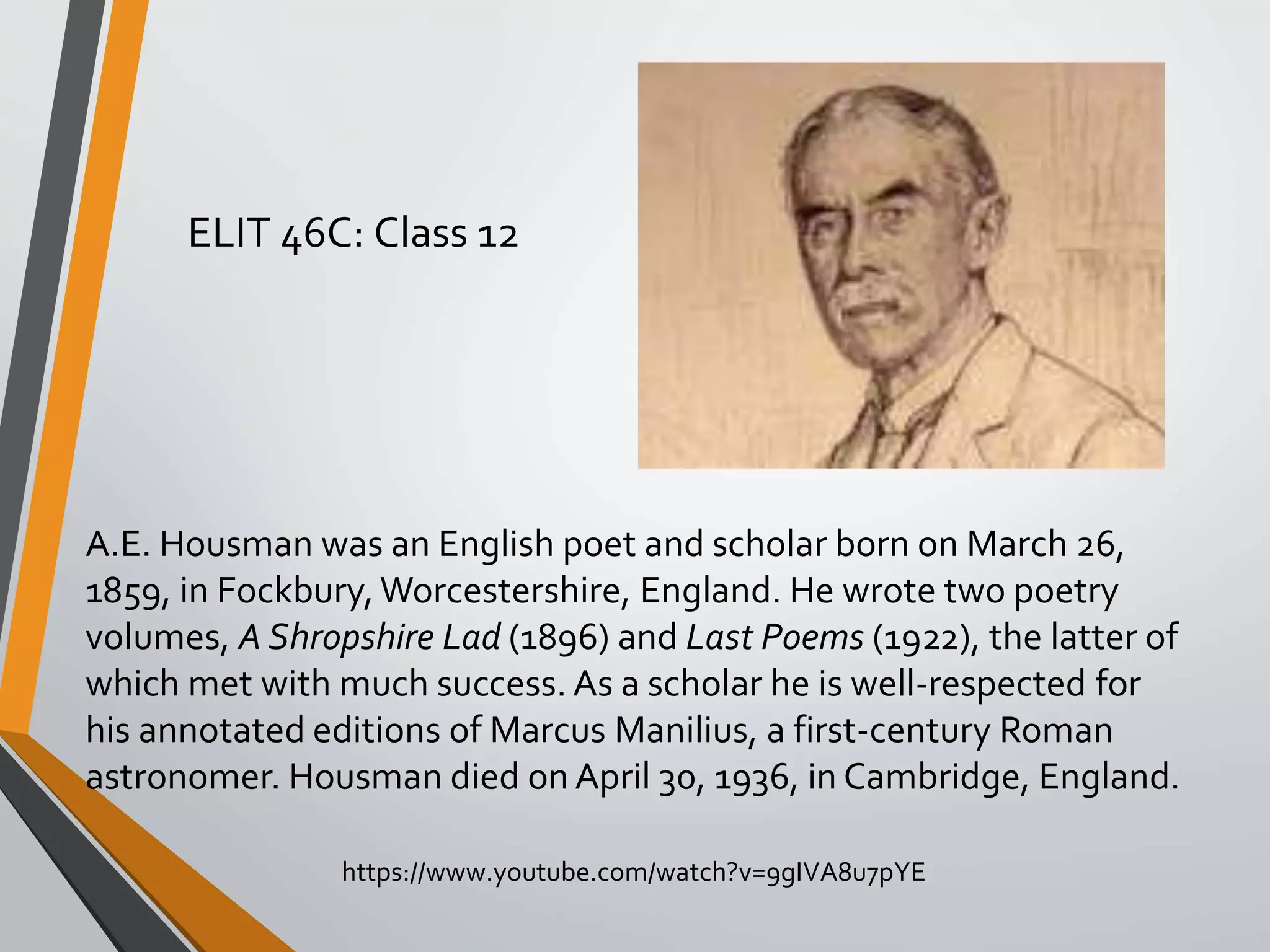
A.E. Housman was an English poet and scholar born on March 26,
1859, in Fockbury,Worcestershire, England. He wrote two poetry
volumes, A Shropshire Lad (1896) and Last Poems (1922), the latter of
which met with much success. As a scholar he is well-respected for
his annotated editions of Marcus Manilius, a first-century Roman
astronomer. Housman died on April 30, 1936, in Cambridge, England.
ELIT 46C: Class 12
https://www.youtube.com/watch?v=9gIVA8u7pYE
Agenda
Chair Poet
Lecture: Introduction to
Modernism:
Discussion: Hardy, “Hap”;
“The DarklingThrush”;Yeats,
“September 1913”; “Easter,
1916”; “The Second Coming”
Author Presentation: Joseph
Conrad
The 20th Century
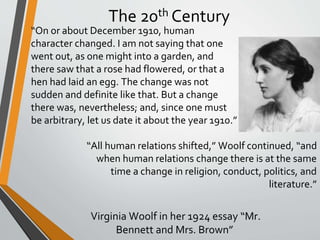
“On or about December 1910, human
character changed. I am not saying that one
went out, as one might into a garden, and
there saw that a rose had flowered, or that a
hen had laid an egg. The change was not
sudden and definite like that. But a change
there was, nevertheless; and, since one must
be arbitrary, let us date it about the year 1910.”
“All human relations shifted,” Woolf continued, “and
when human relations change there is at the same
time a change in religion, conduct, politics, and
literature.”
Virginia Woolf in her 1924 essay “Mr.
Bennett and Mrs. Brown”
1. The Education Act of 1870 required elementary education. This
change had a dramatic impact on literacy rates, which in turn
produced a bigger reading public than ever before.
2.The growing reading public of the late-Victorian era provided
demand for cheap (and generally sensationalist) journalism. It was
against this “mass produced” writing that early Modernism would
react.
3.The British Empire began unraveling as early as the turn of the
twentieth century, though it was not until after the First World War
that many colonial nations gained their independence. What
emerged was the British Commonwealth (as opposed to the British
Empire) within which old colonies retained an allegiance to Britain
(usually in name only) but governed themselves.
:Read and Change the
World
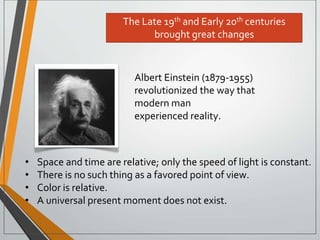
Albert Einstein (1879-1955)
revolutionized the way that
modern man
experienced reality.
• Space and time are relative; only the speed of light is constant.
• There is no such thing as a favored point of view.
• Color is relative.
• A universal present moment does not exist.
The Late 19th and Early 20th centuries
brought great changes
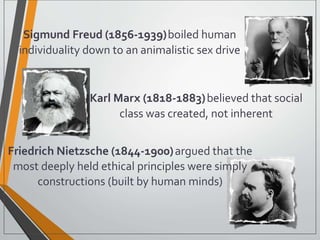
Sigmund Freud (1856-1939)boiled human
individuality down to an animalistic sex drive
Karl Marx (1818-1883)believed that social
class was created, not inherent
Friedrich Nietzsche (1844-1900)argued that the
most deeply held ethical principles were simply
constructions (built by human minds)
In the 1890s, a strand of thinking began to assert that it
was necessary to push aside previous norms entirely,
instead of merely revising past knowledge in light of
current techniques.
It was argued that, if the nature of reality itself was in
question, and if restrictions which had been in place
around human activity were falling, then art, too, would
have to radically change.
Thus, in the first 15 years of the twentieth century a
series of writers, thinkers, and artists made the break
with traditional means of organizing literature, painting,
and music.
Artists began to believe that
the old assurances from the
world -- religion, politics,
society -- were no longer
enough.
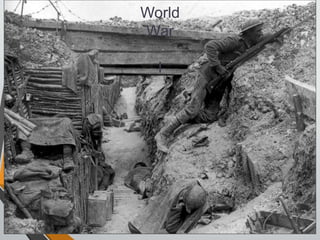
And this
happened...
World
War
I
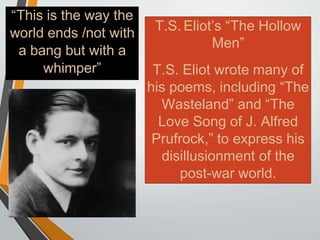
T.S. Eliot’s “The Hollow
Men”
T.S. Eliot wrote many of
his poems, including “The
Wasteland” and “The
Love Song of J. Alfred
Prufrock,” to express his
disillusionment of the
post-war world.
“This is the way the
world ends /not with
a bang but with a
whimper”
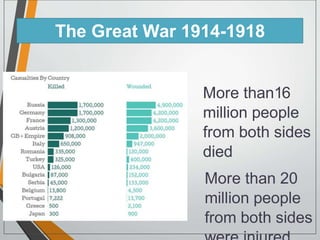
More than16
million people
from both sides
died
More than 20
million people
from both sides
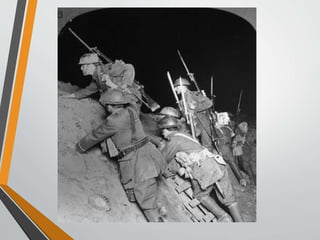
The Great War 1914-1918
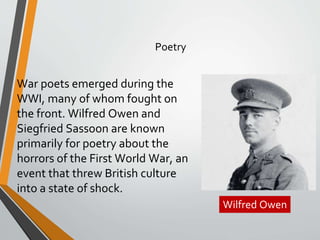
War poets emerged during the
WWI, many of whom fought on
the front. Wilfred Owen and
Siegfried Sassoon are known
primarily for poetry about the
horrors of the First World War, an
event that threw British culture
into a state of shock.
Poetry
Wilfred Owen
A general pessimism about the state of
the world developed from the concern
that society was accelerating toward
destruction and meaninglessness,
There was also a belief that only the rebel
artist was telling the truth about the world
and could help inspire a better society
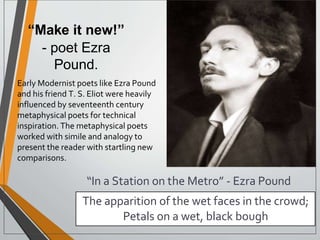
“Make it new!”
- poet Ezra
Pound.
The apparition of the wet faces in the crowd;
Petals on a wet, black bough
“In a Station on the Metro” - Ezra Pound
Early Modernist poets like Ezra Pound
and his friend T. S. Eliot were heavily
influenced by seventeenth century
metaphysical poets for technical
inspiration. The metaphysical poets
worked with simile and analogy to
present the reader with startling new
comparisons.
1. an emphasis on subjectivity in writing; an emphasis on HOW seeing
(or reading or perception itself) takes place, rather than on WHAT is
perceived. An example of this would be stream-of-consciousness
writing.
2. a movement away from the apparent objectivity provided by
omniscient third-person narrators, fixed narrative points of view, and
clear-cut moral positions. Faulkner's multiply-narrated stories are an
example of this aspect of modernism.
3. a blurring of distinctions between genres, so that poetry seems more
documentary (as in T.S. Eliot or ee cummings) and prose seems more
poetic (as in Woolf or Joyce).
Borrowed from Mary Klages: http://www.bdavetian.com/Postmodernism.html
The Main Characteristics of Literary Modernism
4. an emphasis on fragmented forms, discontinuous narratives,
and random-seeming collages of different materials.
5. a tendency toward reflexivity, or self-consciousness, about the
production of the work of art, so that each piece calls attention to
its own status as a production, as something constructed and
consumed in particular ways.
6. a rejection of elaborate formal aesthetics in favor of minimalist
designs (as in the poetry of William Carlos Williams).
7. A rejection of the distinction between "high" and "low" or popular
culture, both in choice of materials used to produce art and in
methods of displaying, distributing, and consuming art.
Main Characteristics of Modernism (Con’t)
Fiction
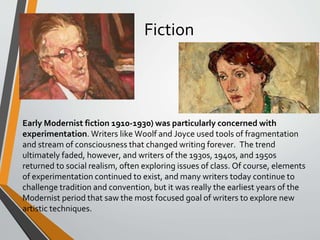
Early Modernist fiction 1910-1930) was particularly concerned with
experimentation. Writers like Woolf and Joyce used tools of fragmentation
and stream of consciousness that changed writing forever. The trend
ultimately faded, however, and writers of the 1930s, 1940s, and 1950s
returned to social realism, often exploring issues of class. Of course, elements
of experimentation continued to exist, and many writers today continue to
challenge tradition and convention, but it was really the earliest years of the
Modernist period that saw the most focused goal of writers to explore new
artistic techniques.
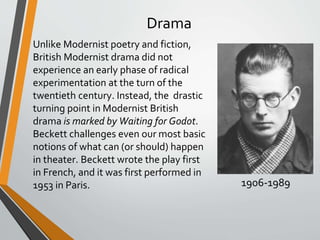
Drama
Unlike Modernist poetry and fiction,
British Modernist drama did not
experience an early phase of radical
experimentation at the turn of the
twentieth century. Instead, the drastic
turning point in Modernist British
drama is marked by Waiting for Godot.
Beckett challenges even our most basic
notions of what can (or should) happen
in theater. Beckett wrote the play first
in French, and it was first performed in
1953 in Paris. 1906-1989
Groups
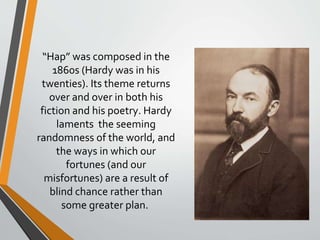
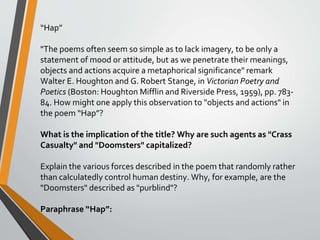
“Hap” was composed in the
1860s (Hardy was in his
twenties). Its theme returns
over and over in both his
fiction and his poetry. Hardy
laments the seeming
randomness of the world, and
the ways in which our
fortunes (and our
misfortunes) are a result of
blind chance rather than
some greater plan.
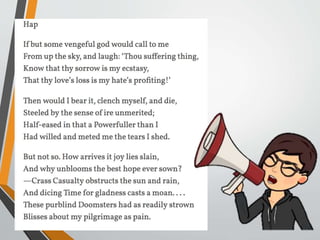
“Hap”
"The poems often seem so simple as to lack imagery, to be only a
statement of mood or attitude, but as we penetrate their meanings,
objects and actions acquire a metaphorical significance" remark
Walter E. Houghton and G. Robert Stange, in Victorian Poetry and
Poetics (Boston: Houghton Mifflin and Riverside Press, 1959), pp. 783-
84. How might one apply this observation to "objects and actions" in
the poem “Hap”?
What is the implication of the title? Why are such agents as "Crass
Casualty" and "Doomsters" capitalized?
Explain the various forces described in the poem that randomly rather
than calculatedly control human destiny. Why, for example, are the
"Doomsters" described as "purblind"?
Paraphrase “Hap”:
https://www.youtube.com/watch?v=-quMvsgNE9E&t=61s
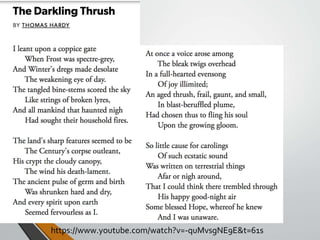
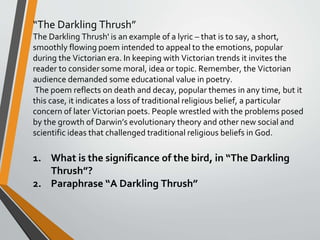
“The Darkling Thrush”
The Darkling Thrush' is an example of a lyric – that is to say, a short,
smoothly flowing poem intended to appeal to the emotions, popular
during the Victorian era. In keeping with Victorian trends it invites the
reader to consider some moral, idea or topic. Remember, the Victorian
audience demanded some educational value in poetry.
The poem reflects on death and decay, popular themes in any time, but it
this case, it indicates a loss of traditional religious belief, a particular
concern of later Victorian poets. People wrestled with the problems posed
by the growth of Darwin’s evolutionary theory and other new social and
scientific ideas that challenged traditional religious beliefs in God.
1. What is the significance of the bird, in “The Darkling
Thrush”?
2. Paraphrase “A Darkling Thrush”
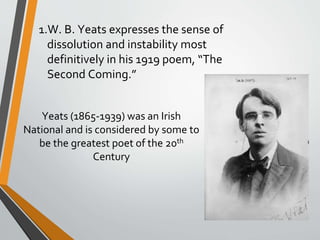
1.W. B. Yeats expresses the sense of
dissolution and instability most
definitively in his 1919 poem, “The
Second Coming.”
Yeats (1865-1939) was an Irish
National and is considered by some to
be the greatest poet of the 20th
Century
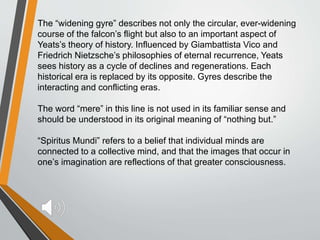
The “widening gyre” describes not only the circular, ever-widening
course of the falcon’s flight but also to an important aspect of
Yeats’s theory of history. Influenced by Giambattista Vico and
Friedrich Nietzsche’s philosophies of eternal recurrence, Yeats
sees history as a cycle of declines and regenerations. Each
historical era is replaced by its opposite. Gyres describe the
interacting and conflicting eras.
The word “mere” in this line is not used in its familiar sense and
should be understood in its original meaning of “nothing but.”
“Spiritus Mundi” refers to a belief that individual minds are
connected to a collective mind, and that the images that occur in
one’s imagination are reflections of that greater consciousness.
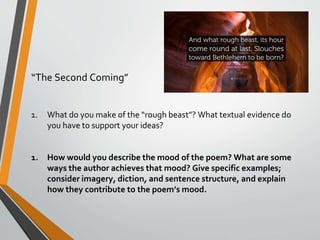
“The Second Coming”
1. What do you make of the “rough beast”? What textual evidence do
you have to support your ideas?
1. How would you describe the mood of the poem? What are some
ways the author achieves that mood? Give specific examples;
consider imagery, diction, and sentence structure, and explain
how they contribute to the poem’s mood.
https://www.youtube.com/watch?v=xeGe5guvSeY
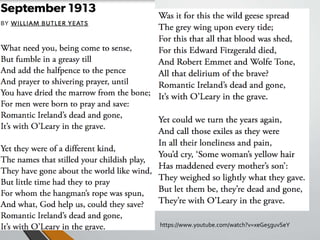
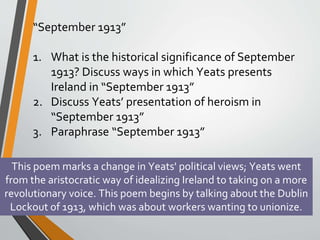
“September 1913”
1. What is the historical significance of September
1913? Discuss ways in which Yeats presents
Ireland in “September 1913”
2. Discuss Yeats’ presentation of heroism in
“September 1913”
3. Paraphrase “September 1913”
This poem marks a change in Yeats' political views; Yeats went
from the aristocratic way of idealizing Ireland to taking on a more
revolutionary voice. This poem begins by talking about the Dublin
Lockout of 1913, which was about workers wanting to unionize.
https://www.youtube.com/watch?v=VLt_OuzW9n0&t=27s
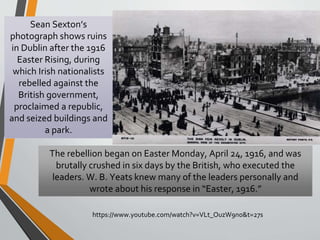
The rebellion began on Easter Monday, April 24, 1916, and was
brutally crushed in six days by the British, who executed the
leaders. W. B. Yeats knew many of the leaders personally and
wrote about his response in “Easter, 1916.”
Sean Sexton’s
photograph shows ruins
in Dublin after the 1916
Easter Rising, during
which Irish nationalists
rebelled against the
British government,
proclaimed a republic,
and seized buildings and
a park.
“Easter 1916”
1. Explain the meaning of the poem’s
famous refrain, “A terrible beauty is
born.” Reveal in your answer the type of
figurative language exemplified in the
phrase “a terrible beauty.”
2. “Easter, 1916” presupposes a considerable
knowledge of historical and biographical
context. Does the need for this knowledge
add to or take away from the poem’s
intensity?
3. Paraphrase “Easter 1916”
QHQs
How do “Hap” and “The Darkling Thrush” relate to
Thomas Hardy’s and the general Modernist’s
attitudes concerning religion?
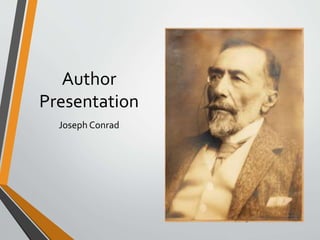
Author
Presentation
Joseph Conrad
His parents, Apollo and Evelina
Korzeniowski, were members of the
Polish noble class. They were also
Polish patriots who conspired
against oppressive Russian rule; as
a consequence, they were arrested
and sent to live in the Russian
province of Vologda with their 4-
year-old son. When Conrad's
parents died several years later, he
was raised by an uncle in Poland.
Conrad's education was erratic: He
was first tutored by his literary father,
then attended school in Krakow and
received further private schooling. At
the age of 16, Conrad left Poland
and traveled to the port city of
Marseilles, France, where he began
his years as a mariner.
Conrad's work influenced numerous
later 20th century writers, from T.S.
Eliot and Graham Greene to Virginia
Woolf, Albert Camus and William
Faulkner. His books have been
translated into dozens of languages.
Joseph Conrad was born on
December 3, 1857, to Polish parents
in Ukraine, and was raised and
educated primarily in Poland. After a
sea-faring career in the French and
British merchant marines, he wrote
short stories and novels like Lord
Jim, Heart of Darkness and The
Secret Agent, which combined his
experiences in remote places with an
interest in moral conflict and the dark
side of human nature. He died in
England on August 3, 1924.
ToWatch Out For in
Heart of Darkness
Darkness
Alienation/Loneliness
Chaos and Order
Sanity and Insanity
Duty and Responsibility
Race and Racism
Violence and Cruelty
Homework
Assigned Reading: Heart of Darkness 1951
Take Quiz 4 (Modernism)
Take Quiz 5 (HOD)
Suggested Reading:
• Achebe, “An Image of Africa: Racism in Conrad's
Heart of Darkness”
• Walcott, “A Far Cry from Africa”
HW: Discussion Question #12
Paper #1 due Friday week 6

Elit 46 c class 12

  • 1.
    A.E. Housman wasan English poet and scholar born on March 26, 1859, in Fockbury,Worcestershire, England. He wrote two poetry volumes, A Shropshire Lad (1896) and Last Poems (1922), the latter of which met with much success. As a scholar he is well-respected for his annotated editions of Marcus Manilius, a first-century Roman astronomer. Housman died on April 30, 1936, in Cambridge, England. ELIT 46C: Class 12 https://www.youtube.com/watch?v=9gIVA8u7pYE
  • 2.
    Agenda Chair Poet Lecture: Introductionto Modernism: Discussion: Hardy, “Hap”; “The DarklingThrush”;Yeats, “September 1913”; “Easter, 1916”; “The Second Coming” Author Presentation: Joseph Conrad
  • 4.
    The 20th Century “Onor about December 1910, human character changed. I am not saying that one went out, as one might into a garden, and there saw that a rose had flowered, or that a hen had laid an egg. The change was not sudden and definite like that. But a change there was, nevertheless; and, since one must be arbitrary, let us date it about the year 1910.” “All human relations shifted,” Woolf continued, “and when human relations change there is at the same time a change in religion, conduct, politics, and literature.” Virginia Woolf in her 1924 essay “Mr. Bennett and Mrs. Brown”
  • 5.
    1. The EducationAct of 1870 required elementary education. This change had a dramatic impact on literacy rates, which in turn produced a bigger reading public than ever before. 2.The growing reading public of the late-Victorian era provided demand for cheap (and generally sensationalist) journalism. It was against this “mass produced” writing that early Modernism would react. 3.The British Empire began unraveling as early as the turn of the twentieth century, though it was not until after the First World War that many colonial nations gained their independence. What emerged was the British Commonwealth (as opposed to the British Empire) within which old colonies retained an allegiance to Britain (usually in name only) but governed themselves. :Read and Change the World
  • 6.
    Albert Einstein (1879-1955) revolutionizedthe way that modern man experienced reality. • Space and time are relative; only the speed of light is constant. • There is no such thing as a favored point of view. • Color is relative. • A universal present moment does not exist. The Late 19th and Early 20th centuries brought great changes
  • 7.
    Sigmund Freud (1856-1939)boiledhuman individuality down to an animalistic sex drive Karl Marx (1818-1883)believed that social class was created, not inherent Friedrich Nietzsche (1844-1900)argued that the most deeply held ethical principles were simply constructions (built by human minds)
  • 9.
    In the 1890s,a strand of thinking began to assert that it was necessary to push aside previous norms entirely, instead of merely revising past knowledge in light of current techniques. It was argued that, if the nature of reality itself was in question, and if restrictions which had been in place around human activity were falling, then art, too, would have to radically change. Thus, in the first 15 years of the twentieth century a series of writers, thinkers, and artists made the break with traditional means of organizing literature, painting, and music.
  • 10.
    Artists began tobelieve that the old assurances from the world -- religion, politics, society -- were no longer enough. And this happened...
  • 11.
  • 13.
    T.S. Eliot’s “TheHollow Men” T.S. Eliot wrote many of his poems, including “The Wasteland” and “The Love Song of J. Alfred Prufrock,” to express his disillusionment of the post-war world. “This is the way the world ends /not with a bang but with a whimper”
  • 14.
    More than16 million people fromboth sides died More than 20 million people from both sides The Great War 1914-1918
  • 15.
    War poets emergedduring the WWI, many of whom fought on the front. Wilfred Owen and Siegfried Sassoon are known primarily for poetry about the horrors of the First World War, an event that threw British culture into a state of shock. Poetry Wilfred Owen
  • 16.
    A general pessimismabout the state of the world developed from the concern that society was accelerating toward destruction and meaninglessness, There was also a belief that only the rebel artist was telling the truth about the world and could help inspire a better society
  • 17.
    “Make it new!” -poet Ezra Pound. The apparition of the wet faces in the crowd; Petals on a wet, black bough “In a Station on the Metro” - Ezra Pound Early Modernist poets like Ezra Pound and his friend T. S. Eliot were heavily influenced by seventeenth century metaphysical poets for technical inspiration. The metaphysical poets worked with simile and analogy to present the reader with startling new comparisons.
  • 18.
    1. an emphasison subjectivity in writing; an emphasis on HOW seeing (or reading or perception itself) takes place, rather than on WHAT is perceived. An example of this would be stream-of-consciousness writing. 2. a movement away from the apparent objectivity provided by omniscient third-person narrators, fixed narrative points of view, and clear-cut moral positions. Faulkner's multiply-narrated stories are an example of this aspect of modernism. 3. a blurring of distinctions between genres, so that poetry seems more documentary (as in T.S. Eliot or ee cummings) and prose seems more poetic (as in Woolf or Joyce). Borrowed from Mary Klages: http://www.bdavetian.com/Postmodernism.html The Main Characteristics of Literary Modernism
  • 19.
    4. an emphasison fragmented forms, discontinuous narratives, and random-seeming collages of different materials. 5. a tendency toward reflexivity, or self-consciousness, about the production of the work of art, so that each piece calls attention to its own status as a production, as something constructed and consumed in particular ways. 6. a rejection of elaborate formal aesthetics in favor of minimalist designs (as in the poetry of William Carlos Williams). 7. A rejection of the distinction between "high" and "low" or popular culture, both in choice of materials used to produce art and in methods of displaying, distributing, and consuming art. Main Characteristics of Modernism (Con’t)
  • 20.
    Fiction Early Modernist fiction1910-1930) was particularly concerned with experimentation. Writers like Woolf and Joyce used tools of fragmentation and stream of consciousness that changed writing forever. The trend ultimately faded, however, and writers of the 1930s, 1940s, and 1950s returned to social realism, often exploring issues of class. Of course, elements of experimentation continued to exist, and many writers today continue to challenge tradition and convention, but it was really the earliest years of the Modernist period that saw the most focused goal of writers to explore new artistic techniques.
  • 21.
    Drama Unlike Modernist poetryand fiction, British Modernist drama did not experience an early phase of radical experimentation at the turn of the twentieth century. Instead, the drastic turning point in Modernist British drama is marked by Waiting for Godot. Beckett challenges even our most basic notions of what can (or should) happen in theater. Beckett wrote the play first in French, and it was first performed in 1953 in Paris. 1906-1989
  • 22.
  • 23.
    “Hap” was composedin the 1860s (Hardy was in his twenties). Its theme returns over and over in both his fiction and his poetry. Hardy laments the seeming randomness of the world, and the ways in which our fortunes (and our misfortunes) are a result of blind chance rather than some greater plan.
  • 25.
    “Hap” "The poems oftenseem so simple as to lack imagery, to be only a statement of mood or attitude, but as we penetrate their meanings, objects and actions acquire a metaphorical significance" remark Walter E. Houghton and G. Robert Stange, in Victorian Poetry and Poetics (Boston: Houghton Mifflin and Riverside Press, 1959), pp. 783- 84. How might one apply this observation to "objects and actions" in the poem “Hap”? What is the implication of the title? Why are such agents as "Crass Casualty" and "Doomsters" capitalized? Explain the various forces described in the poem that randomly rather than calculatedly control human destiny. Why, for example, are the "Doomsters" described as "purblind"? Paraphrase “Hap”:
  • 26.
  • 27.
    “The Darkling Thrush” TheDarkling Thrush' is an example of a lyric – that is to say, a short, smoothly flowing poem intended to appeal to the emotions, popular during the Victorian era. In keeping with Victorian trends it invites the reader to consider some moral, idea or topic. Remember, the Victorian audience demanded some educational value in poetry. The poem reflects on death and decay, popular themes in any time, but it this case, it indicates a loss of traditional religious belief, a particular concern of later Victorian poets. People wrestled with the problems posed by the growth of Darwin’s evolutionary theory and other new social and scientific ideas that challenged traditional religious beliefs in God. 1. What is the significance of the bird, in “The Darkling Thrush”? 2. Paraphrase “A Darkling Thrush”
  • 28.
    1.W. B. Yeatsexpresses the sense of dissolution and instability most definitively in his 1919 poem, “The Second Coming.” Yeats (1865-1939) was an Irish National and is considered by some to be the greatest poet of the 20th Century
  • 29.
    The “widening gyre”describes not only the circular, ever-widening course of the falcon’s flight but also to an important aspect of Yeats’s theory of history. Influenced by Giambattista Vico and Friedrich Nietzsche’s philosophies of eternal recurrence, Yeats sees history as a cycle of declines and regenerations. Each historical era is replaced by its opposite. Gyres describe the interacting and conflicting eras. The word “mere” in this line is not used in its familiar sense and should be understood in its original meaning of “nothing but.” “Spiritus Mundi” refers to a belief that individual minds are connected to a collective mind, and that the images that occur in one’s imagination are reflections of that greater consciousness.
  • 30.
    “The Second Coming” 1.What do you make of the “rough beast”? What textual evidence do you have to support your ideas? 1. How would you describe the mood of the poem? What are some ways the author achieves that mood? Give specific examples; consider imagery, diction, and sentence structure, and explain how they contribute to the poem’s mood.
  • 31.
  • 32.
    “September 1913” 1. Whatis the historical significance of September 1913? Discuss ways in which Yeats presents Ireland in “September 1913” 2. Discuss Yeats’ presentation of heroism in “September 1913” 3. Paraphrase “September 1913” This poem marks a change in Yeats' political views; Yeats went from the aristocratic way of idealizing Ireland to taking on a more revolutionary voice. This poem begins by talking about the Dublin Lockout of 1913, which was about workers wanting to unionize.
  • 33.
    https://www.youtube.com/watch?v=VLt_OuzW9n0&t=27s The rebellion beganon Easter Monday, April 24, 1916, and was brutally crushed in six days by the British, who executed the leaders. W. B. Yeats knew many of the leaders personally and wrote about his response in “Easter, 1916.” Sean Sexton’s photograph shows ruins in Dublin after the 1916 Easter Rising, during which Irish nationalists rebelled against the British government, proclaimed a republic, and seized buildings and a park.
  • 34.
    “Easter 1916” 1. Explainthe meaning of the poem’s famous refrain, “A terrible beauty is born.” Reveal in your answer the type of figurative language exemplified in the phrase “a terrible beauty.” 2. “Easter, 1916” presupposes a considerable knowledge of historical and biographical context. Does the need for this knowledge add to or take away from the poem’s intensity? 3. Paraphrase “Easter 1916”
  • 35.
    QHQs How do “Hap”and “The Darkling Thrush” relate to Thomas Hardy’s and the general Modernist’s attitudes concerning religion?
  • 36.
  • 37.
    His parents, Apolloand Evelina Korzeniowski, were members of the Polish noble class. They were also Polish patriots who conspired against oppressive Russian rule; as a consequence, they were arrested and sent to live in the Russian province of Vologda with their 4- year-old son. When Conrad's parents died several years later, he was raised by an uncle in Poland. Conrad's education was erratic: He was first tutored by his literary father, then attended school in Krakow and received further private schooling. At the age of 16, Conrad left Poland and traveled to the port city of Marseilles, France, where he began his years as a mariner. Conrad's work influenced numerous later 20th century writers, from T.S. Eliot and Graham Greene to Virginia Woolf, Albert Camus and William Faulkner. His books have been translated into dozens of languages. Joseph Conrad was born on December 3, 1857, to Polish parents in Ukraine, and was raised and educated primarily in Poland. After a sea-faring career in the French and British merchant marines, he wrote short stories and novels like Lord Jim, Heart of Darkness and The Secret Agent, which combined his experiences in remote places with an interest in moral conflict and the dark side of human nature. He died in England on August 3, 1924.

  • 38.
    ToWatch Out Forin Heart of Darkness Darkness Alienation/Loneliness Chaos and Order Sanity and Insanity Duty and Responsibility Race and Racism Violence and Cruelty
  • 39.
    Homework Assigned Reading: Heartof Darkness 1951 Take Quiz 4 (Modernism) Take Quiz 5 (HOD) Suggested Reading: • Achebe, “An Image of Africa: Racism in Conrad's Heart of Darkness” • Walcott, “A Far Cry from Africa” HW: Discussion Question #12 Paper #1 due Friday week 6