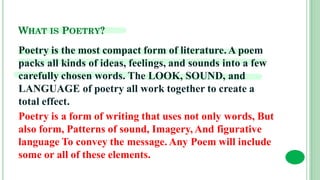
WHAT IS POETRY?
Poetryis the most compact form of literature. A poem
packs all kinds of ideas, feelings, and sounds into a few
carefully chosen words. The LOOK, SOUND, and
LANGUAGE of poetry all work together to create a
total effect.
Poetry is a form of writing that uses not only words, But
also form, Patterns of sound, Imagery, And figurative
language To convey the message. Any Poem will include
some or all of these elements.
3.
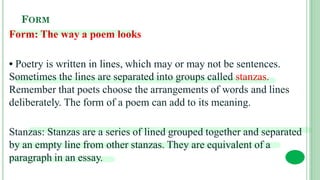
FORM
Form: The waya poem looks
• Poetry is written in lines, which may or may not be sentences.
Sometimes the lines are separated into groups called stanzas.
Remember that poets choose the arrangements of words and lines
deliberately. The form of a poem can add to its meaning.
Stanzas: Stanzas are a series of lined grouped together and separated
by an empty line from other stanzas. They are equivalent of a
paragraph in an essay.
4.
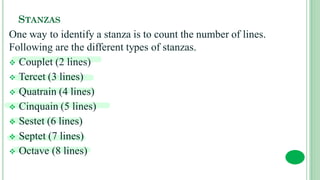
STANZAS
One way toidentify a stanza is to count the number of lines.
Following are the different types of stanzas.
Couplet (2 lines)
Tercet (3 lines)
Quatrain (4 lines)
Cinquain (5 lines)
Sestet (6 lines)
Septet (7 lines)
Octave (8 lines)
5.
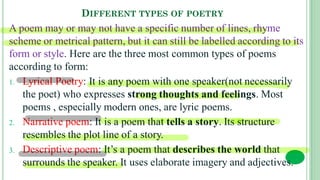
DIFFERENT TYPES OFPOETRY
A poem may or may not have a specific number of lines, rhyme
scheme or metrical pattern, but it can still be labelled according to its
form or style. Here are the three most common types of poems
according to form:
1. Lyrical Poetry: It is any poem with one speaker(not necessarily
the poet) who expresses strong thoughts and feelings. Most
poems , especially modern ones, are lyric poems.
2. Narrative poem: It is a poem that tells a story. Its structure
resembles the plot line of a story.
3. Descriptive poem: It’s a poem that describes the world that
surrounds the speaker. It uses elaborate imagery and adjectives.
6.
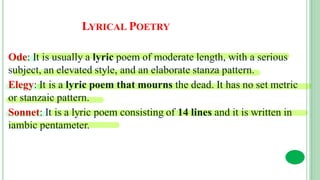
LYRICAL POETRY
Ode: Itis usually a lyric poem of moderate length, with a serious
subject, an elevated style, and an elaborate stanza pattern.
Elegy: It is a lyric poem that mourns the dead. It has no set metric
or stanzaic pattern.
Sonnet: It is a lyric poem consisting of 14 lines and it is written in
iambic pentameter.
7.
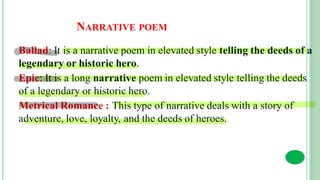
NARRATIVE POEM
Ballad: Itis a narrative poem in elevated style telling the deeds of a
legendary or historic hero.
Epic: It is a long narrative poem in elevated style telling the deeds
of a legendary or historic hero.
Metrical Romance : This type of narrative deals with a story of
adventure, love, loyalty, and the deeds of heroes.
8.
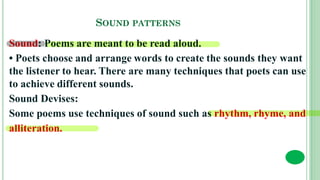
SOUND PATTERNS
Sound: Poemsare meant to be read aloud.
• Poets choose and arrange words to create the sounds they want
the listener to hear. There are many techniques that poets can use
to achieve different sounds.
Sound Devises:
Some poems use techniques of sound such as rhythm, rhyme, and
alliteration.
9.
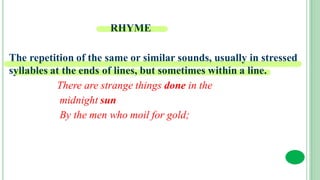
RHYME
The repetition ofthe same or similar sounds, usually in stressed
syllables at the ends of lines, but sometimes within a line.
There are strange things done in the
midnight sun
By the men who moil for gold;
10.
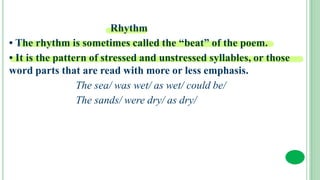
Rhythm
• The rhythmis sometimes called the “beat” of the poem.
• It is the pattern of stressed and unstressed syllables, or those
word parts that are read with more or less emphasis.
The sea/ was wet/ as wet/ could be/
The sands/ were dry/ as dry/
11.
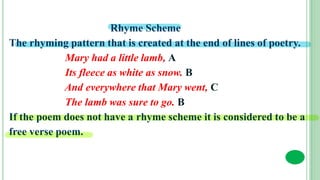
Rhyme Scheme
The rhymingpattern that is created at the end of lines of poetry.
Mary had a little lamb, A
Its fleece as white as snow. B
And everywhere that Mary went, C
The lamb was sure to go. B
If the poem does not have a rhyme scheme it is considered to be a
free verse poem.
12.
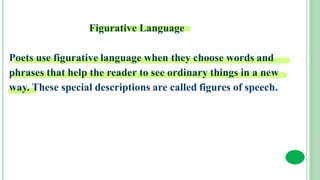
Figurative Language
Poets usefigurative language when they choose words and
phrases that help the reader to see ordinary things in a new
way. These special descriptions are called figures of speech.
13.
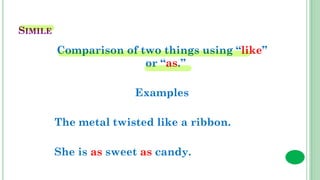
SIMILE
Comparison of twothings using “like”
or “as.”
Examples
The metal twisted like a ribbon.
She is as sweet as candy.
14.
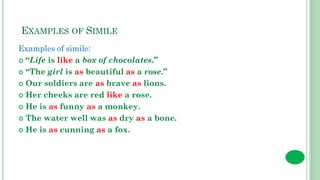
EXAMPLES OF SIMILE
Examplesof simile:
“Life is like a box of chocolates.”
“The girl is as beautiful as a rose.”
Our soldiers are as brave as lions.
Her cheeks are red like a rose.
He is as funny as a monkey.
The water well was as dry as a bone.
He is as cunning as a fox.
15.
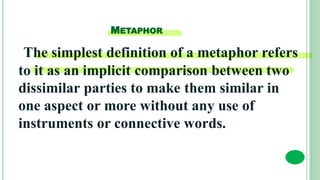
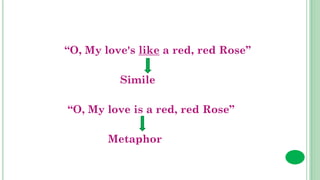
METAPHOR
The simplest definitionof a metaphor refers
to it as an implicit comparison between two
dissimilar parties to make them similar in
one aspect or more without any use of
instruments or connective words.
16.
“O, My love'slike a red, red Rose”
Simile
“O, My love is a red, red Rose”
Metaphor
17.
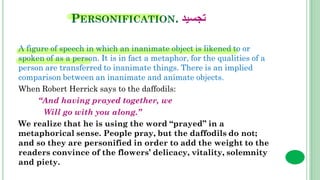
PERSONIFICATION. تجسيد
A figureof speech in which an inanimate object is likened to or
spoken of as a person. It is in fact a metaphor, for the qualities of a
person are transferred to inanimate things. There is an implied
comparison between an inanimate and animate objects.
When Robert Herrick says to the daffodils:
“And having prayed together, we
Will go with you along.”
We realize that he is using the word “prayed” in a
metaphorical sense. People pray, but the daffodils do not;
and so they are personified in order to add the weight to the
readers convince of the flowers’ delicacy, vitality, solemnity
and piety.
20.
Modern Poetry StudyMaterial
Modern history, the modern period or the modern era, is the
global historiographical approach to the timeframe after the Post-classical
history.[1][2]
Modern history can be further broken down into periods:
The early modern period began approximately in the early 16th century; notable
historical milestones included the European Renaissance and the Age of Discovery
The late modern period began approximately in the mid-18th century; notable historical
milestones included the French Revolution, American Revolution, the Industrial
Revolution, and the Great Divergence. It took all of human history up to 1804 for the
world's population to reach 1 billion; the next billion came just over a century later, in
1927.
Contemporary history is the span of historic events that are immediately relevant to the
present time.
Modern
The term "modern" was coined in the 16th century to indicate present or recent times .It
derived from the Latin adverb modo, meaning "just now").The European
Renaissance (about 1420–1630), which marked the transition between the Late Middle
Ages and Early Modern times, started in Italy and was spurred in part by the rediscovery
of classical art and literature, as well as the new perspectives gained from the Age of
Discovery and the invention of the telescope and microscope, expanding the borders of
thought and knowledge.
The term "Early Modern" was introduced in the English language in the 1930s. to distinguish
the time between what we call Middle Ages and time of the late Enlightenment.
The modern era is closely associated with the development of individualism, capitalism,
urbanization and a belief in the possibilities of technological and political progress.
In the Contemporary era, there were various socio-technological trends. Regarding the 21st
century and the late modern world, the Information Age and computers were forefront in use,
not completely everywhere but often present in everyday life. The development of Eastern
powers was of note, with China and India becoming more powerful. In the Eurasian theater,
the European Union and Russian Federation were two forces recently developed.
Significant developments
The modern period has been a period of significant development in the fields
of science, politics, warfare, and technology. It has also been an age of
21.
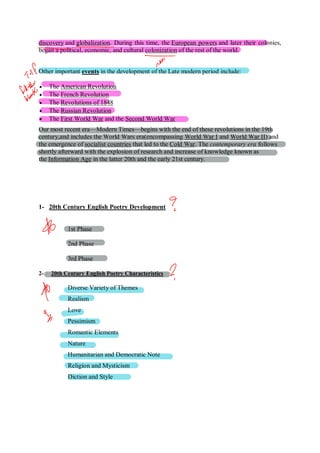
discovery and globalization.During this time, the European powers and later their colonies,
began a political, economic, and cultural colonization of the rest of the world.
Other important events in the development of the Late modern period include:
The American Revolution
The French Revolution
The Revolutions of 1848
The Russian Revolution
The First World War and the Second World War
Our most recent era—Modern Times—begins with the end of these revolutions in the 19th
century,and includes the World Wars era(encompassing World War I and World War II) and
the emergence of socialist countries that led to the Cold War. The contemporary era follows
shortly afterward with the explosion of research and increase of knowledge known as
the Information Age in the latter 20th and the early 21st century.
1- 20th Century English Poetry Development
1st Phase
2nd Phase
3rd Phase
2- 20th Century English Poetry Characteristics
Diverse Variety of Themes
Realism
Love
Pessimism
Romantic Elements
Nature
Humanitarian and Democratic Note
Religion and Mysticism
Diction and Style
22.
----------------------------------------------------------------------------------------------------------------
The 20th
century waslike no time period before it. Einstein, Darwin, Freud, and Marx were
just some of the thinkers who profoundly changed the Western Culture. These changes took
distinct shape in the literature of the 20th
century.
Modernism, a movement that was a radical break from 19th
century Victorianism, led to post-
modernism, which emphasized self-consciousness and pop art. While 20th-century literature
is a diverse field covering a variety of genres, there are common characteristics that changed
literature forever.
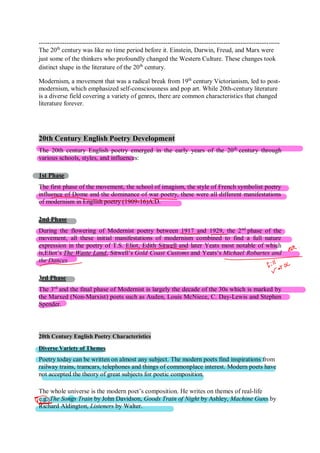
20th Century English Poetry Development
The 20th century English poetry emerged in the early years of the 20th
century through
various schools, styles, and influences:
1st Phase
The first phase of the movement, the school of imagism, the style of French symbolist poetry
influence of Dome and the dominance of war poetry, these were all different manifestations
of modernism in English poetry (1909-16)A.D.
2nd Phase
During the flowering of Modernist poetry between 1917 and 1929, the 2nd
phase of the
movement, all these initial manifestations of modernism combined to find a full nature
expression in the poetry of T.S. Eliot, Edith Sitwell and later Yeats most notable of which
is,Eliot’s The Waste Land, Sitwell’s Gold Coast Customs and Yeats’s Michael Robartes and
the Dances
3rd Phase
The 3rd
and the final phase of Modernist is largely the decade of the 30s which is marked by
the Marxed (Non-Marxist) poets such as Auden, Louis McNiece, C. Day-Lewis and Stephen
Spender.
20th Century English Poetry Characteristics
Diverse Variety of Themes
Poetry today can be written on almost any subject. The modern poets find inspirations from
railway trains, tramcars, telephones and things of commonplace interest. Modern poets have
not accepted the theory of great subjects for poetic composition.
The whole universe is the modern poet’s composition. He writes on themes of real-life
e.g. The Songs Train by John Davidson, Goods Train of Night by Ashley, Machine Guns by
Richard Aldington, Listeners by Walter.
23.
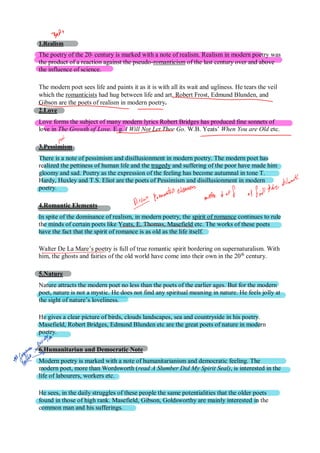
1.Realism
The poetry ofthe 20th
century is marked with a note of realism. Realism in modern poetry was
the product of a reaction against the pseudo-romanticism of the last century over and above
the influence of science.
The modern poet sees life and paints it as it is with all its wait and ugliness. He tears the veil
which the romanticists had hug between life and art. Robert Frost, Edmund Blunden, and
Gibson are the poets of realism in modern poetry.
2.Love
Love forms the subject of many modern lyrics Robert Bridges has produced fine sonnets of
love in The Growth of Love. E.g. I Will Not Let Thee Go. W.B. Yeats’ When You are Old etc.
3.Pessimism
There is a note of pessimism and disillusionment in modern poetry. The modern poet has
realized the pettiness of human life and the tragedy and suffering of the poor have made him
gloomy and sad. Poetry as the expression of the feeling has become autumnal in tone T.
Hardy, Huxley and T.S. Eliot are the poets of Pessimism and disillusionment in modern
poetry.
4.Romantic Elements
In spite of the dominance of realism, in modern poetry, the spirit of romance continues to rule
the minds of certain poets like Yeats, E. Thomas, Masefield etc. The works of these poets
have the fact that the spirit of romance is as old as the life itself.
Walter De La Mare’s poetry is full of true romantic spirit bordering on supernaturalism. With
him, the ghosts and fairies of the old world have come into their own in the 20th
century.
5.Nature
Nature attracts the modern poet no less than the poets of the earlier ages. But for the modern
poet, nature is not a mystic. He does not find any spiritual meaning in nature. He feels jolly at
the sight of nature’s loveliness.
He gives a clear picture of birds, clouds landscapes, sea and countryside in his poetry.
Masefield, Robert Bridges, Edmund Blunden etc are the great poets of nature in modern
poetry.
6.Humanitarian and Democratic Note
Modern poetry is marked with a note of humanitarianism and democratic feeling. The
modern poet, more than Wordsworth (read A Slumber Did My Spirit Seal), is interested in the
life of labourers, workers etc.
He sees, in the daily struggles of these people the same potentialities that the older poets
found in those of high rank. Masefield, Gibson, Goldsworthy are mainly interested in the
common man and his sufferings.
24.
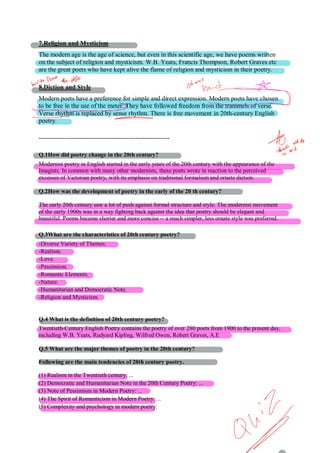
7.Religion and Mysticism
Themodern age is the age of science, but even in this scientific age, we have poems written
on the subject of religion and mysticism. W.B. Yeats, Francis Thompson, Robert Graves etc
are the great poets who have kept alive the flame of religion and mysticism in their poetry.
8.Diction and Style
Modern poets have a preference for simple and direct expression. Modern poets have chosen
to be free in the use of the meter. They have followed freedom from the trammels of verse.
Verse rhythm is replaced by sense rhythm. There is free movement in 20th-century English
poetry.
-------------------------------------------------------------
Q.1How did poetry change in the 20th century?
Modernist poetry in English started in the early years of the 20th century with the appearance of the
Imagists. In common with many other modernists, these poets wrote in reaction to the perceived
excesses of Victorian poetry, with its emphasis on traditional formalism and ornate diction.
Q.2How was the development of poetry in the early of the 20 th century?
The early 20th century saw a lot of push against formal structure and style. The modernist movement
of the early 1900s was in a way fighting back against the idea that poetry should be elegant and
beautiful. Poems became shorter and more concise -- a much simpler, less ornate style was preferred.
Q.3What are the characteristics of 20th century poetry?
-Diverse Variety of Themes.
-Realism.
-Love.
-Pessimism.
-Romantic Elements.
-Nature.
-Humanitarian and Democratic Note.
-Religion and Mysticism.
Q.4 What is the definition of 20th century poetry?
Twentieth-Century English Poetry contains the poetry of over 280 poets from 1900 to the present day,
including W.B. Yeats, Rudyard Kipling, Wilfred Owen, Robert Graves, A.E
Q.5 What are the major themes of poetry in the 20th century?
Following are the main tendencies of 20th century poetry.
(1) Realism in the Twentieth century: ...
(2) Democratic and Humanitarian Note in the 20th Century Poetry: ...
(3) Note of Pessimism in Modern Poetry: ...
(4) The Spirit of Romanticism in Modern Poetry: ...
(5) Complexity and psychology in modern poetry:
25.
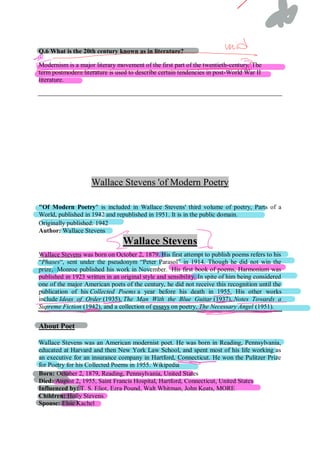
Q.6 What isthe 20th century known as in literature?
Modernism is a major literary movement of the first part of the twentieth-century. The
term postmodern literature is used to describe certain tendencies in post-World War II
literature.
Wallace Stevens 'of Modern Poetry
"Of Modern Poetry" is included in Wallace Stevens' third volume of poetry, Parts of a
World, published in 1942 and republished in 1951. It is in the public domain.
Originally published: 1942
Author: Wallace Stevens
Wallace Stevens
Wallace Stevens was born on October 2, 1879. His first attempt to publish poems refers to his
“Phases“, sent under the pseudonym “Peter Parasol” in 1914. Though he did not win the
prize, Monroe published his work in November. His first book of poems, Harmonium was
published in 1923 written in an original style and sensibility. In spite of him being considered
one of the major American poets of the century, he did not receive this recognition until the
publication of his Collected Poems a year before his death in 1955. His other works
include Ideas of Order (1935), The Man With the Blue Guitar (1937), Notes Towards a
Supreme Fiction (1942), and a collection of essays on poetry, The Necessary Angel (1951).
About Poet
Wallace Stevens was an American modernist poet. He was born in Reading, Pennsylvania,
educated at Harvard and then New York Law School, and spent most of his life working as
an executive for an insurance company in Hartford, Connecticut. He won the Pulitzer Prize
for Poetry for his Collected Poems in 1955. Wikipedia
Born: October 2, 1879, Reading, Pennsylvania, United States
Died: August 2, 1955, Saint Francis Hospital, Hartford, Connecticut, United States
Influenced by: T. S. Eliot, Ezra Pound, Walt Whitman, John Keats, MORE
Children: Holly Stevens
Spouse: Elsie Kachel
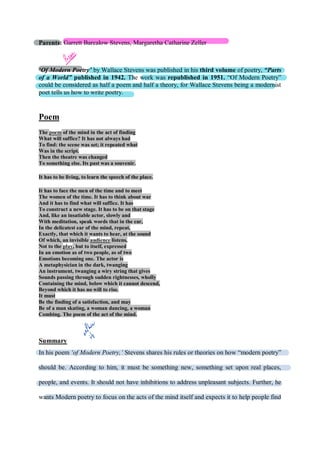
26.
Parents: Garrett BarcalowStevens, Margaretha Catharine Zeller
‘Of Modern Poetry’ by Wallace Stevens was published in his third volume of poetry, “Parts
of a World” published in 1942. The work was republished in 1951. “Of Modern Poetry”
could be considered as half a poem and half a theory, for Wallace Stevens being a modernist
poet tells us how to write poetry.
Poem
The poem of the mind in the act of finding
What will suffice? It has not always had
To find: the scene was set; it repeated what
Was in the script.
Then the theatre was changed
To something else. Its past was a souvenir.
It has to be living, to learn the speech of the place.
It has to face the men of the time and to meet
The women of the time. It has to think about war
And it has to find what will suffice. It has
To construct a new stage. It has to be on that stage
And, like an insatiable actor, slowly and
With meditation, speak words that in the ear,
In the delicatest ear of the mind, repeat,
Exactly, that which it wants to hear, at the sound
Of which, an invisible audience listens,
Not to the play, but to itself, expressed
In an emotion as of two people, as of two
Emotions becoming one. The actor is
A metaphysician in the dark, twanging
An instrument, twanging a wiry string that gives
Sounds passing through sudden rightnesses, wholly
Containing the mind, below which it cannot descend,
Beyond which it has no will to rise.
It must
Be the finding of a satisfaction, and may
Be of a man skating, a woman dancing, a woman
Combing. The poem of the act of the mind.
Summary
In his poem ‘of Modern Poetry,’ Stevens shares his rules or theories on how “modern poetry”
should be. According to him, it must be something new, something set upon real places,
people, and events. It should not have inhibitions to address unpleasant subjects. Further, he
wants Modern poetry to focus on the acts of the mind itself and expects it to help people find
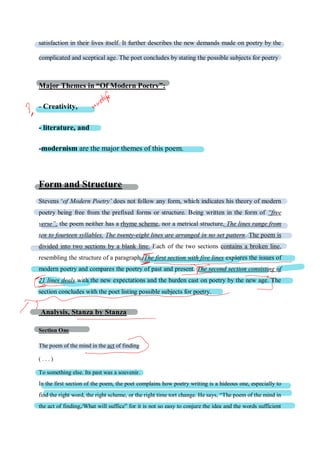
27.
satisfaction in theirlives itself. It further describes the new demands made on poetry by the
complicated and sceptical age. The poet concludes by stating the possible subjects for poetry
Major Themes in “Of Modern Poetry”:
- Creativity,
- literature, and
-modernism are the major themes of this poem.
Form and Structure
Stevens ‘of Modern Poetry’ does not follow any form, which indicates his theory of modern
poetry being free from the prefixed forms or structure. Being written in the form of “free
verse”, the poem neither has a rhyme scheme, nor a metrical structure. The lines range from
ten to fourteen syllables. The twenty-eight lines are arranged in no set pattern. The poem is
divided into two sections by a blank line. Each of the two sections contains a broken line,
resembling the structure of a paragraph. The first section with five lines explores the issues of
modern poetry and compares the poetry of past and present. The second section consisting of
21 lines deals with the new expectations and the burden cast on poetry by the new age. The
section concludes with the poet listing possible subjects for poetry.
Analysis, Stanza by Stanza
Section One
The poem of the mind in the act of finding
( . . . )
To something else. Its past was a souvenir.
In the first section of the poem, the poet complains how poetry writing is a hideous one, especially to
find the right word, the right scheme, or the right time tort change. He says, “The poem of the mind in
the act of finding,/What will suffice” for it is not so easy to conjure the idea and the words sufficient
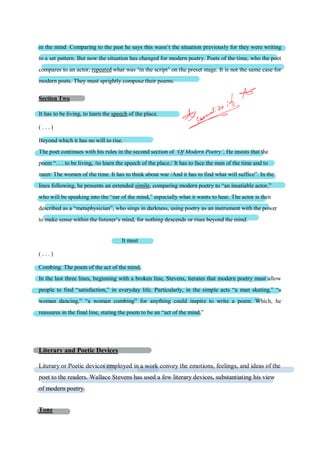
28.
in the mindComparing to the past he says this wasn’t the situation previously for they were writing
to a set pattern. But now the situation has changed for modern poetry. Poets of the time, who the poet
compares to an actor, repeated what was ‘in the script’ on the preset stage. It is not the same case for
modern poets. They must sprightly compose their poems.
Section Two
It has to be living, to learn the speech of the place.
( . . . )
Beyond which it has no will to rise.
The poet continues with his rules in the second section of ‘Of Modern Poetry’. He insists that the
poem “. . . to be living, /to learn the speech of the place./ It has to face the men of the time and to
meet/ The women of the time. It has to think about war /And it has to find what will suffice”. In the
lines following, he presents an extended simile, comparing modern poetry to “an insatiable actor,”
who will be speaking into the “ear of the mind,” especially what it wants to hear. The actor is then
described as a “metaphysician”, who sings in darkness, using poetry as an instrument with the power
to make sense within the listener’s mind, for nothing descends or rises beyond the mind.
It must
( . . . )
Combing. The poem of the act of the mind.
In the last three lines, beginning with a broken line, Stevens, iterates that modern poetry must allow
people to find “satisfaction,” in everyday life. Particularly, in the simple acts “a man skating,” “a
woman dancing,” “a woman combing” for anything could inspire to write a poem. Which, he
reassures in the final line, stating the poem to be an “act of the mind.”
Literary and Poetic Devices
Literary or Poetic devices employed in a work convey the emotions, feelings, and ideas of the
poet to the readers. Wallace Stevens has used a few literary devices, substantiating his view
of modern poetry.
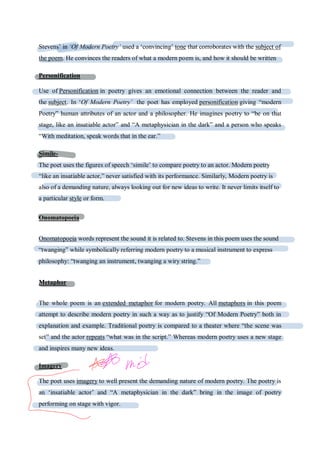
Tone
29.
Stevens’ in ‘OfModern Poetry’ used a ‘convincing’ tone that corroborates with the subject of
the poem. He convinces the readers of what a modern poem is, and how it should be written
Personification
Use of Personification in poetry gives an emotional connection between the reader and
the subject. In ‘Of Modern Poetry’ the poet has employed personification giving “modern
Poetry” human attributes of an actor and a philosopher. He imagines poetry to “be on that
stage, like an insatiable actor” and “A metaphysician in the dark” and a person who speaks
“With meditation, speak words that in the ear.”
Simile-
The poet uses the figures of speech ‘simile’ to compare poetry to an actor. Modern poetry
“like an insatiable actor,” never satisfied with its performance. Similarly, Modern poetry is
also of a demanding nature, always looking out for new ideas to write. It never limits itself to
a particular style or form.
Onomatopoeia
Onomatopoeia words represent the sound it is related to. Stevens in this poem uses the sound
“twanging” while symbolically referring modern poetry to a musical instrument to express
philosophy: “twanging an instrument, twanging a wiry string.”
Metaphor
The whole poem is an extended metaphor for modern poetry. All metaphors in this poem
attempt to describe modern poetry in such a way as to justify “Of Modern Poetry” both in
explanation and example. Traditional poetry is compared to a theater where “the scene was
set” and the actor repeats “what was in the script.” Whereas modern poetry uses a new stage
and inspires many new ideas.
Imagery
The poet uses imagery to well present the demanding nature of modern poetry. The poetry is
an ‘insatiable actor’ and “A metaphysician in the dark” bring in the image of poetry
performing on stage with vigor.
30.
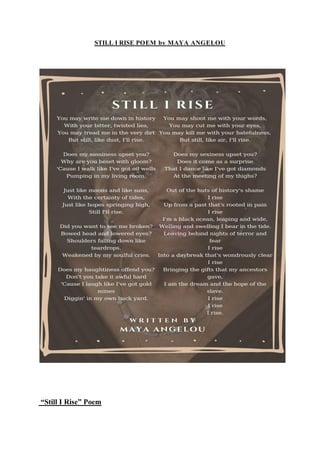
STILL I RISEPOEM by MAYA ANGELOU
“Still I Rise” Poem
31.
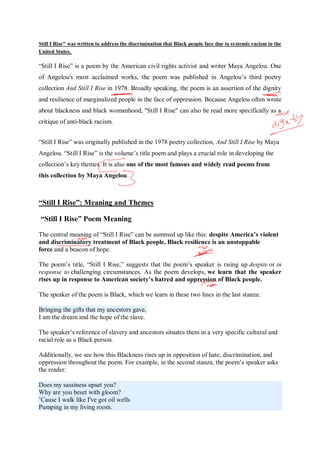
Still I Rise"was written to address the discrimination that Black people face due to systemic racism in the
United States.
“Still I Rise” is a poem by the American civil rights activist and writer Maya Angelou. One
of Angelou's most acclaimed works, the poem was published in Angelou’s third poetry
collection And Still I Rise in 1978. Broadly speaking, the poem is an assertion of the dignity
and resilience of marginalized people in the face of oppression. Because Angelou often wrote
about blackness and black womanhood, "Still I Rise" can also be read more specifically as a
critique of anti-black racism.
“Still I Rise” was originally published in the 1978 poetry collection, And Still I Rise by Maya
Angelou. “Still I Rise” is the volume’s title poem and plays a crucial role in developing the
collection’s key themes. It is also one of the most famous and widely read poems from
this collection by Maya Angelou.
“Still I Rise”: Meaning and Themes
“Still I Rise” Poem Meaning
The central meaning of “Still I Rise” can be summed up like this: despite America’s violent
and discriminatory treatment of Black people, Black resilience is an unstoppable
force and a beacon of hope.
The poem’s title, “Still I Rise,” suggests that the poem’s speaker is rising up despite or in
response to challenging circumstances. As the poem develops, we learn that the speaker
rises up in response to American society’s hatred and oppression of Black people.
The speaker of the poem is Black, which we learn in these two lines in the last stanza:
Bringing the gifts that my ancestors gave,
I am the dream and the hope of the slave.
The speaker’s reference of slavery and ancestors situates them in a very specific cultural and
racial role as a Black person.
Additionally, we see how this Blackness rises up in opposition of hate, discrimination, and
oppression throughout the poem. For example, in the second stanza, the poem’s speaker asks
the reader:
Does my sassiness upset you?
Why are you beset with gloom?
’Cause I walk like I've got oil wells
Pumping in my living room.
32.
The fourth andfifth stanzas pose questions to the reader in a similar fashion, asking:
Did you want to see me broken?
Bowed head and lowered eyes?
Shoulders falling down like teardrops,
Weakened by my soulful cries?
Does my haughtiness offend you?
Don't you take it awful hard
’Cause I laugh like I've got gold mines
Diggin’ in my own backyard.
Angelou opens each of these stanzas with questions as she calls out everyone who has
participated in the oppression of Black people. She demands an explanation for their
hatred, and each question calls out a specific instance of or type of mistreatment. Speaking on
behalf of Black people who have experienced discrimination, the speaker questions why
Black people are treated with violence and contempt.
As the poem goes on, it becomes clear that those who hate Black people do so because of
the strength, beauty, and resilience of Black people...even though the Black community
remains oppressed. We see this in the similes that compare the spirit of Black people to
resources that are an endless wellspring of riches, like “oil wells / Pumping in [the speaker’s]
living room” and “gold mines / Diggin’ in [her] own backyard.” Using these comparisons,
Angelou asks the reader to consider why it’s the enduring hope, joy, and strength of Black
people that makes others want to break them down.
While the strength and beauty of Black people incites hatred and intolerance, Angelou also
portrays these qualities as the ultimate source of Black people’s strength to keep rising
back up. The speaker argues that Black people refuse to give up in the face of society’s
racism and oppression. Instead, they respond with remarkable strength.
Now, let’s take a closer look at the three major themes that define Angelou’s poem: the
relationship between personal and collective experience, the irrationality of racial
hatred, and the enduring nature of Black resilience.
33.
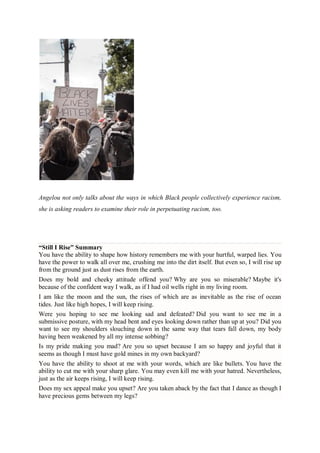
Angelou not onlytalks about the ways in which Black people collectively experience racism,
she is asking readers to examine their role in perpetuating racism, too.
“Still I Rise” Summary
You have the ability to shape how history remembers me with your hurtful, warped lies. You
have the power to walk all over me, crushing me into the dirt itself. But even so, I will rise up
from the ground just as dust rises from the earth.
Does my bold and cheeky attitude offend you? Why are you so miserable? Maybe it's
because of the confident way I walk, as if I had oil wells right in my living room.
I am like the moon and the sun, the rises of which are as inevitable as the rise of ocean
tides. Just like high hopes, I will keep rising.
Were you hoping to see me looking sad and defeated? Did you want to see me in a
submissive posture, with my head bent and eyes looking down rather than up at you? Did you
want to see my shoulders slouching down in the same way that tears fall down, my body
having been weakened by all my intense sobbing?
Is my pride making you mad? Are you so upset because I am so happy and joyful that it
seems as though I must have gold mines in my own backyard?
You have the ability to shoot at me with your words, which are like bullets. You have the
ability to cut me with your sharp glare. You may even kill me with your hatred. Nevertheless,
just as the air keeps rising, I will keep rising.
Does my sex appeal make you upset? Are you taken aback by the fact that I dance as though I
have precious gems between my legs?
34.
I rise upout of history's shameful act of slavery. I rise up from this deeply painful past. I am
as vast and full of power as a dark ocean that rises and swells and carries in the tide.
I rise up, and in doing so leave behind all the darkness of terror and fear. I rise up, and in
doing so enter a bright morning that is full of joyful wonder. With the personal qualities and
grace I inherited from my ancestors, I embody the dreams and hopes of past enslaved
peoples. I will rise, and rise, and rise.
What are the main themes in Still I Rise?
Themes of "Still I Rise"
Strength. This poem is not only a proclamation of her own determination to fight oppression
and rise above society, but also a call to others that they should do the same. ...
Resilience. This poem is about racial legacy, struggle, and overcoming obstacles. ...
Self-respect&Confidence. Still I Rise” is primarily about self-respect and confidence. In the
poem, Angelou reveals how she will overcome anything through her self-esteem.
Robert Lee Frost The Road Not Taken
The Road Not Taken
Poem by Robert Frost
Two roads diverged in a yellow wood,
And sorry I could not travel both
And be one traveler, long I stood
And looked down one as far as I could
To where it bent in the undergrowth;
Then took the other, as just as fair,
And having perhaps the better claim,
Because it was grassy and wanted wear;
Though as for that the passing there
Had worn them really about the same,
And both that morning equally lay
In leaves no step had trodden black.
Oh, I kept the first for another day!
Yet knowing how way leads on to way,
I doubted if I should ever come back.
I shall be telling this with a sigh
Somewhere ages and ages hence:
Two roads diverged in a wood, and I—
I took the one less traveled by,
And that has made all the difference.
35.
Description
"The Road NotTaken" is a narrative poem by Robert Frost, first published in the August
1915 issue of The Atlantic Monthly, and later published as the first poem in the collection
Mountain Interval of 1916.
Originally published: 1916
Author: Robert Frost
Lines: 20
Rhyme scheme: ABAAB
Meter: or
Genre(s): Narrative poem
Metre: irregular iambic tetrameter
Frost's 'The Road Not Taken' Meaning
'The Road Not Taken' is an ambiguous poem that allows the reader to think about choices in
life, whether to go with the mainstream or go it alone. If life is a journey, this poem
highlights those times in life when a decision has to be made. Which way will you go?
“The Road Not Taken” Summary
The speaker, walking through a forest whose leaves have turned yellow in autumn, comes to
a fork in the road. The speaker, regretting that he or she is unable to travel by both roads
(since he or she is, after all, just one person), stands at the fork in the road for a long time and
tries to see where one of the paths leads. However, the speaker can't see very far because the
forest is dense and the road is not straight.
The speaker takes the other path, judging it to be just as good a choice as the first, and
supposing that it may even be the better option of the two, since it is grassy and looks less
worn than the other path. Though, now that the speaker has actually walked on the second
36.
road, he orshe thinks that in reality the two roads must have been more or less equally worn-
in.
Reinforcing this statement, the speaker recalls that both roads were covered in leaves, which
had not yet been turned black by foot traffic. The speaker exclaims that he or she is in fact
just saving the first road, and will travel it at a later date, but then immediately contradicts
him or herself with the acknowledgement that, in life, one road tends to lead onward to
another, so it's therefore unlikely that he or she will ever actually get a chance to return to that
first road.
The speaker imagines him or herself in the distant future, recounting, with a sigh, the story of
making the choice of which road to take. Speaking as though looking back on his or her life
from the future, the speaker states that he or she was faced with a choice between two roads
and chose to take the road that was less traveled, and the consequences of that decision have
made all the difference in his or her life.
Short Summary
The speaker stands in the woods, considering a fork in the road. Both ways are equally worn
and equally overlaid with un-trodden leaves. The speaker chooses one, telling himself that he
will take the other another day. Yet he knows it is unlikely that he will have the opportunity
to do so. And he admits that someday in the future he will recreate the scene with a slight
twist: He will claim that he took the less-travelled road.
Themes of the Poem
1. Youth And The Loss Of Innocence
2. Self-Knowledge Through Nature
3. Community Vs. Isolation
4.Choices And Uncertainty.
5. Individualism And Nonconformity
What Is the Central Message?
'The Road Not Taken' suddenly presents the speaker and the reader with a dilemma. There
are two roads in an autumnal wood separating off, presumably the result of the one road
splitting, and there's nothing else to do but to choose one of the roads and continue life's
journey.
What Is the Symbolism of "The Road Not Taken?"
37.
The road, itself,symbolizes the journey of life, and the image of a road forking off into two
paths symbolizes a choice.
As for color, Frost describes the forest as a "yellow wood." Yellow can be considered a
middle color, something in-between and unsure of itself. This sets the mood of indecision that
characterizes the language of the poem.
What Is the Point of View of "The Road Not Taken?"
The point of view is of the traveler, who, walking along a single path, encounters a fork in the
road and stops to contemplate which path he should follow.
----------------------------------------------------------------------------------------------------------

![Modern Poetry Study Material
Modern history, the modern period or the modern era, is the
global historiographical approach to the timeframe after the Post-classical
history.[1][2]
Modern history can be further broken down into periods:
The early modern period began approximately in the early 16th century; notable
historical milestones included the European Renaissance and the Age of Discovery
The late modern period began approximately in the mid-18th century; notable historical
milestones included the French Revolution, American Revolution, the Industrial
Revolution, and the Great Divergence. It took all of human history up to 1804 for the
world's population to reach 1 billion; the next billion came just over a century later, in
1927.
Contemporary history is the span of historic events that are immediately relevant to the
present time.
Modern
The term "modern" was coined in the 16th century to indicate present or recent times .It
derived from the Latin adverb modo, meaning "just now").The European
Renaissance (about 1420–1630), which marked the transition between the Late Middle
Ages and Early Modern times, started in Italy and was spurred in part by the rediscovery
of classical art and literature, as well as the new perspectives gained from the Age of
Discovery and the invention of the telescope and microscope, expanding the borders of
thought and knowledge.
The term "Early Modern" was introduced in the English language in the 1930s. to distinguish
the time between what we call Middle Ages and time of the late Enlightenment.
The modern era is closely associated with the development of individualism, capitalism,
urbanization and a belief in the possibilities of technological and political progress.
In the Contemporary era, there were various socio-technological trends. Regarding the 21st
century and the late modern world, the Information Age and computers were forefront in use,
not completely everywhere but often present in everyday life. The development of Eastern
powers was of note, with China and India becoming more powerful. In the Eurasian theater,
the European Union and Russian Federation were two forces recently developed.
Significant developments
The modern period has been a period of significant development in the fields
of science, politics, warfare, and technology. It has also been an age of](https://image.slidesharecdn.com/e92ef2ea-1f9e-48f0-b99a-af7d80dcc74f-250517153200-100ec1c9/85/e92ef2ea-1f9e-48f0-b99a-af7d80dcc74f-pdf-pdf-20-320.jpg)
![The fourth and fifth stanzas pose questions to the reader in a similar fashion, asking:
Did you want to see me broken?
Bowed head and lowered eyes?
Shoulders falling down like teardrops,
Weakened by my soulful cries?
Does my haughtiness offend you?
Don't you take it awful hard
’Cause I laugh like I've got gold mines
Diggin’ in my own backyard.
Angelou opens each of these stanzas with questions as she calls out everyone who has
participated in the oppression of Black people. She demands an explanation for their
hatred, and each question calls out a specific instance of or type of mistreatment. Speaking on
behalf of Black people who have experienced discrimination, the speaker questions why
Black people are treated with violence and contempt.
As the poem goes on, it becomes clear that those who hate Black people do so because of
the strength, beauty, and resilience of Black people...even though the Black community
remains oppressed. We see this in the similes that compare the spirit of Black people to
resources that are an endless wellspring of riches, like “oil wells / Pumping in [the speaker’s]
living room” and “gold mines / Diggin’ in [her] own backyard.” Using these comparisons,
Angelou asks the reader to consider why it’s the enduring hope, joy, and strength of Black
people that makes others want to break them down.
While the strength and beauty of Black people incites hatred and intolerance, Angelou also
portrays these qualities as the ultimate source of Black people’s strength to keep rising
back up. The speaker argues that Black people refuse to give up in the face of society’s
racism and oppression. Instead, they respond with remarkable strength.
Now, let’s take a closer look at the three major themes that define Angelou’s poem: the
relationship between personal and collective experience, the irrationality of racial
hatred, and the enduring nature of Black resilience.](https://image.slidesharecdn.com/e92ef2ea-1f9e-48f0-b99a-af7d80dcc74f-250517153200-100ec1c9/85/e92ef2ea-1f9e-48f0-b99a-af7d80dcc74f-pdf-pdf-32-320.jpg)