MODULE - 1
India and the World
through the Ages
61
Modern World – I
SOCIAL SCIENCE
Notes
3
MODERN WORLD – I
From the 14th century onwards, Europe witnessed many profound changes in its
cultural and intellectual life that helped to usher in the modern period. This was the
Renaissance, the awakening, that encouraged thinking and reasoning in social and
political fields and affected every aspect of life.Aperiod of rationality and scientific
enquiry had already begun in theArab world, but the changes that took place during
renaissance in Europe affected the whole world. These changes began with the
disintegration of the feudal system, about which you have read, in detail, in the
previous lesson. In this lesson, we will discuss some of these changes and
developments which transformed medieval society into the modern world.We will
also trace the events that took place in the modern world till the 20th century.
OBJECTIVES
After reading this lesson, you will be able to:
Discuss the impact of decline of the feudalism;
explain the meaning and features of Renaissance;
explain the causes of Reformation and its impact;
describe the development of science;
mention the main scientific discoveries of the age and some of the main voyages
of discoveries;
explain significance of the Industrial Revolution for Europe and the rest of the
world;
explain the causes and effects of the American Revolution and the French
Revolution;
discuss the struggle for National Unification in Germany and Italy; and
examine the growth of socialist ideas and Russian Revolution.
SOCIAL SCIENCE
MODULE - 1 Modern World – I
India and the World
through the Ages
62
Notes
3.1 IMPACT OF DECLINE OF FEUDALISM
DuringtheMedievalAge,oneofthemostimportantinstitutionswasFeudalism.You
havereadaboutitindetailinthepreviouslesson.Feudalismasaninstitutionflourished
inEuropeformanycenturies.Butwiththeriseofthemiddleclass,itstartedtodecline.
Rise of powerful kingdoms as well as warfare between the feudal lords further led
to its decline. Emergence of new towns and cities and a revival of trade also led
to the disintegration of the feudal system. These towns were centers of production
and were governed by elected representatives. The atmosphere of the towns was
free from feudal restriction and control as people were free to go anywhere and to
take up any profession. Towns attracted artisans and peasants from rural areas
because they provided better prospects of living and acting as a refuge from feudal
exploitation. These towns and cities encouraged the production of many crops such
as cotton and sugarcane. Peasants were paid in cash for their product. The
manufactured goods were sold in the markets where money was the medium of
exchange. The lords began to accept money from their vassals instead of services
as they also needed money to buy various luxurious commodities. This led to the
rise of a powerful merchant class. They now began to aspire for a higher status in
the social hierarchy.They began to support the powerful monarchs to undermine the
positionofthefeudallordswhichweakenedthefeudalstructureandledtothedecline
of the feudal order.
The infusion of new ideas created a new awakening. This gave birth to a new
movement called the Renaissance about which we are going to read now.
3.2 RENAISSANCE
The modern period ushered the end of the Age of Faith and the beginning of the
Age of Reason. It witnessed movements like the Renaissanceand the Reformation.
Thesemovementsbroughtmanychangesincultural,intellectual,religious,socialand
political life of the people all over the world. This period is also characterised by
urbanisation,fastermeansoftransportandcommunication,democraticsystemsand
uniform laws based on equality.
TheliteralmeaningofRenaissanceis‘rebirth’.ItstartedinItalyaround14th Century
AD. Italy was divided into small city states at that time. Many of them were built
on the ruins of ancient Roman buildings. The geographical position of Italian cities
made them great trading and intellectual centers. Moreover, the position of Italian
cities such as Venice made them centers of trade and intellectual crossroads. Many
great ideas, along with wealth, were brought by merchants from far corners of the
globe. The new form of political and social organization gave political freedom and
a suitable atmosphere for academic, artistic and cultural advancement. People had
more leisure time for study and other activities.
MODULE - 1
India and the World
through the Ages
63
Modern World – I
SOCIAL SCIENCE
Notes
Thiswasalsoaperiodofgreateconomicexpansion.Manycommercialandfinancial
techniques were developed for trade practices like book keeping, bills of exchange
and public debt. This enabled Italy to become the centre of Renaissance. The major
developments of this time were the revival of urban life, commerce based on private
capital, banking, formation of nation states, explorations to find new routes and
territoriesandthedevelopmentofvernacularliteraturewhichwaspopularizedbythe
printingpress.Thisnewmercantilesocietywaslesshierarchicalandmoreconcerned
with secular objectives. It was in sharp contrast to the earlier rural, tradition bound
society. The adventures and explorers played a significant role in opening a world
economic system. Many new commodities were brought fromAmerica,Asia and
Africaafterthediscoveryoftraderoutes.ThesegoodsenrichedthelifeofEuropeans
andinspiredthemtodevelopnewwaysofproducingtheminlargenumberstomake
profit. The result was that merchants, entrepreneurs and bankers joined hands and
‘Capital’cametoenjoyanimportantpositioninthepoliticallifeaswellasinrelations
with other countries.
The new ideas that were generated in this period like humanism, rationalism and the
spiritofinquirybroughtaprofoundchangeinthethinkingpatternofthepeople.There
wasarenewedinterestintheculturalachievementsoftheClassicalGreekandRoman
Civilisations. Human beings became the central concern of the new scholars. They
believed in the creative potential of the human beings and their right to seek joy and
pleasures in this world itself. This was contrary to the belief of the Medieval Church
whichopposedworldlypleasures.Thisrespectforhumanbeingsencouragedinterest
in art, history, language, literature, ethics, etc. Do you know that it was at this time
that the disciplines grouped under ‘humanities’ were born?
The spirit of Humanism also found expression in the field of art and literature. The
greatestachievementsofRenaissanceartistswere
in the field of paintings. Painters studied the
anatomy and proportions of the human body.
They wanted the human beings to be painted in
realistic form and proportion. Some of the
outstanding artists were Leonardo da Vinci,
Michelangelo,Raphael,BotticelliandTitian.Even
inthefieldofsculpture,artistsbegantomakefree
standing statues. These sculptures now stood
apart from the building or background and were
separate works of art. The first great Renaissance
sculptor was Donatello who made the statue
‘David’.
The Renaissance spirit also marks the rise of
Nationalism in Europe. People now began to free
themselves of medieval religious restrictions and
Figure 3.1 Leonardo da Vinci’s
Monalisa
SOCIAL SCIENCE
MODULE - 1 Modern World – I
India and the World
through the Ages
64
Notes
bonds. National identities grew stronger and this was reflected in the development
of modern European languages such as Italian, Spanish, French, German, English
etc. as the languages of literature. Now the writers used local languages in poetry,
drama, prose, etc., instead of Latin. The works of Renaissance authors became
accessible to a large number of people due to the use of vernacular languages and
the introduction of printing press. The Bible was printed and read by a large number
of people. Several works that were produced in Modern European languages were
Dante’s Divine Comedy, Erasmus, In Praise of Folly; Machiavelli’s The Prince
and Cervantes’ Don Quixote.
Two major developments took place in the history of Europe towards the later part
of the Renaissance. The first was the Protestant Reformation which resulted in the
split in Christianity.The second development concerned reforms within the Roman
CatholicChurch,generallyreferredtoasCatholicReformationorCounterReformation.
Reformation was a part of the socio-religious and political movement which led to
the emergence of the modern world.
ACTIVITY 3.1
Rationalism,Humanism,Inquiry,Observation,ExperimentationandReasoningwere
some of ideas that come up during the Renaissance period. Find their meanings and
relate their relevance in our lives today.
3.3 REFORMATION
The Medieval Catholic Church came to be associated with superstitions, corruption
and greed for money. Superstitious peasants were convinced by the Church that it
possessed the true Cross. People were used to paying fees for seeing a piece of
wood as the true Cross because it was believed that sacred relics had healing power.
The Church laid more emphasis on blind faith than reason as it was the means to
extractmoneyfromthedevotees.AllthischangedwiththecomingoftheRenaissance.
In the new spirit of the Renaissance nothing could be accepted. Do you know that
it was in 1517AD that a German priest called Martin Luther first challenged the
authority of the Roman Catholic Church?According to him, the Bible was the only
sourceofreligiousauthority.Hebelievedthatsalvationcouldbeattainedthroughfaith
inJesusChristinsteadofhavingblindfaithontheChurch.Heprotestedagainstsome
practices of the Church such as the selling of positions in the church, the issuing of
the letters of indulgence for works of charity or going on crusades, to the highest
bidder. Luther had the protection of the German Princes, primarily because of his
desire to seize church property. But on 3 January 1521, he was excommunicated
by Pope Leo X after he refused to stop writing against the Church.
MODULE - 1
India and the World
through the Ages
65
Modern World – I
SOCIAL SCIENCE
Notes
Luther’s views started the Protestant
Reformation in the West and it divided the
Christian world into two, the Protestants and
the Roman Catholics. According to him,
Christians must win salvation by following
Christ and not by buying letter of indulgence.
ThoughtheReformMovementinEnglandwas
influenced by Lutheran ideas, the English
ReformationoccurredasadirectresultofKing
Henry VIII’s efforts to divorce his first wife,
Catherine ofAragon. Thomas Cromwell, the
King’sChiefMinister,helpedtheParliamentto
pass the Act in Restraint of Appeals and the
Act of Supremacy. It gave a royal headship to
the King over the church. The king was
allowed to marryAnne Boleyn, a commoner.
The Reformation proved to be a great upheaval for religious revival. A Reform
MovementalsotookplacewithintheCatholicChurch.Thisisknownasthe‘Counter
Reformation’. It aimed to reduce corruption as well as to improve and strengthen
Catholic Church. It began in Spain where Ignatious Loyal founded the ‘Society of
Jesus’which stressed upon service of God, charity, chastity and missionary work.
ThemovementstartedbyMartinLutherspreadtoothercountriesofEuropethrough
the efforts of King Henry VIII of England, Huldreich Zwingli and John Calvin.
INTEXT QUESTIONS 3.1
1. Fill in the blanks:
(a) .....................expresseditsbeliefinthecreativepotentialofhumanbeings.
(b) Ignatius Loyal founded the .....................
2. Define feudalism. Give at least two features of feudalism.
3. What were the main ideas of Renaissance?
4. Enlist at least two teachings of Martin Luther which influenced reforms in the
Church.
3.4 DEVELOPMENT OF SCIENCE
During the Renaissance, extraordinary accomplishments were made in the field of
science. We have already read that the Renaissance thinkers emphasized more on
Figure 3.2 Martin Luther
SOCIAL SCIENCE
MODULE - 1 Modern World – I
India and the World
through the Ages
66
Notes
reasonthanonblindfaithandstressedthatknowledgecouldbegainedbyobservation
andexperimentation.Theyrejectedblindfaithintraditionandestablishedbeliefs.This
resultedinascientificinquirythathadalmostdisappeared.Renaissancealsobrought
about a scientific revolution. Artists like Leonardo da Vinci made observational
drawings of anatomy and nature which were a unique blend of science and art. The
periodalsosawremarkableachievementsinmedicineandhumananatomy.Michael
Servetus, a Spanish doctor, discovered the circulation of blood.William Harvey, an
Englishman explained the function of the heart in purifying blood and its circulation
through veins. The beginnings that were made by the Renaissance scientists paved
the way for observation and experimentation in other fields of knowledge.
One of the most remarkable achievements of the Renaissance in science was in the
field of astronomy. Have you heard of Copernicus, Kepler and Galileo? They were
great astronomers who formulated and tried to prove that the Earth revolves around
the Sun. Before the Renaissance, it was believed that the Sun revolved around the
Earth and whoever questioned this was denounced as a heretic. Copernicus in his
book On the Revolution of the Heavenly Sphere argued that the earth and the
planets move around the sun in concentric circles. Even though the theory was
imperfect, it aroused thinking and reasoning. Kepler further developed this theory
andsaidthattheotherplanetsmoveinellipticalpathsaroundthesun.Healsoargued
that magnetic attractions between the Sun and the planets kept the heavenly bodies
in an orbital motion. Further on this assumption, Isaac Newton developed his Law
of Universal Gravitation.With his self manufactured telescope, Galileo discovered
the moons of Jupiter, the rings of Saturn and spots in the Sun. He also confirmed
the findings of Copernicus. Renaissance also developed a curiosity in the minds of
Europeans about other lands and other peoples. Let us find out how this happened.
3.5 DISCOVERY OF NEW LANDS
The spirit of inquiry encouraged many adventurers to discover new lands. The new
trade routes that were discovered changed the history of the world. It is said that
‘God,GloryandGold’wasthemainmotivebehindthesediscoveries.Butthemotive
of gold or economic need was the most important. Before the geographical
discoveries, Europeans obtained articles like spices, cotton, precious gems, silk, etc.
from the Eastern part of the world. They travelled through theArabic and Islamic
territoriesforthesupplyofthesearticles.Thiswasnotveryconvenientandalsoposed
uncertainties. So a direct sea route to South East Asia was discovered as it had a
potential of a lucrative trade. The explorers also had another motive, which was to
convert the people of the newly found areas to Christianity. It also became a means
for them to serve God. In addition, the adventurers also hoped to acquire fame by
discoveringnewlands.Somedidindeedbecomeveryfamous.Haveyouheardabout
MODULE - 1
India and the World
through the Ages
67
Modern World – I
SOCIAL SCIENCE
Notes
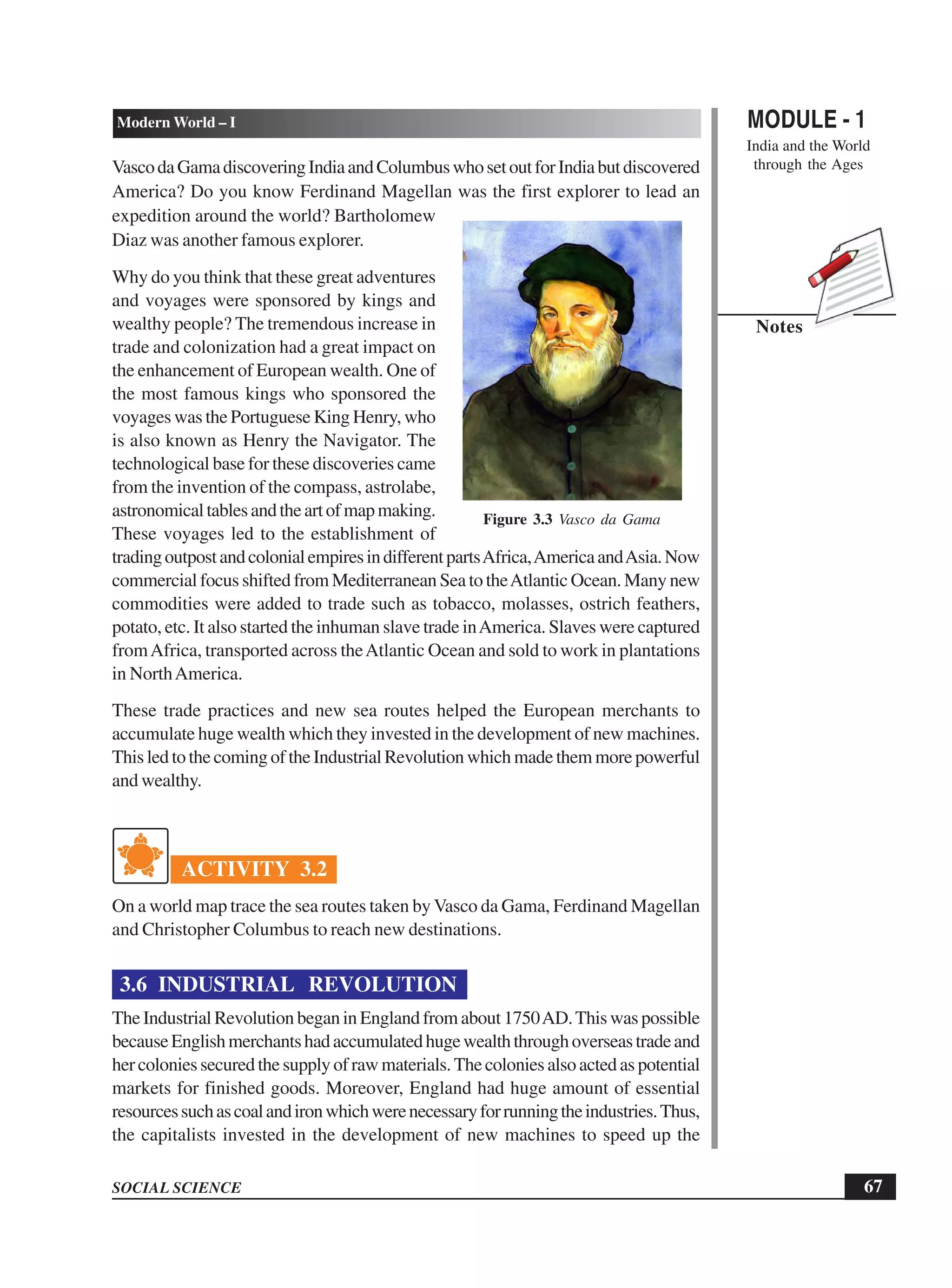
VascodaGamadiscoveringIndiaandColumbuswhosetoutforIndiabutdiscovered
America? Do you know Ferdinand Magellan was the first explorer to lead an
expedition around the world? Bartholomew
Diaz was another famous explorer.
Why do you think that these great adventures
and voyages were sponsored by kings and
wealthy people? The tremendous increase in
trade and colonization had a great impact on
the enhancement of European wealth. One of
the most famous kings who sponsored the
voyages was the Portuguese King Henry, who
is also known as Henry the Navigator. The
technological base for these discoveries came
from the invention of the compass, astrolabe,
astronomicaltablesandtheartofmapmaking.
These voyages led to the establishment of
tradingoutpostandcolonialempiresindifferentpartsAfrica,AmericaandAsia.Now
commercial focus shifted from Mediterranean Sea to theAtlantic Ocean. Many new
commodities were added to trade such as tobacco, molasses, ostrich feathers,
potato, etc. It also started the inhuman slave trade inAmerica. Slaves were captured
fromAfrica, transported across theAtlantic Ocean and sold to work in plantations
in NorthAmerica.
These trade practices and new sea routes helped the European merchants to
accumulate huge wealth which they invested in the development of new machines.
ThisledtothecomingoftheIndustrialRevolutionwhichmadethemmorepowerful
and wealthy.
ACTIVITY 3.2
On a world map trace the sea routes taken by Vasco da Gama, Ferdinand Magellan
and Christopher Columbus to reach new destinations.
3.6 INDUSTRIAL REVOLUTION
The Industrial Revolution began in England from about 1750AD.This was possible
becauseEnglishmerchantshadaccumulatedhugewealththroughoverseastradeand
hercoloniessecuredthesupplyofrawmaterials.Thecoloniesalsoactedaspotential
markets for finished goods. Moreover, England had huge amount of essential
resourcessuchascoalandironwhichwerenecessaryforrunningtheindustries.Thus,
the capitalists invested in the development of new machines to speed up the
Figure 3.3 Vasco da Gama
SOCIAL SCIENCE
MODULE - 1 Modern World – I
India and the World
through the Ages
68
Notes
production with the aim of earning more profits. Now machines began to take over
some of the work of humans and animals for production. Though there was new
developmentandthecominginofnewmachineriestoimproveproduction,thesociety
became unequal. It created a division in society with the coming of two groups of
people – the capitalist or the bourgeoisie and the worker or the proletariat – as they
werelatercalled.YouwillreadmoreabouttheIndustrialRevolutioninthenextlesson.
INTEXT QUESTIONS 3.2
1. Choose the correct answer:
(a) Who discovered the sea route to India?
(i) BartholomewDiaz (ii) Vasco da Gama
(iii) Columbus (iv) None of these
(b) Which of the following was not a result of the voyages of discovery?
(i) Setting up of colonies inAsia andAfrica
(ii) Expansion of European commerce
(iii) Rise in the prosperity of the colonies
(iv) Beginning of slave trade
2. Name at least two contributions of the Renaissance in the field of Science.
3. Enlist at least three discoveries which helped the Europeans to find new sea
routes.
4. Identify the significant change in the society due to the Industrial Revolution.
3.7 AGE OF REVOLUTIONS
The European Revolution of 1848 brought a series of political upheavals with their
opposition to the traditional authority.There was a very strong dissatisfaction with
political leadership and people started demanding more participation in the affairs
of the states. Political awareness, ideas like liberty, equality and fraternity were
popularised by the printing press. The revolutions which were most important
occurred inAmerica, France, Germany, Italy and Russia. Britain had already faced
amajorchangewiththeGloriousRevolution.TheUnitedStatesofAmericawasborn
after the American War of Independence and Russia experienced a workers’
movementwhichledtotheestablishmentofasocialistgovernment.Theseupheavals
wereaccompaniedbyafeelingofnationalismamongstthepopulationofmanystates
which had been encouraged by enlightened ideas. Now we are going to read about
theserevolutions.
MODULE - 1
India and the World
through the Ages
69
Modern World – I
SOCIAL SCIENCE
Notes
3.7.1 The Glorious Revolution
The Glorious Revolution of 1688 occurred in England much before the Age of
Revolutions and proved a source of inspiration for the world. It was called the
Glorious Revolution because no blood was shed to achieve its success. The Stuart
king James II lost the popular support of his countrymen. This was due to his harsh
attitude towards the people. The creation of an expensive standing army and
increasingemploymentofRomanCatholicsinthegovernment,armyanduniversities
had angered the people. The Parliament removed King James II from the throne in
favor of his daughter Mary II and her husband William III, Prince of Orange. The
autocratic rule of James II was replaced with a constitutional form of government.
It showed that the Parliament had the power to change the monarch.
3.7.2 American War of Independence
It will be interesting for you to know that some of the political rights that we enjoy
today are the direct outcome of two very important revolutions that occurred in the
later part of the 18th century.They played a crucial role in the shaping of the modern
world. These were theAmerican Revolution and the French Revolution. Through
these revolutions, people asserted their rights and ended exploitation.
Aroundthe16th century,manyEuropeanshadsettledinAmericabecauseofreligious
persecutioninEngland.Someofthemwerealsoattractedbyeconomicopportunities.
They had formed 13 colonies which had local assemblies to settle their problems.
These colonies were suffering due to the British economic policy of mercantilism
through which they tried to regulate colonial commerce in the British interest. The
colonieswerenotpermittedtosetupindustriesasitwouldresultincompetitionwith
the British industries like iron and textile. They had to export sugar, tobacco and
cotton only to England, at prices determined by the mother country England. This
provoked opposition from the BritishAmerican colonies.
By the 18th century, the wars with France and in India were proving very expensive
for Britain. She needed money to fight these wars, and this was done by collecting
taxes from theAmerican colonies. In 1765, the British Parliament passed the Stamp
Actonallbusinesstransactionslikeofficialdocuments,deeds,mortgages,newspapers
and pamphlets. The revenue was used to pay the cost of maintaining 10,000 British
troops inAmerica.TheAct was opposed by the colonists. Riots broke out in colonial
port cities. The colonial assemblies passed resolutions against the StampAct. The
British Parliament had to repeal the StampAct in 1766. However, the Parliament
continued the tax on tea. On 16th December, 1773 someAmericans disguised as
Native Indians descended upon the three ships of the East India Company and
dumped the tea into the sea. This incident is known as the Boston Tea Party. The
Parliament closed the Port of Boston but the trigger was set for theAmerican War
of Independence.
SOCIAL SCIENCE
MODULE - 1 Modern World – I
India and the World
through the Ages
70
Notes
The representatives of the 13 colonies called the meeting of the first Continental
Congress at Philadelphia in 1774 and appealed to the King of England not to impose
taxeswithouttheirconsent.TheKingregardedthisasanactofrebellionanddeclared
war. This led to fights and finally to the ‘Declaration of Independence’on 4 July,
1776ataCongressatPhiladelphiawhichproclaimedtheirindependencefromGreat
Britain and the formation of a cooperative union. It inspired the whole world with
itsemphasisonequality,righttolife,libertyandpursuitofhappiness.TheBillofRights
granted many freedoms such as freedom of speech, press, religion and justice under
law.TheAmericanRevolutionwasastrugglebywhichthethirteenAmericancolonies
won independence from Britain and gave birth to the nation that is now called the
United States ofAmerica (USA).
ACTIVITY 3.3
Imagine you are a newspaper reporter who was a witness to the Boston Tea Party.
You interviewed the English East India Company officials, the Americans who
participated and passersby who had seen the act. Write a newspaper article on it
bringing out their versions of the story.Also, give your opinion of what must have
taken place.
3.7.3 French Revolution
In the 18th century, French society was still feudal in character with the monarch
exercising complete authority. It was divided into three classes or estates. The First
EstateofClergyorChurchandtheSecondEstateofNobilityenjoyedalltheluxuries
andmanyprivilegesoverreligionandthegovernanceofthecountry.TheThirdEstate
oftheCommonerssuchaspeasantry,cityworkersandthemiddleclasswereheavily
burdened with taxes.
The internal condition of France made it an ideal stage for a revolution to take place.
Louis XVI and his wife Marie Antoinette’s luxurious lifestyles had emptied the
treasury and made the country bankrupt. Louis XVI was forced to call a meeting
of representatives of the three estates- the clergy, the nobility and the commoners
in 1789. He wanted to gain approval for new tax law. The third estate demanded
equalityintaxationandabolitionofspecialprivilegesenjoyedbythefirsttwoestates.
It declared itself a NationalAssembly and took over the sovereign power from the
Emperor. The historic French document, ‘Declaration of the Rights of Man and
Citizen’ was adopted. It was later embodied as the preamble in the French
Constitution of 1791. This was influenced by the U.S. Declaration of Independence,
assertingtheequalityofallmen,thesovereigntyofthepeopleandtherightstoliberty,
property, security, right to education, to free speech, to be informed, right of the poor
topublicassistance,abanontortureandslavery,recognitionoftherightofthepeople
MODULE - 1
India and the World
through the Ages
71
Modern World – I
SOCIAL SCIENCE
Notes
tochoosetheirgovernmentandtheeligibilityofallcitizensforemploymentinpublic
offices.
The French Revolutionary Wars and the Napoleonic Wars starting from 1789 and
lastingforabout15yearsresultedintheformationoftheFrenchRepublic.TheFrench
Revolution tore down the medieval structures of Europe and brought in new ideas
ofliberalismandnationalism.Francewitnessedacompletechangeinthegovernment,
administration, military, society and culture. France became a republic under
NapoleonBonaparte.TheguidingprinciplesoftheFrenchRevolutionwereLiberty,
Fraternity and Equality. The revolutionaries were inspired by the ideas of many
EnlightenmentthinkersandphilosopherssuchasVoltaire,MontesquieuandRousseau.
The American War of Independence and the French Revolution popularizsd the
feelingofnationalismallovertheworld.TheideaofnationalismfromAmerica,France
andBritaininfluencedtheItalians.Theresultwasarevolutionforaunifiedkingdom
of Italy in 1861.
ACTIVITY 3.4
Given below are the flags of France andAmerica.What role do you think these flags
played in the French Revolution and theAmerican War of Independence? Find out
what the different colors signify. Do you think the Indian flag played a similar role
in the Freedom Struggle?
Count the number of stars in theAmerican map. What do you think it represents?
Count the number of stars in the present day flag of America.
Figure 3.4 Flag of France during the French Revolution
Figure 3.5 Flag of the American War of Independence
SOCIAL SCIENCE
MODULE - 1 Modern World – I
India and the World
through the Ages
72
Notes
3.7.4 Unification of Italy
In the 18th century, Italy was a collection of states, each having its own monarch
and traditions. Some of them were Venetia, two Sicilies, Papal States, Sardinia,
Tuscany, etc. During the MiddleAges, the Pope increased their influence in both
religious and political matters. The Pope established their own political rule in what
were called the Papal States. Soon Italy began to grow in importance. They became
centers of political life, banking and foreign trade. During the Renaissance, Italy
becameevenmoreimportantthantheotherstates,aboutwhichyouhavereadearlier.
For many years, France and the Holy Roman Empire fought for the control of Italy.
The French Revolution of 1789 played an important role in the history of Italy.The
Italian rulers sensing danger in their own country drew closer to the European kings
whoopposedFrance.AfterFrancebecamearepublic,secretclubsfavoringanItalian
Republic was formed throughout Italy. From 1796 till 1814, when Napoleon
Bonaparte was defeated by the European powers many Italians had started seeing
the possibility of a united Italy free from foreign control.
ManyrevolutionarieslikeMazziniandGaribaldialongwithsomesecretsocietieskept
spreadingtheideaofanindependentunifiedrepublicamongtheItalians. From1849
onwards, the Kingdom of Piedmont-Sardinia which was a monarchy under Victor
Emmanuel took an active role in this unification. It was significant that the Italian
unification was headed by a monarch. Under his leadership, Cavour the Prime
Minister ousted theAustrians form Lombardy,Tuscany, Modena, etc. Garibaldi led
the revolt and liberated Sicily and Naples. He handed over the charge of the two
states to Emmanuel and declared him the King of Italy. Later, Rome and Venetia
joined the federation of Italian states. The process of unification of Italy began with
the Congress of Vienna in 1815 and ended with the Franco-Prussian War in 1871.
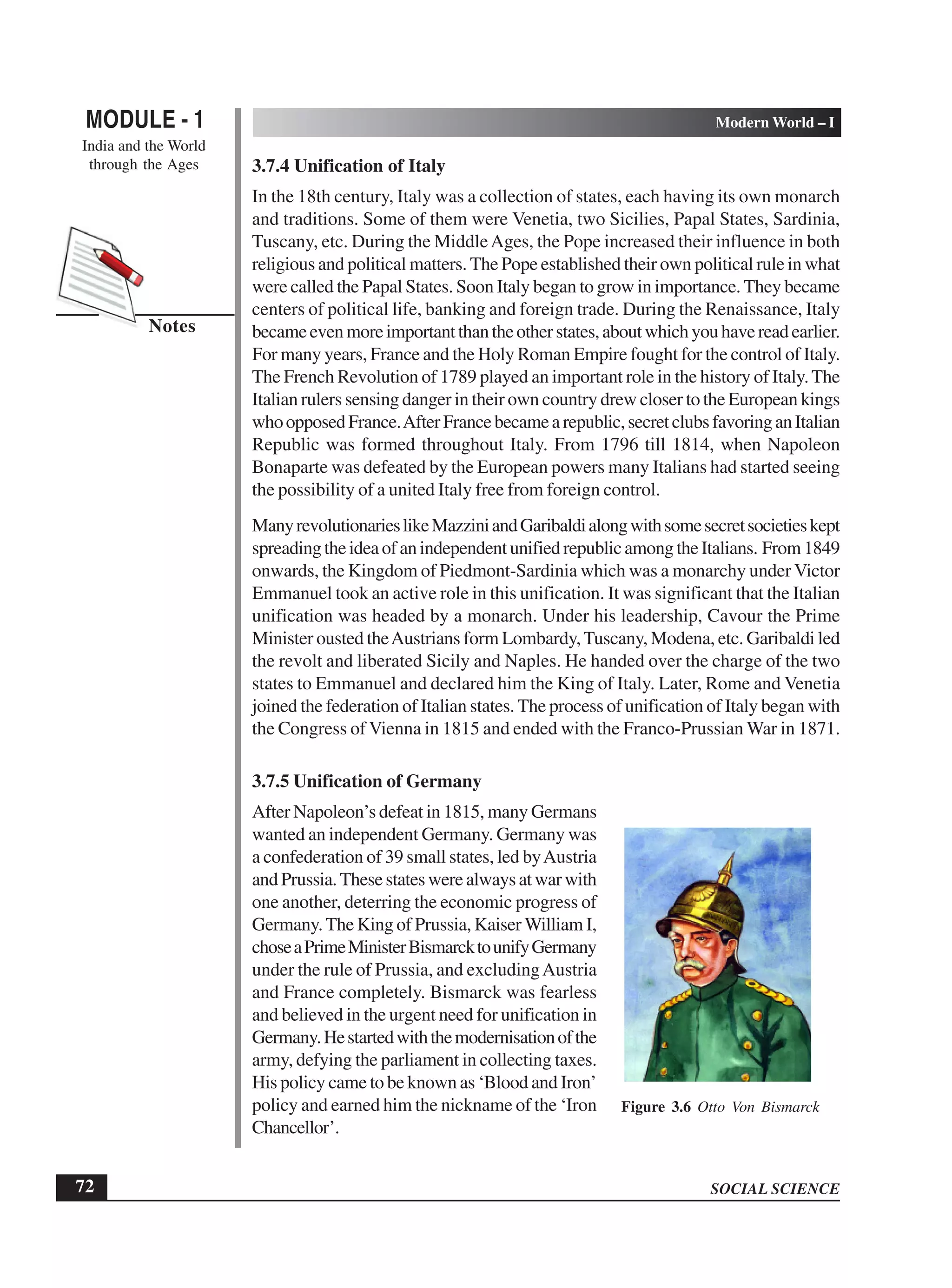
3.7.5 Unification of Germany
After Napoleon’s defeat in 1815, many Germans
wanted an independent Germany. Germany was
a confederation of 39 small states, led byAustria
andPrussia.Thesestateswerealwaysatwarwith
one another, deterring the economic progress of
Germany.The King of Prussia, Kaiser William I,
choseaPrimeMinisterBismarcktounifyGermany
under the rule of Prussia, and excludingAustria
and France completely. Bismarck was fearless
and believed in the urgent need for unification in
Germany.Hestartedwiththemodernisationofthe
army, defying the parliament in collecting taxes.
His policy came to be known as ‘Blood and Iron’
policy and earned him the nickname of the ‘Iron
Chancellor’.
Figure 3.6 Otto Von Bismarck
MODULE - 1
India and the World
through the Ages
73
Modern World – I
SOCIAL SCIENCE
Notes
Withthisimprovedarmy,BismarckencouragedtheGermanpopulationofSchleswig
and Holstein to revolt against their ruler Denmark. In 1864, Bismarck joined hands
withAustria against Denmark. Bismarck’s next target wasAustria. Prussia defeated
Austria and formed the North German Confederation. Bismarck promised the
province of Venice to Italy and kept her out of the war.Austria was forced to give
Venice to Italy, ending the Austrian control in Italy. He also promised territorial
compensation to Napoleon III of France and kept it out of the war. He had already
securedRussia’ssupportbyhelpingtheminsuppressingarevoltinRussiancontrolled
Poland.
TheonlyobstaclestoPrussiandominanceofGermanywerefoursmallGermanstates
in Southern Germany and the disapproval of Napoleon III of France. But a
disagreement between the two countries led France to declare a war on Prussia.
The Franco-Prussian War was quite short. Prussia invaded France in 1871 and
defeated the French. Napoleon III abdicated the throne and France was forced to
give upAlsace and Lorraine. The remainder of the German states, exceptAustria,
were annexed and joined with Germany.The unification of Germany was complete
under Kaiser William I. Soon Germany emerged as the leading power in Europe,
buildingacolonialempiretofurtherGermaneconomicinterestandincreaseGerman
influence in the world.
3.7.6 Socialist Movement and the Russian Revolution
The Industrial Revolution had led to an unequal society. On the one hand were the
workers who were poor, exploited and without any rights; and on the other were
the capitalists who enjoyed all the privileges.At that time, some people began to
thinkaboutthesocietythatshouldbebasedonequalityinsocialandeconomicterms.
Ideas like equality, freedom of speech and democracy gave encouragement in this
regard. The idea of socialism, which tries to establish equal society, began to take
root. The most powerful and influential ideas of socialism was given by Karl Marx
and Friedrich Engels. In the book Das Capital, Marx pointed out that history of
all societies is the history of class struggle.According to him the capitalists always
try to increase their profits by reducing the wages of the workers which leads to
class conflict. He predicted that the struggle will be successful with the end of
capitalismandthecomingofsocialism.Thiswillresultinthecontroloftheownership
of the means of production in the hands of the state and the birth of an equal society.
The first practical example of this was the Russian revolution which resulted in the
establishment of the first socialist government of the world. Russia was industrially
backward and was based on an agrarian economy. Tsar was an autocratic and
oppressive ruler; hence the workers and the peasants suffered a lot. The Revolution
of 1905 led to the formation of a constitutional monarchy with the formation of the
Duma; the members of whom were representatives of peasants, townsmen and
SOCIAL SCIENCE
MODULE - 1 Modern World – I
India and the World
through the Ages
74
Notes
gentry.Evenafterthe1905ofRevolution,thecivilrightsanddemocraticrepresentation
was limited and hence the unrest continued.
In 1917, occurred another revolution in Russia. It happened because the condition
of the Russian workers and peasants, and non Russians living in Russia had become
quite miserable under the autocratic rule ofTsar Nicholas II. Exploitation along with
inhuman working conditions and huge amount of taxes had made the people rise
against him. People were also denied any political rights. Russia had also entered
World War I for imperialist gains. But she was unequipped to do so. Thousands of
Russian soldiers were killed inWorldWar I as they were ill equipped with no proper
warm uniforms and arms to fight in the cold desert of Siberia. Many skilled workers
were forced to enlist in the army and fight in the battlefields resulting in their deaths.
The nobility were also dissatisfied withTsar Nicholas II due to his autocratic ways.
Faminesfurtherworsenedthesituationinthecountry.Thisresultedinlaborriotsand
strikes. Striking crowds attacked courts, prisons and office premises. There was
widespread unrest among all sections of society. The army lacked ammunition, the
cities lacked food while the peasants failed to get proper return for their produce.
The government in the meantime had printed millions of Rouble notes leading to
inflation. The situation slipped out of Tsar’s hands.
Figure 3.7 Demonstrations by the People on 18 June 1917 at Petrograd. The banner
says, “Down with the 10 Capitalist Ministers; All Power to the Soviets of Workers’,
Soldiers’, and Peasants’ Deputies; and to the Socialist Ministers, we demand that
Nicholas II be transferred to the Peter-Paul Fortress.”
This situation was further worsened by the writings of Marx and Tolstoy which
influenced the people, especially the workers, and led to their political awakening.
This led to the formation of the Council of Workers called the Soviets. In February
1917, Tsar was deposed and a Provisional Government was established under the
MODULE - 1
India and the World
through the Ages
75
Modern World – I
SOCIAL SCIENCE
Notes
control of the Menshevik Party. But the Government failed to fulfill the demands of
thepeople.AnotherPartycalledtheBolshevikheadedbyLeninorganisedtheSoviets
and replaced the Government in October 1917. This October Revolution was the
final stage of the Russian Revolution. It brought to an end the rule of the Tsar and
led to the formation of the USSR and a new world order.
In the next lesson you will read more about Industrialisation, Imperialism and the
WorldWars.You will be able to understand how the Industrial Revolution changed
the face of the world and brought about tremendous changes in the life of the people.
You will also read the impact it had on the non-industrialised countries of the world
and how it led to conflicts which are till today considered to be some of the most
horrible wars faced by the world.
INTEXT QUESTIONS 3.3
1. Choose the correct answer:
(a) In how many colonies wasAmerica divided?
(i) 13 (ii) 14 (iii) 15 (iv) 16
(b) The Third Estate in France comprised of the:
(i) Nobility (ii) Clergy (iii) Commoners (iv) Monarchy
(c) GermanUnification was successfully carried out under the leadership of:
(i) Cavour (ii) Mazzini (iii) Bismarck (iv) Garibaldi
2. ‘The Glorious Revolution of 1688 was a source of inspiration for the world’.
Justify this statement within 30 words.
3. Enlist at least two similarities between theAmerican War of Independence and
the French Revolution.
4. TheRussianRevolutionwasinspiredbytheideologyofsocialism.Explainbriefly.
WHAT YOU HAVE LEARNT
The feudal order of Medieval Europe broke down as a result of several factors
such as the emergence of towns and cities, the revival of trade, the growth of
commercial agriculture and the aspirations of the rising merchant class.
The Renaissance or Rebirth that took place in Europe around the middle of the
14th century began with a renewed interest in the cultural achievements of
Classical Greece and Roman Civilisations. It resulted in a profound change in
the thought pattern of the people.
SOCIAL SCIENCE
MODULE - 1 Modern World – I
India and the World
through the Ages
76
Notes
The idea of humanism stressed on the creative potential of human beings and
the human being became the subject of study of the humanists.
The Reformation was an attempt to question the abuses that had crept into the
practices of the Church. It was started in Germany by Martin Luther. It soon
led to the division of the ChristianWorld into the Catholics and the Protestants.
One of the important achievements of the Renaissance was the development of
rationality and scientific attitude and the growth of modern science. Copernicus,
Keplar, Galileo and Newton are remembered for their contributions in this area.
The Renaissance spirit of inquiry led to the voyages of exploration and the
discoveryofnewlands.Thesevoyageshadfarreachingconsequencesforalarge
part of the world.
TheIndustrialRevolutionbeganinEnglandfromaround1750A.D.Thecoming
of the Industrial Revolution increased the rate of industrial production several
timesover.Itcreatedaclassofindustrialworkers/proletariatwhoweremiserably
exploited by the capitalists/bourgeoisie.
TheAmerican Revolution that took place in 1776 inspired the whole world with
its ideas of equality and freedom and the rights of people.
The French Revolution was inspired by the ideas of philosophers such as
Montesquieu, Voltaire and Rousseau. It had a deep influence on the modern
world with its ideas of freedom, equality and fraternity.
The rise of the feeling of nationalism led to the movements for unification of
countries like Germany and Italy.
The problems and concerns of the new industrial working class led to the rise
of the ideas of socialism. The Russian Revolution was an outcome of the growth
of such consciousness and it led to the establishment of the first socialist
government in the world.
TERMINAL EXERCISES
1. Howdidtheriseoftownsandemergenceoftradeledtothedeclineoffeudalism?
2. Why do you think Renaissance marks a break from earlier patterns of thought
and existence? Write in about 100 words.
3. How did the Reformation impact Europe and the rest of the world?
4. How did the discovery of new lands change the economy and society in the
modern world?
5. Enlist the main ideas given in the Declaration ofAmerican Independence.
MODULE - 1
India and the World
through the Ages
77
Modern World – I
SOCIAL SCIENCE
Notes
6. Which ideas of the French Revolution had an impact on the world order?
7. DiscussthestrategiesusedbytheGermanandItalianleadersfortheirunification.
8. Describe the conditions of the industrial workers which influenced the Russian
Revolution.
ANSWERS TO INTEXT QUESTIONS
3.1
1. (a) Renaissance scholars
(b) Society of Jesus
2. Feudalismisdefinedasasysteminwhichpeopleweregivenlandandprotection
by lords in return for their labor. Its two features were:
(a) The workers worked and fought for their lords.
(b) The king was the most powerful feudal chief.
3. The spirit of humanism, rationalism and inquiry.
4. (a) Martin Luther advocated for salvation through faith on Jesus Christ and not
through the blind faith on the church.
(b) The Bible was the only source of religious authority.
3.2
1. (a) (ii)
(b) (iii)
2. (a) The emphasis on reason than on blind faith.
(b) Scientific inquiry based on observation and experimentation.
3. Compass, astrolabe and the art of map making.
4. The society became unequal and was divided into two groups of people – the
capitalist or the bourgeoisie and the worker or the proletariat.
3.3
1. (a) (i)
(b) (iii)
(c) (iii)
SOCIAL SCIENCE
MODULE - 1 Modern World – I
India and the World
through the Ages
78
Notes
2. The Glorious Revolution proved to be a source of inspiration for the world
because the Parliament was able to replace the autocratic rule of James II with
a constitutional form of government without shedding any blood.
3. (a) BoththeRevolutionshelpedasserttherightsofthepeopleandspokeagainst
exploitation.
(b) Both popularised the feeling of nationalism all over the world.
4. The French and Renaissance ideas like equality, freedom of speech and
democracy, along with the writings of Marx helped in strengthening the idea of
socialism. It advocated the control of the ownership of the means of production
inthehandsofthestatewhichwouldgivebirthtoanequalsociety.Thisinfluenced
people and led to political awakening of the people, especially the workers
resultingintheRussianRevolution.

Modern world – i

  • 1.
    MODULE - 1 Indiaand the World through the Ages 61 Modern World – I SOCIAL SCIENCE Notes 3 MODERN WORLD – I From the 14th century onwards, Europe witnessed many profound changes in its cultural and intellectual life that helped to usher in the modern period. This was the Renaissance, the awakening, that encouraged thinking and reasoning in social and political fields and affected every aspect of life.Aperiod of rationality and scientific enquiry had already begun in theArab world, but the changes that took place during renaissance in Europe affected the whole world. These changes began with the disintegration of the feudal system, about which you have read, in detail, in the previous lesson. In this lesson, we will discuss some of these changes and developments which transformed medieval society into the modern world.We will also trace the events that took place in the modern world till the 20th century. OBJECTIVES After reading this lesson, you will be able to: Discuss the impact of decline of the feudalism; explain the meaning and features of Renaissance; explain the causes of Reformation and its impact; describe the development of science; mention the main scientific discoveries of the age and some of the main voyages of discoveries; explain significance of the Industrial Revolution for Europe and the rest of the world; explain the causes and effects of the American Revolution and the French Revolution; discuss the struggle for National Unification in Germany and Italy; and examine the growth of socialist ideas and Russian Revolution.
  • 2.
    SOCIAL SCIENCE MODULE -1 Modern World – I India and the World through the Ages 62 Notes 3.1 IMPACT OF DECLINE OF FEUDALISM DuringtheMedievalAge,oneofthemostimportantinstitutionswasFeudalism.You havereadaboutitindetailinthepreviouslesson.Feudalismasaninstitutionflourished inEuropeformanycenturies.Butwiththeriseofthemiddleclass,itstartedtodecline. Rise of powerful kingdoms as well as warfare between the feudal lords further led to its decline. Emergence of new towns and cities and a revival of trade also led to the disintegration of the feudal system. These towns were centers of production and were governed by elected representatives. The atmosphere of the towns was free from feudal restriction and control as people were free to go anywhere and to take up any profession. Towns attracted artisans and peasants from rural areas because they provided better prospects of living and acting as a refuge from feudal exploitation. These towns and cities encouraged the production of many crops such as cotton and sugarcane. Peasants were paid in cash for their product. The manufactured goods were sold in the markets where money was the medium of exchange. The lords began to accept money from their vassals instead of services as they also needed money to buy various luxurious commodities. This led to the rise of a powerful merchant class. They now began to aspire for a higher status in the social hierarchy.They began to support the powerful monarchs to undermine the positionofthefeudallordswhichweakenedthefeudalstructureandledtothedecline of the feudal order. The infusion of new ideas created a new awakening. This gave birth to a new movement called the Renaissance about which we are going to read now. 3.2 RENAISSANCE The modern period ushered the end of the Age of Faith and the beginning of the Age of Reason. It witnessed movements like the Renaissanceand the Reformation. Thesemovementsbroughtmanychangesincultural,intellectual,religious,socialand political life of the people all over the world. This period is also characterised by urbanisation,fastermeansoftransportandcommunication,democraticsystemsand uniform laws based on equality. TheliteralmeaningofRenaissanceis‘rebirth’.ItstartedinItalyaround14th Century AD. Italy was divided into small city states at that time. Many of them were built on the ruins of ancient Roman buildings. The geographical position of Italian cities made them great trading and intellectual centers. Moreover, the position of Italian cities such as Venice made them centers of trade and intellectual crossroads. Many great ideas, along with wealth, were brought by merchants from far corners of the globe. The new form of political and social organization gave political freedom and a suitable atmosphere for academic, artistic and cultural advancement. People had more leisure time for study and other activities.
  • 3.
    MODULE - 1 Indiaand the World through the Ages 63 Modern World – I SOCIAL SCIENCE Notes Thiswasalsoaperiodofgreateconomicexpansion.Manycommercialandfinancial techniques were developed for trade practices like book keeping, bills of exchange and public debt. This enabled Italy to become the centre of Renaissance. The major developments of this time were the revival of urban life, commerce based on private capital, banking, formation of nation states, explorations to find new routes and territoriesandthedevelopmentofvernacularliteraturewhichwaspopularizedbythe printingpress.Thisnewmercantilesocietywaslesshierarchicalandmoreconcerned with secular objectives. It was in sharp contrast to the earlier rural, tradition bound society. The adventures and explorers played a significant role in opening a world economic system. Many new commodities were brought fromAmerica,Asia and Africaafterthediscoveryoftraderoutes.ThesegoodsenrichedthelifeofEuropeans andinspiredthemtodevelopnewwaysofproducingtheminlargenumberstomake profit. The result was that merchants, entrepreneurs and bankers joined hands and ‘Capital’cametoenjoyanimportantpositioninthepoliticallifeaswellasinrelations with other countries. The new ideas that were generated in this period like humanism, rationalism and the spiritofinquirybroughtaprofoundchangeinthethinkingpatternofthepeople.There wasarenewedinterestintheculturalachievementsoftheClassicalGreekandRoman Civilisations. Human beings became the central concern of the new scholars. They believed in the creative potential of the human beings and their right to seek joy and pleasures in this world itself. This was contrary to the belief of the Medieval Church whichopposedworldlypleasures.Thisrespectforhumanbeingsencouragedinterest in art, history, language, literature, ethics, etc. Do you know that it was at this time that the disciplines grouped under ‘humanities’ were born? The spirit of Humanism also found expression in the field of art and literature. The greatestachievementsofRenaissanceartistswere in the field of paintings. Painters studied the anatomy and proportions of the human body. They wanted the human beings to be painted in realistic form and proportion. Some of the outstanding artists were Leonardo da Vinci, Michelangelo,Raphael,BotticelliandTitian.Even inthefieldofsculpture,artistsbegantomakefree standing statues. These sculptures now stood apart from the building or background and were separate works of art. The first great Renaissance sculptor was Donatello who made the statue ‘David’. The Renaissance spirit also marks the rise of Nationalism in Europe. People now began to free themselves of medieval religious restrictions and Figure 3.1 Leonardo da Vinci’s Monalisa
  • 4.
    SOCIAL SCIENCE MODULE -1 Modern World – I India and the World through the Ages 64 Notes bonds. National identities grew stronger and this was reflected in the development of modern European languages such as Italian, Spanish, French, German, English etc. as the languages of literature. Now the writers used local languages in poetry, drama, prose, etc., instead of Latin. The works of Renaissance authors became accessible to a large number of people due to the use of vernacular languages and the introduction of printing press. The Bible was printed and read by a large number of people. Several works that were produced in Modern European languages were Dante’s Divine Comedy, Erasmus, In Praise of Folly; Machiavelli’s The Prince and Cervantes’ Don Quixote. Two major developments took place in the history of Europe towards the later part of the Renaissance. The first was the Protestant Reformation which resulted in the split in Christianity.The second development concerned reforms within the Roman CatholicChurch,generallyreferredtoasCatholicReformationorCounterReformation. Reformation was a part of the socio-religious and political movement which led to the emergence of the modern world. ACTIVITY 3.1 Rationalism,Humanism,Inquiry,Observation,ExperimentationandReasoningwere some of ideas that come up during the Renaissance period. Find their meanings and relate their relevance in our lives today. 3.3 REFORMATION The Medieval Catholic Church came to be associated with superstitions, corruption and greed for money. Superstitious peasants were convinced by the Church that it possessed the true Cross. People were used to paying fees for seeing a piece of wood as the true Cross because it was believed that sacred relics had healing power. The Church laid more emphasis on blind faith than reason as it was the means to extractmoneyfromthedevotees.AllthischangedwiththecomingoftheRenaissance. In the new spirit of the Renaissance nothing could be accepted. Do you know that it was in 1517AD that a German priest called Martin Luther first challenged the authority of the Roman Catholic Church?According to him, the Bible was the only sourceofreligiousauthority.Hebelievedthatsalvationcouldbeattainedthroughfaith inJesusChristinsteadofhavingblindfaithontheChurch.Heprotestedagainstsome practices of the Church such as the selling of positions in the church, the issuing of the letters of indulgence for works of charity or going on crusades, to the highest bidder. Luther had the protection of the German Princes, primarily because of his desire to seize church property. But on 3 January 1521, he was excommunicated by Pope Leo X after he refused to stop writing against the Church.
  • 5.
    MODULE - 1 Indiaand the World through the Ages 65 Modern World – I SOCIAL SCIENCE Notes Luther’s views started the Protestant Reformation in the West and it divided the Christian world into two, the Protestants and the Roman Catholics. According to him, Christians must win salvation by following Christ and not by buying letter of indulgence. ThoughtheReformMovementinEnglandwas influenced by Lutheran ideas, the English ReformationoccurredasadirectresultofKing Henry VIII’s efforts to divorce his first wife, Catherine ofAragon. Thomas Cromwell, the King’sChiefMinister,helpedtheParliamentto pass the Act in Restraint of Appeals and the Act of Supremacy. It gave a royal headship to the King over the church. The king was allowed to marryAnne Boleyn, a commoner. The Reformation proved to be a great upheaval for religious revival. A Reform MovementalsotookplacewithintheCatholicChurch.Thisisknownasthe‘Counter Reformation’. It aimed to reduce corruption as well as to improve and strengthen Catholic Church. It began in Spain where Ignatious Loyal founded the ‘Society of Jesus’which stressed upon service of God, charity, chastity and missionary work. ThemovementstartedbyMartinLutherspreadtoothercountriesofEuropethrough the efforts of King Henry VIII of England, Huldreich Zwingli and John Calvin. INTEXT QUESTIONS 3.1 1. Fill in the blanks: (a) .....................expresseditsbeliefinthecreativepotentialofhumanbeings. (b) Ignatius Loyal founded the ..................... 2. Define feudalism. Give at least two features of feudalism. 3. What were the main ideas of Renaissance? 4. Enlist at least two teachings of Martin Luther which influenced reforms in the Church. 3.4 DEVELOPMENT OF SCIENCE During the Renaissance, extraordinary accomplishments were made in the field of science. We have already read that the Renaissance thinkers emphasized more on Figure 3.2 Martin Luther
  • 6.
    SOCIAL SCIENCE MODULE -1 Modern World – I India and the World through the Ages 66 Notes reasonthanonblindfaithandstressedthatknowledgecouldbegainedbyobservation andexperimentation.Theyrejectedblindfaithintraditionandestablishedbeliefs.This resultedinascientificinquirythathadalmostdisappeared.Renaissancealsobrought about a scientific revolution. Artists like Leonardo da Vinci made observational drawings of anatomy and nature which were a unique blend of science and art. The periodalsosawremarkableachievementsinmedicineandhumananatomy.Michael Servetus, a Spanish doctor, discovered the circulation of blood.William Harvey, an Englishman explained the function of the heart in purifying blood and its circulation through veins. The beginnings that were made by the Renaissance scientists paved the way for observation and experimentation in other fields of knowledge. One of the most remarkable achievements of the Renaissance in science was in the field of astronomy. Have you heard of Copernicus, Kepler and Galileo? They were great astronomers who formulated and tried to prove that the Earth revolves around the Sun. Before the Renaissance, it was believed that the Sun revolved around the Earth and whoever questioned this was denounced as a heretic. Copernicus in his book On the Revolution of the Heavenly Sphere argued that the earth and the planets move around the sun in concentric circles. Even though the theory was imperfect, it aroused thinking and reasoning. Kepler further developed this theory andsaidthattheotherplanetsmoveinellipticalpathsaroundthesun.Healsoargued that magnetic attractions between the Sun and the planets kept the heavenly bodies in an orbital motion. Further on this assumption, Isaac Newton developed his Law of Universal Gravitation.With his self manufactured telescope, Galileo discovered the moons of Jupiter, the rings of Saturn and spots in the Sun. He also confirmed the findings of Copernicus. Renaissance also developed a curiosity in the minds of Europeans about other lands and other peoples. Let us find out how this happened. 3.5 DISCOVERY OF NEW LANDS The spirit of inquiry encouraged many adventurers to discover new lands. The new trade routes that were discovered changed the history of the world. It is said that ‘God,GloryandGold’wasthemainmotivebehindthesediscoveries.Butthemotive of gold or economic need was the most important. Before the geographical discoveries, Europeans obtained articles like spices, cotton, precious gems, silk, etc. from the Eastern part of the world. They travelled through theArabic and Islamic territoriesforthesupplyofthesearticles.Thiswasnotveryconvenientandalsoposed uncertainties. So a direct sea route to South East Asia was discovered as it had a potential of a lucrative trade. The explorers also had another motive, which was to convert the people of the newly found areas to Christianity. It also became a means for them to serve God. In addition, the adventurers also hoped to acquire fame by discoveringnewlands.Somedidindeedbecomeveryfamous.Haveyouheardabout
  • 7.
    MODULE - 1 Indiaand the World through the Ages 67 Modern World – I SOCIAL SCIENCE Notes VascodaGamadiscoveringIndiaandColumbuswhosetoutforIndiabutdiscovered America? Do you know Ferdinand Magellan was the first explorer to lead an expedition around the world? Bartholomew Diaz was another famous explorer. Why do you think that these great adventures and voyages were sponsored by kings and wealthy people? The tremendous increase in trade and colonization had a great impact on the enhancement of European wealth. One of the most famous kings who sponsored the voyages was the Portuguese King Henry, who is also known as Henry the Navigator. The technological base for these discoveries came from the invention of the compass, astrolabe, astronomicaltablesandtheartofmapmaking. These voyages led to the establishment of tradingoutpostandcolonialempiresindifferentpartsAfrica,AmericaandAsia.Now commercial focus shifted from Mediterranean Sea to theAtlantic Ocean. Many new commodities were added to trade such as tobacco, molasses, ostrich feathers, potato, etc. It also started the inhuman slave trade inAmerica. Slaves were captured fromAfrica, transported across theAtlantic Ocean and sold to work in plantations in NorthAmerica. These trade practices and new sea routes helped the European merchants to accumulate huge wealth which they invested in the development of new machines. ThisledtothecomingoftheIndustrialRevolutionwhichmadethemmorepowerful and wealthy. ACTIVITY 3.2 On a world map trace the sea routes taken by Vasco da Gama, Ferdinand Magellan and Christopher Columbus to reach new destinations. 3.6 INDUSTRIAL REVOLUTION The Industrial Revolution began in England from about 1750AD.This was possible becauseEnglishmerchantshadaccumulatedhugewealththroughoverseastradeand hercoloniessecuredthesupplyofrawmaterials.Thecoloniesalsoactedaspotential markets for finished goods. Moreover, England had huge amount of essential resourcessuchascoalandironwhichwerenecessaryforrunningtheindustries.Thus, the capitalists invested in the development of new machines to speed up the Figure 3.3 Vasco da Gama
  • 8.
    SOCIAL SCIENCE MODULE -1 Modern World – I India and the World through the Ages 68 Notes production with the aim of earning more profits. Now machines began to take over some of the work of humans and animals for production. Though there was new developmentandthecominginofnewmachineriestoimproveproduction,thesociety became unequal. It created a division in society with the coming of two groups of people – the capitalist or the bourgeoisie and the worker or the proletariat – as they werelatercalled.YouwillreadmoreabouttheIndustrialRevolutioninthenextlesson. INTEXT QUESTIONS 3.2 1. Choose the correct answer: (a) Who discovered the sea route to India? (i) BartholomewDiaz (ii) Vasco da Gama (iii) Columbus (iv) None of these (b) Which of the following was not a result of the voyages of discovery? (i) Setting up of colonies inAsia andAfrica (ii) Expansion of European commerce (iii) Rise in the prosperity of the colonies (iv) Beginning of slave trade 2. Name at least two contributions of the Renaissance in the field of Science. 3. Enlist at least three discoveries which helped the Europeans to find new sea routes. 4. Identify the significant change in the society due to the Industrial Revolution. 3.7 AGE OF REVOLUTIONS The European Revolution of 1848 brought a series of political upheavals with their opposition to the traditional authority.There was a very strong dissatisfaction with political leadership and people started demanding more participation in the affairs of the states. Political awareness, ideas like liberty, equality and fraternity were popularised by the printing press. The revolutions which were most important occurred inAmerica, France, Germany, Italy and Russia. Britain had already faced amajorchangewiththeGloriousRevolution.TheUnitedStatesofAmericawasborn after the American War of Independence and Russia experienced a workers’ movementwhichledtotheestablishmentofasocialistgovernment.Theseupheavals wereaccompaniedbyafeelingofnationalismamongstthepopulationofmanystates which had been encouraged by enlightened ideas. Now we are going to read about theserevolutions.
  • 9.
    MODULE - 1 Indiaand the World through the Ages 69 Modern World – I SOCIAL SCIENCE Notes 3.7.1 The Glorious Revolution The Glorious Revolution of 1688 occurred in England much before the Age of Revolutions and proved a source of inspiration for the world. It was called the Glorious Revolution because no blood was shed to achieve its success. The Stuart king James II lost the popular support of his countrymen. This was due to his harsh attitude towards the people. The creation of an expensive standing army and increasingemploymentofRomanCatholicsinthegovernment,armyanduniversities had angered the people. The Parliament removed King James II from the throne in favor of his daughter Mary II and her husband William III, Prince of Orange. The autocratic rule of James II was replaced with a constitutional form of government. It showed that the Parliament had the power to change the monarch. 3.7.2 American War of Independence It will be interesting for you to know that some of the political rights that we enjoy today are the direct outcome of two very important revolutions that occurred in the later part of the 18th century.They played a crucial role in the shaping of the modern world. These were theAmerican Revolution and the French Revolution. Through these revolutions, people asserted their rights and ended exploitation. Aroundthe16th century,manyEuropeanshadsettledinAmericabecauseofreligious persecutioninEngland.Someofthemwerealsoattractedbyeconomicopportunities. They had formed 13 colonies which had local assemblies to settle their problems. These colonies were suffering due to the British economic policy of mercantilism through which they tried to regulate colonial commerce in the British interest. The colonieswerenotpermittedtosetupindustriesasitwouldresultincompetitionwith the British industries like iron and textile. They had to export sugar, tobacco and cotton only to England, at prices determined by the mother country England. This provoked opposition from the BritishAmerican colonies. By the 18th century, the wars with France and in India were proving very expensive for Britain. She needed money to fight these wars, and this was done by collecting taxes from theAmerican colonies. In 1765, the British Parliament passed the Stamp Actonallbusinesstransactionslikeofficialdocuments,deeds,mortgages,newspapers and pamphlets. The revenue was used to pay the cost of maintaining 10,000 British troops inAmerica.TheAct was opposed by the colonists. Riots broke out in colonial port cities. The colonial assemblies passed resolutions against the StampAct. The British Parliament had to repeal the StampAct in 1766. However, the Parliament continued the tax on tea. On 16th December, 1773 someAmericans disguised as Native Indians descended upon the three ships of the East India Company and dumped the tea into the sea. This incident is known as the Boston Tea Party. The Parliament closed the Port of Boston but the trigger was set for theAmerican War of Independence.
  • 10.
    SOCIAL SCIENCE MODULE -1 Modern World – I India and the World through the Ages 70 Notes The representatives of the 13 colonies called the meeting of the first Continental Congress at Philadelphia in 1774 and appealed to the King of England not to impose taxeswithouttheirconsent.TheKingregardedthisasanactofrebellionanddeclared war. This led to fights and finally to the ‘Declaration of Independence’on 4 July, 1776ataCongressatPhiladelphiawhichproclaimedtheirindependencefromGreat Britain and the formation of a cooperative union. It inspired the whole world with itsemphasisonequality,righttolife,libertyandpursuitofhappiness.TheBillofRights granted many freedoms such as freedom of speech, press, religion and justice under law.TheAmericanRevolutionwasastrugglebywhichthethirteenAmericancolonies won independence from Britain and gave birth to the nation that is now called the United States ofAmerica (USA). ACTIVITY 3.3 Imagine you are a newspaper reporter who was a witness to the Boston Tea Party. You interviewed the English East India Company officials, the Americans who participated and passersby who had seen the act. Write a newspaper article on it bringing out their versions of the story.Also, give your opinion of what must have taken place. 3.7.3 French Revolution In the 18th century, French society was still feudal in character with the monarch exercising complete authority. It was divided into three classes or estates. The First EstateofClergyorChurchandtheSecondEstateofNobilityenjoyedalltheluxuries andmanyprivilegesoverreligionandthegovernanceofthecountry.TheThirdEstate oftheCommonerssuchaspeasantry,cityworkersandthemiddleclasswereheavily burdened with taxes. The internal condition of France made it an ideal stage for a revolution to take place. Louis XVI and his wife Marie Antoinette’s luxurious lifestyles had emptied the treasury and made the country bankrupt. Louis XVI was forced to call a meeting of representatives of the three estates- the clergy, the nobility and the commoners in 1789. He wanted to gain approval for new tax law. The third estate demanded equalityintaxationandabolitionofspecialprivilegesenjoyedbythefirsttwoestates. It declared itself a NationalAssembly and took over the sovereign power from the Emperor. The historic French document, ‘Declaration of the Rights of Man and Citizen’ was adopted. It was later embodied as the preamble in the French Constitution of 1791. This was influenced by the U.S. Declaration of Independence, assertingtheequalityofallmen,thesovereigntyofthepeopleandtherightstoliberty, property, security, right to education, to free speech, to be informed, right of the poor topublicassistance,abanontortureandslavery,recognitionoftherightofthepeople
  • 11.
    MODULE - 1 Indiaand the World through the Ages 71 Modern World – I SOCIAL SCIENCE Notes tochoosetheirgovernmentandtheeligibilityofallcitizensforemploymentinpublic offices. The French Revolutionary Wars and the Napoleonic Wars starting from 1789 and lastingforabout15yearsresultedintheformationoftheFrenchRepublic.TheFrench Revolution tore down the medieval structures of Europe and brought in new ideas ofliberalismandnationalism.Francewitnessedacompletechangeinthegovernment, administration, military, society and culture. France became a republic under NapoleonBonaparte.TheguidingprinciplesoftheFrenchRevolutionwereLiberty, Fraternity and Equality. The revolutionaries were inspired by the ideas of many EnlightenmentthinkersandphilosopherssuchasVoltaire,MontesquieuandRousseau. The American War of Independence and the French Revolution popularizsd the feelingofnationalismallovertheworld.TheideaofnationalismfromAmerica,France andBritaininfluencedtheItalians.Theresultwasarevolutionforaunifiedkingdom of Italy in 1861. ACTIVITY 3.4 Given below are the flags of France andAmerica.What role do you think these flags played in the French Revolution and theAmerican War of Independence? Find out what the different colors signify. Do you think the Indian flag played a similar role in the Freedom Struggle? Count the number of stars in theAmerican map. What do you think it represents? Count the number of stars in the present day flag of America. Figure 3.4 Flag of France during the French Revolution Figure 3.5 Flag of the American War of Independence
  • 12.
    SOCIAL SCIENCE MODULE -1 Modern World – I India and the World through the Ages 72 Notes 3.7.4 Unification of Italy In the 18th century, Italy was a collection of states, each having its own monarch and traditions. Some of them were Venetia, two Sicilies, Papal States, Sardinia, Tuscany, etc. During the MiddleAges, the Pope increased their influence in both religious and political matters. The Pope established their own political rule in what were called the Papal States. Soon Italy began to grow in importance. They became centers of political life, banking and foreign trade. During the Renaissance, Italy becameevenmoreimportantthantheotherstates,aboutwhichyouhavereadearlier. For many years, France and the Holy Roman Empire fought for the control of Italy. The French Revolution of 1789 played an important role in the history of Italy.The Italian rulers sensing danger in their own country drew closer to the European kings whoopposedFrance.AfterFrancebecamearepublic,secretclubsfavoringanItalian Republic was formed throughout Italy. From 1796 till 1814, when Napoleon Bonaparte was defeated by the European powers many Italians had started seeing the possibility of a united Italy free from foreign control. ManyrevolutionarieslikeMazziniandGaribaldialongwithsomesecretsocietieskept spreadingtheideaofanindependentunifiedrepublicamongtheItalians. From1849 onwards, the Kingdom of Piedmont-Sardinia which was a monarchy under Victor Emmanuel took an active role in this unification. It was significant that the Italian unification was headed by a monarch. Under his leadership, Cavour the Prime Minister ousted theAustrians form Lombardy,Tuscany, Modena, etc. Garibaldi led the revolt and liberated Sicily and Naples. He handed over the charge of the two states to Emmanuel and declared him the King of Italy. Later, Rome and Venetia joined the federation of Italian states. The process of unification of Italy began with the Congress of Vienna in 1815 and ended with the Franco-Prussian War in 1871. 3.7.5 Unification of Germany After Napoleon’s defeat in 1815, many Germans wanted an independent Germany. Germany was a confederation of 39 small states, led byAustria andPrussia.Thesestateswerealwaysatwarwith one another, deterring the economic progress of Germany.The King of Prussia, Kaiser William I, choseaPrimeMinisterBismarcktounifyGermany under the rule of Prussia, and excludingAustria and France completely. Bismarck was fearless and believed in the urgent need for unification in Germany.Hestartedwiththemodernisationofthe army, defying the parliament in collecting taxes. His policy came to be known as ‘Blood and Iron’ policy and earned him the nickname of the ‘Iron Chancellor’. Figure 3.6 Otto Von Bismarck
  • 13.
    MODULE - 1 Indiaand the World through the Ages 73 Modern World – I SOCIAL SCIENCE Notes Withthisimprovedarmy,BismarckencouragedtheGermanpopulationofSchleswig and Holstein to revolt against their ruler Denmark. In 1864, Bismarck joined hands withAustria against Denmark. Bismarck’s next target wasAustria. Prussia defeated Austria and formed the North German Confederation. Bismarck promised the province of Venice to Italy and kept her out of the war.Austria was forced to give Venice to Italy, ending the Austrian control in Italy. He also promised territorial compensation to Napoleon III of France and kept it out of the war. He had already securedRussia’ssupportbyhelpingtheminsuppressingarevoltinRussiancontrolled Poland. TheonlyobstaclestoPrussiandominanceofGermanywerefoursmallGermanstates in Southern Germany and the disapproval of Napoleon III of France. But a disagreement between the two countries led France to declare a war on Prussia. The Franco-Prussian War was quite short. Prussia invaded France in 1871 and defeated the French. Napoleon III abdicated the throne and France was forced to give upAlsace and Lorraine. The remainder of the German states, exceptAustria, were annexed and joined with Germany.The unification of Germany was complete under Kaiser William I. Soon Germany emerged as the leading power in Europe, buildingacolonialempiretofurtherGermaneconomicinterestandincreaseGerman influence in the world. 3.7.6 Socialist Movement and the Russian Revolution The Industrial Revolution had led to an unequal society. On the one hand were the workers who were poor, exploited and without any rights; and on the other were the capitalists who enjoyed all the privileges.At that time, some people began to thinkaboutthesocietythatshouldbebasedonequalityinsocialandeconomicterms. Ideas like equality, freedom of speech and democracy gave encouragement in this regard. The idea of socialism, which tries to establish equal society, began to take root. The most powerful and influential ideas of socialism was given by Karl Marx and Friedrich Engels. In the book Das Capital, Marx pointed out that history of all societies is the history of class struggle.According to him the capitalists always try to increase their profits by reducing the wages of the workers which leads to class conflict. He predicted that the struggle will be successful with the end of capitalismandthecomingofsocialism.Thiswillresultinthecontroloftheownership of the means of production in the hands of the state and the birth of an equal society. The first practical example of this was the Russian revolution which resulted in the establishment of the first socialist government of the world. Russia was industrially backward and was based on an agrarian economy. Tsar was an autocratic and oppressive ruler; hence the workers and the peasants suffered a lot. The Revolution of 1905 led to the formation of a constitutional monarchy with the formation of the Duma; the members of whom were representatives of peasants, townsmen and
  • 14.
    SOCIAL SCIENCE MODULE -1 Modern World – I India and the World through the Ages 74 Notes gentry.Evenafterthe1905ofRevolution,thecivilrightsanddemocraticrepresentation was limited and hence the unrest continued. In 1917, occurred another revolution in Russia. It happened because the condition of the Russian workers and peasants, and non Russians living in Russia had become quite miserable under the autocratic rule ofTsar Nicholas II. Exploitation along with inhuman working conditions and huge amount of taxes had made the people rise against him. People were also denied any political rights. Russia had also entered World War I for imperialist gains. But she was unequipped to do so. Thousands of Russian soldiers were killed inWorldWar I as they were ill equipped with no proper warm uniforms and arms to fight in the cold desert of Siberia. Many skilled workers were forced to enlist in the army and fight in the battlefields resulting in their deaths. The nobility were also dissatisfied withTsar Nicholas II due to his autocratic ways. Faminesfurtherworsenedthesituationinthecountry.Thisresultedinlaborriotsand strikes. Striking crowds attacked courts, prisons and office premises. There was widespread unrest among all sections of society. The army lacked ammunition, the cities lacked food while the peasants failed to get proper return for their produce. The government in the meantime had printed millions of Rouble notes leading to inflation. The situation slipped out of Tsar’s hands. Figure 3.7 Demonstrations by the People on 18 June 1917 at Petrograd. The banner says, “Down with the 10 Capitalist Ministers; All Power to the Soviets of Workers’, Soldiers’, and Peasants’ Deputies; and to the Socialist Ministers, we demand that Nicholas II be transferred to the Peter-Paul Fortress.” This situation was further worsened by the writings of Marx and Tolstoy which influenced the people, especially the workers, and led to their political awakening. This led to the formation of the Council of Workers called the Soviets. In February 1917, Tsar was deposed and a Provisional Government was established under the
  • 15.
    MODULE - 1 Indiaand the World through the Ages 75 Modern World – I SOCIAL SCIENCE Notes control of the Menshevik Party. But the Government failed to fulfill the demands of thepeople.AnotherPartycalledtheBolshevikheadedbyLeninorganisedtheSoviets and replaced the Government in October 1917. This October Revolution was the final stage of the Russian Revolution. It brought to an end the rule of the Tsar and led to the formation of the USSR and a new world order. In the next lesson you will read more about Industrialisation, Imperialism and the WorldWars.You will be able to understand how the Industrial Revolution changed the face of the world and brought about tremendous changes in the life of the people. You will also read the impact it had on the non-industrialised countries of the world and how it led to conflicts which are till today considered to be some of the most horrible wars faced by the world. INTEXT QUESTIONS 3.3 1. Choose the correct answer: (a) In how many colonies wasAmerica divided? (i) 13 (ii) 14 (iii) 15 (iv) 16 (b) The Third Estate in France comprised of the: (i) Nobility (ii) Clergy (iii) Commoners (iv) Monarchy (c) GermanUnification was successfully carried out under the leadership of: (i) Cavour (ii) Mazzini (iii) Bismarck (iv) Garibaldi 2. ‘The Glorious Revolution of 1688 was a source of inspiration for the world’. Justify this statement within 30 words. 3. Enlist at least two similarities between theAmerican War of Independence and the French Revolution. 4. TheRussianRevolutionwasinspiredbytheideologyofsocialism.Explainbriefly. WHAT YOU HAVE LEARNT The feudal order of Medieval Europe broke down as a result of several factors such as the emergence of towns and cities, the revival of trade, the growth of commercial agriculture and the aspirations of the rising merchant class. The Renaissance or Rebirth that took place in Europe around the middle of the 14th century began with a renewed interest in the cultural achievements of Classical Greece and Roman Civilisations. It resulted in a profound change in the thought pattern of the people.
  • 16.
    SOCIAL SCIENCE MODULE -1 Modern World – I India and the World through the Ages 76 Notes The idea of humanism stressed on the creative potential of human beings and the human being became the subject of study of the humanists. The Reformation was an attempt to question the abuses that had crept into the practices of the Church. It was started in Germany by Martin Luther. It soon led to the division of the ChristianWorld into the Catholics and the Protestants. One of the important achievements of the Renaissance was the development of rationality and scientific attitude and the growth of modern science. Copernicus, Keplar, Galileo and Newton are remembered for their contributions in this area. The Renaissance spirit of inquiry led to the voyages of exploration and the discoveryofnewlands.Thesevoyageshadfarreachingconsequencesforalarge part of the world. TheIndustrialRevolutionbeganinEnglandfromaround1750A.D.Thecoming of the Industrial Revolution increased the rate of industrial production several timesover.Itcreatedaclassofindustrialworkers/proletariatwhoweremiserably exploited by the capitalists/bourgeoisie. TheAmerican Revolution that took place in 1776 inspired the whole world with its ideas of equality and freedom and the rights of people. The French Revolution was inspired by the ideas of philosophers such as Montesquieu, Voltaire and Rousseau. It had a deep influence on the modern world with its ideas of freedom, equality and fraternity. The rise of the feeling of nationalism led to the movements for unification of countries like Germany and Italy. The problems and concerns of the new industrial working class led to the rise of the ideas of socialism. The Russian Revolution was an outcome of the growth of such consciousness and it led to the establishment of the first socialist government in the world. TERMINAL EXERCISES 1. Howdidtheriseoftownsandemergenceoftradeledtothedeclineoffeudalism? 2. Why do you think Renaissance marks a break from earlier patterns of thought and existence? Write in about 100 words. 3. How did the Reformation impact Europe and the rest of the world? 4. How did the discovery of new lands change the economy and society in the modern world? 5. Enlist the main ideas given in the Declaration ofAmerican Independence.
  • 17.
    MODULE - 1 Indiaand the World through the Ages 77 Modern World – I SOCIAL SCIENCE Notes 6. Which ideas of the French Revolution had an impact on the world order? 7. DiscussthestrategiesusedbytheGermanandItalianleadersfortheirunification. 8. Describe the conditions of the industrial workers which influenced the Russian Revolution. ANSWERS TO INTEXT QUESTIONS 3.1 1. (a) Renaissance scholars (b) Society of Jesus 2. Feudalismisdefinedasasysteminwhichpeopleweregivenlandandprotection by lords in return for their labor. Its two features were: (a) The workers worked and fought for their lords. (b) The king was the most powerful feudal chief. 3. The spirit of humanism, rationalism and inquiry. 4. (a) Martin Luther advocated for salvation through faith on Jesus Christ and not through the blind faith on the church. (b) The Bible was the only source of religious authority. 3.2 1. (a) (ii) (b) (iii) 2. (a) The emphasis on reason than on blind faith. (b) Scientific inquiry based on observation and experimentation. 3. Compass, astrolabe and the art of map making. 4. The society became unequal and was divided into two groups of people – the capitalist or the bourgeoisie and the worker or the proletariat. 3.3 1. (a) (i) (b) (iii) (c) (iii)
  • 18.
    SOCIAL SCIENCE MODULE -1 Modern World – I India and the World through the Ages 78 Notes 2. The Glorious Revolution proved to be a source of inspiration for the world because the Parliament was able to replace the autocratic rule of James II with a constitutional form of government without shedding any blood. 3. (a) BoththeRevolutionshelpedasserttherightsofthepeopleandspokeagainst exploitation. (b) Both popularised the feeling of nationalism all over the world. 4. The French and Renaissance ideas like equality, freedom of speech and democracy, along with the writings of Marx helped in strengthening the idea of socialism. It advocated the control of the ownership of the means of production inthehandsofthestatewhichwouldgivebirthtoanequalsociety.Thisinfluenced people and led to political awakening of the people, especially the workers resultingintheRussianRevolution.