Modern Requirements Tools
Advantages & Applications
Dr. Andreas Birk, Software.Process.Management
June 3, 2014, Erlangen, ASQF Regionalgruppe „Requirements-Engineering“ Franken
Handout version including notes and
comments
Agenda
Why tool-based requirements management (RM)?
What is a RM tool?
Advantages of tool-based RM
 Do requirements “right”
 Improve RM practices & beyond
How to introduce & use RM tools?
Experience & case studies
June 3, 2014 Copyright © 2014, Software.Process.Management 2
Why Tool-Based Requirements
Management (RM)?
Shortcomings of traditional document-based RM
Document-based RM using word processors, Wikis, or spread sheet applications
as the only tool support usually becomes very inefficient and defect-prone
Especially for large, distributed, or long-running development endeavours,
document-based RM can become particularly cumbersome:
 Where is the latest document version? Is somebody else editing it?
 Is a requirements’ identifier still up to date?
 How can I express relationships between requirements?
 How can I find out which requirements in the document are stable?
Also for agile projects, suitable RM tool support can be essential
June 3, 2014 Copyright © 2014, Software.Process.Management 3
Why Tool-Based Requirements
Management (RM)?
Objectives of good RM tool support
Good RM tool support can, among others, bring the following benefits:
 Always have the latest requirements version at hand, even if a colleague
finished editing just one minute ago
 Don’t bother with requirements IDs; focus on requirements contents, instead
 Work with and decide on each individual requirement, while always being able
to generate a complete specification document in an instant
 Master requirements structures across different levels, tracing from
requirements to code and tests, and enabling efficient requirements reuse
 Monitor and manage projects based on requirements status and regarding
contribution to customer value
June 3, 2014 Copyright © 2014, Software.Process.Management 4
Why Tool-Based Requirements
Management (RM)?
„... a bicycle for our minds“
„What a computer is to me is it‘s the most remarkable tool that we‘ve ever come
up with, and it‘s the equivalent of a bicycle for our minds.“
Steve Jobs
What Steve Jobs has demanded from computers: Requirements Managers can
demand it from modern RM tools, too
June 3, 2014 Copyright © 2014, Software.Process.Management 5
What Is A RM Tool?
June 3, 2014 Copyright © 2014, Software.Process.Management 6
Requirements Management Tools Surveys
INCOSE – http://www.incose.org/productspubs/products/rmsurvey.aspx
Volere – http://volere.co.uk/tools.htm
Ian Alexander – http://www.scenarioplus.org.uk/vendors.htm
Making of Software – http://makingofsoftware.com/resources/list-of-rm-tools
 Currently the most comprehensive & most up to date list
 Actively researched & edited by the authors
Source & additional information: http://makingofsoftware.com/2014/lists-of-requirements-tools
June 3, 2014 Copyright © 2014, Software.Process.Management 7
http://makingofsoftware.com/resources/list-of-rm-tools
Example RM Tools
Blueprint Requirements Center, Blueprint Software Systems, Inc.
CaliberRM, Borland (Micro Focus)
codeBeamer Requirements Management, Intland Software GmbH
HP Quality Center, ALM, Hewlett-Packard
IBM Rational DOORS, IBM
IBM Rational Requirements Composer, IBM
Innovator for Business Analysts, MID GmbH
inteGREAT, eDev Technologies
Jama, Jama Software
Kovair ALM Studio, Kovair Software, Inc.
Polarion Requirements, Polarion Software
PTC Integrity, PTC Integrity
Serena Requirements Manager, Serena Software
TestTrack RM, Seapine Software, Inc.
Visure Requirements, Visure
June 3, 2014 Copyright © 2014, Software.Process.Management 8
These tools belong to the list of
selected RM tools at the website
MakingOfSoftware.com
The complete list contains links to
more than 100 RM tools
Features of Modern RM Tools
Design requirements structures
Manage requirements structures
Reuse & manage requirements across projects
Collaborate on requirements
Visualize & explore requirements information
Integrate requirements across the application lifecycle
June 3, 2014 Copyright © 2014, Software.Process.Management 9
Among the various features of
today’s RM tools, these might be the
most relevant ones, providing highest
value to requirement management
Examples of RM Tool
Functionality
June 3, 2014 Copyright © 2014, Software.Process.Management 10
The following slides show examples
of modern RM tool functionality using
selected tools
The presented tools are good
examples but usually by far not the
only ones providing such functionality
Design Requirements Structures
(Jama)
June 3, 2014 Copyright © 2014, Software.Process.Management 11
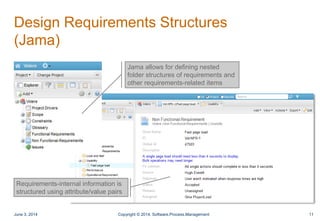
Jama allows for defining nested
folder structures of requirements and
other requirements-related items
Requirements-internal information is
structured using attribute/value pairs
Design Requirements
Structure (HP ALM)
HP ALM structural concepts
 Folders, Groups
 Requirements Types
a
June 3, 2014 Copyright © 2014, Software.Process.Management 12
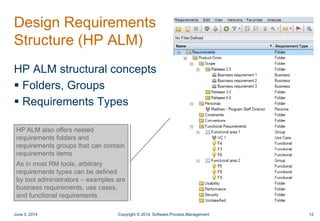
HP ALM also offers nested
requirements folders and
requirements groups that can contain
requirements items
As in most RM tools, arbitrary
requirements types can be defined
by tool administrators – examples are
business requirements, use cases,
and functional requirements
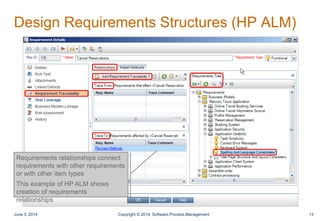
Design Requirements Structures (HP ALM)
June 3, 2014 Copyright © 2014, Software.Process.Management 13
Requirements relationships connect
requirements with other requirements
or with other item types
This example of HP ALM shows
creation of requirements
relationships
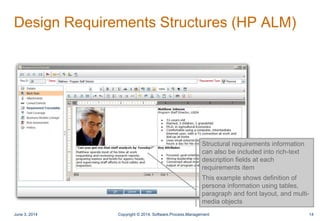
Design Requirements Structures (HP ALM)
June 3, 2014 Copyright © 2014, Software.Process.Management 14
Structural requirements information
can also be included into rich-text
description fields at each
requirements item
This example shows definition of
persona information using tables,
paragraph and font layout, and multi-
media objects
Reuse Requirements
(Jama)
June 3, 2014 Copyright © 2014, Software.Process.Management 15
Some tools, in this case Jama, offer
specific support for requirements
reuse, which includes well-controlled
copying of existing requirements
collections, and support for later two-
way synchronization of requirements
between source and destination
Manage Reused Requirements
(Jama)
June 3, 2014 Copyright © 2014, Software.Process.Management 16
This screenshot shows one of
Jama’s dialogs using which
requirements managers can analyze
and manage deviations between
reuse source and destination
Collaborate on Requirements
(Polarion ALM)
June 3, 2014 Copyright © 2014, Software.Process.Management 17
Modern RM tools also offer various
support for collaboration on
requirements
This example shows the Comments
menu entry of Polarion ALM
Collaborate on Requirements (Jama)
June 3, 2014 Copyright © 2014, Software.Process.Management 18
Jama offers discussion threads for
commenting and discussing
requirements
Contributions can be marked as
decision requests, decisions etc.
Visualize & Explore Requirements
Information (HP ALM)
June 3, 2014 Copyright © 2014, Software.Process.Management 19
RM tools visualize requirements
information using dashboards
Information can often be explored
further by clicking on interactive
graphs (drilldown functionality)
HP ALM offers conditional color
coding when data exceeds user-
defined threshold values
Visualize & Explore Requirements
Information (Jama)
June 3, 2014 Copyright © 2014, Software.Process.Management 20
Jama provides a list view that can be
enriched by color coding of picklist
values
Users can directly edit requirements
data within this view
Visualize & Explore Requirements
Information (HP ALM)
June 3, 2014 Copyright © 2014, Software.Process.Management 21
Visualization of trace relationships
supports impact analysis: If we
change a requirement, what other
requirements might be affected?
Integrate Requirements across the
Application Lifecycle (HP ALM)
June 3, 2014 Copyright © 2014, Software.Process.Management 22
Visualization also supports
development management across
the entire application lifecycle: What
is the test status of the
requirements?
Advantages of
Tool-Based RM
June 3, 2014 Copyright © 2014, Software.Process.Management 23
Do Requirements “Right”
Focus on individual requirements items
Establish clear requirements ownership
Determine requirements status & quality
June 3, 2014 Copyright © 2014, Software.Process.Management 24
These principles help ensuring
quality of requirements management
RM tools can significantly ease
implementation and practice of these
principles
Fit Criterion: Link RM with Testing
Fit Criterion: A measurement of the requirement such that it is possible
to test if the solution matches the original requirement
June 3, 2014 Copyright © 2014, Software.Process.Management 25
Fit criteria establish testable
requirements
They should be part of every
individual requirements definition
This example is from the Volere
method
S.RobertsonandJ.Robertson:Masteringtherequirements
process(2ndEd.),Addison-Wesley,2006.
Requirements Definition in HP Quality Center
June 3, 2014 Copyright © 2014, Software.Process.Management 26
Testability attributes document review
& acceptance of fit criteria
Here, the fit criteria is a section of a
requirements definition template
It could as well be a separate
requirements attribute
Improve RM Practices & Beyond
Make RM more effective & efficient
Increase involvement & interaction among RM actors & stakeholders
Integrate activities across the entire development lifecycle,
starting with RM
June 3, 2014 Copyright © 2014, Software.Process.Management 27
Modern RM tools can be an excellent
vehicle for improving RM practices
Case Studies
June 3, 2014 Copyright © 2014, Software.Process.Management 28
The following case studies illustrate
possible implementations and benefit
of RM tool support
Check out the original reports to
learn more about them
Intel Mobile Communications:
RM Tool Migration & Improvement
Migrate long-established tool-based RM practices to
new tool generation
Continuously improve & align RM practices
Further advance large-scale catalog-based reuse
Case study report from REConf 2014 can be requested via info@swpm.de
June 3, 2014 Copyright © 2014, Software.Process.Management 29
Requirements Practices at Intel Mobile
Communications since 2004
System Requirements
Marketing Requirements
Component Requirements
RE Team
& Network
Various other
user roles
working with
requirements
Key Characteristics
 Tool-based RM
 Central repository with several 10K
requirements and for several hundreds of
users
 Multi-stage requirements hierarchy from
marketing requirements via system to
component requirements
 Requirements traces from product
management to component development and
testing
June 3, 2014 Copyright © 2014, Software.Process.Management 30
Usage Context of RE-Tool
RE Tool
Requirements
Engineer
Marketing
& Product
Management
Project & Program
Management
approx. 5 user roles with
different RE activity
profiles
Product Planning
Artifacts
Company-
External
Stakeholder
Requirements-
Related
Documents
ArchitectSpecification
Documents
e.g., customers, telecommunication
operators, standardization bodies
Verification
Engineer
June 3, 2014 Copyright © 2014, Software.Process.Management 31
Overview of Evaluation Phase
Evaluation OperationMigration & Rollout
Analyze Obstacles
Scenario-Based Detailed
Evaluation
Propose Future Solution
(Process & Tool)
Load & Performance Testing
Align IT &
Prepare Migration in
Business Unit
Plan & Prepare Migration
Address & Involve
Stakeholders
BusinessIT
IT Project
Lead
RE Team
Lead
IT Operations
Team
RE Team
RE Experts
Process & Tool
Evaluation, Migration & Rollout:
Set-Up of Core Team
Success Factors
• Early and continuous involvement of key stakeholders
• Customization of tool to match work practices
• Assessment of usability with selected key users
• Systematic load & performance test
June 3, 2014 Copyright © 2014, Software.Process.Management 32
IT and business collaborated closely
to master the ambitious evaluation
and migration projects
Advantest:
Establish New Agile RM Practices
Introduce new tool platform for request management, task
management & requirements management (Jira & Jira Agile)
Introduce agile practices
Further integrate planning change for products & requirements
Case study report from Scrum Day 2013 can be requested via info@swpm.de
June 3, 2014 Copyright © 2014, Software.Process.Management 33
Requirements Structures & Workflow
Page 34
ProgramPlanningTeamPlanning
Funnel Backlog Priority Backlog Next PSI ✔
Limit: 1- 2 PSI
Just enough detail to plan for
the next milestone (PSI) and to
coordinate the different projects
Limit: Next Release
Just enough detail to make a
milestone plan and to align the
different projects
No Limit
Not clear if implemented at all
Pool of great ideas
Team Planning Board
Dispatching to Teams
Build in Scrum Teams
H
Done
✔
Next 1-2 SprintsNext 1-2 PSI
Sprint Board
Ready
for Acc.
Work in
Progress
Planned
Done
✔
June 3, 2014 Copyright © 2014, Software.Process.Management 34
RM tool effectively supports large-
scale development activities across
the entire product lifecycle
Establish Dependency Management
Integrate dependency management into the
value chain model
 Identify & manage dependencies across
projects
 Mark blocked & blocking items in the backlog
 Generate & visualize dependency trees
Quote of a product owner:
“Dependency management is still one of our most
challenging areas, but we could not make it without
our tool support.”
June 3, 2014 Copyright © 2014, Software.Process.Management 35
Dependency management could only
be implemented with RM tool support
Key Achievements & Contributors
Key Achievements … Due to ...
Transparency & focus across
the entire organisation
 Requirement abstraction model
 Core contributions
 PSI planning
 Cadence & synchronisation
Effective & easy coordination  User stories
 Acceptance tests
 Backlog grooming
 Using the Scaled Agile Framework
Successful planning & management of
dependencies
 Synchronization of sprints
 Program and Scrum team planning
 Early tool support
June 3, 2014 Copyright © 2014, Software.Process.Management 36
Most key achievements have only
been possible with RM tool support
It‘s All about People
Let the system grow
Using agile principles that conform with existing culture
Start at the pain points
Keep activities focused on impediments
Try out new ideas & learn
June 3, 2014 Copyright © 2014, Software.Process.Management 37
Although modern RM tools can be an
excellent support, primarily it is
people who count
RM tool support shall be designed so
that it helps people achieving their
best job results
When introducing RM tool support,
start with simple solutions that can
easily be used
Remove impediments fasts
If needed, extend the solutions Image Source: Microsoft Clip Art, j0427683.jpg
Summary
June 3, 2014 Copyright © 2014, Software.Process.Management 38
Success Factors of Tool-Based RM
Introduce & establish tool-based RM using concrete
usage scenarios
Select application areas on current needs & capabilities
Ensure to integrate process & tool well with each other
Build people-centred support infrastructure & commitment
Improve continuously & grow gradually
June 3, 2014 Copyright © 2014, Software.Process.Management 39
Contact
Dr. Andreas Birk
Software.Process.Management
info@swpm.de
http://www.swpm.de
Blog & Resources
http://MakingOfSoftware.com
June 3, 2014 Copyright © 2014, Software.Process.Management 40

Modern Requirements Tools: Advantages & Applications

  • 1.
    Modern Requirements Tools Advantages& Applications Dr. Andreas Birk, Software.Process.Management June 3, 2014, Erlangen, ASQF Regionalgruppe „Requirements-Engineering“ Franken Handout version including notes and comments
  • 2.
    Agenda Why tool-based requirementsmanagement (RM)? What is a RM tool? Advantages of tool-based RM  Do requirements “right”  Improve RM practices & beyond How to introduce & use RM tools? Experience & case studies June 3, 2014 Copyright © 2014, Software.Process.Management 2
  • 3.
    Why Tool-Based Requirements Management(RM)? Shortcomings of traditional document-based RM Document-based RM using word processors, Wikis, or spread sheet applications as the only tool support usually becomes very inefficient and defect-prone Especially for large, distributed, or long-running development endeavours, document-based RM can become particularly cumbersome:  Where is the latest document version? Is somebody else editing it?  Is a requirements’ identifier still up to date?  How can I express relationships between requirements?  How can I find out which requirements in the document are stable? Also for agile projects, suitable RM tool support can be essential June 3, 2014 Copyright © 2014, Software.Process.Management 3
  • 4.
    Why Tool-Based Requirements Management(RM)? Objectives of good RM tool support Good RM tool support can, among others, bring the following benefits:  Always have the latest requirements version at hand, even if a colleague finished editing just one minute ago  Don’t bother with requirements IDs; focus on requirements contents, instead  Work with and decide on each individual requirement, while always being able to generate a complete specification document in an instant  Master requirements structures across different levels, tracing from requirements to code and tests, and enabling efficient requirements reuse  Monitor and manage projects based on requirements status and regarding contribution to customer value June 3, 2014 Copyright © 2014, Software.Process.Management 4
  • 5.
    Why Tool-Based Requirements Management(RM)? „... a bicycle for our minds“ „What a computer is to me is it‘s the most remarkable tool that we‘ve ever come up with, and it‘s the equivalent of a bicycle for our minds.“ Steve Jobs What Steve Jobs has demanded from computers: Requirements Managers can demand it from modern RM tools, too June 3, 2014 Copyright © 2014, Software.Process.Management 5
  • 6.
    What Is ARM Tool? June 3, 2014 Copyright © 2014, Software.Process.Management 6
  • 7.
    Requirements Management ToolsSurveys INCOSE – http://www.incose.org/productspubs/products/rmsurvey.aspx Volere – http://volere.co.uk/tools.htm Ian Alexander – http://www.scenarioplus.org.uk/vendors.htm Making of Software – http://makingofsoftware.com/resources/list-of-rm-tools  Currently the most comprehensive & most up to date list  Actively researched & edited by the authors Source & additional information: http://makingofsoftware.com/2014/lists-of-requirements-tools June 3, 2014 Copyright © 2014, Software.Process.Management 7
  • 8.
    http://makingofsoftware.com/resources/list-of-rm-tools Example RM Tools BlueprintRequirements Center, Blueprint Software Systems, Inc. CaliberRM, Borland (Micro Focus) codeBeamer Requirements Management, Intland Software GmbH HP Quality Center, ALM, Hewlett-Packard IBM Rational DOORS, IBM IBM Rational Requirements Composer, IBM Innovator for Business Analysts, MID GmbH inteGREAT, eDev Technologies Jama, Jama Software Kovair ALM Studio, Kovair Software, Inc. Polarion Requirements, Polarion Software PTC Integrity, PTC Integrity Serena Requirements Manager, Serena Software TestTrack RM, Seapine Software, Inc. Visure Requirements, Visure June 3, 2014 Copyright © 2014, Software.Process.Management 8 These tools belong to the list of selected RM tools at the website MakingOfSoftware.com The complete list contains links to more than 100 RM tools
  • 9.
    Features of ModernRM Tools Design requirements structures Manage requirements structures Reuse & manage requirements across projects Collaborate on requirements Visualize & explore requirements information Integrate requirements across the application lifecycle June 3, 2014 Copyright © 2014, Software.Process.Management 9 Among the various features of today’s RM tools, these might be the most relevant ones, providing highest value to requirement management
  • 10.
    Examples of RMTool Functionality June 3, 2014 Copyright © 2014, Software.Process.Management 10 The following slides show examples of modern RM tool functionality using selected tools The presented tools are good examples but usually by far not the only ones providing such functionality
  • 11.
    Design Requirements Structures (Jama) June3, 2014 Copyright © 2014, Software.Process.Management 11 Jama allows for defining nested folder structures of requirements and other requirements-related items Requirements-internal information is structured using attribute/value pairs
  • 12.
    Design Requirements Structure (HPALM) HP ALM structural concepts  Folders, Groups  Requirements Types a June 3, 2014 Copyright © 2014, Software.Process.Management 12 HP ALM also offers nested requirements folders and requirements groups that can contain requirements items As in most RM tools, arbitrary requirements types can be defined by tool administrators – examples are business requirements, use cases, and functional requirements
  • 13.
    Design Requirements Structures(HP ALM) June 3, 2014 Copyright © 2014, Software.Process.Management 13 Requirements relationships connect requirements with other requirements or with other item types This example of HP ALM shows creation of requirements relationships
  • 14.
    Design Requirements Structures(HP ALM) June 3, 2014 Copyright © 2014, Software.Process.Management 14 Structural requirements information can also be included into rich-text description fields at each requirements item This example shows definition of persona information using tables, paragraph and font layout, and multi- media objects
  • 15.
    Reuse Requirements (Jama) June 3,2014 Copyright © 2014, Software.Process.Management 15 Some tools, in this case Jama, offer specific support for requirements reuse, which includes well-controlled copying of existing requirements collections, and support for later two- way synchronization of requirements between source and destination
  • 16.
    Manage Reused Requirements (Jama) June3, 2014 Copyright © 2014, Software.Process.Management 16 This screenshot shows one of Jama’s dialogs using which requirements managers can analyze and manage deviations between reuse source and destination
  • 17.
    Collaborate on Requirements (PolarionALM) June 3, 2014 Copyright © 2014, Software.Process.Management 17 Modern RM tools also offer various support for collaboration on requirements This example shows the Comments menu entry of Polarion ALM
  • 18.
    Collaborate on Requirements(Jama) June 3, 2014 Copyright © 2014, Software.Process.Management 18 Jama offers discussion threads for commenting and discussing requirements Contributions can be marked as decision requests, decisions etc.
  • 19.
    Visualize & ExploreRequirements Information (HP ALM) June 3, 2014 Copyright © 2014, Software.Process.Management 19 RM tools visualize requirements information using dashboards Information can often be explored further by clicking on interactive graphs (drilldown functionality) HP ALM offers conditional color coding when data exceeds user- defined threshold values
  • 20.
    Visualize & ExploreRequirements Information (Jama) June 3, 2014 Copyright © 2014, Software.Process.Management 20 Jama provides a list view that can be enriched by color coding of picklist values Users can directly edit requirements data within this view
  • 21.
    Visualize & ExploreRequirements Information (HP ALM) June 3, 2014 Copyright © 2014, Software.Process.Management 21 Visualization of trace relationships supports impact analysis: If we change a requirement, what other requirements might be affected?
  • 22.
    Integrate Requirements acrossthe Application Lifecycle (HP ALM) June 3, 2014 Copyright © 2014, Software.Process.Management 22 Visualization also supports development management across the entire application lifecycle: What is the test status of the requirements?
  • 23.
    Advantages of Tool-Based RM June3, 2014 Copyright © 2014, Software.Process.Management 23
  • 24.
    Do Requirements “Right” Focuson individual requirements items Establish clear requirements ownership Determine requirements status & quality June 3, 2014 Copyright © 2014, Software.Process.Management 24 These principles help ensuring quality of requirements management RM tools can significantly ease implementation and practice of these principles
  • 25.
    Fit Criterion: LinkRM with Testing Fit Criterion: A measurement of the requirement such that it is possible to test if the solution matches the original requirement June 3, 2014 Copyright © 2014, Software.Process.Management 25 Fit criteria establish testable requirements They should be part of every individual requirements definition This example is from the Volere method S.RobertsonandJ.Robertson:Masteringtherequirements process(2ndEd.),Addison-Wesley,2006.
  • 26.
    Requirements Definition inHP Quality Center June 3, 2014 Copyright © 2014, Software.Process.Management 26 Testability attributes document review & acceptance of fit criteria Here, the fit criteria is a section of a requirements definition template It could as well be a separate requirements attribute
  • 27.
    Improve RM Practices& Beyond Make RM more effective & efficient Increase involvement & interaction among RM actors & stakeholders Integrate activities across the entire development lifecycle, starting with RM June 3, 2014 Copyright © 2014, Software.Process.Management 27 Modern RM tools can be an excellent vehicle for improving RM practices
  • 28.
    Case Studies June 3,2014 Copyright © 2014, Software.Process.Management 28 The following case studies illustrate possible implementations and benefit of RM tool support Check out the original reports to learn more about them
  • 29.
    Intel Mobile Communications: RMTool Migration & Improvement Migrate long-established tool-based RM practices to new tool generation Continuously improve & align RM practices Further advance large-scale catalog-based reuse Case study report from REConf 2014 can be requested via info@swpm.de June 3, 2014 Copyright © 2014, Software.Process.Management 29
  • 30.
    Requirements Practices atIntel Mobile Communications since 2004 System Requirements Marketing Requirements Component Requirements RE Team & Network Various other user roles working with requirements Key Characteristics  Tool-based RM  Central repository with several 10K requirements and for several hundreds of users  Multi-stage requirements hierarchy from marketing requirements via system to component requirements  Requirements traces from product management to component development and testing June 3, 2014 Copyright © 2014, Software.Process.Management 30
  • 31.
    Usage Context ofRE-Tool RE Tool Requirements Engineer Marketing & Product Management Project & Program Management approx. 5 user roles with different RE activity profiles Product Planning Artifacts Company- External Stakeholder Requirements- Related Documents ArchitectSpecification Documents e.g., customers, telecommunication operators, standardization bodies Verification Engineer June 3, 2014 Copyright © 2014, Software.Process.Management 31
  • 32.
    Overview of EvaluationPhase Evaluation OperationMigration & Rollout Analyze Obstacles Scenario-Based Detailed Evaluation Propose Future Solution (Process & Tool) Load & Performance Testing Align IT & Prepare Migration in Business Unit Plan & Prepare Migration Address & Involve Stakeholders BusinessIT IT Project Lead RE Team Lead IT Operations Team RE Team RE Experts Process & Tool Evaluation, Migration & Rollout: Set-Up of Core Team Success Factors • Early and continuous involvement of key stakeholders • Customization of tool to match work practices • Assessment of usability with selected key users • Systematic load & performance test June 3, 2014 Copyright © 2014, Software.Process.Management 32 IT and business collaborated closely to master the ambitious evaluation and migration projects
  • 33.
    Advantest: Establish New AgileRM Practices Introduce new tool platform for request management, task management & requirements management (Jira & Jira Agile) Introduce agile practices Further integrate planning change for products & requirements Case study report from Scrum Day 2013 can be requested via info@swpm.de June 3, 2014 Copyright © 2014, Software.Process.Management 33
  • 34.
    Requirements Structures &Workflow Page 34 ProgramPlanningTeamPlanning Funnel Backlog Priority Backlog Next PSI ✔ Limit: 1- 2 PSI Just enough detail to plan for the next milestone (PSI) and to coordinate the different projects Limit: Next Release Just enough detail to make a milestone plan and to align the different projects No Limit Not clear if implemented at all Pool of great ideas Team Planning Board Dispatching to Teams Build in Scrum Teams H Done ✔ Next 1-2 SprintsNext 1-2 PSI Sprint Board Ready for Acc. Work in Progress Planned Done ✔ June 3, 2014 Copyright © 2014, Software.Process.Management 34 RM tool effectively supports large- scale development activities across the entire product lifecycle
  • 35.
    Establish Dependency Management Integratedependency management into the value chain model  Identify & manage dependencies across projects  Mark blocked & blocking items in the backlog  Generate & visualize dependency trees Quote of a product owner: “Dependency management is still one of our most challenging areas, but we could not make it without our tool support.” June 3, 2014 Copyright © 2014, Software.Process.Management 35 Dependency management could only be implemented with RM tool support
  • 36.
    Key Achievements &Contributors Key Achievements … Due to ... Transparency & focus across the entire organisation  Requirement abstraction model  Core contributions  PSI planning  Cadence & synchronisation Effective & easy coordination  User stories  Acceptance tests  Backlog grooming  Using the Scaled Agile Framework Successful planning & management of dependencies  Synchronization of sprints  Program and Scrum team planning  Early tool support June 3, 2014 Copyright © 2014, Software.Process.Management 36 Most key achievements have only been possible with RM tool support
  • 37.
    It‘s All aboutPeople Let the system grow Using agile principles that conform with existing culture Start at the pain points Keep activities focused on impediments Try out new ideas & learn June 3, 2014 Copyright © 2014, Software.Process.Management 37 Although modern RM tools can be an excellent support, primarily it is people who count RM tool support shall be designed so that it helps people achieving their best job results When introducing RM tool support, start with simple solutions that can easily be used Remove impediments fasts If needed, extend the solutions Image Source: Microsoft Clip Art, j0427683.jpg
  • 38.
    Summary June 3, 2014Copyright © 2014, Software.Process.Management 38
  • 39.
    Success Factors ofTool-Based RM Introduce & establish tool-based RM using concrete usage scenarios Select application areas on current needs & capabilities Ensure to integrate process & tool well with each other Build people-centred support infrastructure & commitment Improve continuously & grow gradually June 3, 2014 Copyright © 2014, Software.Process.Management 39
  • 40.
    Contact Dr. Andreas Birk Software.Process.Management info@swpm.de http://www.swpm.de Blog& Resources http://MakingOfSoftware.com June 3, 2014 Copyright © 2014, Software.Process.Management 40

Editor's Notes

  • #13 Explain requirement types in more detail Functional, non functional, personas, use cases, user stories, even tasks Interesting to note, that this structure is very flexible. E.g. On the same data elements we might impose a backlog structure, or component view or project view.
  • #15 Evtl die verschiedenen RE Repräsentationsformate hier oder als separate Folie ergänzen.
  • #31 Stefan Vorschlag: Nachfolgende Folie weglassen (zu viele Details); die wichtigsten Punkte davon mündlich hier erwähnen Punkte der nachfolgenden Folie (jetzt entfernt): Key Characteristics (2/2) RE integrated closely with other disciplines & tools across the application lifecycle Catalog-based requirements reuse1 for every new R&D project Large and ever growing number of projects, product variants & versions Dedicated RE team supports projects & network of other RE roles across the business unit 1: Catalog-based reuse: A new project selects its relevant requirements from the catalog of existing requirements (esp. those from similar previous projects) and adds new ones. This project‘s new and updated requirements become part of the catalog, too, for reuse by future projects.
  • #32 Stefan Vorschlag zur Überleitung (urspr. folgende Folie inzwischen gelöscht): Vorschlag: Die folgenden Punkte als Interview Andreas: 2 – 3 Fragen stellen entsprechend der Folieninhalte (tbd.) Stefan: Antworten (tbd.) Andreas: Überleitung zu IT; IT hat die Projektleitung inne Alex: Antwort / erstes Statement; danach Übernahme der Präsentation Folieninhalte der urspr. folgenden Folie, für Interviewgestaltung: Situation & Issues Vendor has stopped development of previous tool RM practices and data volume exceed limits of previous tool capabilities, which causes several incidents for RE operations Decisions & Actions Move to new tool generation; evaluate candidate tool Use tool change as opportunity for further advancing RE practices Change RE practices as requested from corporate alignment initiative
  • #33 Alex