Modeling and Simulation  in Business Process Management Denis Gagné CEO, Trisotech, Canada. [email_address]
Abstract Practitioners in Business Process Management (BPM) know the critical importance of carefully leading organizations during periods of business transformation.  While business modeling is progressively being addressed by various standards bodies, the use of simulation in this context is still generally underexploited.  In this presentation, we explore ways in which simulation could be used to provide value in the context of business transformation and present some examples of current use of simulation in the specific context of business process management.
Speaker Denis Gagné CEO, Trisotech, Canada.   M. Gagné is responsible for the solutions and technology vision at Trisotech. He has led Trisotech through the process of developing unique services and product propositions and provided leadership in plotting out Trisotech's market strategy. M. Gagné holds an M.Math. degree in Artificial Intelligence from the University of Waterloo and a B.Sc. in Computer Science (Systems) from the Collège Militaire Royal (CMR) de St-Jean. He is the author of over 25 scientific publications and numerous technical presentations and seminars in Artificial Intelligence, Simulation Training, and Business Process Management. His current research interest is in technological and know-how innovation in the fields of business process management and business transformation.
Who we are Established 1996 Private Cie Based in Montréal Software Consulting Business Process Management(BPM) Innovation,  Experience & Expertise  and   Agility
At Trisotech
Business Process Modeling Why Business Modeling Business Modeling Disciplines Business Modeling Standards
Why Business Modeling Communication between People Training & Learning Persuasion & Selling Analysis of a Business Situation Compliance Management Development of Software Requirements Knowledge Management & Reuse Direct Execution in a Software Engine Business Modeling: A Practical Guide to Realizing Business Value Bridgeland & Zahavi
Business Modeling Disciplines Business Process Modeling Business Motivation Modeling Business Organizational Modeling Business Rule Modeling Business Event Modeling Business Entity Modeling
Some Business Modeling Standards OMG: Object Management Group BPMN: Business Process Modeling Notation BMM: Business Motivation Model BPMM: Business Process Maturity Model SBVR: Semantics of Business Vocabulary and Business Rules BPDM: Business Process Definition Metamodel PRR: Production Rule Representation  Workflow Management Facility WfMC: Workflow Management Coalition XPDL:  XML Process Definition Language Wf-XML: Extension to the OASIS Asynchronous Service Access Protocol.(ASAP) BPAF: Business Process Analytics Format  OASIS: Organization for the Advancement of Structured Information  Standards BPEL: Business Process Execution Language BPSS: ebXML Business Process Specification Schema … www.OMG.org/technology/documents/br_pm_spec_catalog.htm www.WfMC.org www.OASIS-Open.org/specs/
Business Model Simulation Why Simulating Business Models Types of Simulation for Business Models BPM Simulation Examples BPM Numeric Simulation Caveats & Best Practices
Why Simulating Business Models Advantages of simulation over testing on the real world include:  speed low cost no disturbance of current operations Training & Learning Although very popular in support of operations, limited use in other Business Modeling disciplines Persuasion & Selling Simulating results of a proposed solution Cause and Effect simulation Analysis of a Business Situation Simulation complements static analysis techniques with a dynamic perspective Verification & Validation Validation:  Are we doing the right “thing”? Verification: Are we doing “it” right?
Types of Simulation for Business Models Visual Depiction  (Visualization & Animation) User is presented with a (sometime interactive) animated depiction of the business model Scenario Simulation  (Role Play) User asked to take actions and make decisions within a simulated business environment Numeric  Simulation  (Discreet Events)  User asked to provide values for input and decision parameters of a simulated business model
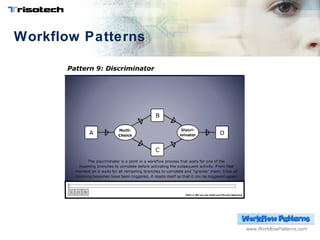
Visual Depiction - BPM Mostly used for: Teaching & Learning  Verification & Validation Examples: Modeling patterns User is presented with an animation to better grasp sometime complex patterns Tracing a Business Process Model User follows the flow of process activities during simulation and validates its logic
Workflow Patterns www.WorkflowPatterns.com
Scenario Simulation - BPM Mostly used for: Teaching & Learning Examples: Process Management IBM Inno8 Generic Capitalism    often regarded as the first successful    business simulation game Industry Specific (Hollywood) Mogul (Lemon Stand) Tycoon
Innov8 INNOV8 Academic Edition version 1.0 http://www-01.ibm.com/software/solutions/soa/innov8/index.html Online  mini version available at:  http://www-01.ibm.com/software/solutions/soa/innov8/innov8game.jsp
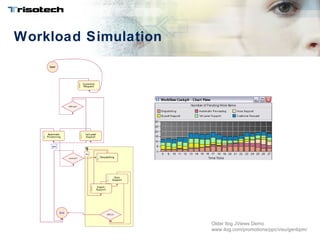
Numeric Simulation - BPM Mostly used for: Teaching & Learning Persuasion & Selling Analysis of a Business Situation  Verification & Validation Examples: Process Management Cycle Time and Capacity Analysis V&V of Business Scenario (What if) Scenario : Activities, Resources,.. Engineering Product Requirements Manufacturing MRP, MRP II, ERP, APS Finance Risk Assessment / Adjustment Revenue Forecasting Economics Economic Context Forecasting …
Workload Simulation Older Ilog JViews Demo www.ilog.com/promotions/ppc/visu/genbpm/
BPM Numeric Simulation Caveats Unrealistic User Expectations  Simple Press-Button Simulation Deterministic behavior assumptions A Business Model  is a  Simulation Model ( not necessarily)  Their goals (purposes) may be misaligned Be Mindful of Misleading Results (Garbage in Garbage Out) A simulation model that is fidel &valid fed with uncharacteristic data can lead to : Incorrect conclusions or predictions, Negative Training, … Sub-Optimization Partial or sub-model optimization can lead you astray
BPM Numeric Simulation  Best Practices The Right Expert for the Right Task Although conceptually simple to grasp, successfully (meaningfully) using numerical simulation for business modeling still requires some expertise (Advanced Mathematical Skills) The Right Model for the Right Goal Align Modeling Objectives with Simulation Objectives Abstraction Fidelity Validity (soundness and completeness) The Right Answer to the Right Question Make sure to instrument your business model with parameters that are actual indicators (influencers) of what you wish to  explore
State of Simulation in BPM There are no specific standards for Business Process Model Simulation Only XPDL can interchange some very limited simulation attributes  Most Business Process Management Suites (BPMS) provide a simulation module, but of very variable value  Very limited use of advanced mathematical simulation packages  For a perspective on this see: www.brsilver.com/wordpress/2009/02/15/making-simulation-useful/
Conclusions Take Away Further Readings
Take Away Business Modeling and particularly Business Process Modeling is actively being addressed by various standard bodies, progressively leading to a more structured and accessible discipline. Business Simulation, and particularly Business Process Numeric Simulation, is a domain that requires more nurturing to become all it could be. Proceed with care! Get started!
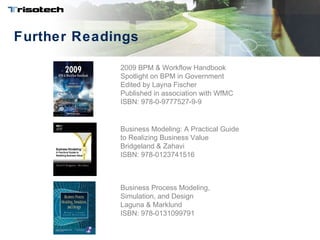
Further Readings Business Modeling: A Practical Guide to Realizing Business Value Bridgeland & Zahavi ISBN: 978-0123741516 Business Process Modeling, Simulation, and Design Laguna & Marklund ISBN: 978-0131099791 2009 BPM & Workflow Handbook Spotlight on BPM in Government  Edited by Layna Fischer Published in association with WfMC ISBN: 978-0-9777527-9-9
This presentation is a available at: www.slideshare.net/dgagne www.Trisotech.com/BPM

Modeling and Simulation in Business Process Management

  • 1.
    Modeling and Simulation in Business Process Management Denis Gagné CEO, Trisotech, Canada. [email_address]
  • 2.
    Abstract Practitioners inBusiness Process Management (BPM) know the critical importance of carefully leading organizations during periods of business transformation. While business modeling is progressively being addressed by various standards bodies, the use of simulation in this context is still generally underexploited. In this presentation, we explore ways in which simulation could be used to provide value in the context of business transformation and present some examples of current use of simulation in the specific context of business process management.
  • 3.
    Speaker Denis GagnéCEO, Trisotech, Canada.   M. Gagné is responsible for the solutions and technology vision at Trisotech. He has led Trisotech through the process of developing unique services and product propositions and provided leadership in plotting out Trisotech's market strategy. M. Gagné holds an M.Math. degree in Artificial Intelligence from the University of Waterloo and a B.Sc. in Computer Science (Systems) from the Collège Militaire Royal (CMR) de St-Jean. He is the author of over 25 scientific publications and numerous technical presentations and seminars in Artificial Intelligence, Simulation Training, and Business Process Management. His current research interest is in technological and know-how innovation in the fields of business process management and business transformation.
  • 4.
    Who we areEstablished 1996 Private Cie Based in Montréal Software Consulting Business Process Management(BPM) Innovation, Experience & Expertise and Agility
  • 5.
  • 6.
    Business Process ModelingWhy Business Modeling Business Modeling Disciplines Business Modeling Standards
  • 7.
    Why Business ModelingCommunication between People Training & Learning Persuasion & Selling Analysis of a Business Situation Compliance Management Development of Software Requirements Knowledge Management & Reuse Direct Execution in a Software Engine Business Modeling: A Practical Guide to Realizing Business Value Bridgeland & Zahavi
  • 8.
    Business Modeling DisciplinesBusiness Process Modeling Business Motivation Modeling Business Organizational Modeling Business Rule Modeling Business Event Modeling Business Entity Modeling
  • 9.
    Some Business ModelingStandards OMG: Object Management Group BPMN: Business Process Modeling Notation BMM: Business Motivation Model BPMM: Business Process Maturity Model SBVR: Semantics of Business Vocabulary and Business Rules BPDM: Business Process Definition Metamodel PRR: Production Rule Representation Workflow Management Facility WfMC: Workflow Management Coalition XPDL: XML Process Definition Language Wf-XML: Extension to the OASIS Asynchronous Service Access Protocol.(ASAP) BPAF: Business Process Analytics Format OASIS: Organization for the Advancement of Structured Information Standards BPEL: Business Process Execution Language BPSS: ebXML Business Process Specification Schema … www.OMG.org/technology/documents/br_pm_spec_catalog.htm www.WfMC.org www.OASIS-Open.org/specs/
  • 10.
    Business Model SimulationWhy Simulating Business Models Types of Simulation for Business Models BPM Simulation Examples BPM Numeric Simulation Caveats & Best Practices
  • 11.
    Why Simulating BusinessModels Advantages of simulation over testing on the real world include: speed low cost no disturbance of current operations Training & Learning Although very popular in support of operations, limited use in other Business Modeling disciplines Persuasion & Selling Simulating results of a proposed solution Cause and Effect simulation Analysis of a Business Situation Simulation complements static analysis techniques with a dynamic perspective Verification & Validation Validation: Are we doing the right “thing”? Verification: Are we doing “it” right?
  • 12.
    Types of Simulationfor Business Models Visual Depiction (Visualization & Animation) User is presented with a (sometime interactive) animated depiction of the business model Scenario Simulation (Role Play) User asked to take actions and make decisions within a simulated business environment Numeric Simulation (Discreet Events) User asked to provide values for input and decision parameters of a simulated business model
  • 13.
    Visual Depiction -BPM Mostly used for: Teaching & Learning Verification & Validation Examples: Modeling patterns User is presented with an animation to better grasp sometime complex patterns Tracing a Business Process Model User follows the flow of process activities during simulation and validates its logic
  • 14.
  • 15.
    Scenario Simulation -BPM Mostly used for: Teaching & Learning Examples: Process Management IBM Inno8 Generic Capitalism often regarded as the first successful business simulation game Industry Specific (Hollywood) Mogul (Lemon Stand) Tycoon
  • 16.
    Innov8 INNOV8 AcademicEdition version 1.0 http://www-01.ibm.com/software/solutions/soa/innov8/index.html Online mini version available at: http://www-01.ibm.com/software/solutions/soa/innov8/innov8game.jsp
  • 17.
    Numeric Simulation -BPM Mostly used for: Teaching & Learning Persuasion & Selling Analysis of a Business Situation Verification & Validation Examples: Process Management Cycle Time and Capacity Analysis V&V of Business Scenario (What if) Scenario : Activities, Resources,.. Engineering Product Requirements Manufacturing MRP, MRP II, ERP, APS Finance Risk Assessment / Adjustment Revenue Forecasting Economics Economic Context Forecasting …
  • 18.
    Workload Simulation OlderIlog JViews Demo www.ilog.com/promotions/ppc/visu/genbpm/
  • 19.
    BPM Numeric SimulationCaveats Unrealistic User Expectations Simple Press-Button Simulation Deterministic behavior assumptions A Business Model is a Simulation Model ( not necessarily) Their goals (purposes) may be misaligned Be Mindful of Misleading Results (Garbage in Garbage Out) A simulation model that is fidel &valid fed with uncharacteristic data can lead to : Incorrect conclusions or predictions, Negative Training, … Sub-Optimization Partial or sub-model optimization can lead you astray
  • 20.
    BPM Numeric Simulation Best Practices The Right Expert for the Right Task Although conceptually simple to grasp, successfully (meaningfully) using numerical simulation for business modeling still requires some expertise (Advanced Mathematical Skills) The Right Model for the Right Goal Align Modeling Objectives with Simulation Objectives Abstraction Fidelity Validity (soundness and completeness) The Right Answer to the Right Question Make sure to instrument your business model with parameters that are actual indicators (influencers) of what you wish to explore
  • 21.
    State of Simulationin BPM There are no specific standards for Business Process Model Simulation Only XPDL can interchange some very limited simulation attributes Most Business Process Management Suites (BPMS) provide a simulation module, but of very variable value Very limited use of advanced mathematical simulation packages For a perspective on this see: www.brsilver.com/wordpress/2009/02/15/making-simulation-useful/
  • 22.
    Conclusions Take AwayFurther Readings
  • 23.
    Take Away BusinessModeling and particularly Business Process Modeling is actively being addressed by various standard bodies, progressively leading to a more structured and accessible discipline. Business Simulation, and particularly Business Process Numeric Simulation, is a domain that requires more nurturing to become all it could be. Proceed with care! Get started!
  • 24.
    Further Readings BusinessModeling: A Practical Guide to Realizing Business Value Bridgeland & Zahavi ISBN: 978-0123741516 Business Process Modeling, Simulation, and Design Laguna & Marklund ISBN: 978-0131099791 2009 BPM & Workflow Handbook Spotlight on BPM in Government Edited by Layna Fischer Published in association with WfMC ISBN: 978-0-9777527-9-9
  • 25.
    This presentation isa available at: www.slideshare.net/dgagne www.Trisotech.com/BPM