Modals
Modals
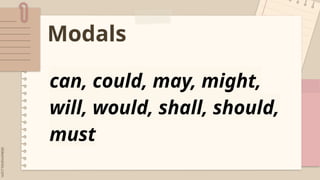
can, could, may, might,
will, would, shall, should,
must
Modals
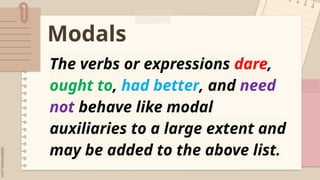
The verbs or expressions dare,
ought to, had better, and need
not behave like modal
auxiliaries to a large extent and
may be added to the above list.
Use of modal verbs:
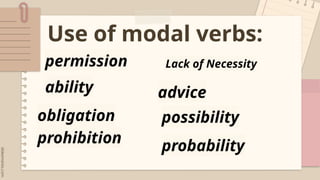
permission
ability
obligation
prohibition
Lack of Necessity
advice
possibility
probability
Use of modal verbs:
BE ABLE TO Ability / Capability
(past, present, future)
After the operation John was able to
walk again. (Single past occasion)
I’m able to play tennis twice a week.
(Circumstances permit me to do this)
I will be able to visit Paris next year.
(Nothing should prevent me from
doing this)
Use of modal verbs:
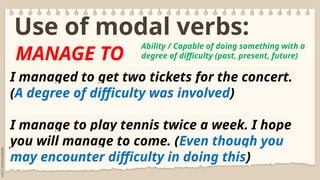
MANAGE TO
Ability / Capable of doing something with a
degree of difficulty (past, present, future)
I managed to get two tickets for the concert.
(A degree of difficulty was involved)
I manage to play tennis twice a week. I hope
you will manage to come. (Even though you
may encounter difficulty in doing this)
Use of modal verbs:
CAN
Ability/ Capability (present), Permission, Possibility,
Request, Offer, Negative deduction (present), Prohibition
I can swim. (Ability)
You can go to the Cinema. (Permission)
Smoking can cause cancer. (Possibility)
Can I use your phone? (Request)
Can I help you, madam? (Offer)
You can’t be hungry; you have just eaten two pizzas.
(Negative deduction)
Use of modal verbs:
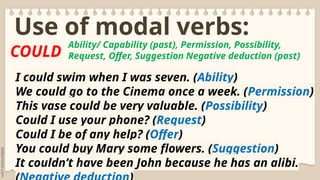
COULD
Ability/ Capability (past), Permission, Possibility,
Request, Offer, Suggestion Negative deduction (past)
I could swim when I was seven. (Ability)
We could go to the Cinema once a week. (Permission)
This vase could be very valuable. (Possibility)
Could I use your phone? (Request)
Could I be of any help? (Offer)
You could buy Mary some flowers. (Suggestion)
It couldn’t have been John because he has an alibi.
Use of modal verbs:
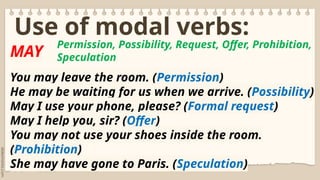
MAY
Permission, Possibility, Request, Offer, Prohibition,
Speculation
You may leave the room. (Permission)
He may be waiting for us when we arrive. (Possibility)
May I use your phone, please? (Formal request)
May I help you, sir? (Offer)
You may not use your shoes inside the room.
(Prohibition)
She may have gone to Paris. (Speculation)
Use of modal verbs:
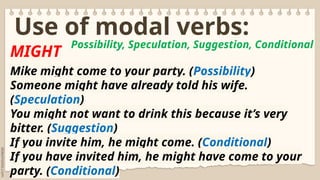
MIGHT
Possibility, Speculation, Suggestion, Conditional
Mike might come to your party. (Possibility)
Someone might have already told his wife.
(Speculation)
You might not want to drink this because it’s very
bitter. (Suggestion)
If you invite him, he might come. (Conditional)
If you have invited him, he might have come to your
party. (Conditional)
Exercise
1. ______ you play the piano when you were a child?
2. George is absent from class today. He____ be sick.
3. My cat _________ jump, but it ____________ talk.
4. ____________ I borrow your dictionary?
5. Peter ____________ swim when he was a child, but now
he ____________. In fact, he swims every day!
Exercise
6. I'm going to bring an umbrella today because it
________ rain.
7. The family can't decide where to go on vacation.
They ____ go to Los Angeles or they____ go to
Hawaii.
Use of modal verbs:
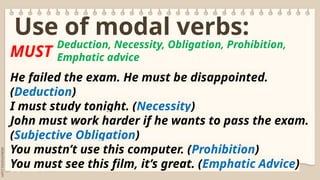
MUST
Deduction, Necessity, Obligation, Prohibition,
Emphatic advice
He failed the exam. He must be disappointed.
(Deduction)
I must study tonight. (Necessity)
John must work harder if he wants to pass the exam.
(Subjective Obligation)
You mustn’t use this computer. (Prohibition)
You must see this film, it’s great. (Emphatic Advice)
Use of modal verbs:
HAVE TO
Obligation, Negative: Not necessary and not done,
You have to stop when the traffic light is red.
(Imposed Obligation)
I don’t have to go to work tomorrow. (Not done)
I didn’t have to water the flowers yesterday because
it rained.(Not necessary)
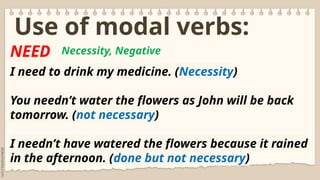
Use of modal verbs:
NEED Necessity, Negative
I need to drink my medicine. (Necessity)
You needn’t water the flowers as John will be back
tomorrow. (not necessary)
I needn’t have watered the flowers because it rained
in the afternoon. (done but not necessary)
Use of modal verbs:
OUGHT TO Deduction, Assumption, Advice,
Recommendation
He has studied very hard he ought to pass the exam.
(Deduction)
He ought to have received the parcel by now.
(Assumption)
You ought not smoke so much.(Advice)
You ought to tell him the truth.(Recommendation)
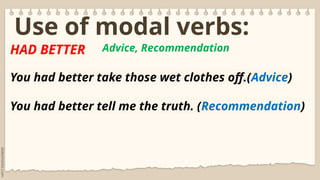
Use of modal verbs:
HAD BETTER Advice, Recommendation
You had better take those wet clothes off.(Advice)
You had better tell me the truth. (Recommendation)
Use of modal verbs:
SHOULD
Assumption/ Deduction, Advice, Recommendation,
Necessity, Obligation, Prediction, Prohibition
The plane should be landing now. (Deduction/
Assumption)
You should go to the doctor. (Advice)
You should take one of these pills every day.
(Recommendation)
You should be wearing a coat, it’s very cold.
(Necessity)
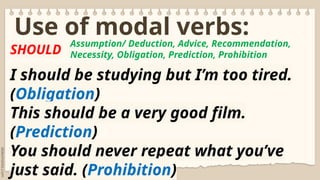
Use of modal verbs:
SHOULD
Assumption/ Deduction, Advice, Recommendation,
Necessity, Obligation, Prediction, Prohibition
I should be studying but I’m too tired.
(Obligation)
This should be a very good film.
(Prediction)
You should never repeat what you’ve
just said. (Prohibition)
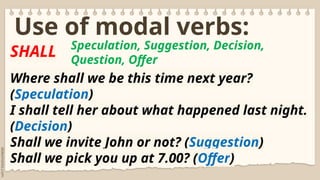
Use of modal verbs:
SHALL Speculation, Suggestion, Decision,
Question, Offer
Where shall we be this time next year?
(Speculation)
I shall tell her about what happened last night.
(Decision)
Shall we invite John or not? (Suggestion)
Shall we pick you up at 7.00? (Offer)
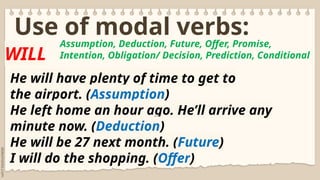
Use of modal verbs:
WILL
Assumption, Deduction, Future, Offer, Promise,
Intention, Obligation/ Decision, Prediction, Conditional
He will have plenty of time to get to
the airport. (Assumption)
He left home an hour ago. He’ll arrive any
minute now. (Deduction)
He will be 27 next month. (Future)
I will do the shopping. (Offer)
Use of modal verbs:
WILL
Assumption, Deduction, Future, Offer, Promise,
Intention, Obligation/ Decision, Prediction, Conditional
I will marry you. (Promise)
I will wait for you. (Intention)
I will stay with you until we get older. (Obligation/
Decision)
I will rain tomorrow. (Prediction)
If it rains tomorrow, I will not go to the park.
(Prediction)
Use of modal verbs:
WOULD
Possibility, Request, Speculation, Polite Question,
Offer, Past tense “will” (indirect speech, Customary
Past Action, Invitation, Preference, Conditional
John would visit us tomorrow. (Possibility)
Would you please answer the question?
(Request)
We would enjoy the party. (Speculation)
Would you, please, close the door? (Polite
Question)
Use of modal verbs:
WOULD
Possibility, Request, Speculation, Polite Question,
Offer, Past tense “will” (indirect speech, Customary
Past Action, Invitation, Preference, Conditional
Would you like a cup of tea? (Offer)
John said he would take me to the Cinema.
(Past tense “will” (indirect speech)
She would take the dog for a walk every
morning before going to work. (Customary
Past Action)
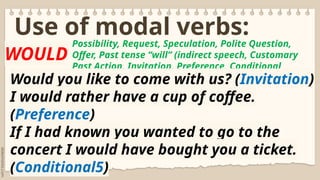
Use of modal verbs:
WOULD
Possibility, Request, Speculation, Polite Question,
Offer, Past tense “will” (indirect speech, Customary
Past Action, Invitation, Preference, Conditional
Would you like to come with us? (Invitation)
I would rather have a cup of coffee.
(Preference)
If I had known you wanted to go to the
concert I would have bought you a ticket.
(Conditional5)

Modals and their functions for Grade 9 Lessons

  • 1.
  • 2.
    Modals can, could, may,might, will, would, shall, should, must
  • 3.
    Modals The verbs orexpressions dare, ought to, had better, and need not behave like modal auxiliaries to a large extent and may be added to the above list.
  • 4.
    Use of modalverbs: permission ability obligation prohibition Lack of Necessity advice possibility probability
  • 5.
    Use of modalverbs: BE ABLE TO Ability / Capability (past, present, future) After the operation John was able to walk again. (Single past occasion) I’m able to play tennis twice a week. (Circumstances permit me to do this) I will be able to visit Paris next year. (Nothing should prevent me from doing this)
  • 6.
    Use of modalverbs: MANAGE TO Ability / Capable of doing something with a degree of difficulty (past, present, future) I managed to get two tickets for the concert. (A degree of difficulty was involved) I manage to play tennis twice a week. I hope you will manage to come. (Even though you may encounter difficulty in doing this)
  • 7.
    Use of modalverbs: CAN Ability/ Capability (present), Permission, Possibility, Request, Offer, Negative deduction (present), Prohibition I can swim. (Ability) You can go to the Cinema. (Permission) Smoking can cause cancer. (Possibility) Can I use your phone? (Request) Can I help you, madam? (Offer) You can’t be hungry; you have just eaten two pizzas. (Negative deduction)
  • 8.
    Use of modalverbs: COULD Ability/ Capability (past), Permission, Possibility, Request, Offer, Suggestion Negative deduction (past) I could swim when I was seven. (Ability) We could go to the Cinema once a week. (Permission) This vase could be very valuable. (Possibility) Could I use your phone? (Request) Could I be of any help? (Offer) You could buy Mary some flowers. (Suggestion) It couldn’t have been John because he has an alibi.
  • 9.
    Use of modalverbs: MAY Permission, Possibility, Request, Offer, Prohibition, Speculation You may leave the room. (Permission) He may be waiting for us when we arrive. (Possibility) May I use your phone, please? (Formal request) May I help you, sir? (Offer) You may not use your shoes inside the room. (Prohibition) She may have gone to Paris. (Speculation)
  • 10.
    Use of modalverbs: MIGHT Possibility, Speculation, Suggestion, Conditional Mike might come to your party. (Possibility) Someone might have already told his wife. (Speculation) You might not want to drink this because it’s very bitter. (Suggestion) If you invite him, he might come. (Conditional) If you have invited him, he might have come to your party. (Conditional)
  • 11.
    Exercise 1. ______ youplay the piano when you were a child? 2. George is absent from class today. He____ be sick. 3. My cat _________ jump, but it ____________ talk. 4. ____________ I borrow your dictionary? 5. Peter ____________ swim when he was a child, but now he ____________. In fact, he swims every day!
  • 12.
    Exercise 6. I'm goingto bring an umbrella today because it ________ rain. 7. The family can't decide where to go on vacation. They ____ go to Los Angeles or they____ go to Hawaii.
  • 13.
    Use of modalverbs: MUST Deduction, Necessity, Obligation, Prohibition, Emphatic advice He failed the exam. He must be disappointed. (Deduction) I must study tonight. (Necessity) John must work harder if he wants to pass the exam. (Subjective Obligation) You mustn’t use this computer. (Prohibition) You must see this film, it’s great. (Emphatic Advice)
  • 14.
    Use of modalverbs: HAVE TO Obligation, Negative: Not necessary and not done, You have to stop when the traffic light is red. (Imposed Obligation) I don’t have to go to work tomorrow. (Not done) I didn’t have to water the flowers yesterday because it rained.(Not necessary)
  • 15.
    Use of modalverbs: NEED Necessity, Negative I need to drink my medicine. (Necessity) You needn’t water the flowers as John will be back tomorrow. (not necessary) I needn’t have watered the flowers because it rained in the afternoon. (done but not necessary)
  • 16.
    Use of modalverbs: OUGHT TO Deduction, Assumption, Advice, Recommendation He has studied very hard he ought to pass the exam. (Deduction) He ought to have received the parcel by now. (Assumption) You ought not smoke so much.(Advice) You ought to tell him the truth.(Recommendation)
  • 17.
    Use of modalverbs: HAD BETTER Advice, Recommendation You had better take those wet clothes off.(Advice) You had better tell me the truth. (Recommendation)
  • 18.
    Use of modalverbs: SHOULD Assumption/ Deduction, Advice, Recommendation, Necessity, Obligation, Prediction, Prohibition The plane should be landing now. (Deduction/ Assumption) You should go to the doctor. (Advice) You should take one of these pills every day. (Recommendation) You should be wearing a coat, it’s very cold. (Necessity)
  • 19.
    Use of modalverbs: SHOULD Assumption/ Deduction, Advice, Recommendation, Necessity, Obligation, Prediction, Prohibition I should be studying but I’m too tired. (Obligation) This should be a very good film. (Prediction) You should never repeat what you’ve just said. (Prohibition)
  • 20.
    Use of modalverbs: SHALL Speculation, Suggestion, Decision, Question, Offer Where shall we be this time next year? (Speculation) I shall tell her about what happened last night. (Decision) Shall we invite John or not? (Suggestion) Shall we pick you up at 7.00? (Offer)
  • 21.
    Use of modalverbs: WILL Assumption, Deduction, Future, Offer, Promise, Intention, Obligation/ Decision, Prediction, Conditional He will have plenty of time to get to the airport. (Assumption) He left home an hour ago. He’ll arrive any minute now. (Deduction) He will be 27 next month. (Future) I will do the shopping. (Offer)
  • 22.
    Use of modalverbs: WILL Assumption, Deduction, Future, Offer, Promise, Intention, Obligation/ Decision, Prediction, Conditional I will marry you. (Promise) I will wait for you. (Intention) I will stay with you until we get older. (Obligation/ Decision) I will rain tomorrow. (Prediction) If it rains tomorrow, I will not go to the park. (Prediction)
  • 23.
    Use of modalverbs: WOULD Possibility, Request, Speculation, Polite Question, Offer, Past tense “will” (indirect speech, Customary Past Action, Invitation, Preference, Conditional John would visit us tomorrow. (Possibility) Would you please answer the question? (Request) We would enjoy the party. (Speculation) Would you, please, close the door? (Polite Question)
  • 24.
    Use of modalverbs: WOULD Possibility, Request, Speculation, Polite Question, Offer, Past tense “will” (indirect speech, Customary Past Action, Invitation, Preference, Conditional Would you like a cup of tea? (Offer) John said he would take me to the Cinema. (Past tense “will” (indirect speech) She would take the dog for a walk every morning before going to work. (Customary Past Action)
  • 25.
    Use of modalverbs: WOULD Possibility, Request, Speculation, Polite Question, Offer, Past tense “will” (indirect speech, Customary Past Action, Invitation, Preference, Conditional Would you like to come with us? (Invitation) I would rather have a cup of coffee. (Preference) If I had known you wanted to go to the concert I would have bought you a ticket. (Conditional5)