Fictional Narrative Mrs. Coffee Quitman Elementary 4 th  Grade
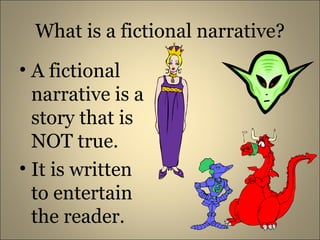
What is a fictional narrative? A fictional narrative is a story that is NOT true. It is written to entertain the reader.
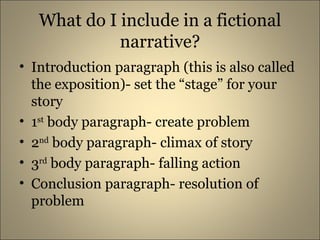
What do I include in a fictional narrative? Introduction paragraph (this is also called the exposition)- set the “stage” for your story 1 st  body paragraph- create problem 2 nd  body paragraph- climax of story 3 rd  body paragraph- falling action Conclusion paragraph- resolution of problem
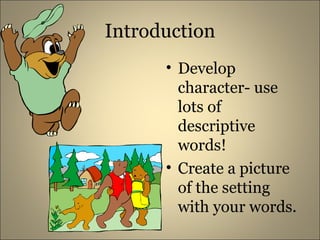
Introduction Develop character- use lots of descriptive words! Create a picture of the setting with your words.
1 st  Body Paragraph Create the problem. What is your character trying to do or overcome? Use lots of details and descriptive words, so your reader will understand how much trouble your character is in.
2 nd  Body Paragraph Create the climax. This is the part that will have your reader hanging on the edge of his seat. This is the part where it seems as though things can’t get worse for your reader. Make your reader wonder, “Will everything be ok?”
3 rd  Body Paragraph This is called the falling action.  This paragraph is where you start to tie up the loose ends. Someone comes in to save the day, or things start getting better.
Conclusion This is where the problem is finally solved. Everything is finally better. WHEW! Tell how the problem is solved, using lots of descriptive words.
And they lived happily ever after…

Fictional narrative

  • 1.
    Fictional Narrative Mrs.Coffee Quitman Elementary 4 th Grade
  • 2.
    What is afictional narrative? A fictional narrative is a story that is NOT true. It is written to entertain the reader.
  • 3.
    What do Iinclude in a fictional narrative? Introduction paragraph (this is also called the exposition)- set the “stage” for your story 1 st body paragraph- create problem 2 nd body paragraph- climax of story 3 rd body paragraph- falling action Conclusion paragraph- resolution of problem
  • 4.
    Introduction Develop character-use lots of descriptive words! Create a picture of the setting with your words.
  • 5.
    1 st Body Paragraph Create the problem. What is your character trying to do or overcome? Use lots of details and descriptive words, so your reader will understand how much trouble your character is in.
  • 6.
    2 nd Body Paragraph Create the climax. This is the part that will have your reader hanging on the edge of his seat. This is the part where it seems as though things can’t get worse for your reader. Make your reader wonder, “Will everything be ok?”
  • 7.
    3 rd Body Paragraph This is called the falling action. This paragraph is where you start to tie up the loose ends. Someone comes in to save the day, or things start getting better.
  • 8.
    Conclusion This iswhere the problem is finally solved. Everything is finally better. WHEW! Tell how the problem is solved, using lots of descriptive words.
  • 9.
    And they livedhappily ever after…