What are Modal Verbs?
- Helping verbs used together with base
form of main verbs
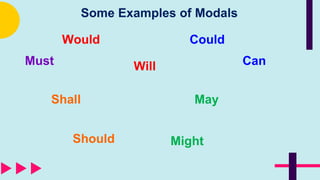
Would
Must
Shall
Should
Could
Can
May
Might
Will
Some Examples of Modals
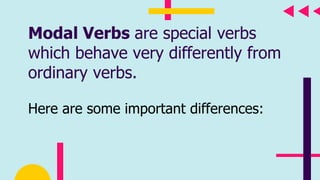
Modal Verbs are special verbs
which behave very differently from
ordinary verbs.
Here are some important differences:
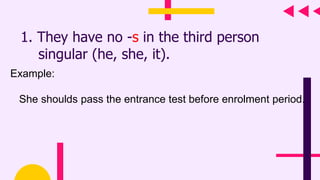
1. They have no -s in the third person
singular (he, she, it).
Example:
She shoulds pass the entrance test before enrolment period.
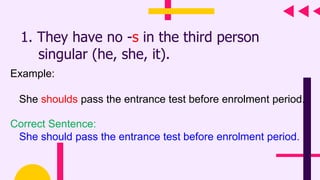
1. They have no -s in the third person
singular (he, she, it).
Example:
She shoulds pass the entrance test before enrolment period.
Correct Sentence:
She should pass the entrance test before enrolment period.
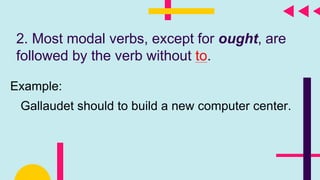
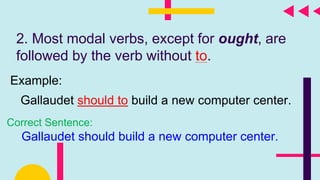
2. Most modal verbs, except for ought, are
followed by the verb without to.
Example:
Gallaudet should to build a new computer center.
2. Most modal verbs, except for ought, are
followed by the verb without to.
Example:
Gallaudet should to build a new computer center.
Correct Sentence:
Gallaudet should build a new computer center.
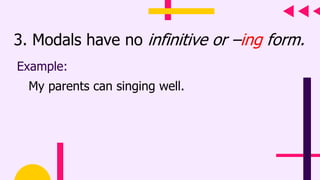
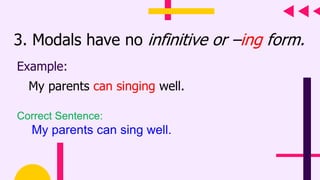
3. Modals have no infinitive or –ing form.
Example:
My parents can singing well.
3. Modals have no infinitive or –ing form.
Example:
My parents can singing well.
Correct Sentence:
My parents can sing well.
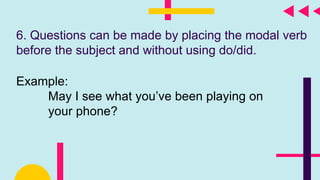
6. Questions can be made by placing the modal verb
before the subject and without using do/did.
Example:
May I see what you’ve been playing on
your phone?
Let’s practice!
Which sentence has a
modal verb?
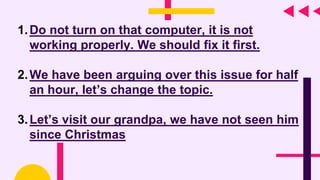
1.Do not turn on that computer, it is not
working properly. We should fix it first.
2.We have been arguing over this issue for half
an hour, let’s change the topic.
3.Let’s visit our grandpa, we have not seen him
since Christmas
Please choose the correct
negative form of modal verb.
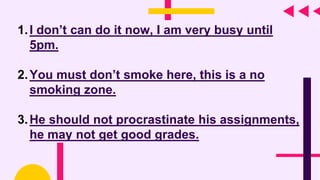
1.I don’t can do it now, I am very busy until
5pm.
2.You must don’t smoke here, this is a no
smoking zone.
3.He should not procrastinate his assignments,
he may not get good grades.
Modal Verbs
Usage
 Ability
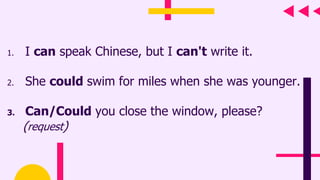
1. I can speak Chinese, but I can't write it.
2. She could swim for miles when she was younger.
3. Can/Could you close the window, please?
(request)
 Permission
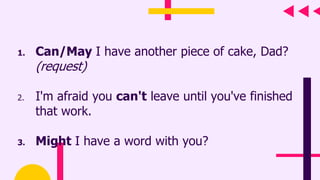
1. Can/May I have another piece of cake, Dad?
(request)
2. I'm afraid you can't leave until you've finished
that work.
3. Might I have a word with you?
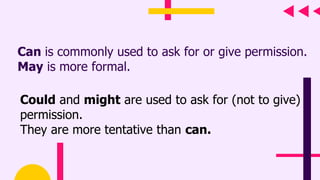
Can is commonly used to ask for or give permission.
May is more formal.
Could and might are used to ask for (not to give)
permission.
They are more tentative than can.
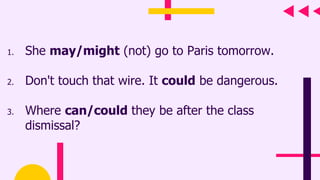
 Possibility
1. She may/might (not) go to Paris tomorrow.
2. Don't touch that wire. It could be dangerous.
3. Where can/could they be after the class
dismissal?
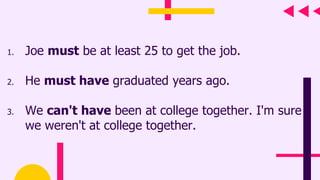
 Certainty
1. Joe must be at least 25 to get the job.
2. He must have graduated years ago.
3. We can't have been at college together. I'm sure
we weren't at college together.
 Obligation, requirement
1. I must phone my parents tonight before attending
the party.
2. You must not smoke in the cinema.
3. He had to leave early for the final rehearsal.
Had to is the past form of must when it is
used to express obligation.
 Probability
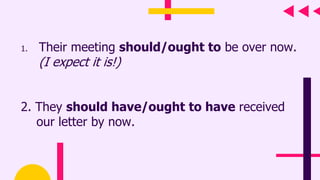
1. Their meeting should/ought to be over now.
(I expect it is!)
2. They should have/ought to have received
our letter by now.
Let’s practice!
Identify the modal verb and
modality (definition) in the following
sentences.
1. You could play with your PS4 after school,
but you must finish your homework first.
1. You could play with your PS4 after school,
but you must finish your homework first.
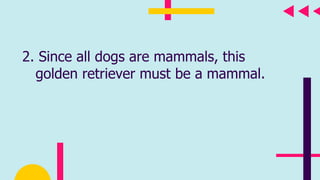
2. Since all dogs are mammals, this
golden retriever must be a mammal.
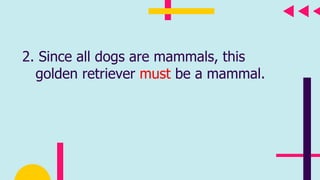
2. Since all dogs are mammals, this
golden retriever must be a mammal.
3. You might consider finishing your
household chores before playing
computer games.
3. You might consider finishing your
household chores before playing
computer games.
4. I will finish my essay tonight even if I
have to forgo sleep.
4. I will finish my essay tonight even if I
have to forgo sleep.
5. The puppy can sit on command.
6. I would eat cereal every day as a child.
7. You may encounter some difficult players
on occasion.
7. You may encounter some difficult players
on occasion.
8. The train should arrive in a few minutes.
I better be going.
8. The train should arrive in a few minutes.
I better be going.
9. The situation would not be so bad if we all
remained calm.
9. The situation would not be so bad if we all
remained calm.
10. I will have earned my graduate degree
next semester.
10. I will have earned my graduate degree
next semester.
Quiz time!
You are
amazing!

Gr9 MODALS

  • 2.
    What are ModalVerbs? - Helping verbs used together with base form of main verbs
  • 3.
  • 4.
    Modal Verbs arespecial verbs which behave very differently from ordinary verbs. Here are some important differences:
  • 5.
    1. They haveno -s in the third person singular (he, she, it). Example: She shoulds pass the entrance test before enrolment period.
  • 6.
    1. They haveno -s in the third person singular (he, she, it). Example: She shoulds pass the entrance test before enrolment period. Correct Sentence: She should pass the entrance test before enrolment period.
  • 7.
    2. Most modalverbs, except for ought, are followed by the verb without to. Example: Gallaudet should to build a new computer center.
  • 8.
    2. Most modalverbs, except for ought, are followed by the verb without to. Example: Gallaudet should to build a new computer center. Correct Sentence: Gallaudet should build a new computer center.
  • 9.
    3. Modals haveno infinitive or –ing form. Example: My parents can singing well.
  • 10.
    3. Modals haveno infinitive or –ing form. Example: My parents can singing well. Correct Sentence: My parents can sing well.
  • 11.
    6. Questions canbe made by placing the modal verb before the subject and without using do/did. Example: May I see what you’ve been playing on your phone?
  • 12.
  • 13.
    Which sentence hasa modal verb?
  • 14.
    1.Do not turnon that computer, it is not working properly. We should fix it first. 2.We have been arguing over this issue for half an hour, let’s change the topic. 3.Let’s visit our grandpa, we have not seen him since Christmas
  • 17.
    Please choose thecorrect negative form of modal verb.
  • 18.
    1.I don’t cando it now, I am very busy until 5pm. 2.You must don’t smoke here, this is a no smoking zone. 3.He should not procrastinate his assignments, he may not get good grades.
  • 21.

  • 22.
  • 23.
    1. I canspeak Chinese, but I can't write it. 2. She could swim for miles when she was younger. 3. Can/Could you close the window, please? (request)
  • 24.
  • 25.
    1. Can/May Ihave another piece of cake, Dad? (request) 2. I'm afraid you can't leave until you've finished that work. 3. Might I have a word with you?
  • 26.
    Can is commonlyused to ask for or give permission. May is more formal. Could and might are used to ask for (not to give) permission. They are more tentative than can.
  • 27.
  • 28.
    1. She may/might(not) go to Paris tomorrow. 2. Don't touch that wire. It could be dangerous. 3. Where can/could they be after the class dismissal?
  • 29.
  • 30.
    1. Joe mustbe at least 25 to get the job. 2. He must have graduated years ago. 3. We can't have been at college together. I'm sure we weren't at college together.
  • 31.
  • 32.
    1. I mustphone my parents tonight before attending the party. 2. You must not smoke in the cinema. 3. He had to leave early for the final rehearsal.
  • 33.
    Had to isthe past form of must when it is used to express obligation.
  • 34.
  • 35.
    1. Their meetingshould/ought to be over now. (I expect it is!) 2. They should have/ought to have received our letter by now.
  • 36.
  • 37.
    Identify the modalverb and modality (definition) in the following sentences.
  • 38.
    1. You couldplay with your PS4 after school, but you must finish your homework first.
  • 39.
    1. You couldplay with your PS4 after school, but you must finish your homework first.
  • 40.
    2. Since alldogs are mammals, this golden retriever must be a mammal.
  • 41.
    2. Since alldogs are mammals, this golden retriever must be a mammal.
  • 42.
    3. You mightconsider finishing your household chores before playing computer games.
  • 43.
    3. You mightconsider finishing your household chores before playing computer games.
  • 44.
    4. I willfinish my essay tonight even if I have to forgo sleep.
  • 45.
    4. I willfinish my essay tonight even if I have to forgo sleep.
  • 46.
    5. The puppycan sit on command.
  • 47.
    5. The puppycan sit on command.
  • 48.
    6. I wouldeat cereal every day as a child.
  • 49.
    6. I wouldeat cereal every day as a child.
  • 50.
    7. You mayencounter some difficult players on occasion.
  • 51.
    7. You mayencounter some difficult players on occasion.
  • 52.
    8. The trainshould arrive in a few minutes. I better be going.
  • 53.
    8. The trainshould arrive in a few minutes. I better be going.
  • 54.
    9. The situationwould not be so bad if we all remained calm.
  • 55.
    9. The situationwould not be so bad if we all remained calm.
  • 56.
    10. I willhave earned my graduate degree next semester.
  • 57.
    10. I willhave earned my graduate degree next semester.
  • 58.
  • 59.