CREATIVITY
Creativity
CREATIVITY
is any act, idea, idea or product
that changes an existing domain or that
transforms an existing domain into new one.
Creativity can be described as the discovery
of something that is novel but also useful or
relevant or economical , valuable.
TYPES OF CREATIVITY
 Primary creativity : deals with spontaneous
creations.
 Secondary creativity : is more deliberate
and skilled as in the application of ideas and
insight to inventions.
 Technical creativity : aims at finding out
improvement in a process so as to improve
efficiency.
 Inventive creativity : aims at making or
devising new combination of ingredients
 Innovative creativity
reaching application
: it involves for
of more basic ideas
such as management application of
principles of psychology to develop a much
more effective system for motivating staff.
 Emergentive creativity : it consist of new
revolutionary principles for an art or science
such as psycho- analytical concepts of
Freud.
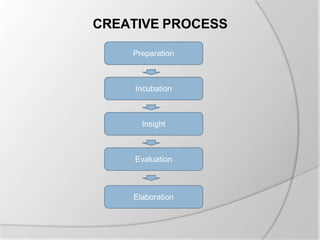
CREATIVE PROCESS
Preparation
Incubation
Insight
Evaluation
Elaboration
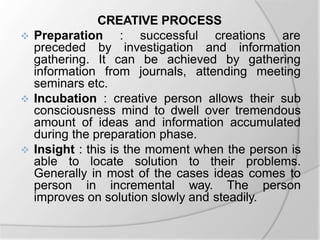
CREATIVE PROCESS
 Preparation : successful creations are
preceded by investigation and information
gathering. It can be achieved by gathering
information from journals, attending meeting
seminars etc.
 Incubation : creative person allows their sub
consciousness mind to dwell over tremendous
amount of ideas and information accumulated
during the preparation phase.
 Insight : this is the moment when the person is
able to locate solution to their problems.
Generally in most of the cases ideas comes to
person in incremental way. The person
improves on solution slowly and steadily.
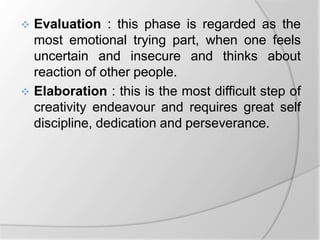
 Evaluation : this phase is regarded as the
most emotional trying part, when one feels
uncertain and insecure and thinks about
reaction of other people.
 Elaboration : this is the most difficult step of
creativity endeavour and requires great self
discipline, dedication and perseverance.
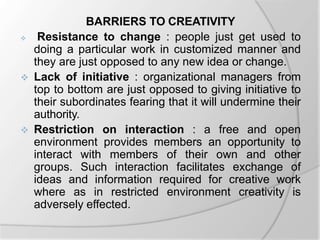
BARRIERS TO CREATIVITY
 Resistance to change : people just get used to
doing a particular work in customized manner and
they are just opposed to any new idea or change.
 Lack of initiative : organizational managers from
top to bottom are just opposed to giving initiative to
their subordinates fearing that it will undermine their
authority.
 Restriction on interaction : a free and open
environment provides members an opportunity to
interact with members of their own and other
groups. Such interaction facilitates exchange of
ideas and information required for creative work
where as in restricted environment creativity is
adversely effected.
 Fear of something going wrong : many new
ideas may go wrong or prove impractical.
Whenever creative work is to be undertaken the
possibility of success or failure is always there.
 Lack of recognition : failure to recognize or
reward creativity acts as de motivating factor.
Hard work put in by creative people must be
compensated with adequate financial and non
financial rewards.
 Resource constraints : creativity demands
sufficient availability of resources. Absence of
adequate resources may dampen the spirit of
creativity.
SOURCES OF NEW IDEAS
 Basic research : all firms are engaged in some
kind of basic research and development , which can
lead to development of new product ideas that have
already passed the initial screening stage.
 Production stage : workers actively engaged in the
production of products can suggest certain
modifications and improvements. These workers
can provide ideas aimed at improving quality , cost
and performance of potential product.
 Sales force : sales representative are directly in
touch with the customers and are thus better
equipped to take note of customer needs by this
they can provide better product development idea.
 Management : management team based on
their knowledge, skill and experience can
come out with new ideas for product
development.
 Magazines and trade journal : useful ideas
about new products can be obtained from
these magazines and trade journals.
 Competitors : in order to survive in present
day competitive environment, it is in the
interest of the entrepreneur to keep a eye on
activities of his rivals.
 Buyers : an entrepreneur while keeping
track of the requirements of the consumers
can definitely get useful ideas aimed at
developing a better product.
 Sellers : can provide idea for new product
development as they act as link between
producers and consumers and are better
equipped to provide required information.
 Overseas market : a producer interested in
taking care of foreign market can do it in
better manner by getting right ideas aimed at
improving product acceptability in these
markets.
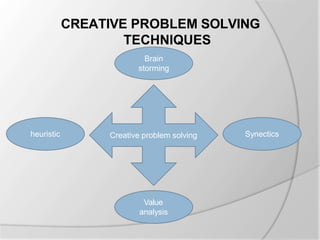
CREATIVE PROBLEM SOLVING
TECHNIQUES
Creative problem solving
Brain
storming
heuristic Synectics
Value
analysis
 Heuristic : is an adjective for experience
based techniques that help in problem
solving , learning and discovery. This method
is used to rapidly come to an solution that is
hoped to be close to best possible answer.
Heuristics stands for strategies using, readily
https://www.facebook.com/ialwaysthinkprettythings
accessible, though
information to control
loosely applicable,
problem solving in
human beings and machines. Although the
solution quality may not be the best, often
they work well in generalized situation.
 Brain storming : in this group members or
individuals are encouraged to spell out
maximum number of possible solutions of a
specific or stated problem. Under
storming more emphasis is laid on
brain
the
number of possible solutions or ideas.
CHARACTERISTICS OF BRAIN STORMING
 This technique is not suitable where the problem
has a unique solution which can be found
through analysis or evaluation.
 brain storming can take place only when there is
specific topic.
 Brain storming results in generation of numerous
ideas out of which a few ideas are chosen for in
depth investigation.
 Brain storming provides ample opportunities to
participants to put forth various suggestions for
solving specific problems.
 Brain storming enables participation to freely
share different ideas.
PRINCIPLES OF BRAIN STORMING
 During the generation phase of ideas,
evaluation process is deferred.
 The second principle is based on ‘quantity
begets quality’ right environment must be
provided for generating maximum number of
ideas.
 Brain storming brings forth novel and
different ideas. Novels ideas in certain cases
may not appear to be practical ideas.
 It is better to appreciate ideas of others as
well as ones own previous ideas.
https://www.facebook.com/ialwaysthinkprettythings
 Synectics : has been adopted by the Greek
word synecticos incorporating diverse
finding
is applied in
to a number of in
elements.
innovative
traceable
synectics
practices
technical
 Value analysis is important approach to
improving the value of product or process by
understanding its constitutes components
and their associated costs. Value analysis is
a cost reduction and problem solving
technique that analyzes an existing product
or service in order to reduce or eliminate any
costs that do not contribute to value of
performance.
PROFITS AND INNOVATION
 Entrepreneur is one who always searches for
changes and responds to it and exploits it as
an opportunity. Innovation is treated as an
instrument of entrepreneurship. An
entrepreneur innovates and creates
resources until someone finds a use for it and
endows economic value to it.
ROLE OF ENTREPRENEURS
 An entrepreneur must be an innovator as well as
leader.
 He must be capable of analyzing and exploiting the
opportunities.
 An entrepreneur should innovate for the present
period and not for the future.
 Innovation must be easy to understand otherwise it
may not give the desired result.
 An entrepreneur must posses the knowledge,
ingenuity, diligence, persistence, and commitment to
innovation.
 An entrepreneur must mobilize resources and
allocate them to make a commercial gains from the
opportunities indentified.

Creativity.pptx

  • 1.
  • 2.
    Creativity CREATIVITY is any act,idea, idea or product that changes an existing domain or that transforms an existing domain into new one. Creativity can be described as the discovery of something that is novel but also useful or relevant or economical , valuable.
  • 3.
    TYPES OF CREATIVITY Primary creativity : deals with spontaneous creations.  Secondary creativity : is more deliberate and skilled as in the application of ideas and insight to inventions.  Technical creativity : aims at finding out improvement in a process so as to improve efficiency.  Inventive creativity : aims at making or devising new combination of ingredients
  • 4.
     Innovative creativity reachingapplication : it involves for of more basic ideas such as management application of principles of psychology to develop a much more effective system for motivating staff.  Emergentive creativity : it consist of new revolutionary principles for an art or science such as psycho- analytical concepts of Freud.
  • 5.
  • 6.
    CREATIVE PROCESS  Preparation: successful creations are preceded by investigation and information gathering. It can be achieved by gathering information from journals, attending meeting seminars etc.  Incubation : creative person allows their sub consciousness mind to dwell over tremendous amount of ideas and information accumulated during the preparation phase.  Insight : this is the moment when the person is able to locate solution to their problems. Generally in most of the cases ideas comes to person in incremental way. The person improves on solution slowly and steadily.
  • 7.
     Evaluation :this phase is regarded as the most emotional trying part, when one feels uncertain and insecure and thinks about reaction of other people.  Elaboration : this is the most difficult step of creativity endeavour and requires great self discipline, dedication and perseverance.
  • 8.
    BARRIERS TO CREATIVITY Resistance to change : people just get used to doing a particular work in customized manner and they are just opposed to any new idea or change.  Lack of initiative : organizational managers from top to bottom are just opposed to giving initiative to their subordinates fearing that it will undermine their authority.  Restriction on interaction : a free and open environment provides members an opportunity to interact with members of their own and other groups. Such interaction facilitates exchange of ideas and information required for creative work where as in restricted environment creativity is adversely effected.
  • 9.
     Fear ofsomething going wrong : many new ideas may go wrong or prove impractical. Whenever creative work is to be undertaken the possibility of success or failure is always there.  Lack of recognition : failure to recognize or reward creativity acts as de motivating factor. Hard work put in by creative people must be compensated with adequate financial and non financial rewards.  Resource constraints : creativity demands sufficient availability of resources. Absence of adequate resources may dampen the spirit of creativity.
  • 10.
    SOURCES OF NEWIDEAS  Basic research : all firms are engaged in some kind of basic research and development , which can lead to development of new product ideas that have already passed the initial screening stage.  Production stage : workers actively engaged in the production of products can suggest certain modifications and improvements. These workers can provide ideas aimed at improving quality , cost and performance of potential product.  Sales force : sales representative are directly in touch with the customers and are thus better equipped to take note of customer needs by this they can provide better product development idea.
  • 11.
     Management :management team based on their knowledge, skill and experience can come out with new ideas for product development.  Magazines and trade journal : useful ideas about new products can be obtained from these magazines and trade journals.  Competitors : in order to survive in present day competitive environment, it is in the interest of the entrepreneur to keep a eye on activities of his rivals.
  • 12.
     Buyers :an entrepreneur while keeping track of the requirements of the consumers can definitely get useful ideas aimed at developing a better product.  Sellers : can provide idea for new product development as they act as link between producers and consumers and are better equipped to provide required information.  Overseas market : a producer interested in taking care of foreign market can do it in better manner by getting right ideas aimed at improving product acceptability in these markets.
  • 13.
    CREATIVE PROBLEM SOLVING TECHNIQUES Creativeproblem solving Brain storming heuristic Synectics Value analysis
  • 14.
     Heuristic :is an adjective for experience based techniques that help in problem solving , learning and discovery. This method is used to rapidly come to an solution that is hoped to be close to best possible answer. Heuristics stands for strategies using, readily https://www.facebook.com/ialwaysthinkprettythings accessible, though information to control loosely applicable, problem solving in human beings and machines. Although the solution quality may not be the best, often they work well in generalized situation.
  • 15.
     Brain storming: in this group members or individuals are encouraged to spell out maximum number of possible solutions of a specific or stated problem. Under storming more emphasis is laid on brain the number of possible solutions or ideas.
  • 16.
    CHARACTERISTICS OF BRAINSTORMING  This technique is not suitable where the problem has a unique solution which can be found through analysis or evaluation.  brain storming can take place only when there is specific topic.  Brain storming results in generation of numerous ideas out of which a few ideas are chosen for in depth investigation.  Brain storming provides ample opportunities to participants to put forth various suggestions for solving specific problems.  Brain storming enables participation to freely share different ideas.
  • 17.
    PRINCIPLES OF BRAINSTORMING  During the generation phase of ideas, evaluation process is deferred.  The second principle is based on ‘quantity begets quality’ right environment must be provided for generating maximum number of ideas.  Brain storming brings forth novel and different ideas. Novels ideas in certain cases may not appear to be practical ideas.  It is better to appreciate ideas of others as well as ones own previous ideas. https://www.facebook.com/ialwaysthinkprettythings
  • 18.
     Synectics :has been adopted by the Greek word synecticos incorporating diverse finding is applied in to a number of in elements. innovative traceable synectics practices technical
  • 19.
     Value analysisis important approach to improving the value of product or process by understanding its constitutes components and their associated costs. Value analysis is a cost reduction and problem solving technique that analyzes an existing product or service in order to reduce or eliminate any costs that do not contribute to value of performance.
  • 20.
    PROFITS AND INNOVATION Entrepreneur is one who always searches for changes and responds to it and exploits it as an opportunity. Innovation is treated as an instrument of entrepreneurship. An entrepreneur innovates and creates resources until someone finds a use for it and endows economic value to it.
  • 21.
    ROLE OF ENTREPRENEURS An entrepreneur must be an innovator as well as leader.  He must be capable of analyzing and exploiting the opportunities.  An entrepreneur should innovate for the present period and not for the future.  Innovation must be easy to understand otherwise it may not give the desired result.  An entrepreneur must posses the knowledge, ingenuity, diligence, persistence, and commitment to innovation.  An entrepreneur must mobilize resources and allocate them to make a commercial gains from the opportunities indentified.