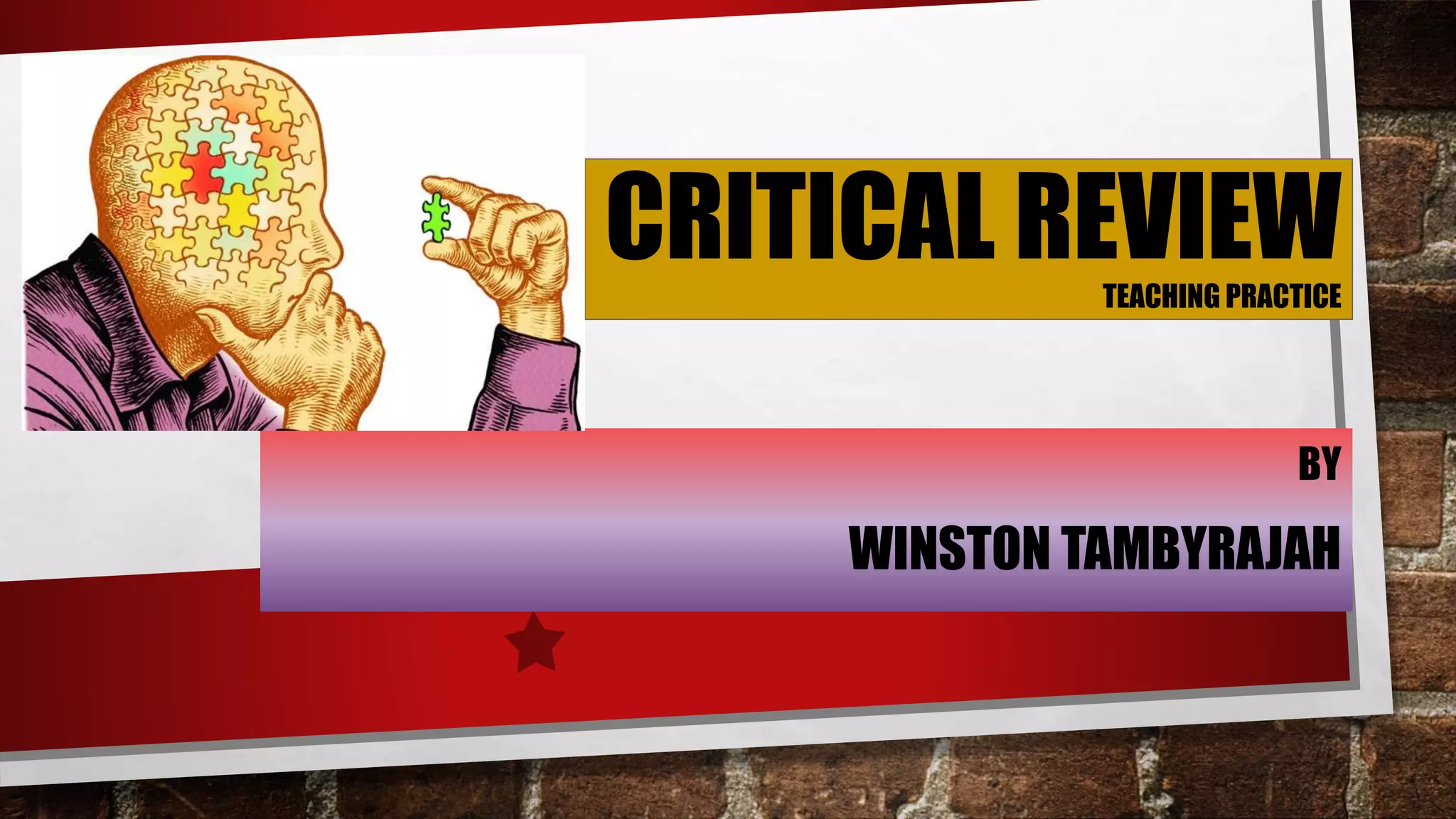
CRITICAL REVIEWTEACHING PRACTICE
BY
WINSTON TAMBYRAJAH
TEACHING METHODOLOGY - CRITICAL REVIEW
•REFLECTIONS ON MY TEACHING METHODOLOGY
MY PAST TEACHING EXPERIENCE
COMING FROM A UNIVERSITY TEACHING PAST
LECTURER CANTERED
MAJORITY OF THE STUDENTS ARE MOTIVATED
ADULT / MATURE STUDENTS
EXPERIENCED LEARNERS
LIMITED TEACHER - LEANER INTERACTIONS
06/03/20182WINSTON TAMBYRAJAH / PGCE
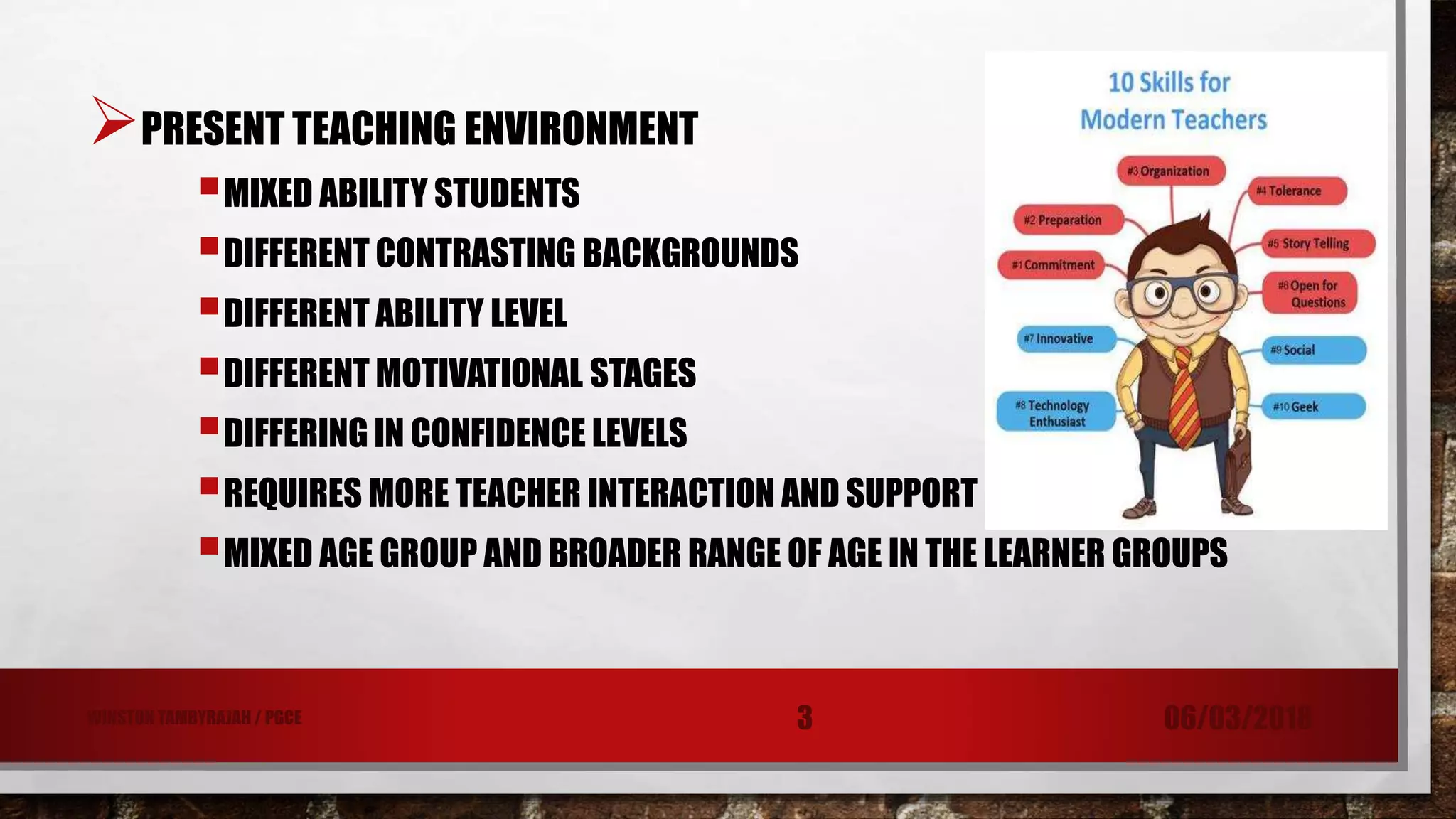
PRESENT TEACHING ENVIRONMENT
MIXED ABILITY STUDENTS
DIFFERENT CONTRASTING BACKGROUNDS
DIFFERENT ABILITY LEVEL
DIFFERENT MOTIVATIONAL STAGES
DIFFERING IN CONFIDENCE LEVELS
REQUIRES MORE TEACHER INTERACTION AND SUPPORT
MIXED AGE GROUP AND BROADER RANGE OF AGE IN THE LEARNER GROUPS
06/03/20183WINSTON TAMBYRAJAH / PGCE
PRESENT
SITUATIONAL
ANALYSIS
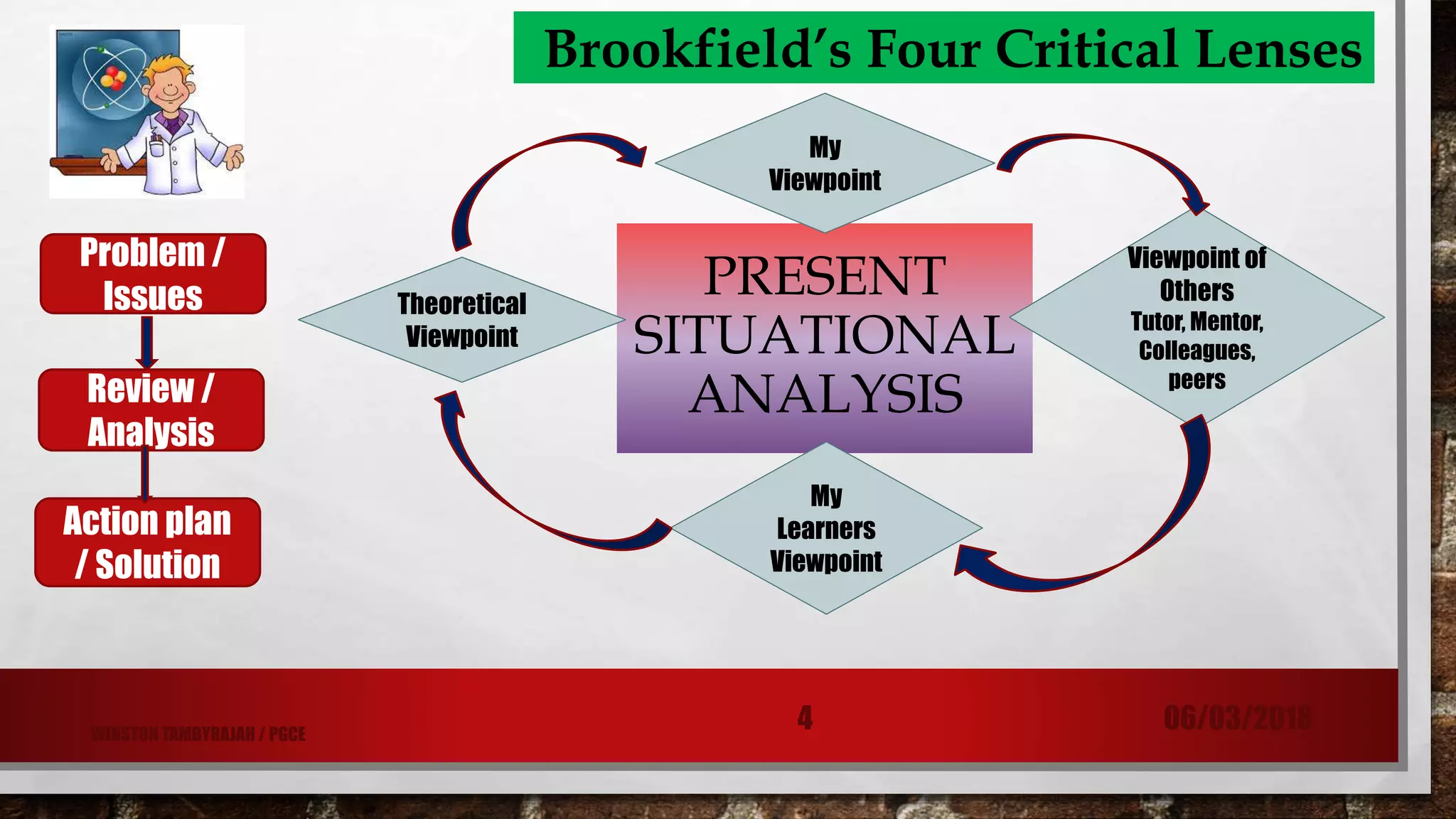
Brookfield’s Four Critical Lenses
Problem /
Issues
Review /
Analysis
Action plan
/ Solution
My
Viewpoint
Viewpoint of
Others
Tutor, Mentor,
Colleagues,
peers
Theoretical
Viewpoint
My
Learners
Viewpoint
06/03/20184WINSTON TAMBYRAJAH / PGCE
HOW BROOKFIELD’S FOUR CRITICAL LENSES WERE USED
Problems & Issues were identified from
My Viewpoint
Viewpoint of Others
My Learners Viewpoint
06/03/20185WINSTON TAMBYRAJAH / PGCE
PROBLEM / ISSUES
•Lessons were too lecturer focused.
•Learners begin to follow the lesson but as time goes tend to lose out and
become defocused.
•Only common handouts were given to all learners.
•All learners were given the same tasks.
•Preparation of laboratory worksheets
06/03/20186WINSTON TAMBYRAJAH / PGCE
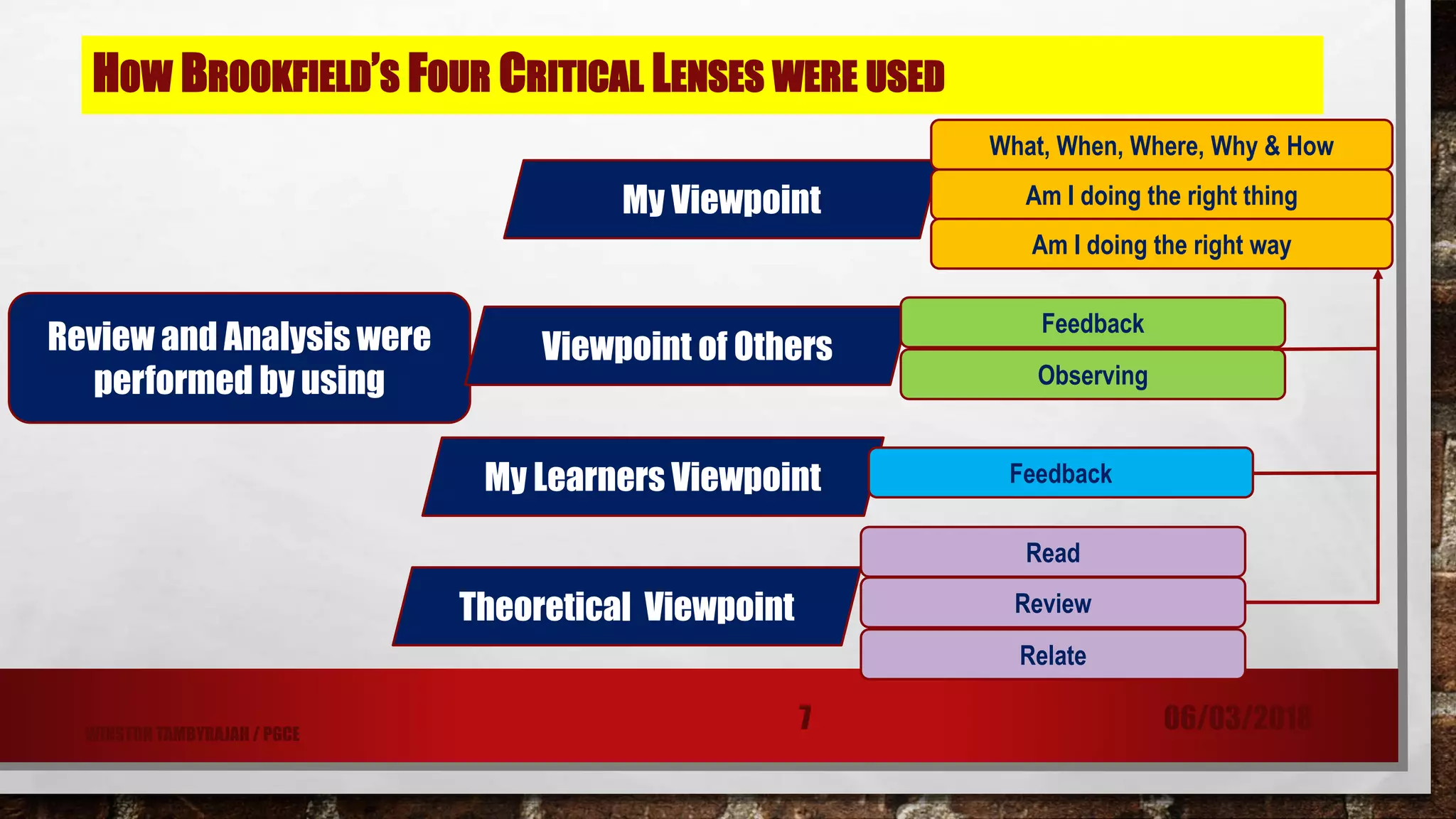
HOW BROOKFIELD’S FOUR CRITICAL LENSES WERE USED
Review and Analysis were
performed by using
My Viewpoint
Viewpoint of Others
My Learners Viewpoint
Theoretical Viewpoint
What, When, Where, Why & How
Am I doing the right thing
Am I doing the right way
Feedback
Observing
Feedback
Read
Review
Relate
06/03/20187WINSTON TAMBYRAJAH / PGCE
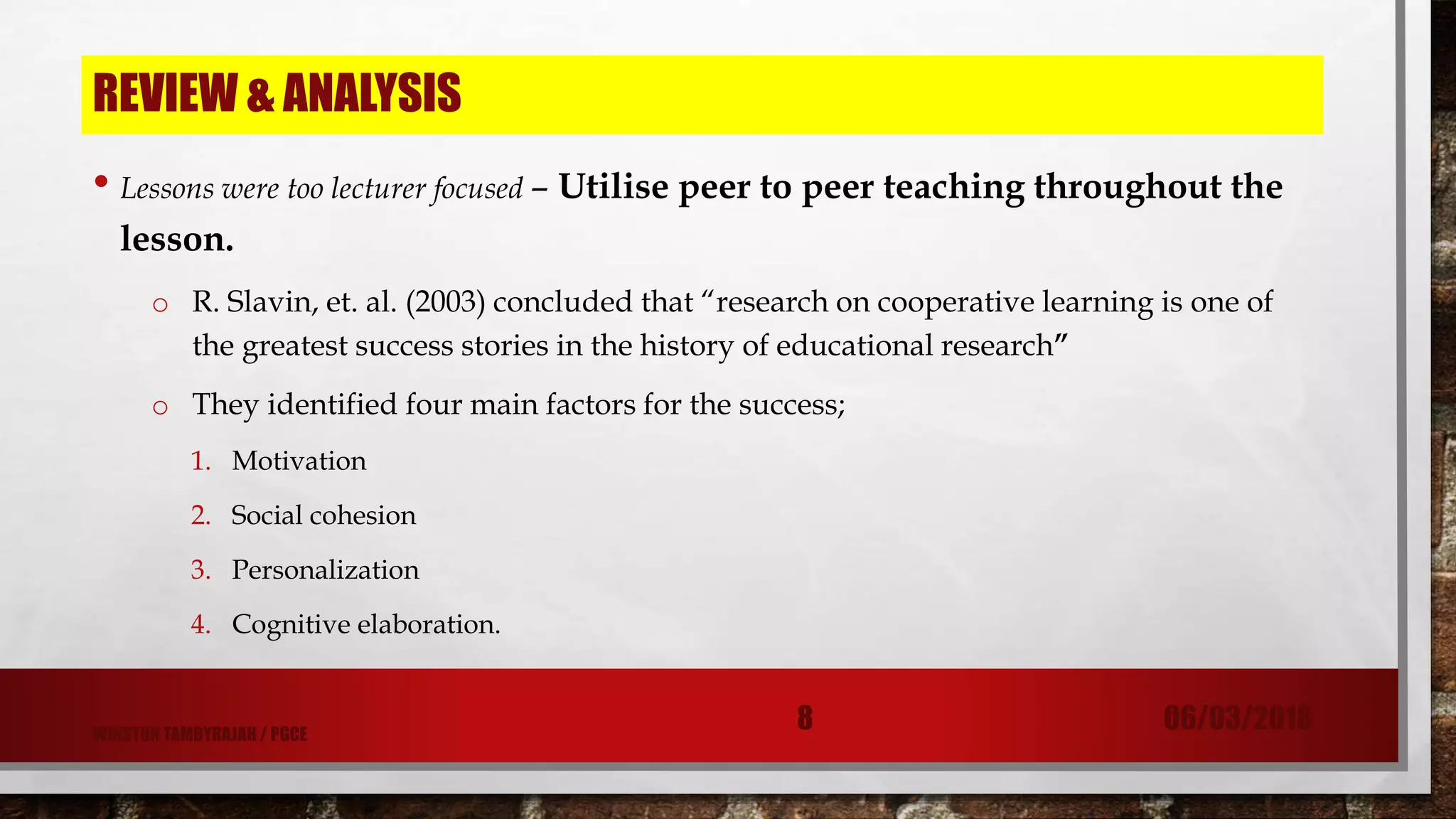
REVIEW & ANALYSIS
• Lessons were too lecturer focused – Utilise peer to peer teaching throughout the
lesson.
o R. Slavin, et. al. (2003) concluded that “research on cooperative learning is one of
the greatest success stories in the history of educational research”
o They identified four main factors for the success;
1. Motivation
2. Social cohesion
3. Personalization
4. Cognitive elaboration.
06/03/20188WINSTON TAMBYRAJAH / PGCE
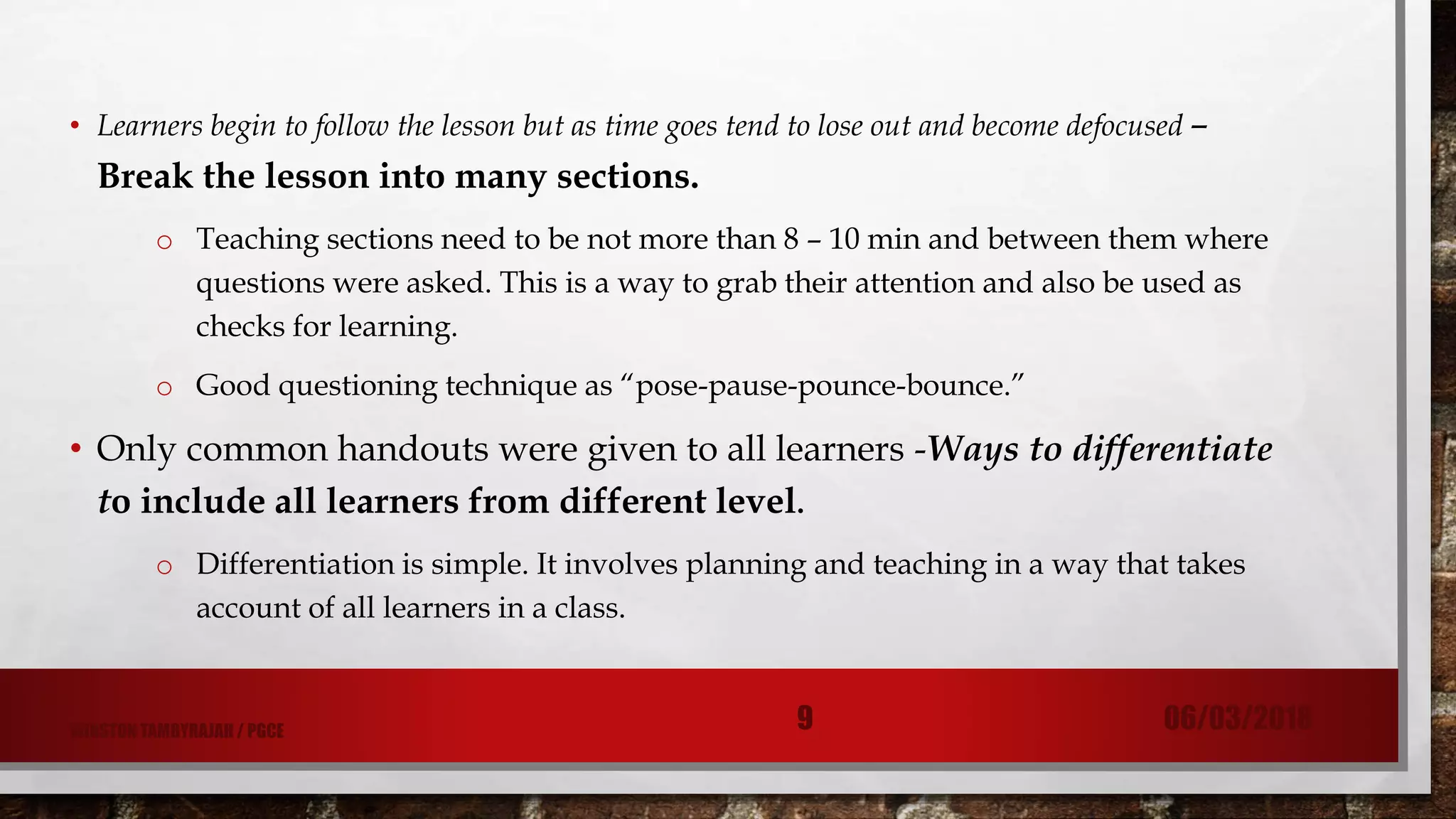
• Learners begin to follow the lesson but as time goes tend to lose out and become defocused –
Break the lesson into many sections.
o Teaching sections need to be not more than 8 – 10 min and between them where
questions were asked. This is a way to grab their attention and also be used as
checks for learning.
o Good questioning technique as “pose-pause-pounce-bounce.”
• Only common handouts were given to all learners -Ways to differentiate
to include all learners from different level.
o Differentiation is simple. It involves planning and teaching in a way that takes
account of all learners in a class.
06/03/20189WINSTON TAMBYRAJAH / PGCE
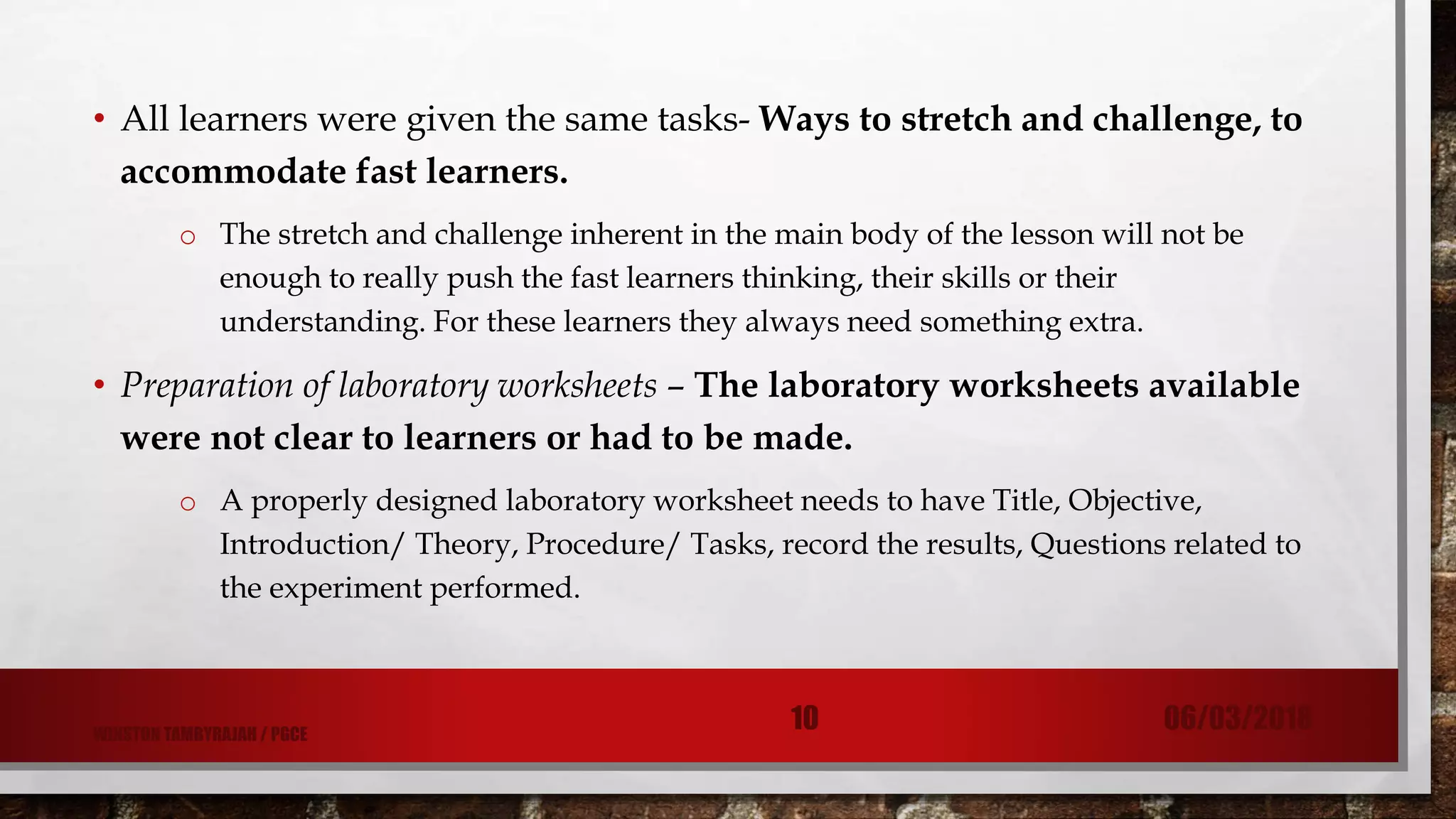
• All learners were given the same tasks- Ways to stretch and challenge, to
accommodate fast learners.
o The stretch and challenge inherent in the main body of the lesson will not be
enough to really push the fast learners thinking, their skills or their
understanding. For these learners they always need something extra.
• Preparation of laboratory worksheets – The laboratory worksheets available
were not clear to learners or had to be made.
o A properly designed laboratory worksheet needs to have Title, Objective,
Introduction/ Theory, Procedure/ Tasks, record the results, Questions related to
the experiment performed.
06/03/201810WINSTON TAMBYRAJAH / PGCE
HOW BROOKFIELD’S FOUR CRITICAL LENSES WERE USED
Action plan & Solution were
decided and taken Others Viewpoint
Theoretical
Viewpoint
My Viewpoint
Problem Thinking Solution
What, When, Where, Why & How
06/03/201811WINSTON TAMBYRAJAH / PGCE
ACTION PLAN & SOLUTION
Eliciting Evidence of Learners’ Achievement is by questioning. This is done
in between lesson’s sections and to draw the attention of the learners. This
was used to as a checks for learning. This practice made the learning more
active and interactive.
Peer to peer teaching was used throughout the lesson. Mini whiteboards
were used to in learner groups to share information within group and then
to the whole class.
06/03/201812WINSTON TAMBYRAJAH / PGCE
Learners were identified through lessons progressing for their Math, logical
thinking, reasoning skills, etc. and were provided worksheets having extra
help if required.
The seating plans were decided as mixed ability groups, thus enabling and
encouraging peer to peer teaching and learning.
1 Temperature change, ∆T o
2 Volume of final mixture cm3
3 Mass of final mixture (g)
4 Specific Heat of a mixture 4.18 J / g oC 4.18 J / g oC
5 Heat evolved in J
6 Heat evolved in kJ
7 Moles of OH–
reacted
8 Moles of H2O formed (mol)
9 ∆Hn (kJ / mol H2O)
10 Average ∆Hn (kJ / mol H2O)
(only required if you did two trials)
1 Temperature change, ∆T oC (∆T = Tf -Ti)
2 Volume of final mixture cm3
(Volume of acid + base)
3 Mass of final mixture (g)
(Mass of calorimeter + neutralized solution) - (Mass of calorimeter)
4 Specific Heat of a mixture 4.18 J / g oC 4.18 J / g oC
5 Heat evolved ∆H in J
(q = m s t)
6 Heat evolved in kJ
(Heat evolved in J /1000)
7 Moles of OH– reacted
(calculate from the 2M NaOH in 25 cm3).
0.05 mol 0.05 mol
8 Moles of H2O formed (mol)
(reaction= 1:1)
0.05 mol 0.05 mol
9 ∆Hn (kJ / mol H2O)
(Heat evolved in kJ / moles of water formed)
10 Average ∆Hn (kJ / mol H2O)
(only required if you did two trials)
06/03/201813WINSTON TAMBYRAJAH / PGCE
There were a lot of stretch incorporated into the main lesson handouts in the
form of additional questions of increasing difficulty. However, at many
instances this was not adequate and some advanced learners required even
more.
To accommodate this additional worksheets were prepared and given to those
who completed the minimum required tasks for the lesson.
06/03/201814WINSTON TAMBYRAJAH / PGCE
06/03/201815WINSTON TAMBYRAJAH / PGCE
A properly designed laboratory worksheets prepared and provided to all
learners with, Title, Objective, Introduction/ Theory, Procedure/ Tasks,
record the results, Questions related to the experiment performed.
On these laboratory sheets differentiation and stretch and challenge all
were incorporated.
06/03/201816
06/03/201817
REFERENCES:
• Brookfield, S. D., (2002) Using the lenses of critically reflective
teaching in the community college classroom. Wiley
Periodicals, Inc., A Wiley Company.
• Wiliam D. Embedded Formative Assessment (p. 133, 71, 82).
Solution Tree Press. Kindle Edition.
• Slavin, R. E., Hurley, E. A., & Chamberlain, A. M. (2003).
Cooperative learning and achievement. In Reynolds, W. M. &
Miller, G. J. (Eds.), Handbook of psychology: Vol. 7.
Educational psychology (pp. 177–198). Hoboken, NJ: Wiley.
• Gershon, M. How to use Differentiation in the Classroom: The
Complete Guide (The 'How To...' Great Classroom Teaching
Series Book 3) (p. 12). Mike Gershon. Kindle Edition.
• Gershon, M. 50 Quick Ways to Stretch and Challenge More-
Able Students (Quick 50 Teaching Series Book 16) (p. 14).
Kindle Edition.
• Wiliam D. Assessment: The Bridge between Teaching and
Learning (2013), Voices form the middle, vol. 21 number 2.
06/03/2018WINSTON TAMBYRAJAH / PGCE 18

Critical review - Teaching Practice

  • 1.
  • 2.
    TEACHING METHODOLOGY -CRITICAL REVIEW •REFLECTIONS ON MY TEACHING METHODOLOGY MY PAST TEACHING EXPERIENCE COMING FROM A UNIVERSITY TEACHING PAST LECTURER CANTERED MAJORITY OF THE STUDENTS ARE MOTIVATED ADULT / MATURE STUDENTS EXPERIENCED LEARNERS LIMITED TEACHER - LEANER INTERACTIONS 06/03/20182WINSTON TAMBYRAJAH / PGCE
  • 3.
    PRESENT TEACHING ENVIRONMENT MIXEDABILITY STUDENTS DIFFERENT CONTRASTING BACKGROUNDS DIFFERENT ABILITY LEVEL DIFFERENT MOTIVATIONAL STAGES DIFFERING IN CONFIDENCE LEVELS REQUIRES MORE TEACHER INTERACTION AND SUPPORT MIXED AGE GROUP AND BROADER RANGE OF AGE IN THE LEARNER GROUPS 06/03/20183WINSTON TAMBYRAJAH / PGCE
  • 4.
    PRESENT SITUATIONAL ANALYSIS Brookfield’s Four CriticalLenses Problem / Issues Review / Analysis Action plan / Solution My Viewpoint Viewpoint of Others Tutor, Mentor, Colleagues, peers Theoretical Viewpoint My Learners Viewpoint 06/03/20184WINSTON TAMBYRAJAH / PGCE
  • 5.
    HOW BROOKFIELD’S FOURCRITICAL LENSES WERE USED Problems & Issues were identified from My Viewpoint Viewpoint of Others My Learners Viewpoint 06/03/20185WINSTON TAMBYRAJAH / PGCE
  • 6.
    PROBLEM / ISSUES •Lessonswere too lecturer focused. •Learners begin to follow the lesson but as time goes tend to lose out and become defocused. •Only common handouts were given to all learners. •All learners were given the same tasks. •Preparation of laboratory worksheets 06/03/20186WINSTON TAMBYRAJAH / PGCE
  • 7.
    HOW BROOKFIELD’S FOURCRITICAL LENSES WERE USED Review and Analysis were performed by using My Viewpoint Viewpoint of Others My Learners Viewpoint Theoretical Viewpoint What, When, Where, Why & How Am I doing the right thing Am I doing the right way Feedback Observing Feedback Read Review Relate 06/03/20187WINSTON TAMBYRAJAH / PGCE
  • 8.
    REVIEW & ANALYSIS •Lessons were too lecturer focused – Utilise peer to peer teaching throughout the lesson. o R. Slavin, et. al. (2003) concluded that “research on cooperative learning is one of the greatest success stories in the history of educational research” o They identified four main factors for the success; 1. Motivation 2. Social cohesion 3. Personalization 4. Cognitive elaboration. 06/03/20188WINSTON TAMBYRAJAH / PGCE
  • 9.
    • Learners beginto follow the lesson but as time goes tend to lose out and become defocused – Break the lesson into many sections. o Teaching sections need to be not more than 8 – 10 min and between them where questions were asked. This is a way to grab their attention and also be used as checks for learning. o Good questioning technique as “pose-pause-pounce-bounce.” • Only common handouts were given to all learners -Ways to differentiate to include all learners from different level. o Differentiation is simple. It involves planning and teaching in a way that takes account of all learners in a class. 06/03/20189WINSTON TAMBYRAJAH / PGCE
  • 10.
    • All learnerswere given the same tasks- Ways to stretch and challenge, to accommodate fast learners. o The stretch and challenge inherent in the main body of the lesson will not be enough to really push the fast learners thinking, their skills or their understanding. For these learners they always need something extra. • Preparation of laboratory worksheets – The laboratory worksheets available were not clear to learners or had to be made. o A properly designed laboratory worksheet needs to have Title, Objective, Introduction/ Theory, Procedure/ Tasks, record the results, Questions related to the experiment performed. 06/03/201810WINSTON TAMBYRAJAH / PGCE
  • 11.
    HOW BROOKFIELD’S FOURCRITICAL LENSES WERE USED Action plan & Solution were decided and taken Others Viewpoint Theoretical Viewpoint My Viewpoint Problem Thinking Solution What, When, Where, Why & How 06/03/201811WINSTON TAMBYRAJAH / PGCE
  • 12.
    ACTION PLAN &SOLUTION Eliciting Evidence of Learners’ Achievement is by questioning. This is done in between lesson’s sections and to draw the attention of the learners. This was used to as a checks for learning. This practice made the learning more active and interactive. Peer to peer teaching was used throughout the lesson. Mini whiteboards were used to in learner groups to share information within group and then to the whole class. 06/03/201812WINSTON TAMBYRAJAH / PGCE
  • 13.
    Learners were identifiedthrough lessons progressing for their Math, logical thinking, reasoning skills, etc. and were provided worksheets having extra help if required. The seating plans were decided as mixed ability groups, thus enabling and encouraging peer to peer teaching and learning. 1 Temperature change, ∆T o 2 Volume of final mixture cm3 3 Mass of final mixture (g) 4 Specific Heat of a mixture 4.18 J / g oC 4.18 J / g oC 5 Heat evolved in J 6 Heat evolved in kJ 7 Moles of OH– reacted 8 Moles of H2O formed (mol) 9 ∆Hn (kJ / mol H2O) 10 Average ∆Hn (kJ / mol H2O) (only required if you did two trials) 1 Temperature change, ∆T oC (∆T = Tf -Ti) 2 Volume of final mixture cm3 (Volume of acid + base) 3 Mass of final mixture (g) (Mass of calorimeter + neutralized solution) - (Mass of calorimeter) 4 Specific Heat of a mixture 4.18 J / g oC 4.18 J / g oC 5 Heat evolved ∆H in J (q = m s t) 6 Heat evolved in kJ (Heat evolved in J /1000) 7 Moles of OH– reacted (calculate from the 2M NaOH in 25 cm3). 0.05 mol 0.05 mol 8 Moles of H2O formed (mol) (reaction= 1:1) 0.05 mol 0.05 mol 9 ∆Hn (kJ / mol H2O) (Heat evolved in kJ / moles of water formed) 10 Average ∆Hn (kJ / mol H2O) (only required if you did two trials) 06/03/201813WINSTON TAMBYRAJAH / PGCE
  • 14.
    There were alot of stretch incorporated into the main lesson handouts in the form of additional questions of increasing difficulty. However, at many instances this was not adequate and some advanced learners required even more. To accommodate this additional worksheets were prepared and given to those who completed the minimum required tasks for the lesson. 06/03/201814WINSTON TAMBYRAJAH / PGCE
  • 15.
  • 16.
    A properly designedlaboratory worksheets prepared and provided to all learners with, Title, Objective, Introduction/ Theory, Procedure/ Tasks, record the results, Questions related to the experiment performed. On these laboratory sheets differentiation and stretch and challenge all were incorporated. 06/03/201816
  • 17.
  • 18.
    REFERENCES: • Brookfield, S.D., (2002) Using the lenses of critically reflective teaching in the community college classroom. Wiley Periodicals, Inc., A Wiley Company. • Wiliam D. Embedded Formative Assessment (p. 133, 71, 82). Solution Tree Press. Kindle Edition. • Slavin, R. E., Hurley, E. A., & Chamberlain, A. M. (2003). Cooperative learning and achievement. In Reynolds, W. M. & Miller, G. J. (Eds.), Handbook of psychology: Vol. 7. Educational psychology (pp. 177–198). Hoboken, NJ: Wiley. • Gershon, M. How to use Differentiation in the Classroom: The Complete Guide (The 'How To...' Great Classroom Teaching Series Book 3) (p. 12). Mike Gershon. Kindle Edition. • Gershon, M. 50 Quick Ways to Stretch and Challenge More- Able Students (Quick 50 Teaching Series Book 16) (p. 14). Kindle Edition. • Wiliam D. Assessment: The Bridge between Teaching and Learning (2013), Voices form the middle, vol. 21 number 2. 06/03/2018WINSTON TAMBYRAJAH / PGCE 18