Structure and mock question
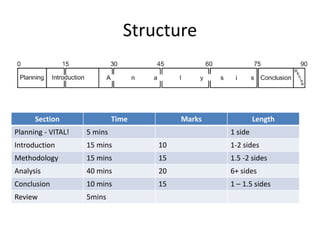
Structure
Section Time Marks Length
Planning - VITAL! 5 mins 1 side
Introduction 15 mins 10 1-2 sides
Methodology 15 mins 15 1.5 -2 sides
Analysis 40 mins 20 6+ sides
Conclusion 10 mins 15 1 – 1.5 sides
Review 5mins
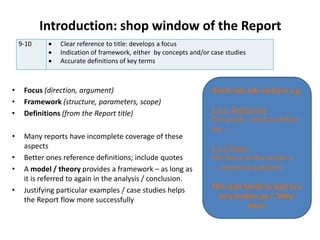
Introduction: shop window of the Report
9-10  Clear reference to title: develops a focus
 Indication of framework, either by concepts and/or case studies
 Accurate definitions of key terms
• Focus (direction, argument)
• Framework (structure, parameters, scope)
• Definitions (from the Report title)
• Many reports have incomplete coverage of these
aspects
• Better ones reference definitions; include quotes
• A model / theory provides a framework – as long as
it is referred to again in the analysis / conclusion.
• Justifying particular examples / case studies helps
the Report flow more successfully
Avoid sub-sub-sections e.g.
1.1.1. Definitions
The words I need to define
are......
1.1.2 Focus
The focus of this report is
.....(rewrites question)
This style tends to lead to a
very broken up / ‘bitty’
intro.
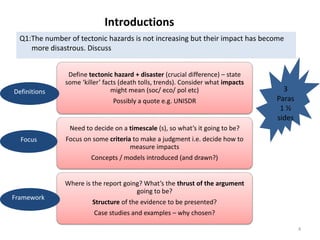
Introductions
Q1:The number of tectonic hazards is not increasing but their impact has become
more disastrous. Discuss
Define tectonic hazard + disaster (crucial difference) – state
some ‘killer’ facts (death tolls, trends). Consider what impacts
might mean (soc/ eco/ pol etc)
Possibly a quote e.g. UNISDR
Need to decide on a timescale (s), so what’s it going to be?
Focus on some criteria to make a judgment i.e. decide how to
measure impacts
Concepts / models introduced (and drawn?)
Where is the report going? What’s the thrust of the argument
going to be?
Structure of the evidence to be presented?
Case studies and examples – why chosen?
3
Paras
1 ½
sides
Definitions
Focus
Framework
4
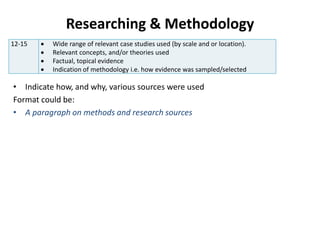
Researching & Methodology
12-15  Wide range of relevant case studies used (by scale and or location).
 Relevant concepts, and/or theories used
 Factual, topical evidence
 Indication of methodology i.e. how evidence was sampled/selected
• Indicate how, and why, various sources were used
Format could be:
• A paragraph on methods and research sources
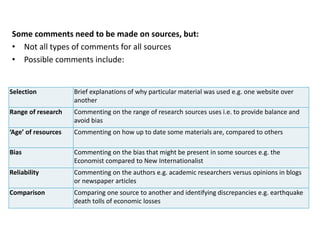
Selection Brief explanations of why particular material was used e.g. one website over
another
Range of research Commenting on the range of research sources uses i.e. to provide balance and
avoid bias
‘Age’ of resources Commenting on how up to date some materials are, compared to others
Bias Commenting on the bias that might be present in some sources e.g. the
Economist compared to New Internationalist
Reliability Commenting on the authors e.g. academic researchers versus opinions in blogs
or newspaper articles
Comparison Comparing one source to another and identifying discrepancies e.g. earthquake
death tolls of economic losses
Some comments need to be made on sources, but:
• Not all types of comments for all sources
• Possible comments include:
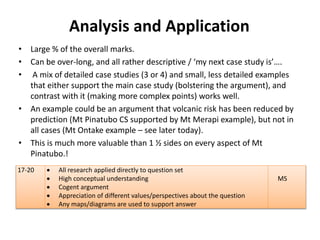
Analysis and Application
17-20  All research applied directly to question set
 High conceptual understanding
 Cogent argument
 Appreciation of different values/perspectives about the question
 Any maps/diagrams are used to support answer
MS
• Large % of the overall marks.
• Can be over-long, and all rather descriptive / ‘my next case study is’….
• A mix of detailed case studies (3 or 4) and small, less detailed examples
that either support the main case study (bolstering the argument), and
contrast with it (making more complex points) works well.
• An example could be an argument that volcanic risk has been reduced by
prediction (Mt Pinatubo CS supported by Mt Merapi example), but not in
all cases (Mt Ontake example – see later today).
• This is much more valuable than 1 ½ sides on every aspect of Mt
Pinatubo.!
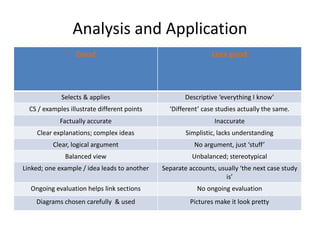
Analysis and Application
Good Less good
Selects & applies Descriptive ‘everything I know’
CS / examples illustrate different points ‘Different’ case studies actually the same.
Factually accurate Inaccurate
Clear explanations; complex ideas Simplistic, lacks understanding
Clear, logical argument No argument, just ‘stuff’
Balanced view Unbalanced; stereotypical
Linked; one example / idea leads to another Separate accounts, usually ‘the next case study
is’
Ongoing evaluation helps link sections No ongoing evaluation
Diagrams chosen carefully & used Pictures make it look pretty
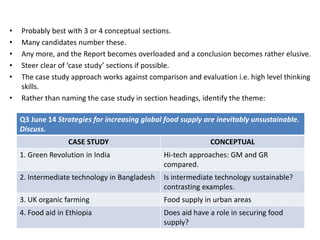
• Probably best with 3 or 4 conceptual sections.
• Many candidates number these.
• Any more, and the Report becomes overloaded and a conclusion becomes rather elusive.
• Steer clear of ‘case study’ sections if possible.
• The case study approach works against comparison and evaluation i.e. high level thinking
skills.
• Rather than naming the case study in section headings, identify the theme:
Q3 June 14 Strategies for increasing global food supply are inevitably unsustainable.
Discuss.
CASE STUDY CONCEPTUAL
1. Green Revolution in India Hi-tech approaches: GM and GR
compared.
2. Intermediate technology in Bangladesh Is intermediate technology sustainable?
contrasting examples.
3. UK organic farming Food supply in urban areas
4. Food aid in Ethiopia Does aid have a role in securing food
supply?
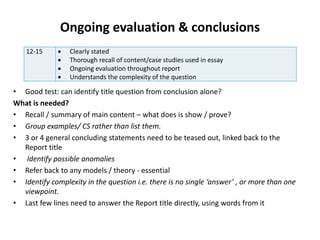
Ongoing evaluation & conclusions
12-15  Clearly stated
 Thorough recall of content/case studies used in essay
 Ongoing evaluation throughout report
 Understands the complexity of the question
• Good test: can identify title question from conclusion alone?
What is needed?
• Recall / summary of main content – what does is show / prove?
• Group examples/ CS rather than list them.
• 3 or 4 general concluding statements need to be teased out, linked back to the
Report title
• Identify possible anomalies
• Refer back to any models / theory - essential
• Identify complexity in the question i.e. there is no single ‘answer’ , or more than one
viewpoint.
• Last few lines need to answer the Report title directly, using words from it
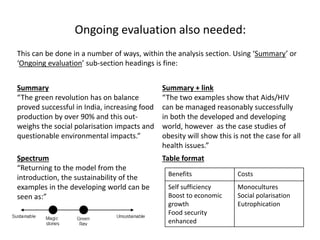
Ongoing evaluation also needed:
This can be done in a number of ways, within the analysis section. Using ‘Summary’ or
‘Ongoing evaluation’ sub-section headings is fine:
Summary
“The green revolution has on balance
proved successful in India, increasing food
production by over 90% and this out-
weighs the social polarisation impacts and
questionable environmental impacts.”
Summary + link
“The two examples show that Aids/HIV
can be managed reasonably successfully
in both the developed and developing
world, however as the case studies of
obesity will show this is not the case for all
health issues.”
Spectrum
“Returning to the model from the
introduction, the sustainability of the
examples in the developing world can be
seen as:”
Table format
Benefits Costs
Self sufficiency
Boost to economic
growth
Food security
enhanced
Monocultures
Social polarisation
Eutrophication
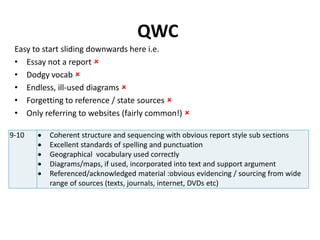
QWC
9-10  Coherent structure and sequencing with obvious report style sub sections
 Excellent standards of spelling and punctuation
 Geographical vocabulary used correctly
 Diagrams/maps, if used, incorporated into text and support argument
 Referenced/acknowledged material :obvious evidencing / sourcing from wide
range of sources (texts, journals, internet, DVDs etc)
Easy to start sliding downwards here i.e.
• Essay not a report 
• Dodgy vocab 
• Endless, ill-used diagrams 
• Forgetting to reference / state sources 
• Only referring to websites (fairly common!) 
Remember argue
both sides of coin
until the
conclusion
POSSIBLE questions?
• Evaluate the importance of demographics as a key cause of food
insecurity.
• The environment is just one element in a complex set of causes
leading to food insecurity. Discuss.
• There are a number of causes that lead to food insecurity and they
exist at all scales. Discuss.
• To what extent is food insecurity the result of environmental
causes?
• Assess the role of demographics in global food insecurity.
• Assess the view that food insecurity is the result of demographic,
environmental and other factors operating at national scales.
• "The global pattern of food insecurity reflects local and regional
factors." Discuss.
• To what extent is food insecurity the result of one primary cause?
Practice Question
To what extent do causes of food insecurity vary
from place to place?

Mock

  • 1.
  • 2.
    Structure Section Time MarksLength Planning - VITAL! 5 mins 1 side Introduction 15 mins 10 1-2 sides Methodology 15 mins 15 1.5 -2 sides Analysis 40 mins 20 6+ sides Conclusion 10 mins 15 1 – 1.5 sides Review 5mins
  • 3.
    Introduction: shop windowof the Report 9-10  Clear reference to title: develops a focus  Indication of framework, either by concepts and/or case studies  Accurate definitions of key terms • Focus (direction, argument) • Framework (structure, parameters, scope) • Definitions (from the Report title) • Many reports have incomplete coverage of these aspects • Better ones reference definitions; include quotes • A model / theory provides a framework – as long as it is referred to again in the analysis / conclusion. • Justifying particular examples / case studies helps the Report flow more successfully Avoid sub-sub-sections e.g. 1.1.1. Definitions The words I need to define are...... 1.1.2 Focus The focus of this report is .....(rewrites question) This style tends to lead to a very broken up / ‘bitty’ intro.
  • 4.
    Introductions Q1:The number oftectonic hazards is not increasing but their impact has become more disastrous. Discuss Define tectonic hazard + disaster (crucial difference) – state some ‘killer’ facts (death tolls, trends). Consider what impacts might mean (soc/ eco/ pol etc) Possibly a quote e.g. UNISDR Need to decide on a timescale (s), so what’s it going to be? Focus on some criteria to make a judgment i.e. decide how to measure impacts Concepts / models introduced (and drawn?) Where is the report going? What’s the thrust of the argument going to be? Structure of the evidence to be presented? Case studies and examples – why chosen? 3 Paras 1 ½ sides Definitions Focus Framework 4
  • 5.
    Researching & Methodology 12-15 Wide range of relevant case studies used (by scale and or location).  Relevant concepts, and/or theories used  Factual, topical evidence  Indication of methodology i.e. how evidence was sampled/selected • Indicate how, and why, various sources were used Format could be: • A paragraph on methods and research sources
  • 6.
    Selection Brief explanationsof why particular material was used e.g. one website over another Range of research Commenting on the range of research sources uses i.e. to provide balance and avoid bias ‘Age’ of resources Commenting on how up to date some materials are, compared to others Bias Commenting on the bias that might be present in some sources e.g. the Economist compared to New Internationalist Reliability Commenting on the authors e.g. academic researchers versus opinions in blogs or newspaper articles Comparison Comparing one source to another and identifying discrepancies e.g. earthquake death tolls of economic losses Some comments need to be made on sources, but: • Not all types of comments for all sources • Possible comments include:
  • 7.
    Analysis and Application 17-20 All research applied directly to question set  High conceptual understanding  Cogent argument  Appreciation of different values/perspectives about the question  Any maps/diagrams are used to support answer MS • Large % of the overall marks. • Can be over-long, and all rather descriptive / ‘my next case study is’…. • A mix of detailed case studies (3 or 4) and small, less detailed examples that either support the main case study (bolstering the argument), and contrast with it (making more complex points) works well. • An example could be an argument that volcanic risk has been reduced by prediction (Mt Pinatubo CS supported by Mt Merapi example), but not in all cases (Mt Ontake example – see later today). • This is much more valuable than 1 ½ sides on every aspect of Mt Pinatubo.!
  • 8.
    Analysis and Application GoodLess good Selects & applies Descriptive ‘everything I know’ CS / examples illustrate different points ‘Different’ case studies actually the same. Factually accurate Inaccurate Clear explanations; complex ideas Simplistic, lacks understanding Clear, logical argument No argument, just ‘stuff’ Balanced view Unbalanced; stereotypical Linked; one example / idea leads to another Separate accounts, usually ‘the next case study is’ Ongoing evaluation helps link sections No ongoing evaluation Diagrams chosen carefully & used Pictures make it look pretty
  • 9.
    • Probably bestwith 3 or 4 conceptual sections. • Many candidates number these. • Any more, and the Report becomes overloaded and a conclusion becomes rather elusive. • Steer clear of ‘case study’ sections if possible. • The case study approach works against comparison and evaluation i.e. high level thinking skills. • Rather than naming the case study in section headings, identify the theme: Q3 June 14 Strategies for increasing global food supply are inevitably unsustainable. Discuss. CASE STUDY CONCEPTUAL 1. Green Revolution in India Hi-tech approaches: GM and GR compared. 2. Intermediate technology in Bangladesh Is intermediate technology sustainable? contrasting examples. 3. UK organic farming Food supply in urban areas 4. Food aid in Ethiopia Does aid have a role in securing food supply?
  • 10.
    Ongoing evaluation &conclusions 12-15  Clearly stated  Thorough recall of content/case studies used in essay  Ongoing evaluation throughout report  Understands the complexity of the question • Good test: can identify title question from conclusion alone? What is needed? • Recall / summary of main content – what does is show / prove? • Group examples/ CS rather than list them. • 3 or 4 general concluding statements need to be teased out, linked back to the Report title • Identify possible anomalies • Refer back to any models / theory - essential • Identify complexity in the question i.e. there is no single ‘answer’ , or more than one viewpoint. • Last few lines need to answer the Report title directly, using words from it
  • 11.
    Ongoing evaluation alsoneeded: This can be done in a number of ways, within the analysis section. Using ‘Summary’ or ‘Ongoing evaluation’ sub-section headings is fine: Summary “The green revolution has on balance proved successful in India, increasing food production by over 90% and this out- weighs the social polarisation impacts and questionable environmental impacts.” Summary + link “The two examples show that Aids/HIV can be managed reasonably successfully in both the developed and developing world, however as the case studies of obesity will show this is not the case for all health issues.” Spectrum “Returning to the model from the introduction, the sustainability of the examples in the developing world can be seen as:” Table format Benefits Costs Self sufficiency Boost to economic growth Food security enhanced Monocultures Social polarisation Eutrophication
  • 12.
    QWC 9-10  Coherentstructure and sequencing with obvious report style sub sections  Excellent standards of spelling and punctuation  Geographical vocabulary used correctly  Diagrams/maps, if used, incorporated into text and support argument  Referenced/acknowledged material :obvious evidencing / sourcing from wide range of sources (texts, journals, internet, DVDs etc) Easy to start sliding downwards here i.e. • Essay not a report  • Dodgy vocab  • Endless, ill-used diagrams  • Forgetting to reference / state sources  • Only referring to websites (fairly common!) 
  • 13.
    Remember argue both sidesof coin until the conclusion
  • 15.
    POSSIBLE questions? • Evaluatethe importance of demographics as a key cause of food insecurity. • The environment is just one element in a complex set of causes leading to food insecurity. Discuss. • There are a number of causes that lead to food insecurity and they exist at all scales. Discuss. • To what extent is food insecurity the result of environmental causes? • Assess the role of demographics in global food insecurity. • Assess the view that food insecurity is the result of demographic, environmental and other factors operating at national scales. • "The global pattern of food insecurity reflects local and regional factors." Discuss. • To what extent is food insecurity the result of one primary cause?
  • 16.
    Practice Question To whatextent do causes of food insecurity vary from place to place?