Report Writing Workshop Improving the quality of Reporting as a learning and monitoring tool April 2007
Time Plan 9 – 9.30 Introduce Ourselves - Expectations 9.30 -9.45 Who do we Report for? 5 Buzz Groups 9.45 - 10.30  Groups Plenary – The Who and Why  of Reporting 10.30 – 11.00 Tea 11 – 11.45   A Template – One Example of a  Report Structure 11.45 - 12.30  Group work in 5s – Our Report 12.30 – 1.30 Lunch 1.30 – 2.30 Plenary Feedback – presentation of  reports 2.30 – 3.00 How can we apply what we have learnt 3 – 3.30 Tea 3.30 – 4.30  Outcomes and Indicators?
Who Do You Write a Report For? Ourselves – our institutional memory – where we learn and encourage others to  learn  from passed experience Our Partners – people we work with to achieve our objectives, donors as well as boundary partners (those local agencies who joins us in implementation)‏ Beneficiaries – members those for who the project is aimed and with whom we have planned it Researchers, Universities, Government agencies, others
Some Basic Principles First a Few Simple Ideas Each separate report should be correctly identified. At the very beginning are the main identifiers, including at least the title  (period and location the report covers)  and the author. .  Using headers and footers in WORD ensures page numbering and that some ‘identifiers’ then appear on every page of a document.
Reporting – Key Questions Did you do what you set out to do? What were you expected outcomes? What progress did you make and what obstacles did you encounter? What change, for the community, did you bring about and.. How do you know? What now? What will you now do differently? Where is the data on which you base your report? What did we  learn?
Now a Suggested Template What is the Background/Context to our work,  introduction; brief context history and summary of project history Was our Project successes!!  How do these relate to our stated Outcomes? What were our indicators of success?  If we succeeded Why?  (what were the key factors, causes); What Failed in your Project  (which outcomes were not achieved?)  Why?  (reasons); How did the community participate? Planning the project and management/decision making What was the community’s contribution  (donations, inputs eg. labour, and cash)? What did we have to change in our plan and why?  (eg changes in strategies)? Were there unanticipated problems? What Lessons  did we learn? Some key learning points What are our Recommendations  (specify to whom).
Background, introduction; What was your original clear purpose, Aim? What were the OUTCOMES that you set yourself for the period under review Has the general context changed? Economic,  Political , nationally or locally Is this part of a wider effort in which your agency is one ‘partner’?
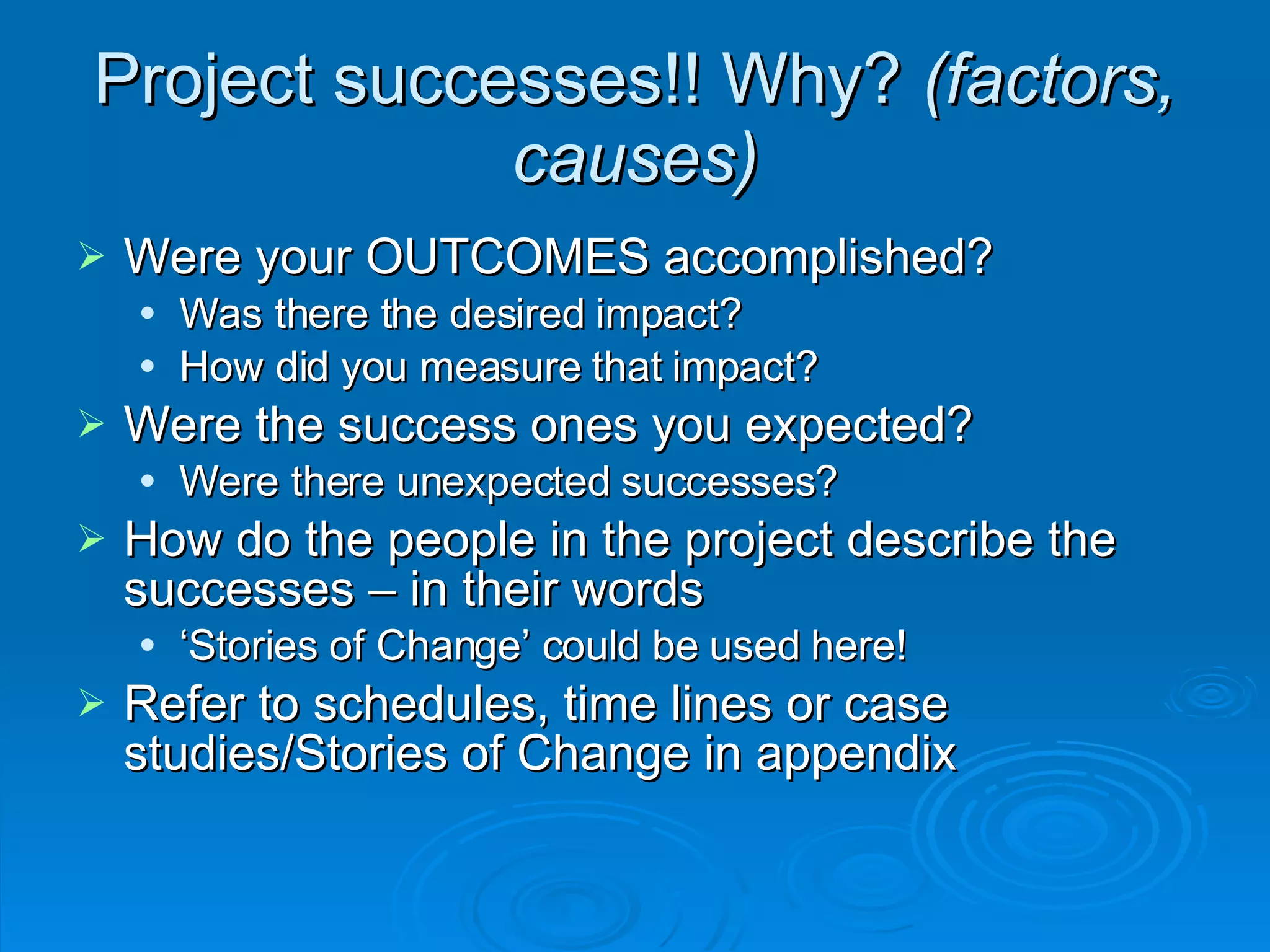
Project successes!! Why?  (factors, causes)‏ Were your OUTCOMES accomplished?  Was there the desired impact? How did you measure that impact? Were the success ones you expected?  Were there unexpected successes? How do the people in the project describe the successes – in their words  ‘ Stories of Change’ could be used here! Refer to schedules, time lines or case studies/Stories of Change in appendix
Project failures  (in reaching objectives)  Why?  (reasons)‏ Be honest – that’s primarily how we learn Where projects failed to meet expectations was that due to poor capacity/skills of staff or were the objectives poorly thought through Did you fail to reach your objectives BUT reach unexpected successes? Were the factors producing failure things you could control or factors over which you had no control?
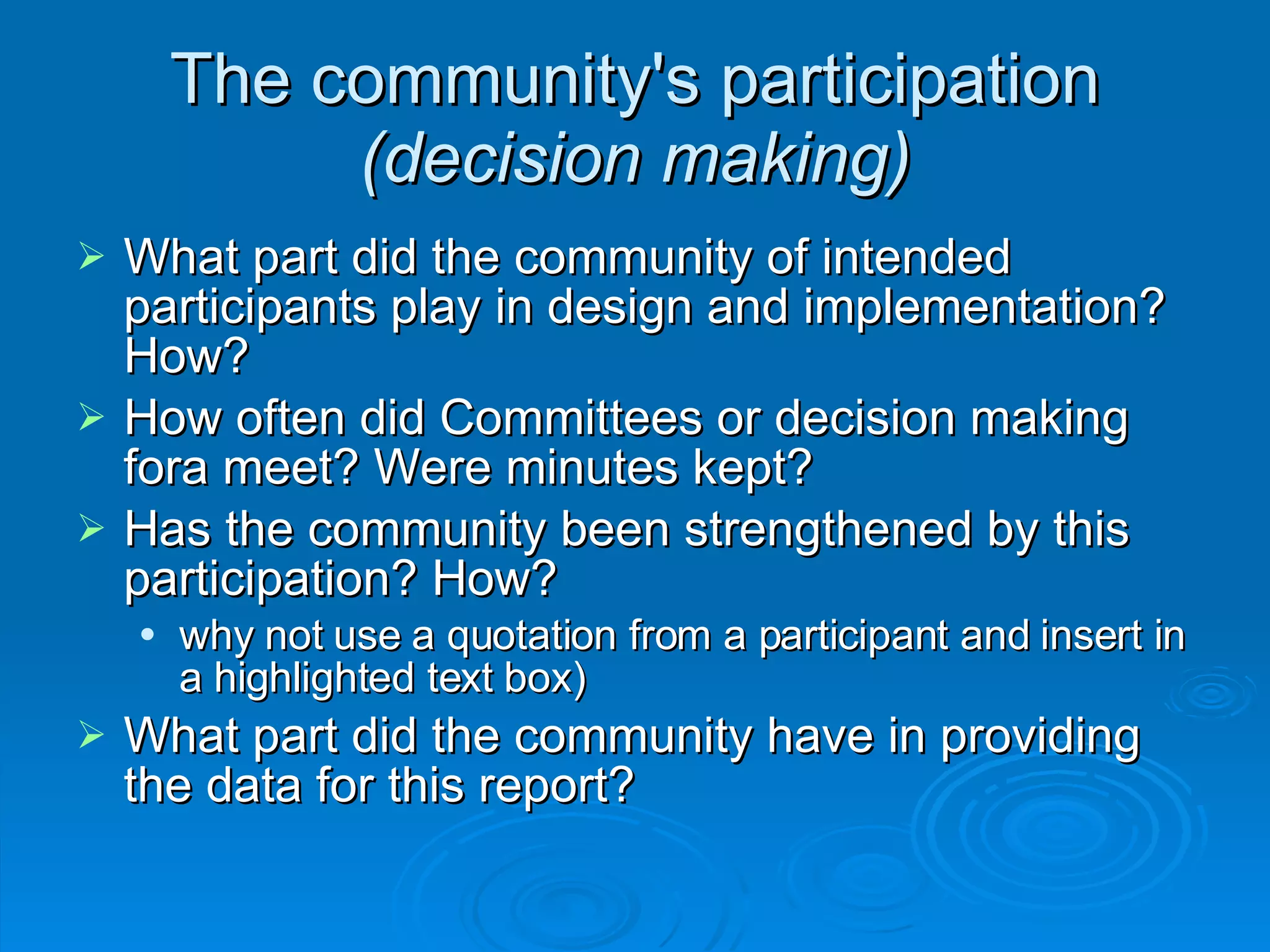
The community's participation  (decision making)‏ What part did the community of intended participants play in design and implementation? How? How often did Committees or decision making fora meet? Were minutes kept? Has the community been strengthened by this participation? How? why not use a quotation from a participant and insert in a highlighted text box)‏ What part did the community have in providing the data for this report?
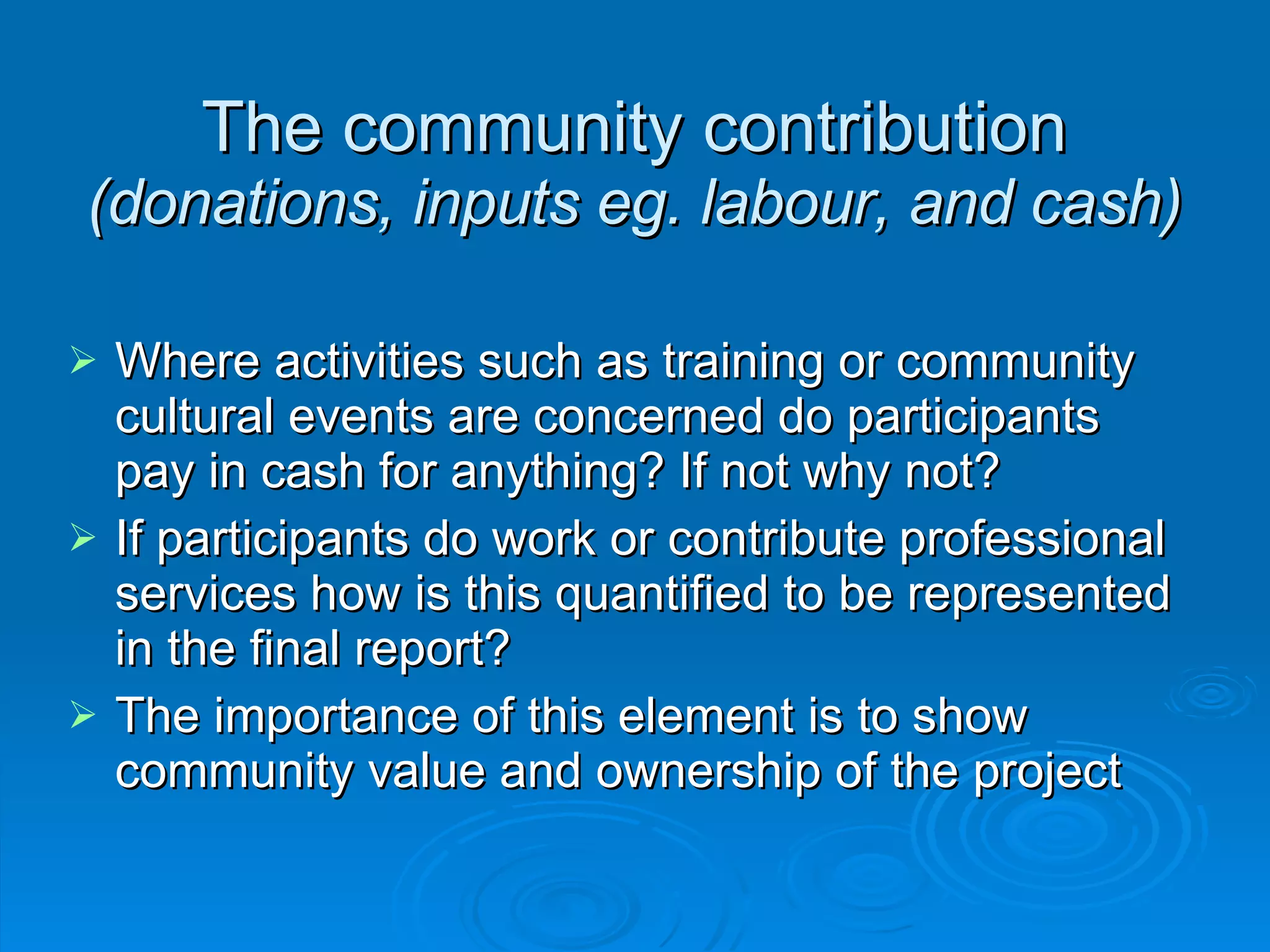
The community contribution  (donations, inputs eg. labour, and cash)‏ Where activities such as training or community cultural events are concerned do participants pay in cash for anything? If not why not? If participants do work or contribute professional services how is this quantified to be represented in the final report? The importance of this element is to show community value and ownership of the project
Needed changes  (e.g changes in strategies)‏ What did you have to change to meet the project Outcomes?  Staffing? Training? Were the key staff enabled to do their work effectively/line management sufficient? Were physical inputs sufficient or altered because over or under budget?  Did you programme have to be substantially changed because of external factors (war, local obstacles?)‏
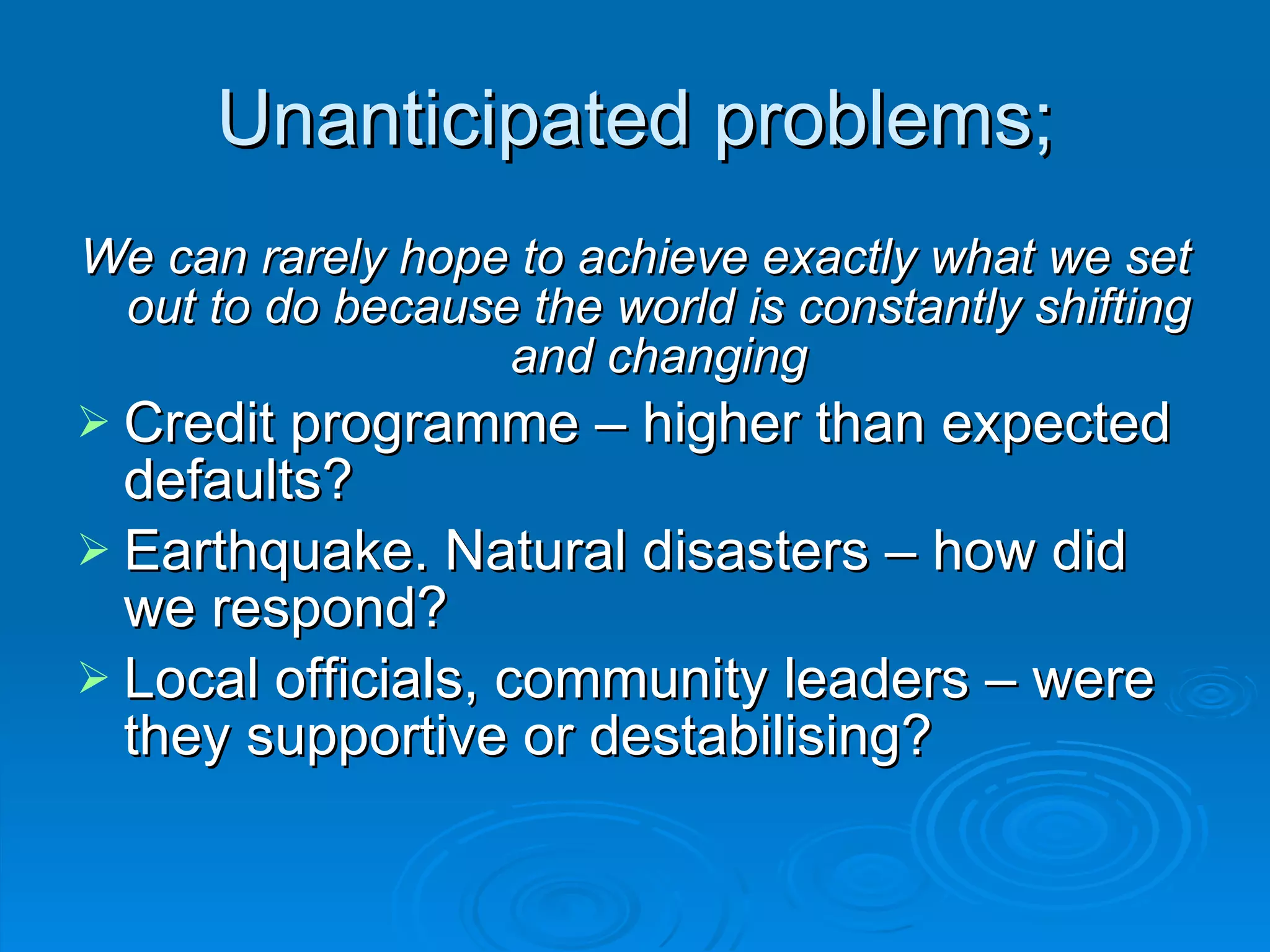
Unanticipated problems; We can rarely hope to achieve exactly what we set out to do because the world is constantly shifting and changing Credit programme – higher than expected defaults? Earthquake. Natural disasters – how did we respond? Local officials, community leaders – were they supportive or destabilising?
Lessons learned This is often the key to a good report – what have you learnt from this period? How did you conclude that these were areas of learning?  Was this reviewed by the staff team – are these commonly agreed learning points? What have the community learned from what’s been achieved?  How have you captured this? (Stories of Change)‏
Recommendations  (specify to whom)‏ Recommendations can have different audiences; staff Management board Members Donors Other partners Be precise and not vague and rate your recommendations as those most serious and those of less priority or where more ‘research must be done
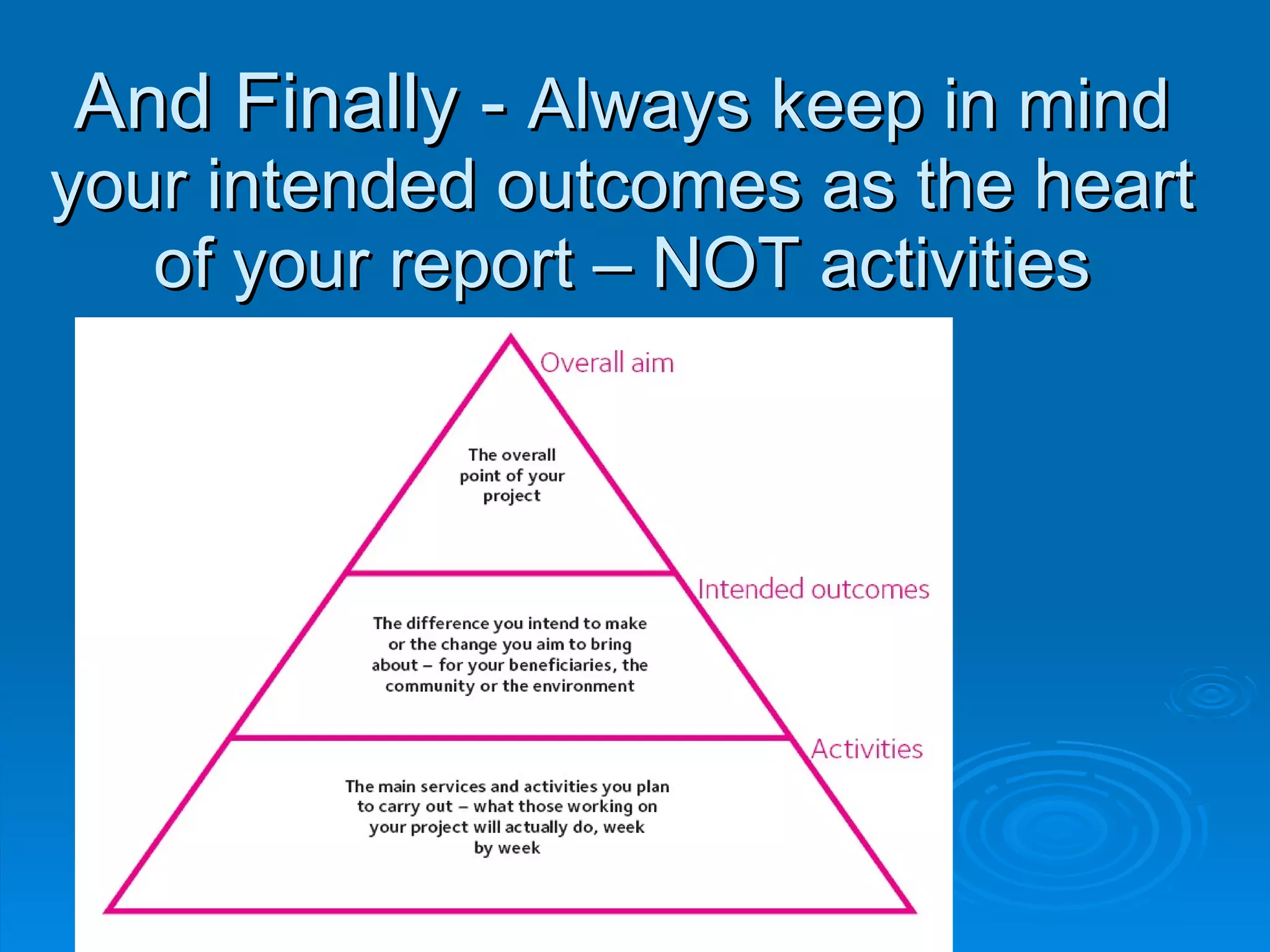
And Finally -  Always keep in mind your intended outcomes as the heart of your report – NOT activities
END Remember to try and use ‘reported speech’, direct quotations from your participants,, in the text of your report.  These can be slightly separated from the main body of the text and possibly put in a highlighted box.

Reporting Workshop

  • 1.
    Report Writing WorkshopImproving the quality of Reporting as a learning and monitoring tool April 2007
  • 2.
    Time Plan 9– 9.30 Introduce Ourselves - Expectations 9.30 -9.45 Who do we Report for? 5 Buzz Groups 9.45 - 10.30 Groups Plenary – The Who and Why of Reporting 10.30 – 11.00 Tea 11 – 11.45 A Template – One Example of a Report Structure 11.45 - 12.30 Group work in 5s – Our Report 12.30 – 1.30 Lunch 1.30 – 2.30 Plenary Feedback – presentation of reports 2.30 – 3.00 How can we apply what we have learnt 3 – 3.30 Tea 3.30 – 4.30 Outcomes and Indicators?
  • 3.
    Who Do YouWrite a Report For? Ourselves – our institutional memory – where we learn and encourage others to learn from passed experience Our Partners – people we work with to achieve our objectives, donors as well as boundary partners (those local agencies who joins us in implementation)‏ Beneficiaries – members those for who the project is aimed and with whom we have planned it Researchers, Universities, Government agencies, others
  • 4.
    Some Basic PrinciplesFirst a Few Simple Ideas Each separate report should be correctly identified. At the very beginning are the main identifiers, including at least the title (period and location the report covers) and the author. . Using headers and footers in WORD ensures page numbering and that some ‘identifiers’ then appear on every page of a document.
  • 5.
    Reporting – KeyQuestions Did you do what you set out to do? What were you expected outcomes? What progress did you make and what obstacles did you encounter? What change, for the community, did you bring about and.. How do you know? What now? What will you now do differently? Where is the data on which you base your report? What did we learn?
  • 6.
    Now a SuggestedTemplate What is the Background/Context to our work, introduction; brief context history and summary of project history Was our Project successes!! How do these relate to our stated Outcomes? What were our indicators of success? If we succeeded Why? (what were the key factors, causes); What Failed in your Project (which outcomes were not achieved?) Why? (reasons); How did the community participate? Planning the project and management/decision making What was the community’s contribution (donations, inputs eg. labour, and cash)? What did we have to change in our plan and why? (eg changes in strategies)? Were there unanticipated problems? What Lessons did we learn? Some key learning points What are our Recommendations (specify to whom).
  • 7.
    Background, introduction; Whatwas your original clear purpose, Aim? What were the OUTCOMES that you set yourself for the period under review Has the general context changed? Economic, Political , nationally or locally Is this part of a wider effort in which your agency is one ‘partner’?
  • 8.
    Project successes!! Why? (factors, causes)‏ Were your OUTCOMES accomplished? Was there the desired impact? How did you measure that impact? Were the success ones you expected? Were there unexpected successes? How do the people in the project describe the successes – in their words ‘ Stories of Change’ could be used here! Refer to schedules, time lines or case studies/Stories of Change in appendix
  • 9.
    Project failures (in reaching objectives) Why? (reasons)‏ Be honest – that’s primarily how we learn Where projects failed to meet expectations was that due to poor capacity/skills of staff or were the objectives poorly thought through Did you fail to reach your objectives BUT reach unexpected successes? Were the factors producing failure things you could control or factors over which you had no control?
  • 10.
    The community's participation (decision making)‏ What part did the community of intended participants play in design and implementation? How? How often did Committees or decision making fora meet? Were minutes kept? Has the community been strengthened by this participation? How? why not use a quotation from a participant and insert in a highlighted text box)‏ What part did the community have in providing the data for this report?
  • 11.
    The community contribution (donations, inputs eg. labour, and cash)‏ Where activities such as training or community cultural events are concerned do participants pay in cash for anything? If not why not? If participants do work or contribute professional services how is this quantified to be represented in the final report? The importance of this element is to show community value and ownership of the project
  • 12.
    Needed changes (e.g changes in strategies)‏ What did you have to change to meet the project Outcomes? Staffing? Training? Were the key staff enabled to do their work effectively/line management sufficient? Were physical inputs sufficient or altered because over or under budget? Did you programme have to be substantially changed because of external factors (war, local obstacles?)‏
  • 13.
    Unanticipated problems; Wecan rarely hope to achieve exactly what we set out to do because the world is constantly shifting and changing Credit programme – higher than expected defaults? Earthquake. Natural disasters – how did we respond? Local officials, community leaders – were they supportive or destabilising?
  • 14.
    Lessons learned Thisis often the key to a good report – what have you learnt from this period? How did you conclude that these were areas of learning? Was this reviewed by the staff team – are these commonly agreed learning points? What have the community learned from what’s been achieved? How have you captured this? (Stories of Change)‏
  • 15.
    Recommendations (specifyto whom)‏ Recommendations can have different audiences; staff Management board Members Donors Other partners Be precise and not vague and rate your recommendations as those most serious and those of less priority or where more ‘research must be done
  • 16.
    And Finally - Always keep in mind your intended outcomes as the heart of your report – NOT activities
  • 17.
    END Remember totry and use ‘reported speech’, direct quotations from your participants,, in the text of your report. These can be slightly separated from the main body of the text and possibly put in a highlighted box.