1
Let me explain
Becoming a more
creative,
Engagement driven
Management
style company
Source: DRIVE, Daniel H. Pink, Canongate Books, 2010
2
The Candle Problem Experiment
Was conducted first 40 years ago. Then, every year after that.
The Candle
Problem
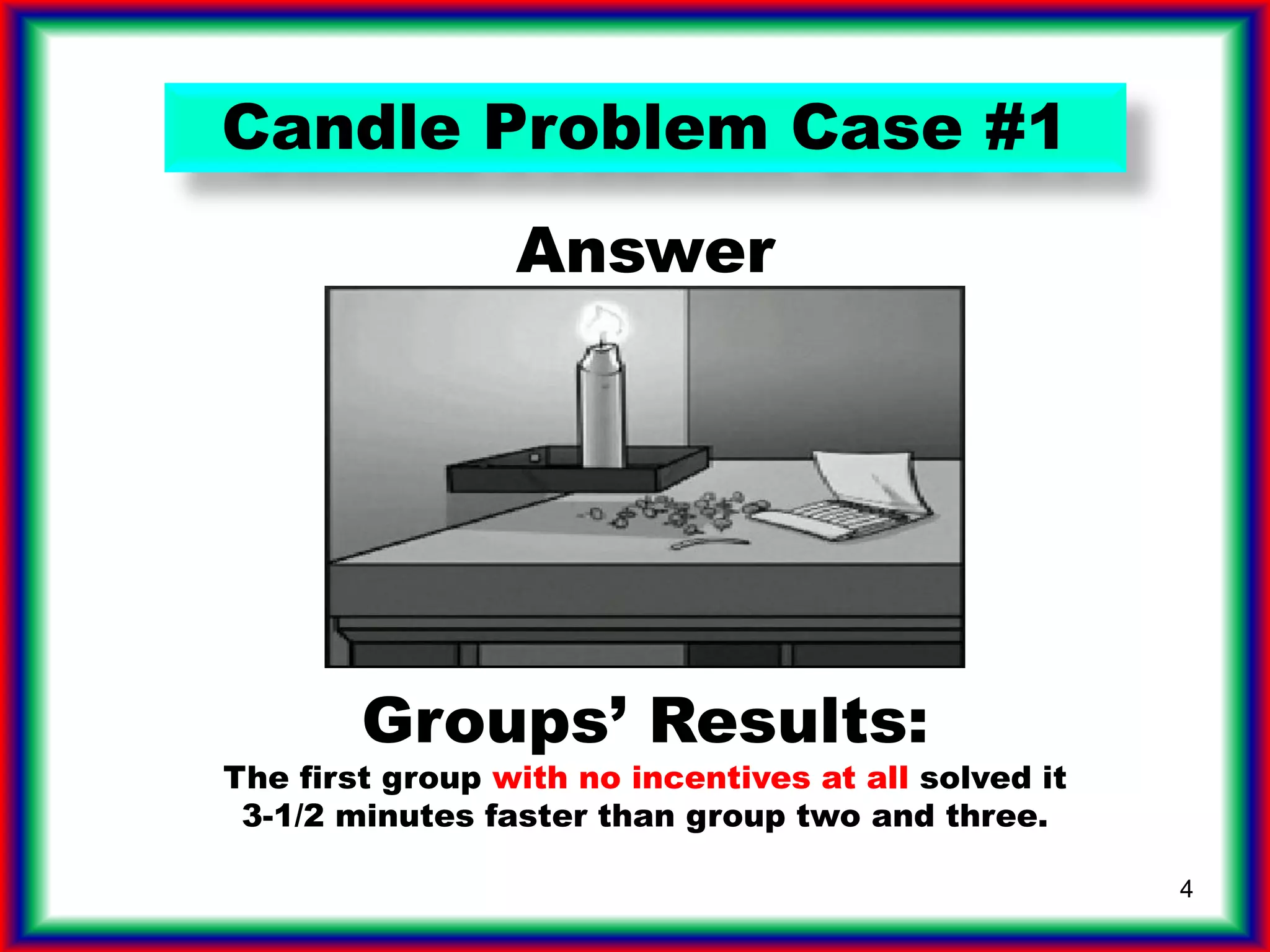
Using what is on the table, put the candle on the wall,
not touching the table. Do it the best possible way.
3
(1) The 1st group was only asked to
solve the problem as fast as possible
and given an average time.
(1) The 1st group was only asked to
solve the problem as fast as possible
and given an average time.
(2) The 2nd group was given rewards, US$5
for the top 25% of the group, US$25 for the very top person.
(1) The 1st group was only asked to
solve the problem as fast as possible
and given an average time.
(2) The 2nd group was given rewards, US$5
for the top 25% of the group, US$25 for the very top person.
(3) The 3rd group was told the bottom 5% would have to pay US$5.
Quick replies…….
Some guessed the answer was to melt the side of
candle and attach it to the wall.
Others guessed attaching the candle with the tacks.
Both were wrong.
Candle Problem Experiment
The Candle
Problem Case #1
Source for this study: Sam Blacksburg, Psychology Department Princeton University
For a recent study, three groups
of 50 people each were tested.
(1) The 1st group was only asked to
solve the problem as fast as possible
and given an average time.
(2) The 2nd group was given rewards, US$5
for the top 25% of the group, US$25 for the very top person.
(3) The 3rd group was told the bottom 5% would have to pay US$5.
4
Answer
Candle Problem Case #1
Groups’ Results:
The first group with no incentives at all solved it
3-1/2 minutes faster than group two and three.
5
For this task……..
Reward Management Technique
(pay for fastest)
…..more money, prizes, trips to
foreign countries, other rewards…
Special recognition,
promotion, high status….
did not work.
The problem is “functional fixedness” (One object has one purpose, box holds tacks).
6
Result:
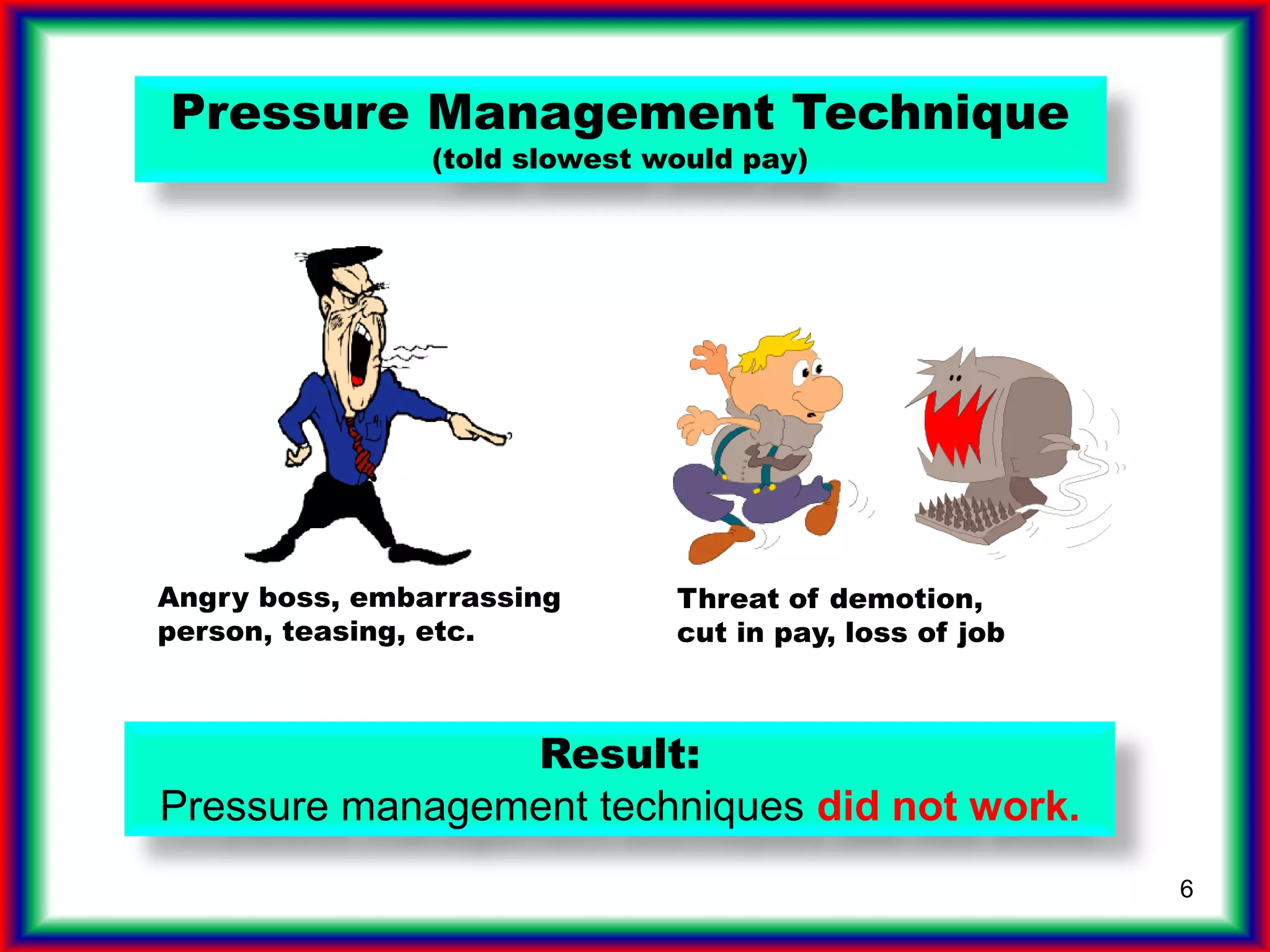
Pressure management techniques did not work.
Pressure Management Technique
(told slowest would pay)
Threat of demotion,
cut in pay, loss of job
Angry boss, embarrassing
person, teasing, etc.
7
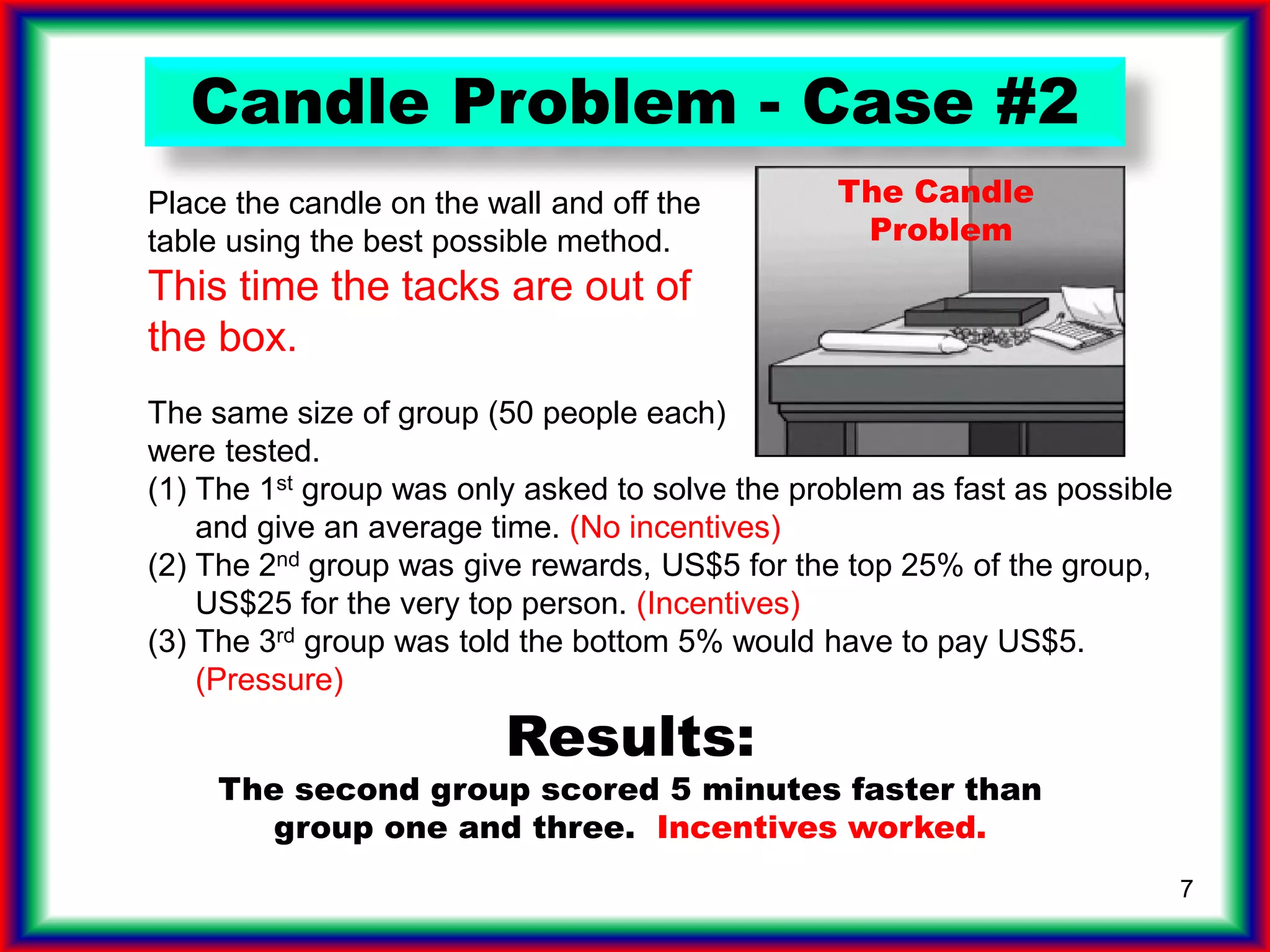
Place the candle on the wall and off the
table using the best possible method.
This time the tacks are out of
the box.
The same size of group (50 people each)
were tested.
(1) The 1st group was only asked to solve the problem as fast as possible
and give an average time. (No incentives)
(2) The 2nd group was give rewards, US$5 for the top 25% of the group,
US$25 for the very top person. (Incentives)
(3) The 3rd group was told the bottom 5% would have to pay US$5.
(Pressure)
Results:
The second group scored 5 minutes faster than
group one and three. Incentives worked.
Candle Problem - Case #2
The Candle
Problem
8
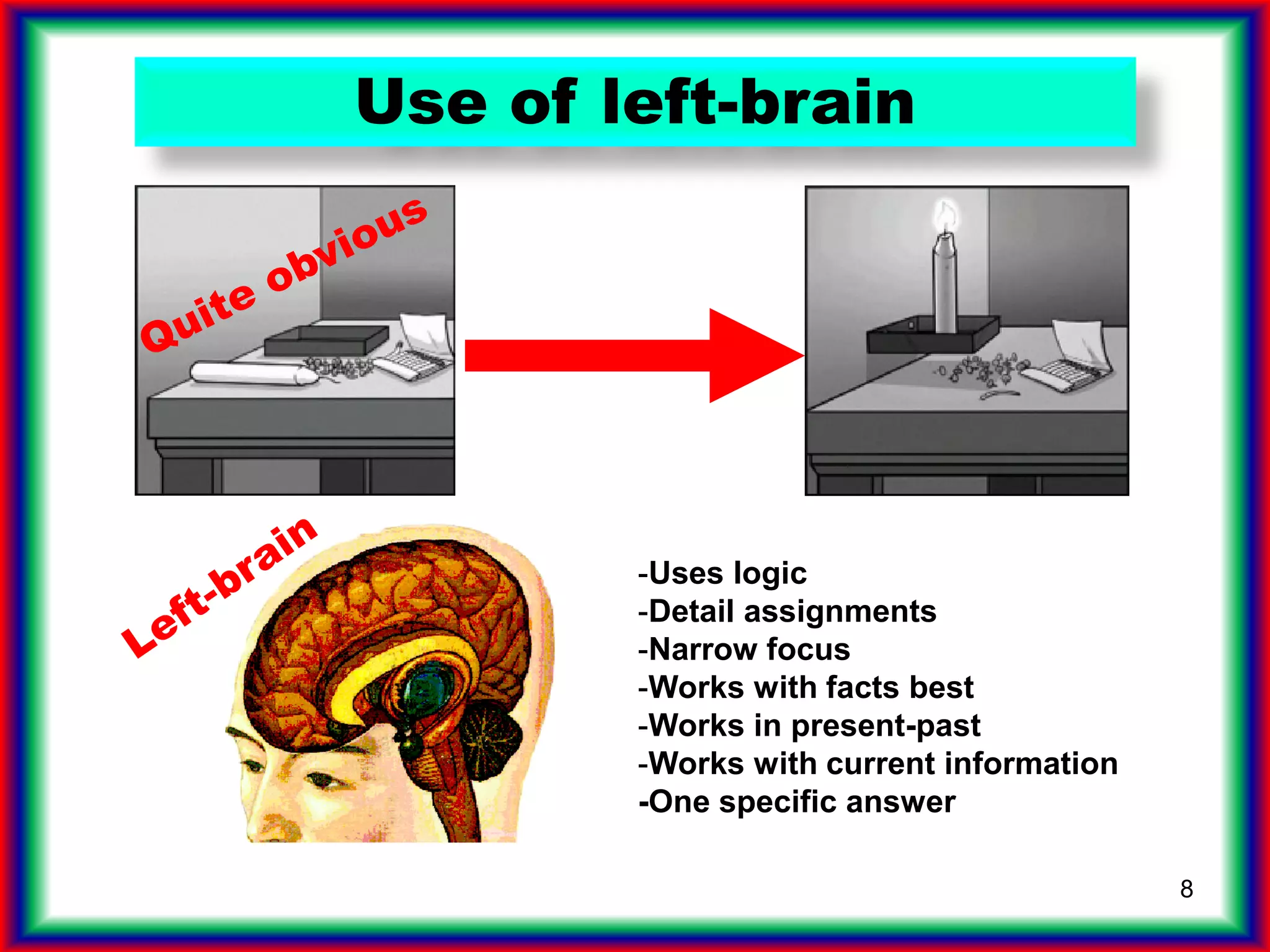
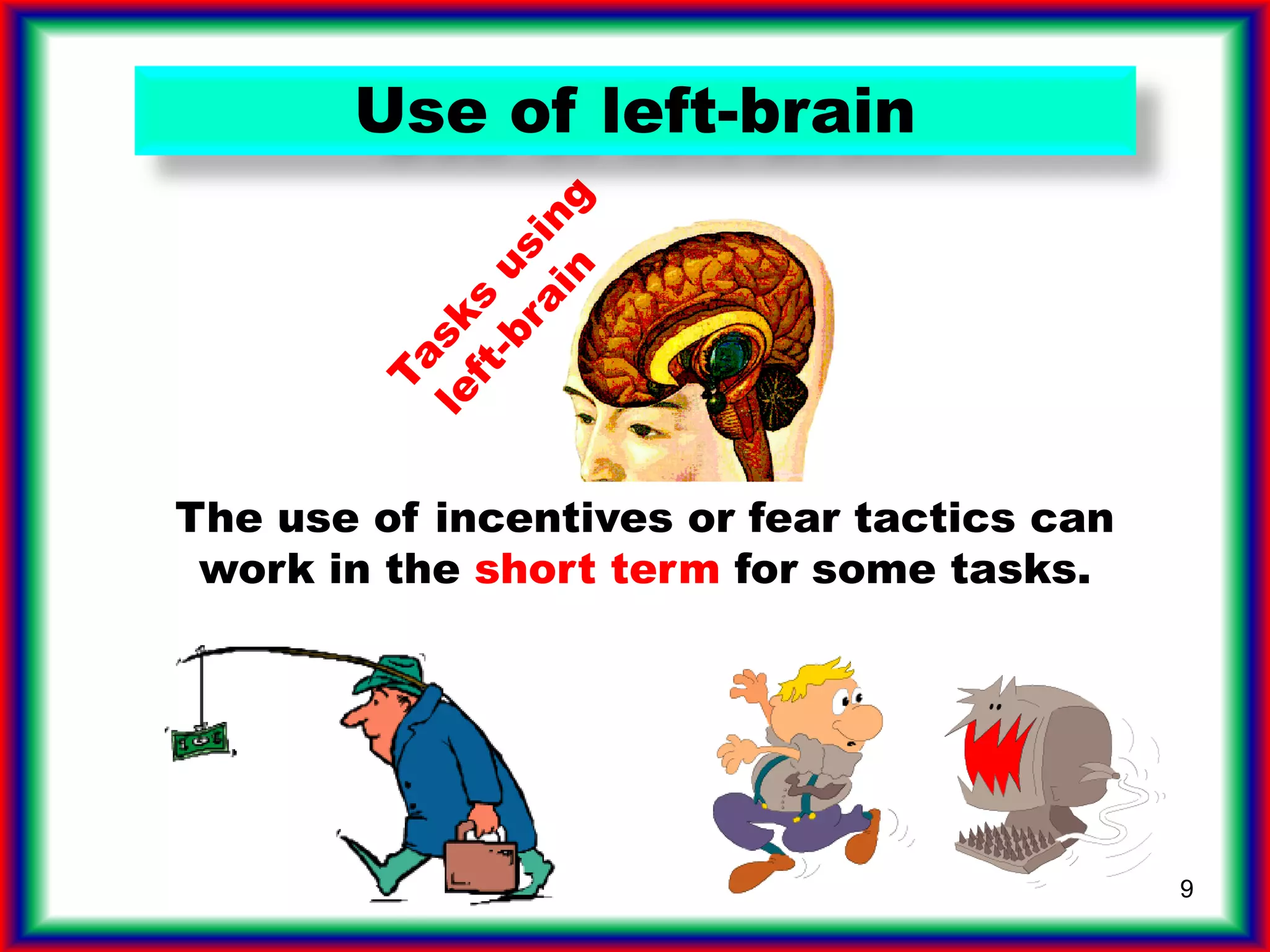
Use of left-brain
-Uses logic
-Detail assignments
-Narrow focus
-Works with facts best
-Works in present-past
-Works with current information
-One specific answer
9
The use of incentives or fear tactics can
work in the short term for some tasks.
Use of left-brain
10
Right-brain problem
Uses feeling
Creative work
Planning work
Broad oriented
Imagination work
Future oriented
Researching
Look for possibilities
No single solution
11
Incentives and fear tactics do not work
for complex tasks.
Best management technique
for complex strategies
They narrow a person’s thinking, not broaden
it to look around for solutions.
12
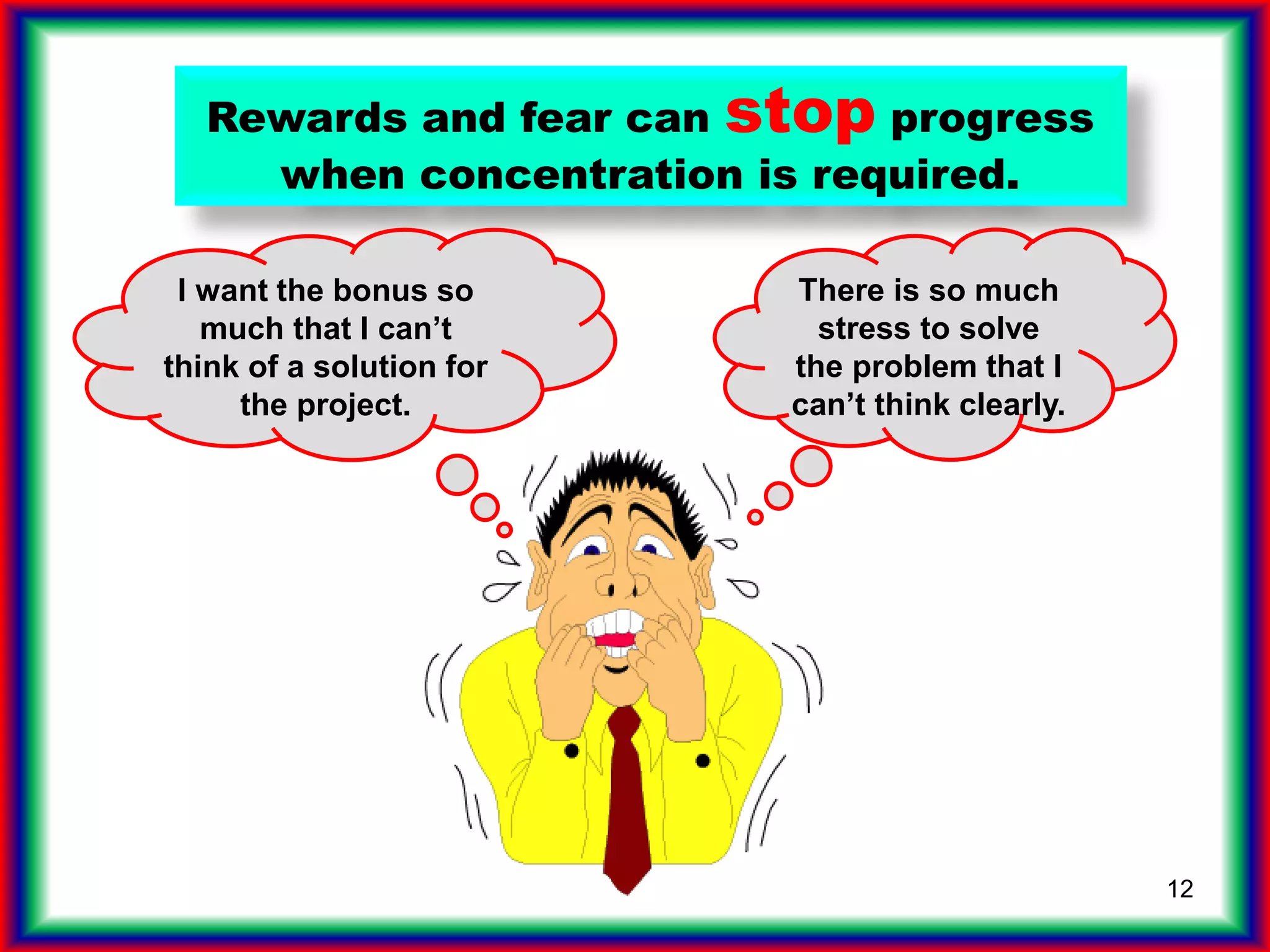
Rewards and fear can stop progress
when concentration is required.
I want the bonus so
much that I can’t
think of a solution for
the project.
There is so much
stress to solve
the problem that I
can’t think clearly.
13
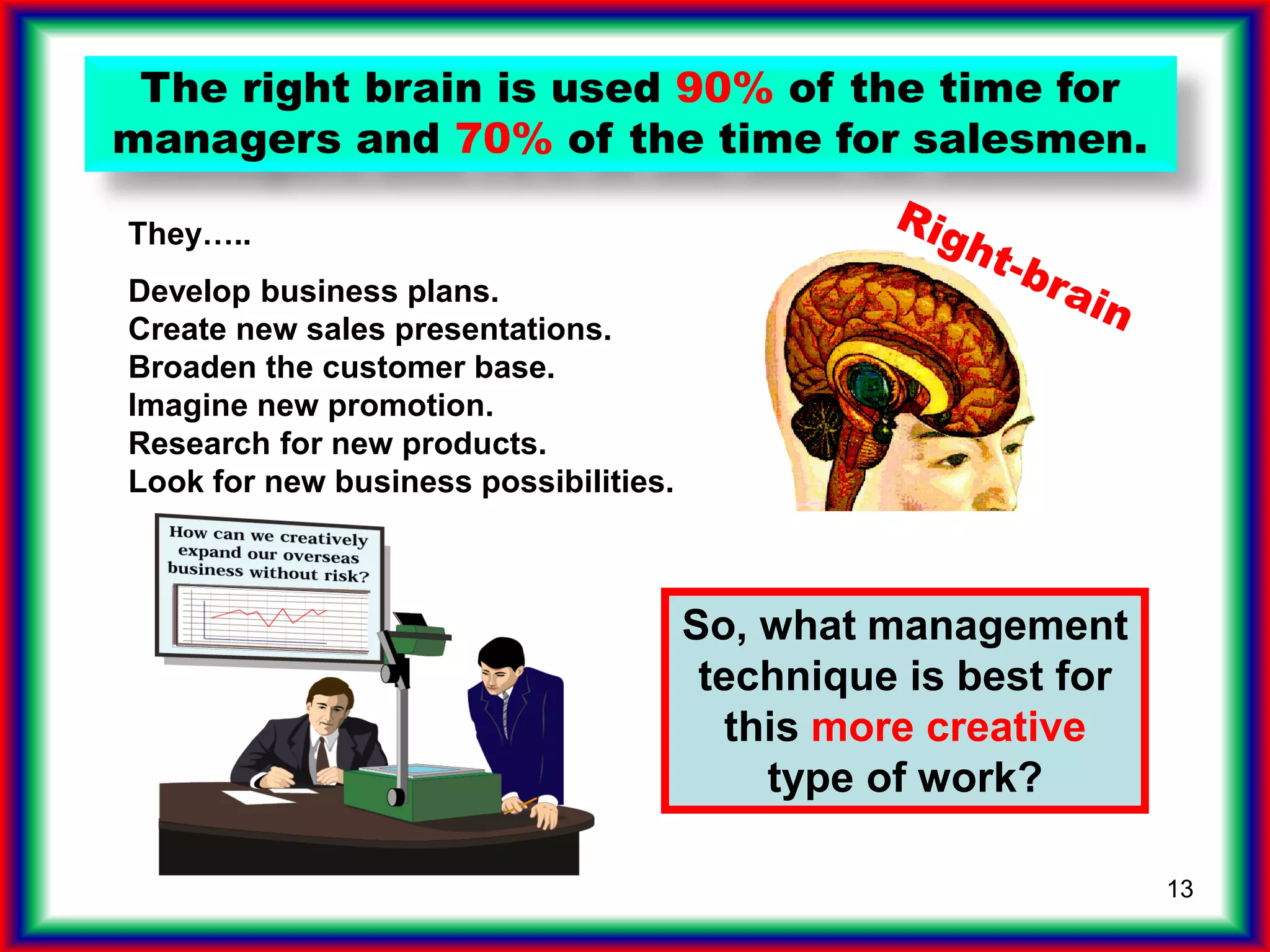
The right brain is used 90% of the time for
managers and 70% of the time for salesmen.
So, what management
technique is best for
this more creative
type of work?
They…..
Develop business plans.
Create new sales presentations.
Broaden the customer base.
Imagine new promotion.
Research for new products.
Look for new business possibilities.
14
Engagement driven management
for complex assignments
There are three independent strategies:There are three independent strategies:
1. Autonomy – Let people work on any problem freely to
expand collaboration and discussion. “Here is the
problem. Come up with a solution any way you like.”
There are three independent strategies:
1. Autonomy – Let people work on any problem freely to
expand collaboration and discussion. “Here is the
problem. Come up with a solution any way you like.”
2. Mastery – Give people time to learn, practice and
experiment.
There are three independent strategies:
1. Autonomy – Let people work on any problem freely to
expand collaboration and discussion. “Here is the
problem. Come up with a solution any way you like.”
2. Mastery – Give people time to learn, practice and
experiment.
3. Purpose – Convince people there is a high chance of
success and great value to themselves and others.
There are three independent strategies:
1. Autonomy – Let people work on any problem freely to
expand collaboration and discussion. “Here is the
problem. Come up with a solution any way you like.”
2. Mastery – Give people time to learn, practice and
experiment.
3. Purpose – Convince people there is a high chance of
success and great value to themselves and others.
15
(low) (high)
SupportiveBehavior
Supportive Behavior is only being available when the
person needs or asks for help, and is giving recognition
when warranted (high employee autonomy).
High Supportive
Low Directive
Behavior
High Directive
High Supportive
Behavior
SUPPORTING COACHING
DELEGATING DIRECTING
High Directive
Low Supportive
Behavior
Low Supportive
Low Directive
Behavior
Directive Behavior is usually one-way communication. It is
giving the person activities (low employee autonomy).
(low)(high)
Directive Behavior
Basic Leadership Styles
16
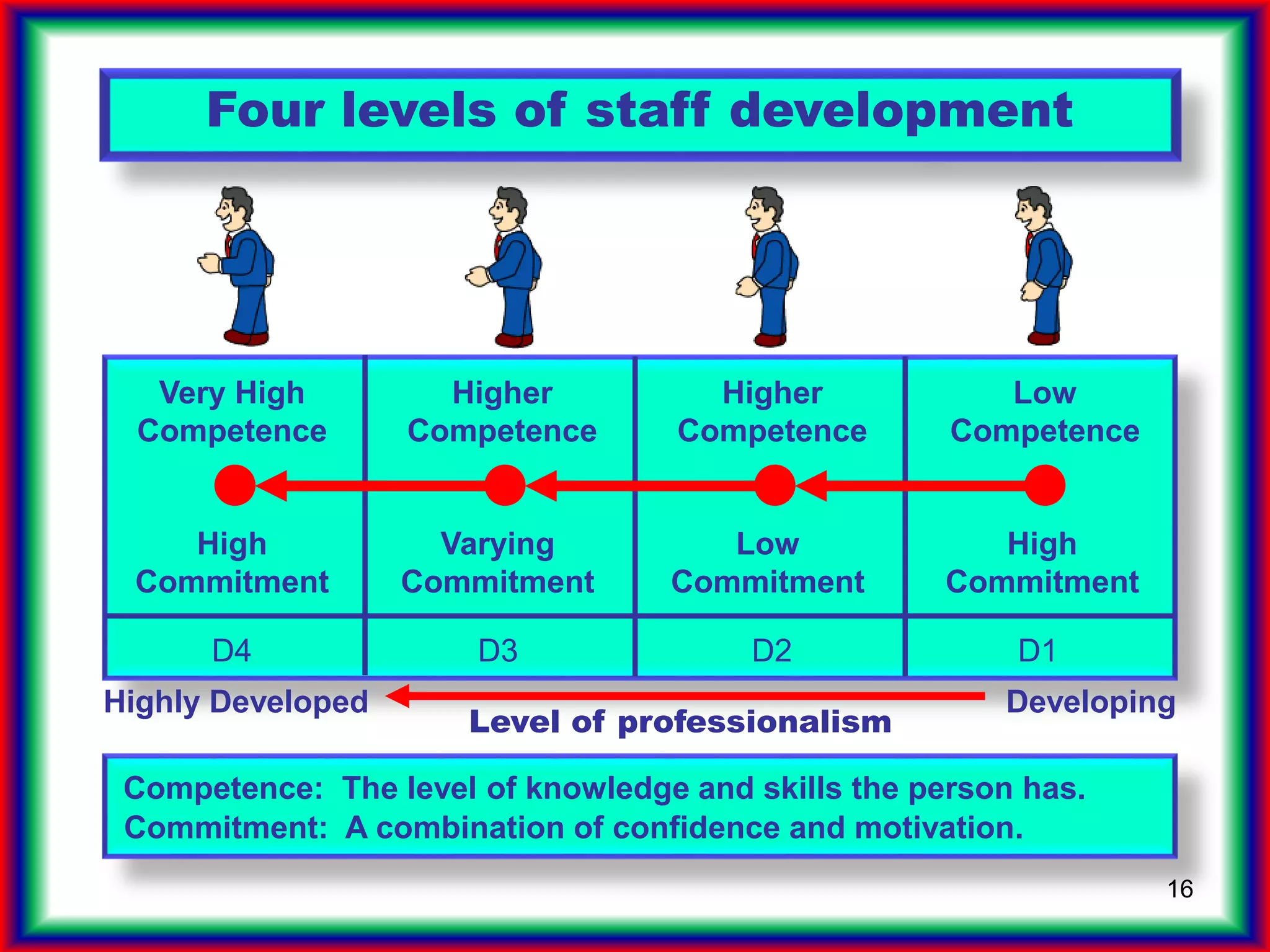
Competence: The level of knowledge and skills the person has.
Commitment: A combination of confidence and motivation.
Highly Developed Developing
Very High
Competence
Higher
Competence
High
Commitment
Varying
Commitment
Low
Commitment
Low
Competence
High
Commitment
Higher
Competence
D1D2D3D4
Level of professionalism
Four levels of staff development
17
Development Level of Staff
The Four Leadership Styles
SupportiveBehavior
Matching Leadership Style
to Staff Development
18
Management style for creative right-brain work
like planning, research, forecasting, etc.
Development Level of Staff
The Four Leadership Styles
SupportiveBehavior
19
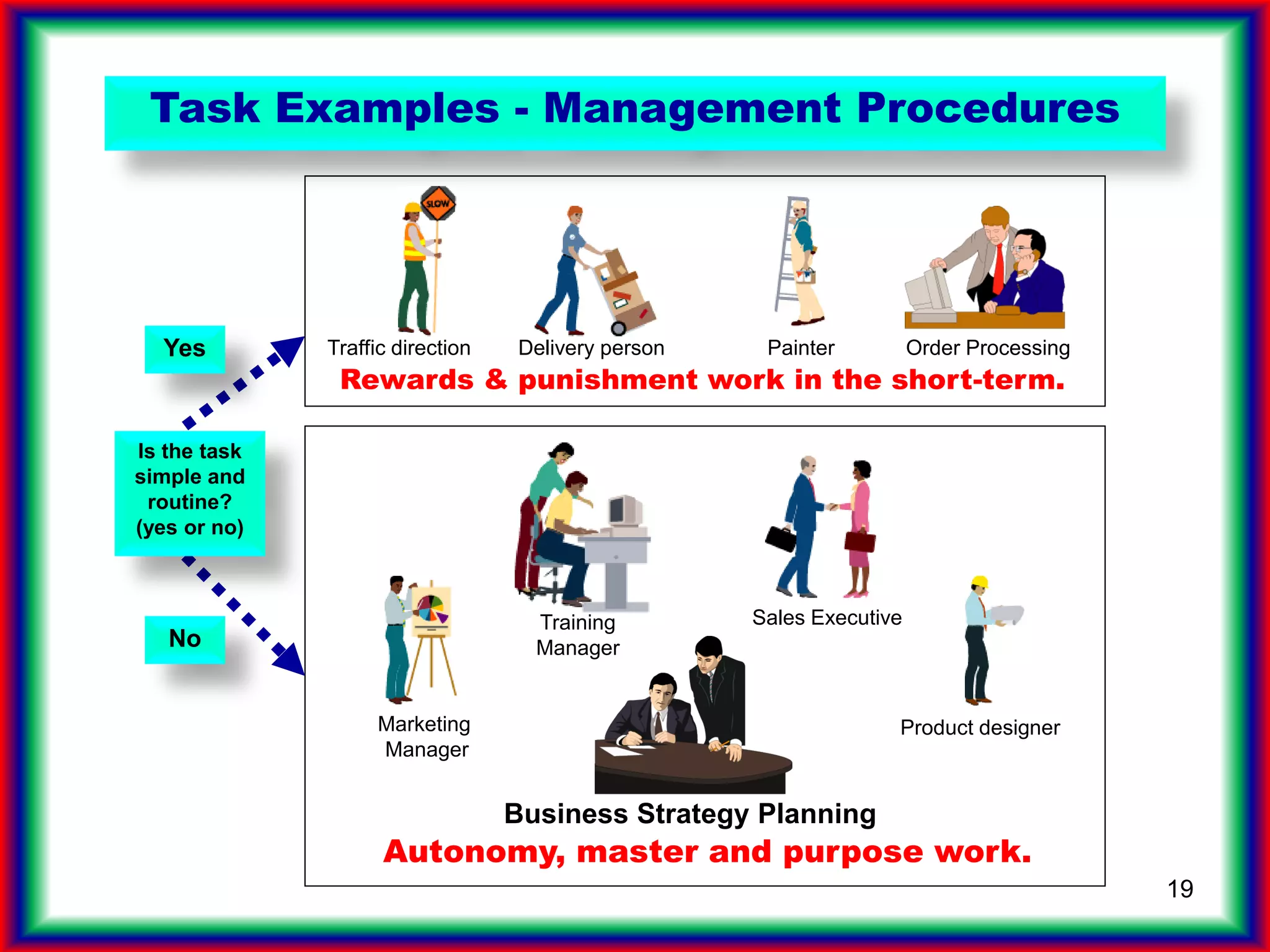
Task Examples - Management Procedures
No
Yes
Marketing
Manager
Sales Executive
Business Strategy Planning
Autonomy, master and purpose work.
Delivery person Painter Order ProcessingTraffic direction
Rewards & punishment work in the short-term.
Product designer
Training
Manager
Is the task
simple and
routine?
(yes or no)
20
Determining Task Management Procedure
Explain the task
necessity.
Yes
No
Acknowledge that
the work is boring.
Allow the person
to perform the task
in his own way.Work on autonomy,
mastery and purpose.
Yes
Use rewards with three
conditions.No
Can you make it more
interesting/challenging?
Is the task
simple and
routine?
(yes or no)
21
Determining Task Management Procedure
Is the task
simple and
routine?
(yes or no)
Yes
No
Can you make it more
interesting/challenging?
Work on autonomy,
mastery and purpose
Yes
Avoid all
“if…then”
rewards or
punishment.
Consider
unexpected, non-
contingent
“now…that”
rewards.
Second, the rewards
provide useful
information rather than
an attempt to control.
First, The rewards are
in the form of praise
and feedback, rather
than things people can
touch or spend.
22
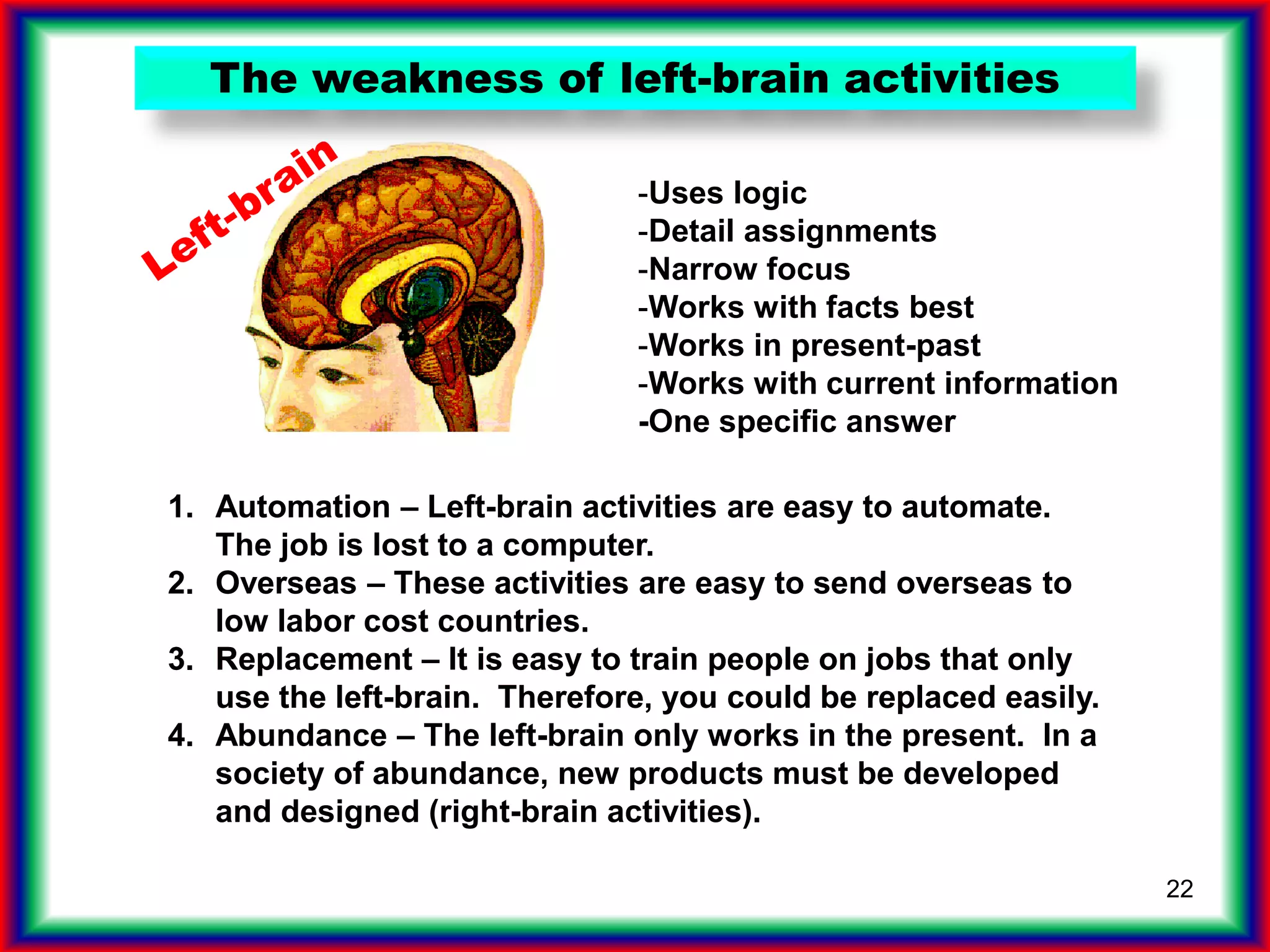
-Uses logic
-Detail assignments
-Narrow focus
-Works with facts best
-Works in present-past
-Works with current information
-One specific answer
1. Automation – Left-brain activities are easy to automate.
The job is lost to a computer.
1. Automation – Left-brain activities are easy to automate.
The job is lost to a computer.
2. Overseas – These activities are easy to send overseas to
low labor cost countries.
1. Automation – Left-brain activities are easy to automate.
The job is lost to a computer.
2. Overseas – These activities are easy to send overseas to
low labor cost countries.
3. Replacement – It is easy to train people on jobs that only
use the left-brain. Therefore, you could be replaced easily.
1. Automation – Left-brain activities are easy to automate.
The job is lost to a computer.
2. Overseas – These activities are easy to send overseas to
low labor cost countries.
3. Replacement – It is easy to train people on jobs that only
use the left-brain. Therefore, you could be replaced easily.
4. Abundance – The left-brain only works in the present. In a
society of abundance, new products must be developed
and designed (right-brain activities).
The weakness of left-brain activities
23
Mental and
Physical
Health
Independent
Financial
Stability
Engagement driven management – Overall Happiness
Unhealthy
Outside Circle
Source: DRIVE, Daniel H. Pink, Canongate Books, 2010
24
Engagement driven management
- Ask these questions -
If the answers are
“yes”, take the job.
1. Autonomy – Can I work on what I want at
least part of the time at this company?
1. Autonomy – Can I work on what I want at
least part of the time at this company?
2. Mastery – Can I learn new things and skills
at least part of the time at this company?
1. Autonomy – Can I work on what I want at
least part of the time at this company?
2. Mastery – Can I learn new things and skills
at least part of the time at this company?
3. Purpose – Do I think what this company is
doing now and for the future important?
Yes,
High drive
No,
Low drive
Source: DRIVE, Daniel H. Pink, Canongate Books, 2010
25
Thank You
Look for companies with a dominant
engagement driven management
style and you will have a company
with a future.
Source: DRIVE, Daniel H. Pink, Canongate Books, 2010

Mobilizing engagement

  • 1.
    1 Let me explain Becominga more creative, Engagement driven Management style company Source: DRIVE, Daniel H. Pink, Canongate Books, 2010
  • 2.
    2 The Candle ProblemExperiment Was conducted first 40 years ago. Then, every year after that. The Candle Problem Using what is on the table, put the candle on the wall, not touching the table. Do it the best possible way.
  • 3.
    3 (1) The 1stgroup was only asked to solve the problem as fast as possible and given an average time. (1) The 1st group was only asked to solve the problem as fast as possible and given an average time. (2) The 2nd group was given rewards, US$5 for the top 25% of the group, US$25 for the very top person. (1) The 1st group was only asked to solve the problem as fast as possible and given an average time. (2) The 2nd group was given rewards, US$5 for the top 25% of the group, US$25 for the very top person. (3) The 3rd group was told the bottom 5% would have to pay US$5. Quick replies……. Some guessed the answer was to melt the side of candle and attach it to the wall. Others guessed attaching the candle with the tacks. Both were wrong. Candle Problem Experiment The Candle Problem Case #1 Source for this study: Sam Blacksburg, Psychology Department Princeton University For a recent study, three groups of 50 people each were tested. (1) The 1st group was only asked to solve the problem as fast as possible and given an average time. (2) The 2nd group was given rewards, US$5 for the top 25% of the group, US$25 for the very top person. (3) The 3rd group was told the bottom 5% would have to pay US$5.
  • 4.
    4 Answer Candle Problem Case#1 Groups’ Results: The first group with no incentives at all solved it 3-1/2 minutes faster than group two and three.
  • 5.
    5 For this task…….. RewardManagement Technique (pay for fastest) …..more money, prizes, trips to foreign countries, other rewards… Special recognition, promotion, high status…. did not work. The problem is “functional fixedness” (One object has one purpose, box holds tacks).
  • 6.
    6 Result: Pressure management techniquesdid not work. Pressure Management Technique (told slowest would pay) Threat of demotion, cut in pay, loss of job Angry boss, embarrassing person, teasing, etc.
  • 7.
    7 Place the candleon the wall and off the table using the best possible method. This time the tacks are out of the box. The same size of group (50 people each) were tested. (1) The 1st group was only asked to solve the problem as fast as possible and give an average time. (No incentives) (2) The 2nd group was give rewards, US$5 for the top 25% of the group, US$25 for the very top person. (Incentives) (3) The 3rd group was told the bottom 5% would have to pay US$5. (Pressure) Results: The second group scored 5 minutes faster than group one and three. Incentives worked. Candle Problem - Case #2 The Candle Problem
  • 8.
    8 Use of left-brain -Useslogic -Detail assignments -Narrow focus -Works with facts best -Works in present-past -Works with current information -One specific answer
  • 9.
    9 The use ofincentives or fear tactics can work in the short term for some tasks. Use of left-brain
  • 10.
    10 Right-brain problem Uses feeling Creativework Planning work Broad oriented Imagination work Future oriented Researching Look for possibilities No single solution
  • 11.
    11 Incentives and feartactics do not work for complex tasks. Best management technique for complex strategies They narrow a person’s thinking, not broaden it to look around for solutions.
  • 12.
    12 Rewards and fearcan stop progress when concentration is required. I want the bonus so much that I can’t think of a solution for the project. There is so much stress to solve the problem that I can’t think clearly.
  • 13.
    13 The right brainis used 90% of the time for managers and 70% of the time for salesmen. So, what management technique is best for this more creative type of work? They….. Develop business plans. Create new sales presentations. Broaden the customer base. Imagine new promotion. Research for new products. Look for new business possibilities.
  • 14.
    14 Engagement driven management forcomplex assignments There are three independent strategies:There are three independent strategies: 1. Autonomy – Let people work on any problem freely to expand collaboration and discussion. “Here is the problem. Come up with a solution any way you like.” There are three independent strategies: 1. Autonomy – Let people work on any problem freely to expand collaboration and discussion. “Here is the problem. Come up with a solution any way you like.” 2. Mastery – Give people time to learn, practice and experiment. There are three independent strategies: 1. Autonomy – Let people work on any problem freely to expand collaboration and discussion. “Here is the problem. Come up with a solution any way you like.” 2. Mastery – Give people time to learn, practice and experiment. 3. Purpose – Convince people there is a high chance of success and great value to themselves and others. There are three independent strategies: 1. Autonomy – Let people work on any problem freely to expand collaboration and discussion. “Here is the problem. Come up with a solution any way you like.” 2. Mastery – Give people time to learn, practice and experiment. 3. Purpose – Convince people there is a high chance of success and great value to themselves and others.
  • 15.
    15 (low) (high) SupportiveBehavior Supportive Behavioris only being available when the person needs or asks for help, and is giving recognition when warranted (high employee autonomy). High Supportive Low Directive Behavior High Directive High Supportive Behavior SUPPORTING COACHING DELEGATING DIRECTING High Directive Low Supportive Behavior Low Supportive Low Directive Behavior Directive Behavior is usually one-way communication. It is giving the person activities (low employee autonomy). (low)(high) Directive Behavior Basic Leadership Styles
  • 16.
    16 Competence: The levelof knowledge and skills the person has. Commitment: A combination of confidence and motivation. Highly Developed Developing Very High Competence Higher Competence High Commitment Varying Commitment Low Commitment Low Competence High Commitment Higher Competence D1D2D3D4 Level of professionalism Four levels of staff development
  • 17.
    17 Development Level ofStaff The Four Leadership Styles SupportiveBehavior Matching Leadership Style to Staff Development
  • 18.
    18 Management style forcreative right-brain work like planning, research, forecasting, etc. Development Level of Staff The Four Leadership Styles SupportiveBehavior
  • 19.
    19 Task Examples -Management Procedures No Yes Marketing Manager Sales Executive Business Strategy Planning Autonomy, master and purpose work. Delivery person Painter Order ProcessingTraffic direction Rewards & punishment work in the short-term. Product designer Training Manager Is the task simple and routine? (yes or no)
  • 20.
    20 Determining Task ManagementProcedure Explain the task necessity. Yes No Acknowledge that the work is boring. Allow the person to perform the task in his own way.Work on autonomy, mastery and purpose. Yes Use rewards with three conditions.No Can you make it more interesting/challenging? Is the task simple and routine? (yes or no)
  • 21.
    21 Determining Task ManagementProcedure Is the task simple and routine? (yes or no) Yes No Can you make it more interesting/challenging? Work on autonomy, mastery and purpose Yes Avoid all “if…then” rewards or punishment. Consider unexpected, non- contingent “now…that” rewards. Second, the rewards provide useful information rather than an attempt to control. First, The rewards are in the form of praise and feedback, rather than things people can touch or spend.
  • 22.
    22 -Uses logic -Detail assignments -Narrowfocus -Works with facts best -Works in present-past -Works with current information -One specific answer 1. Automation – Left-brain activities are easy to automate. The job is lost to a computer. 1. Automation – Left-brain activities are easy to automate. The job is lost to a computer. 2. Overseas – These activities are easy to send overseas to low labor cost countries. 1. Automation – Left-brain activities are easy to automate. The job is lost to a computer. 2. Overseas – These activities are easy to send overseas to low labor cost countries. 3. Replacement – It is easy to train people on jobs that only use the left-brain. Therefore, you could be replaced easily. 1. Automation – Left-brain activities are easy to automate. The job is lost to a computer. 2. Overseas – These activities are easy to send overseas to low labor cost countries. 3. Replacement – It is easy to train people on jobs that only use the left-brain. Therefore, you could be replaced easily. 4. Abundance – The left-brain only works in the present. In a society of abundance, new products must be developed and designed (right-brain activities). The weakness of left-brain activities
  • 23.
    23 Mental and Physical Health Independent Financial Stability Engagement drivenmanagement – Overall Happiness Unhealthy Outside Circle Source: DRIVE, Daniel H. Pink, Canongate Books, 2010
  • 24.
    24 Engagement driven management -Ask these questions - If the answers are “yes”, take the job. 1. Autonomy – Can I work on what I want at least part of the time at this company? 1. Autonomy – Can I work on what I want at least part of the time at this company? 2. Mastery – Can I learn new things and skills at least part of the time at this company? 1. Autonomy – Can I work on what I want at least part of the time at this company? 2. Mastery – Can I learn new things and skills at least part of the time at this company? 3. Purpose – Do I think what this company is doing now and for the future important? Yes, High drive No, Low drive Source: DRIVE, Daniel H. Pink, Canongate Books, 2010
  • 25.
    25 Thank You Look forcompanies with a dominant engagement driven management style and you will have a company with a future. Source: DRIVE, Daniel H. Pink, Canongate Books, 2010