Mobile Seva 
Bringing Citizens and Government Together Through Mobiles 
Department of Electronics and Information Technology (DeitY) 
Government of India 
08 October 2014
Agenda 
• About Mobile Seva 
• Why Mobile? – ICT connectivity in India 
• Challenges to overcome 
• Strategies adopted 
• Operational channels 
• Project impacts and outcomes 
• Project sustainability 
• Critical success factors 
• Lessons learned 
• Way forward
About Mobile Seva 
Provides an integrated, 
centrally-available platform 
to all Govt. Depts.: 
 for integration with 
common e-Gov 
infrastructure in the country 
to deliver public services 
to citizens over mobile 
devices through SMS, USSD, 
Voice/ IVR, m-apps & other 
channels 
Unique,1st nationwide m-initiative 
1-stop shop for all mobile services 
Centrally hosted core infra on cloud 
Depts. need not invest in own m-platform 
Depts. can onboard very quickly 
PoC in July 2011, national rollout in Nov 2012 
Owned, funded and implemented by DeitY 
Technical development by C-DAC,
Mobile AppStore launched in 
Jan_2012 
 310+ live mobile apps hosted 
 http://apps.mgov.gov.in 
About Mobile Seva (2) 
PoC with SMSGateway launched 
in Jul 2011, scaled up in Nov 12 
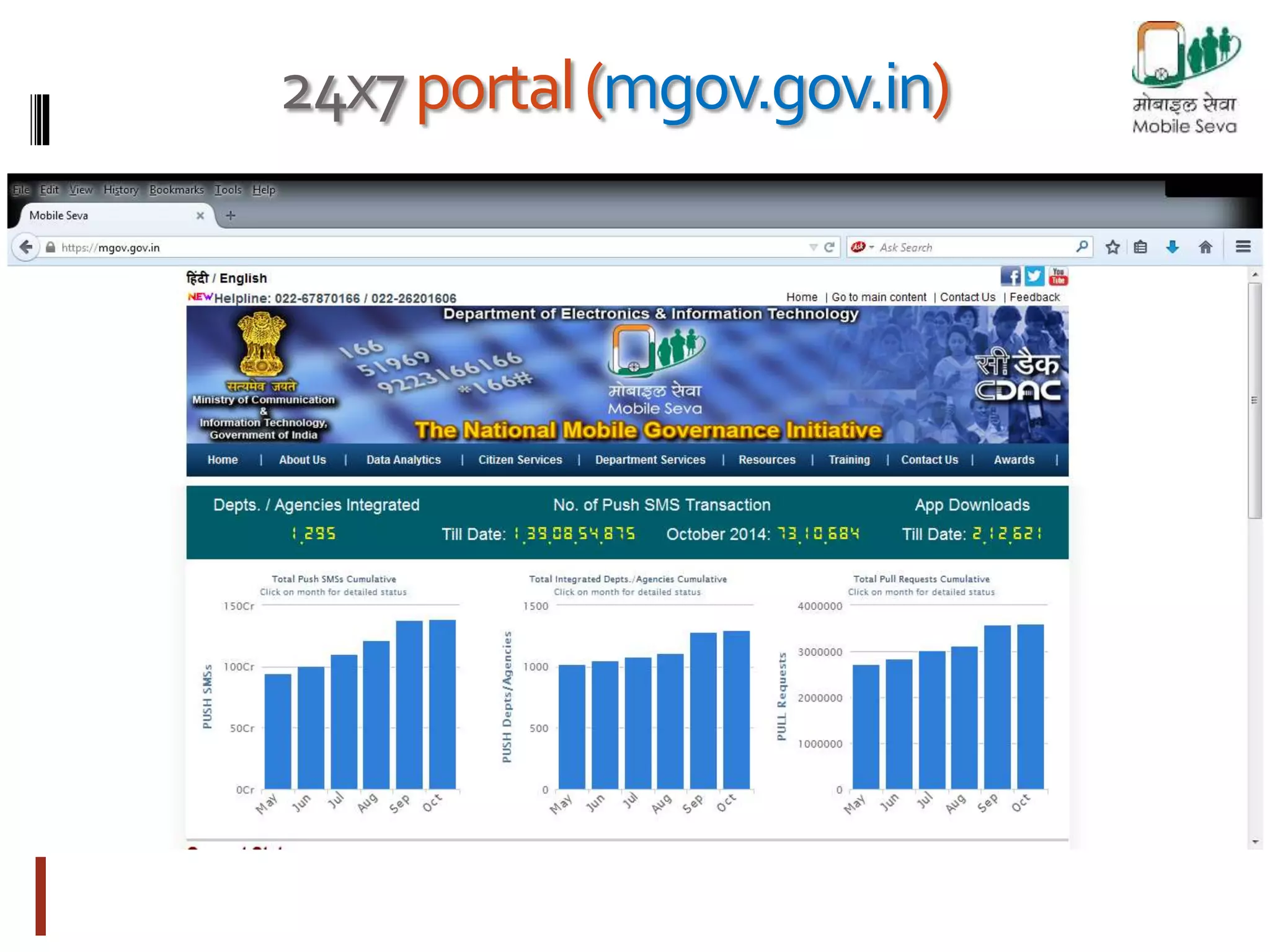
 PUSH SMS: 1290+ Depts. 
integrated; 1.39 bn+ SMSs sent 
 PULL SMS: 355+ services 
integrated 
IVRS : Live, 164,145 Transactions Real-time status 24x7 on mgov 
portal ( www.mgov.gov.in ) 
Regular posts on social media 
( facebook.com/DIT.MGOV , 
@mgovindia, goo.gl/nCpTUP ) 
M-payment solutions available 
through cards, net-banking & IMPS 
USSD picking up
Why Mobile? ICT connectivity in India 
Total population: >1.2 billion 
Total telecom subscribers: 946.4 million 
 Total wireless subscribers: 918.7 million 
 41.1% rural 
 Overall wireless teledensity: 73.8% 
 Urban: 140.9% 
 Rural: 43.9% 
Total Internet Subscribers: ~243 million 
 ~76% access Internet through mobile devices 
Mobile platform ideally suited for widening access to e-Gov 
Source: Telecom Regulatory Authority of India (2014)
Challenges to overcome 
 Low access to electronic public services, especially in rural areas 
 No institutional and policy driver for mobile-enablement 
 High investment requirements for depts. for m-enablement 
 Lack of capacity and skilled personnel 
 No convenience of a single number 
 No “single window” solution
Strategies adopted 
 Open consultations – Framework for Mobile Governance notified 
in Feb. 2012 
Policy directions from PM’s Committee on NeGP in 2011 and 2013 
One-stop shop approach – covers all mobile based channels 
Universal access to all citizens – All Telcos brought on board 
 Two short codes (51969 and 166) & one long code 9223166166 operational 
 Online on-boarding of departments 
 Complete handholding and 24x7 support
Best Practices (1 ) : Open standards 
Deploy 
Open Stds. 
Cloud-based 
solns.
Best practices (2 ): Umbrella approach 
SMS IVRS USSD Apps 
1 stop 
shop 
All m-enablement solutions under one roof 
No need for govt. depts. to create their own mobile platforms
51969 
Opened by all telcos at 
normal rates 
166 
Opened by most telcos 
at normal rates 
9223166166 
Universally accessible 
at p2p rates 
Best practices (3): Universal access 
National platform 
connected with all 
telcos 
Nationally avaiable 
number for all non-emergency 
public 
services
Best Practices (4): Fast Onboarding 
Create account: 
http://services.mgov.gov.in 
(Expedited vetting follows) 
PUSH SMS 
(i) through account 
dashboard 
(ii) through programmatic 
interface 
PULL SMS 
(i) Provide API to send 
messages 
(ii) Define keywords, sub-keywords, 
responses 
e.g.: SMS “UID STATUS 
XXXX” to 51969
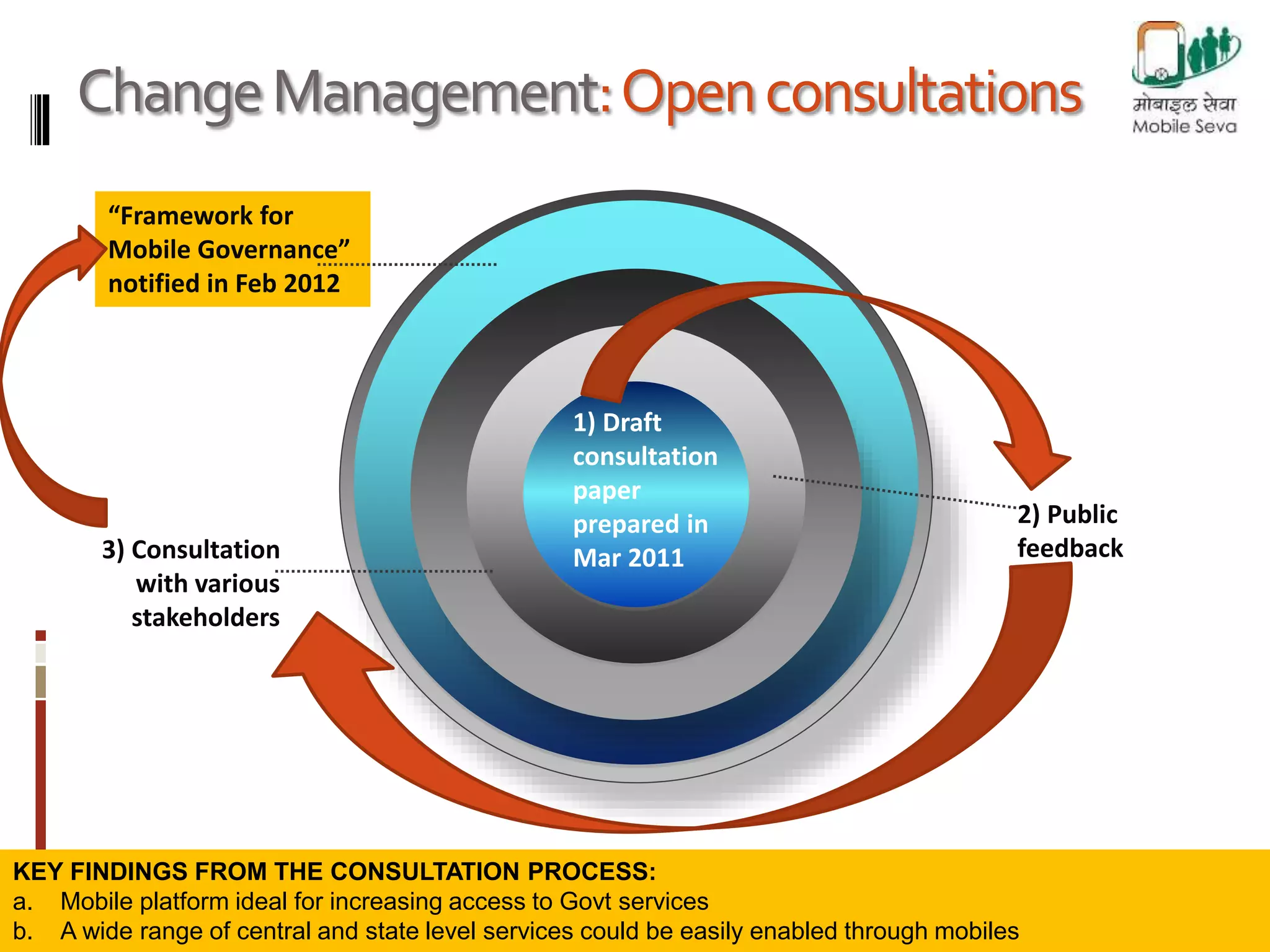
Change Management: Open consultations 
“Framework for 
Mobile Governance” 
notified in Feb 2012 
2) Public 
3) Consultation feedback 
with various 
stakeholders 
1) Draft 
consultation 
paper 
prepared in 
Mar 2011 
KEY FINDINGS FROM THE CONSULTATION PROCESS: 
a. Mobile platform ideal for increasing access to Govt services 
b. A wide range of central and state level services could be easily enabled through mobiles
24x7 portal (mgov.gov.in)
Govt. AppStore(apps.mgov.gov.in)
ECI maps 913,000 
polling stns; 
tracks EVMs more 
effectively 
Keyboards in 11 Indian 
languages: Boost to use 
of Indian languages on 
mobile devices 
Andhra Pradesh, 
Himachal Pradesh & 
Maharashtra – States 
with maximum 
adoption 
>210 mn notifications 
between UIDAI and 
citizens 
m-enablement of 
eDistrict and SSDG 
services for true and 
widest impact 
>569 mn notifications 
between M/o 
Agriculture and farmers 
>329 mn notifications 
between depts in 
Andhra Pradesh and 
citizens 
>211,000 downloads 
from m-app store 
Unique partnership 
among all stakeholders: 
telcos, govt. depts., 
citizens, mobile industry 
& civil society 
Massive and growing impact!
User feedback 
Available online @ http://youtu.be/PlepXLGzJOo 
(Video 1)
Project Outcomes 
• Savings in Costs, Efforts and Time for Depts. & Citizens 
• Improved Access to all Depts.- No technical expertise needed 
• Greater Transparency and Improved Interface with Citizens 
• Simplified Procedures/Processes for Departments 
• Increased Reach & Access to Government Services for Citizens
Project Sustainability 
• Institutional Sustainability –Owned, funded and implemented 
by DeitY, full support from PM’s Committee on NeGP 
• Technical Sustainability – based on open standards and open 
source, strategic control with DeitY 
• Financial Sustainability – Fully funded by DeitY as a national 
core ICT infrastructure, business model being developed
Critical success factors 
• National policy framework on mobile governance 
• Support from the highest decision making body on NeGP 
• Ease of on boarding and implementation for the depts. 
• Responsiveness of the implementing team 
• Portal effectiveness 
• Performance reliability 
• Transparency and participatory design
Lessons learned 
• Capacity within departments is a major issue 
• Lack of app developer ecosystem for public services 
• Need for a policy framework for m-governance 
• On boarding process and implementation must be simple 
and transparent 
• Complete handholding and continuous support needed
Way forward 
• Develop ecosystem for smart m-governance 
 Device and OS agnostic apps: HTML5 
 Transactional and integrated services 
 Mobile based payments for services 
 Mobile based authentication 
 Location based services 
 Indian language based apps 
• Integration with common e-Gov ICT Infrastructure 
 State Wide Area Networks, Data Centres, Service Delivery Gateways 
• Additional channels 
 Cell broadcasting 
 Sim Tool Kit 
 MMS
rajendra.ias@gov.in, 
jsegov@deity.gov.in

Mobile Seva: Bringing Citizens and Government Together Through Mobiles, India

  • 1.
    Mobile Seva BringingCitizens and Government Together Through Mobiles Department of Electronics and Information Technology (DeitY) Government of India 08 October 2014
  • 2.
    Agenda • AboutMobile Seva • Why Mobile? – ICT connectivity in India • Challenges to overcome • Strategies adopted • Operational channels • Project impacts and outcomes • Project sustainability • Critical success factors • Lessons learned • Way forward
  • 3.
    About Mobile Seva Provides an integrated, centrally-available platform to all Govt. Depts.:  for integration with common e-Gov infrastructure in the country to deliver public services to citizens over mobile devices through SMS, USSD, Voice/ IVR, m-apps & other channels Unique,1st nationwide m-initiative 1-stop shop for all mobile services Centrally hosted core infra on cloud Depts. need not invest in own m-platform Depts. can onboard very quickly PoC in July 2011, national rollout in Nov 2012 Owned, funded and implemented by DeitY Technical development by C-DAC,
  • 4.
    Mobile AppStore launchedin Jan_2012  310+ live mobile apps hosted  http://apps.mgov.gov.in About Mobile Seva (2) PoC with SMSGateway launched in Jul 2011, scaled up in Nov 12  PUSH SMS: 1290+ Depts. integrated; 1.39 bn+ SMSs sent  PULL SMS: 355+ services integrated IVRS : Live, 164,145 Transactions Real-time status 24x7 on mgov portal ( www.mgov.gov.in ) Regular posts on social media ( facebook.com/DIT.MGOV , @mgovindia, goo.gl/nCpTUP ) M-payment solutions available through cards, net-banking & IMPS USSD picking up
  • 5.
    Why Mobile? ICTconnectivity in India Total population: >1.2 billion Total telecom subscribers: 946.4 million  Total wireless subscribers: 918.7 million  41.1% rural  Overall wireless teledensity: 73.8%  Urban: 140.9%  Rural: 43.9% Total Internet Subscribers: ~243 million  ~76% access Internet through mobile devices Mobile platform ideally suited for widening access to e-Gov Source: Telecom Regulatory Authority of India (2014)
  • 6.
    Challenges to overcome  Low access to electronic public services, especially in rural areas  No institutional and policy driver for mobile-enablement  High investment requirements for depts. for m-enablement  Lack of capacity and skilled personnel  No convenience of a single number  No “single window” solution
  • 7.
    Strategies adopted Open consultations – Framework for Mobile Governance notified in Feb. 2012 Policy directions from PM’s Committee on NeGP in 2011 and 2013 One-stop shop approach – covers all mobile based channels Universal access to all citizens – All Telcos brought on board  Two short codes (51969 and 166) & one long code 9223166166 operational  Online on-boarding of departments  Complete handholding and 24x7 support
  • 8.
    Best Practices (1) : Open standards Deploy Open Stds. Cloud-based solns.
  • 9.
    Best practices (2): Umbrella approach SMS IVRS USSD Apps 1 stop shop All m-enablement solutions under one roof No need for govt. depts. to create their own mobile platforms
  • 10.
    51969 Opened byall telcos at normal rates 166 Opened by most telcos at normal rates 9223166166 Universally accessible at p2p rates Best practices (3): Universal access National platform connected with all telcos Nationally avaiable number for all non-emergency public services
  • 11.
    Best Practices (4):Fast Onboarding Create account: http://services.mgov.gov.in (Expedited vetting follows) PUSH SMS (i) through account dashboard (ii) through programmatic interface PULL SMS (i) Provide API to send messages (ii) Define keywords, sub-keywords, responses e.g.: SMS “UID STATUS XXXX” to 51969
  • 12.
    Change Management: Openconsultations “Framework for Mobile Governance” notified in Feb 2012 2) Public 3) Consultation feedback with various stakeholders 1) Draft consultation paper prepared in Mar 2011 KEY FINDINGS FROM THE CONSULTATION PROCESS: a. Mobile platform ideal for increasing access to Govt services b. A wide range of central and state level services could be easily enabled through mobiles
  • 13.
  • 14.
  • 15.
    ECI maps 913,000 polling stns; tracks EVMs more effectively Keyboards in 11 Indian languages: Boost to use of Indian languages on mobile devices Andhra Pradesh, Himachal Pradesh & Maharashtra – States with maximum adoption >210 mn notifications between UIDAI and citizens m-enablement of eDistrict and SSDG services for true and widest impact >569 mn notifications between M/o Agriculture and farmers >329 mn notifications between depts in Andhra Pradesh and citizens >211,000 downloads from m-app store Unique partnership among all stakeholders: telcos, govt. depts., citizens, mobile industry & civil society Massive and growing impact!
  • 16.
    User feedback Availableonline @ http://youtu.be/PlepXLGzJOo (Video 1)
  • 17.
    Project Outcomes •Savings in Costs, Efforts and Time for Depts. & Citizens • Improved Access to all Depts.- No technical expertise needed • Greater Transparency and Improved Interface with Citizens • Simplified Procedures/Processes for Departments • Increased Reach & Access to Government Services for Citizens
  • 18.
    Project Sustainability •Institutional Sustainability –Owned, funded and implemented by DeitY, full support from PM’s Committee on NeGP • Technical Sustainability – based on open standards and open source, strategic control with DeitY • Financial Sustainability – Fully funded by DeitY as a national core ICT infrastructure, business model being developed
  • 19.
    Critical success factors • National policy framework on mobile governance • Support from the highest decision making body on NeGP • Ease of on boarding and implementation for the depts. • Responsiveness of the implementing team • Portal effectiveness • Performance reliability • Transparency and participatory design
  • 20.
    Lessons learned •Capacity within departments is a major issue • Lack of app developer ecosystem for public services • Need for a policy framework for m-governance • On boarding process and implementation must be simple and transparent • Complete handholding and continuous support needed
  • 21.
    Way forward •Develop ecosystem for smart m-governance  Device and OS agnostic apps: HTML5  Transactional and integrated services  Mobile based payments for services  Mobile based authentication  Location based services  Indian language based apps • Integration with common e-Gov ICT Infrastructure  State Wide Area Networks, Data Centres, Service Delivery Gateways • Additional channels  Cell broadcasting  Sim Tool Kit  MMS
  • 22.

Editor's Notes