Ministry of External Affairs
Investments & Technology
Promotion Division
Nov 2015
Ensure the government services are made
available to citizens electronically by
reducing paper work.
What is
Digital India?
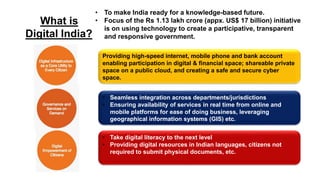
Providing high-speed internet, mobile phone and bank account
enabling participation in digital & financial space; shareable private
space on a public cloud, and creating a safe and secure cyber
space.
• Seamless integration across departments/jurisdictions
• Ensuring availability of services in real time from online and
mobile platforms for ease of doing business, leveraging
geographical information systems (GIS) etc.
• Take digital literacy to the next level
• Providing digital resources in Indian languages, citizens not
required to submit physical documents, etc.
• To make India ready for a knowledge-based future.
• Focus of the Rs 1.13 lakh crore (appx. US$ 17 billion) initiative
is on using technology to create a participative, transparent
and responsive government.
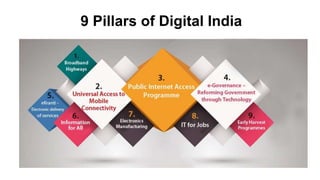
9 Pillars of Digital India
1. Broadband Highways
• Broadband for All – Rural: 2,50,000 village
Panchayats to be covered under the National
Network (NOFN) by Dec 2016.
• Broadband for All – Urban: Virtual Network
Operators would be leveraged for service
communication infrastructure in new urban
buildings would be mandated.
• National Information Infrastructure (NII): NII
would integrate the network and cloud
country to provide high speed connectivity and
to various government departments up to the
2. Universal Access to Phones
• Plan seeks to provide mobile coverage in a
phased manner to the remaining 55,619
villages in the country. The total project cost
will be around Rs.16,000 Cr (appx. US$ 2.3
billion) during 2014-18.
3. Public Internet Access Programme
• Common Service Centres (CSCs): CSCs would be
strengthened and increased from the current
135,000 to 250,000. CSCs – one in each Gram
Panchayat, would be made viable & multi-
functional end-points for delivery of government
services.
• Post Offices as Multi-service centres: 150,000
Post Offices to be converted into multi service
centres.
4. E-governance:
• Online applications and tracking, Form
reduction.
• Online repositories - Use of online repositories
educational degrees, identity documents, etc.) so
not required to submit these documents in
5. E-Kranti:
• The biggest programme within Digital India and
focusses on a mobile-first approach.
• Integration of services and platforms e.g. Aadhaar
platform of Unique Identity Authority of India
(UIDAI), payment gateway, Mobile Seva platform
etc.
• There are 44 Mission Mode Projects under e-
Kranti, which are at various stages of
implementation.
• E-education: Free wi-fi in all schools and
providing massive online open courses (MOOCs)
• E-healthcare: online medical consultation, online
medical records, online medicine supply, pan-
India exchange for patient information, etc.
• Technology for farmers: real time price
information, online ordering of inputs and
online cash, loan, and relief payment with
mobile banking.
• Technology for security: Mobile based
emergency services and disaster related
services on real time basis.
• Technology for cyber-security: National Cyber
Security Co-ordination Centre would be set up
to ensure safe and secure cyber-space within
the country.
• Technology for financial inclusion: Through
use of mobile banking, Micro-ATM program
and CSCs/ Post Offices.
• Technology for Justice: e-Courts, e-Police, e-
Prosecution etc.
E-Kranti:
Transforming E-governance for
Transforming Governance
6. Information for all:
• Open Data platform: http://data.gov.in
facilitates proactive release of datasets in open
ministries/departments for use, reuse and
Provides open and easy access to information
• Engagement through social media: Pro-actively
engage through social media and web based
inform and interact with citizens.
• MyGov.in: This website crowdsources ideas
from the public for design of programmes
management, using big data for making cities
• Online messaging: Online messaging to
citizens on special occasions/programs would
through emails and SMS.
7. Electronics Manufacture:
• This pillar focuses on promoting electronics
manufacturing in the country with the target of
NET ZERO Imports by 2020 as a striking
demonstration of intent.
Vision of digital India
 Digital infrastructures utility to every citizen
 Governance & service on demand
 Digital of citizens
Centered on 3 key areas
Digital India is a campaign launched by the
Government of India to ensure that Government
services are made available to citizens electronically
by improving online infrastructure and by increasing
Internet connectivity or by making the country
digitally empowered in the field of technology
HISTORY
• Digital India was launched by Prime Minister of India Narendra Modi on 1
July 2015.Under ministry of communication and information technology
with dr. Ravi Shankar Prasad as key member.
• The vision of Digital India programme also aims at inclusive growth in
areas of electronic services, products, manufacturing and job opportunities
etc.
• The Government of India entity Bharat Broadband Network Limited which
executes the National Optical Fibre Network project will be the custodian
of Digital India (DI) project.
• BBNL had ordered United Telecoms Limited to connect 250,000 villages
through GPON to ensure FTTH based broadband. This will provide the first
basic setup to achieve towards Digital India and is expected to be
completed by 2017.
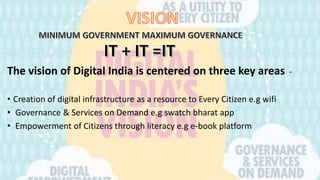
The vision of Digital India is centered on three key areas -
• Creation of digital infrastructure as a resource to Every Citizen e.g wifi
• Governance & Services on Demand e.g swatch bharat app
• Empowerment of Citizens through literacy e.g e-book platform
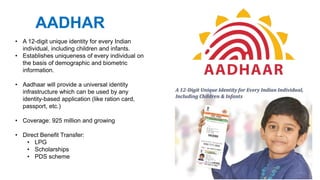
• A 12-digit unique identity for every Indian
individual, including children and infants.
• Establishes uniqueness of every individual on
the basis of demographic and biometric
information.
• Aadhaar will provide a universal identity
infrastructure which can be used by any
identity-based application (like ration card,
passport, etc.)
• Coverage: 925 million and growing
• Direct Benefit Transfer:
• LPG
• Scholarships
• PDS scheme
AADHAR
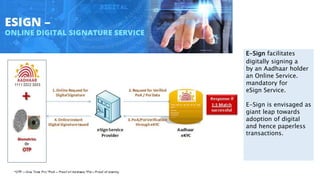
E-Sign facilitates
digitally signing a
by an Aadhaar holder
an Online Service.
mandatory for
eSign Service.
E-Sign is envisaged as
giant leap towards
adoption of digital
and hence paperless
transactions.
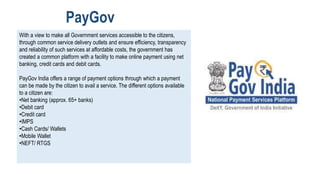
With a view to make all Government services accessible to the citizens,
through common service delivery outlets and ensure efficiency, transparency
and reliability of such services at affordable costs, the government has
created a common platform with a facility to make online payment using net
banking, credit cards and debit cards.
PayGov India offers a range of payment options through which a payment
can be made by the citizen to avail a service. The different options available
to a citizen are:
•Net banking (approx. 65+ banks)
•Debit card
•Credit card
•IMPS
•Cash Cards/ Wallets
•Mobile Wallet
•NEFT/ RTGS
PayGov
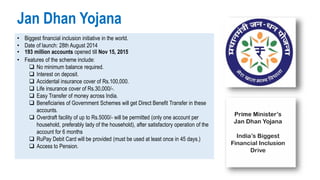
• Biggest financial inclusion initiative in the world.
• Date of launch: 28th August 2014
• 193 million accounts opened till Nov 15, 2015
• Features of the scheme include:
 No minimum balance required.
 Interest on deposit.
 Accidental insurance cover of Rs.100,000.
 Life insurance cover of Rs.30,000/-.
 Easy Transfer of money across India.
 Beneficiaries of Government Schemes will get Direct Benefit Transfer in these
accounts.
 Overdraft facility of up to Rs.5000/- will be permitted (only one account per
household, preferably lady of the household), after satisfactory operation of the
account for 6 months
 RuPay Debit Card will be provided (must be used at least once in 45 days.)
 Access to Pension.
Jan Dhan Yojana
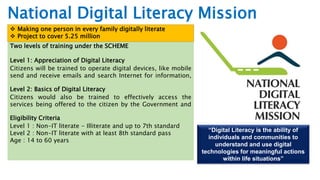
“Digital Literacy is the ability of
individuals and communities to
understand and use digital
technologies for meaningful actions
within life situations”
Two levels of training under the SCHEME
Level 1: Appreciation of Digital Literacy
Citizens will be trained to operate digital devices, like mobile
send and receive emails and search Internet for information,
Level 2: Basics of Digital Literacy
Citizens would also be trained to effectively access the
services being offered to the citizen by the Government and
Eligibility Criteria
Level 1 : Non-IT literate - Illiterate and up to 7th standard
Level 2 : Non-IT literate with at least 8th standard pass
Age : 14 to 60 years
National Digital Literacy Mission
 Making one person in every family digitally literate
 Project to cover 5.25 million
•DigiLocker
•ATTENDANCE.GOV.IN
•MyGov.in
•Swachh Bharat Mission (SBM) Mobile app
•eSign or eCertificate framework
•Online Registration System (ORS)
•Railways
•e-post
•E-sampark mobile seva
•E- book platform
•broadband connectivity on highway
•digital india platform
•Next generation network(30yr old)
•National Scholarships Portal
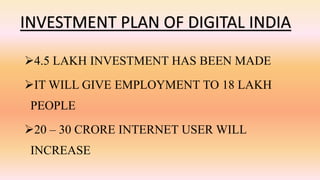
4.5 LAKH INVESTMENT HAS BEEN MADE
IT WILL GIVE EMPLOYMENT TO 18 LAKH
PEOPLE
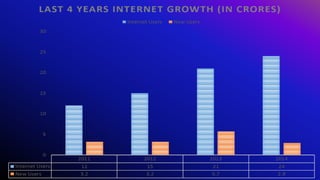
20 – 30 CRORE INTERNET USER WILL
INCREASE
INVESTMENT PLAN OF DIGITAL INDIA
• Building broadband infrastructure
• Creating identity solutions, payment systems, web or mobile based
delivery structures etc.
• Cybersecurity
• Healthcare - telemedicine and remote health
• Smart Cities – 100 smart cities program already announced.
• Make in India - Electronics Manufacturing - For India to transition to a
digital future, it is imperative that a greater proportion of its consumption is
serviced locally.
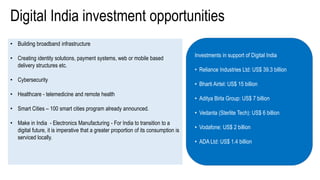
Digital India investment opportunities
Investments in support of Digital India
• Reliance Industries Ltd: US$ 39.3 billion
• Bharti Airtel: US$ 15 billion
• Aditya Birla Group: US$ 7 billion
• Vedanta (Sterlite Tech): US$ 6 billion
• Vodafone: US$ 2 billion
• ADA Ltd: US$ 1.4 billion
REFERENCES
Official site of digital india https://mygov.in/group/digital-india/
Google images
WIKIPEDIA
India.gov.in
MyGov.in
National e-Governance Plan
Digital India .pptx

Digital India .pptx

  • 2.
    Ministry of ExternalAffairs Investments & Technology Promotion Division Nov 2015
  • 3.
    Ensure the governmentservices are made available to citizens electronically by reducing paper work.
  • 4.
    What is Digital India? Providinghigh-speed internet, mobile phone and bank account enabling participation in digital & financial space; shareable private space on a public cloud, and creating a safe and secure cyber space. • Seamless integration across departments/jurisdictions • Ensuring availability of services in real time from online and mobile platforms for ease of doing business, leveraging geographical information systems (GIS) etc. • Take digital literacy to the next level • Providing digital resources in Indian languages, citizens not required to submit physical documents, etc. • To make India ready for a knowledge-based future. • Focus of the Rs 1.13 lakh crore (appx. US$ 17 billion) initiative is on using technology to create a participative, transparent and responsive government.
  • 5.
    9 Pillars ofDigital India
  • 6.
    1. Broadband Highways •Broadband for All – Rural: 2,50,000 village Panchayats to be covered under the National Network (NOFN) by Dec 2016. • Broadband for All – Urban: Virtual Network Operators would be leveraged for service communication infrastructure in new urban buildings would be mandated. • National Information Infrastructure (NII): NII would integrate the network and cloud country to provide high speed connectivity and to various government departments up to the 2. Universal Access to Phones • Plan seeks to provide mobile coverage in a phased manner to the remaining 55,619 villages in the country. The total project cost will be around Rs.16,000 Cr (appx. US$ 2.3 billion) during 2014-18. 3. Public Internet Access Programme • Common Service Centres (CSCs): CSCs would be strengthened and increased from the current 135,000 to 250,000. CSCs – one in each Gram Panchayat, would be made viable & multi- functional end-points for delivery of government services. • Post Offices as Multi-service centres: 150,000 Post Offices to be converted into multi service centres.
  • 7.
    4. E-governance: • Onlineapplications and tracking, Form reduction. • Online repositories - Use of online repositories educational degrees, identity documents, etc.) so not required to submit these documents in 5. E-Kranti: • The biggest programme within Digital India and focusses on a mobile-first approach. • Integration of services and platforms e.g. Aadhaar platform of Unique Identity Authority of India (UIDAI), payment gateway, Mobile Seva platform etc. • There are 44 Mission Mode Projects under e- Kranti, which are at various stages of implementation. • E-education: Free wi-fi in all schools and providing massive online open courses (MOOCs) • E-healthcare: online medical consultation, online medical records, online medicine supply, pan- India exchange for patient information, etc. • Technology for farmers: real time price information, online ordering of inputs and online cash, loan, and relief payment with mobile banking. • Technology for security: Mobile based emergency services and disaster related services on real time basis. • Technology for cyber-security: National Cyber Security Co-ordination Centre would be set up to ensure safe and secure cyber-space within the country. • Technology for financial inclusion: Through use of mobile banking, Micro-ATM program and CSCs/ Post Offices. • Technology for Justice: e-Courts, e-Police, e- Prosecution etc. E-Kranti: Transforming E-governance for Transforming Governance
  • 8.
    6. Information forall: • Open Data platform: http://data.gov.in facilitates proactive release of datasets in open ministries/departments for use, reuse and Provides open and easy access to information • Engagement through social media: Pro-actively engage through social media and web based inform and interact with citizens. • MyGov.in: This website crowdsources ideas from the public for design of programmes management, using big data for making cities • Online messaging: Online messaging to citizens on special occasions/programs would through emails and SMS. 7. Electronics Manufacture: • This pillar focuses on promoting electronics manufacturing in the country with the target of NET ZERO Imports by 2020 as a striking demonstration of intent.
  • 9.
    Vision of digitalIndia  Digital infrastructures utility to every citizen  Governance & service on demand  Digital of citizens Centered on 3 key areas
  • 10.
    Digital India isa campaign launched by the Government of India to ensure that Government services are made available to citizens electronically by improving online infrastructure and by increasing Internet connectivity or by making the country digitally empowered in the field of technology
  • 11.
    HISTORY • Digital Indiawas launched by Prime Minister of India Narendra Modi on 1 July 2015.Under ministry of communication and information technology with dr. Ravi Shankar Prasad as key member. • The vision of Digital India programme also aims at inclusive growth in areas of electronic services, products, manufacturing and job opportunities etc. • The Government of India entity Bharat Broadband Network Limited which executes the National Optical Fibre Network project will be the custodian of Digital India (DI) project. • BBNL had ordered United Telecoms Limited to connect 250,000 villages through GPON to ensure FTTH based broadband. This will provide the first basic setup to achieve towards Digital India and is expected to be completed by 2017.
  • 12.
    The vision ofDigital India is centered on three key areas - • Creation of digital infrastructure as a resource to Every Citizen e.g wifi • Governance & Services on Demand e.g swatch bharat app • Empowerment of Citizens through literacy e.g e-book platform
  • 13.
    • A 12-digitunique identity for every Indian individual, including children and infants. • Establishes uniqueness of every individual on the basis of demographic and biometric information. • Aadhaar will provide a universal identity infrastructure which can be used by any identity-based application (like ration card, passport, etc.) • Coverage: 925 million and growing • Direct Benefit Transfer: • LPG • Scholarships • PDS scheme AADHAR
  • 14.
    E-Sign facilitates digitally signinga by an Aadhaar holder an Online Service. mandatory for eSign Service. E-Sign is envisaged as giant leap towards adoption of digital and hence paperless transactions.
  • 15.
    With a viewto make all Government services accessible to the citizens, through common service delivery outlets and ensure efficiency, transparency and reliability of such services at affordable costs, the government has created a common platform with a facility to make online payment using net banking, credit cards and debit cards. PayGov India offers a range of payment options through which a payment can be made by the citizen to avail a service. The different options available to a citizen are: •Net banking (approx. 65+ banks) •Debit card •Credit card •IMPS •Cash Cards/ Wallets •Mobile Wallet •NEFT/ RTGS PayGov
  • 16.
    • Biggest financialinclusion initiative in the world. • Date of launch: 28th August 2014 • 193 million accounts opened till Nov 15, 2015 • Features of the scheme include:  No minimum balance required.  Interest on deposit.  Accidental insurance cover of Rs.100,000.  Life insurance cover of Rs.30,000/-.  Easy Transfer of money across India.  Beneficiaries of Government Schemes will get Direct Benefit Transfer in these accounts.  Overdraft facility of up to Rs.5000/- will be permitted (only one account per household, preferably lady of the household), after satisfactory operation of the account for 6 months  RuPay Debit Card will be provided (must be used at least once in 45 days.)  Access to Pension. Jan Dhan Yojana
  • 17.
    “Digital Literacy isthe ability of individuals and communities to understand and use digital technologies for meaningful actions within life situations” Two levels of training under the SCHEME Level 1: Appreciation of Digital Literacy Citizens will be trained to operate digital devices, like mobile send and receive emails and search Internet for information, Level 2: Basics of Digital Literacy Citizens would also be trained to effectively access the services being offered to the citizen by the Government and Eligibility Criteria Level 1 : Non-IT literate - Illiterate and up to 7th standard Level 2 : Non-IT literate with at least 8th standard pass Age : 14 to 60 years National Digital Literacy Mission  Making one person in every family digitally literate  Project to cover 5.25 million
  • 18.
    •DigiLocker •ATTENDANCE.GOV.IN •MyGov.in •Swachh Bharat Mission(SBM) Mobile app •eSign or eCertificate framework •Online Registration System (ORS)
  • 19.
    •Railways •e-post •E-sampark mobile seva •E-book platform •broadband connectivity on highway •digital india platform •Next generation network(30yr old) •National Scholarships Portal
  • 20.
    4.5 LAKH INVESTMENTHAS BEEN MADE IT WILL GIVE EMPLOYMENT TO 18 LAKH PEOPLE 20 – 30 CRORE INTERNET USER WILL INCREASE INVESTMENT PLAN OF DIGITAL INDIA
  • 22.
    • Building broadbandinfrastructure • Creating identity solutions, payment systems, web or mobile based delivery structures etc. • Cybersecurity • Healthcare - telemedicine and remote health • Smart Cities – 100 smart cities program already announced. • Make in India - Electronics Manufacturing - For India to transition to a digital future, it is imperative that a greater proportion of its consumption is serviced locally. Digital India investment opportunities Investments in support of Digital India • Reliance Industries Ltd: US$ 39.3 billion • Bharti Airtel: US$ 15 billion • Aditya Birla Group: US$ 7 billion • Vedanta (Sterlite Tech): US$ 6 billion • Vodafone: US$ 2 billion • ADA Ltd: US$ 1.4 billion
  • 23.
    REFERENCES Official site ofdigital india https://mygov.in/group/digital-india/ Google images WIKIPEDIA India.gov.in MyGov.in National e-Governance Plan