CCTV OUTLINE
• Introduction
• Overview
• Components of CCTV System
• Camera and Lens Considerations
• Transmission media
• Networking Basics
• Monitors
• Power
• Auxiliary equipment
• System Design
• Recording
• Commissioning
• Troubleshooting
What Is CCTV
• CCTV is a visual surveillance technology designed
for monitoring a variety of environments and
activities all at the same time. CCTV systems
typically involve a dedicated communications link
between cameras in the field and monitors at one
or more control centers. Systems can be made up
of technically mature analog cameras and image
storage devices, or newly developed digital
cameras and image storage devices, or a mix of
the two technologies.
CCTV – Where Did It All Begin?
• 1942 The first CCTV was developed, by Siemens AG in Germany. It was built
to observe the launch of rockets in the war. Let’s give a huge *high-five* to
Walter Bruch who installed and designed the breakthrough system.
• 1949 – A US company introduced the first commercial CCTV television system.
In that year, a government contractor named Vericon started to promote the
system. Little is known about the technology used in this product, however the
video couldn’t be recorded, they could on be used as live monitoring systems.
• 1968 -The the invention of the well-known VCR advanced CCTV’s technology
dramatically. Olean, New York was the first city in the World to install CCTV
cameras along its main street.
• 1973 – The NYPD in New York set up cameras to monitor and deter crime in
Times Square, however the rates did not drop as expected.
• 1980’s – Despite the cameras having little effect on crime reduction, video
surveillance began to spread across the US.
• 1985 – After many unsuccessful trials in the 1970’s, the UK took a leap of faith
and installed the first outdoor CCTV system in the beautiful seaside town,
Bournemouth.
• 1987 – In King’s Lynn, Norfolk, the council set up the first local government surveillance system.
The installing of the cameras were proven successful in deterring crime. This resulted in a dramatic
increase in CCTV cameras being installed in public places.
• 1998 – Over 3,000 CCTV were now in use in New York and private businesses and government
organisations were investing heavily in the technology.
• 2001 – Following the 9/11 attacks in New York, CCTV was seen as a key tool for fighting terrorism
and the use of surveillance cameras rocketed around the world.
• 2013 – The British Security Industry Authority (BSIA) estimated that Britain has a CCTV camera for
every 11 people. That’s a whopping 5.9 million active cameras in the country.
• How to work in the security sector
• If you are interested in working in the security sector, whether it be as a Door Supervisor, Security
Guard or CCTV Operative, you will need to obtain a SIA Licence.
• To obtain a SIA Licence, you will need to complete a course. Once you have completed the course,
will you then be able to apply for an SIA Licence and work in the security sector.
•
Why do we use cctv camera
• CCTV systems provide surveillance capabilities
used in the protection of people, assets, and
systems. A CCTV system serves mainly as a
security force multiplier, providing surveillance
for a larger area, more of the time, than would
be feasible with security personnel alone
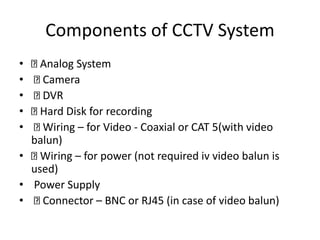
Components of CCTV System
• Analog System
• Camera
• DVR
• Hard Disk for recording
• Wiring – for Video - Coaxial or CAT 5(with video
balun)
• Wiring – for power (not required iv video balun is
used)
• Power Supply
• Connector – BNC or RJ45 (in case of video balun)
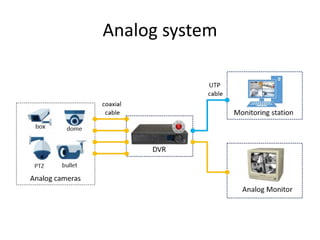
Analog system
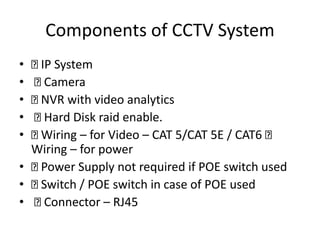
Components of CCTV System
• IP System
• Camera
• NVR with video analytics
• Hard Disk raid enable.
• Wiring – for Video – CAT 5/CAT 5E / CAT6
Wiring – for power
• Power Supply not required if POE switch used
• Switch / POE switch in case of POE used
• Connector – RJ45
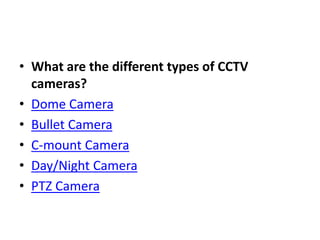
• What are the different types of CCTV
cameras?
• Dome Camera
• Bullet Camera
• C-mount Camera
• Day/Night Camera
• PTZ Camera
Type of camera and their Use
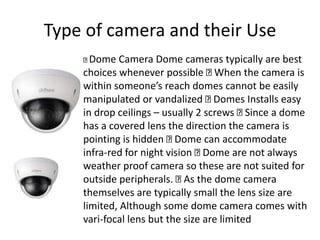
Dome Camera Dome cameras typically are best
choices whenever possible When the camera is
within someone’s reach domes cannot be easily
manipulated or vandalized Domes Installs easy
in drop ceilings – usually 2 screws Since a dome
has a covered lens the direction the camera is
pointing is hidden Dome can accommodate
infra-red for night vision Dome are not always
weather proof camera so these are not suited for
outside peripherals. As the dome camera
themselves are typically small the lens size are
limited, Although some dome camera comes with
vari-focal lens but the size are limited
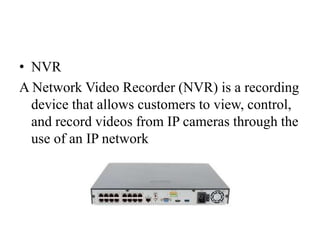
• NVR
A Network Video Recorder (NVR) is a recording
device that allows customers to view, control,
and record videos from IP cameras through the
use of an IP network
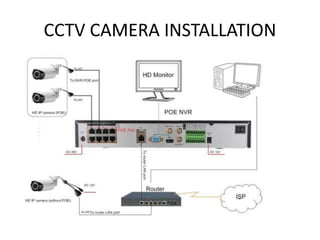
CCTV CAMERA INSTALLATION
POE AND NON POE DEVICE
• POE STANDS FOR (POWER OVER ETHERNET)
Power over Ethernet (POE) is a technology that lets network
cables carry electrical power.
For example, a digital security camera normally requires
two connections to be made when it is installed:
A network connection, in order to be able to communicate with
video recording and display equipment
A power connection, to deliver the electrical power the
camera needs to operate
However, if the camera is POE-enabled, only the network
connection needs to be made, as it will receive its electrical
power from this cable as well.

Cctv presentation

  • 2.
    CCTV OUTLINE • Introduction •Overview • Components of CCTV System • Camera and Lens Considerations • Transmission media • Networking Basics • Monitors • Power • Auxiliary equipment • System Design • Recording • Commissioning • Troubleshooting
  • 3.
    What Is CCTV •CCTV is a visual surveillance technology designed for monitoring a variety of environments and activities all at the same time. CCTV systems typically involve a dedicated communications link between cameras in the field and monitors at one or more control centers. Systems can be made up of technically mature analog cameras and image storage devices, or newly developed digital cameras and image storage devices, or a mix of the two technologies.
  • 4.
    CCTV – WhereDid It All Begin? • 1942 The first CCTV was developed, by Siemens AG in Germany. It was built to observe the launch of rockets in the war. Let’s give a huge *high-five* to Walter Bruch who installed and designed the breakthrough system. • 1949 – A US company introduced the first commercial CCTV television system. In that year, a government contractor named Vericon started to promote the system. Little is known about the technology used in this product, however the video couldn’t be recorded, they could on be used as live monitoring systems. • 1968 -The the invention of the well-known VCR advanced CCTV’s technology dramatically. Olean, New York was the first city in the World to install CCTV cameras along its main street. • 1973 – The NYPD in New York set up cameras to monitor and deter crime in Times Square, however the rates did not drop as expected. • 1980’s – Despite the cameras having little effect on crime reduction, video surveillance began to spread across the US. • 1985 – After many unsuccessful trials in the 1970’s, the UK took a leap of faith and installed the first outdoor CCTV system in the beautiful seaside town, Bournemouth.
  • 5.
    • 1987 –In King’s Lynn, Norfolk, the council set up the first local government surveillance system. The installing of the cameras were proven successful in deterring crime. This resulted in a dramatic increase in CCTV cameras being installed in public places. • 1998 – Over 3,000 CCTV were now in use in New York and private businesses and government organisations were investing heavily in the technology. • 2001 – Following the 9/11 attacks in New York, CCTV was seen as a key tool for fighting terrorism and the use of surveillance cameras rocketed around the world. • 2013 – The British Security Industry Authority (BSIA) estimated that Britain has a CCTV camera for every 11 people. That’s a whopping 5.9 million active cameras in the country. • How to work in the security sector • If you are interested in working in the security sector, whether it be as a Door Supervisor, Security Guard or CCTV Operative, you will need to obtain a SIA Licence. • To obtain a SIA Licence, you will need to complete a course. Once you have completed the course, will you then be able to apply for an SIA Licence and work in the security sector. •
  • 6.
    Why do weuse cctv camera • CCTV systems provide surveillance capabilities used in the protection of people, assets, and systems. A CCTV system serves mainly as a security force multiplier, providing surveillance for a larger area, more of the time, than would be feasible with security personnel alone
  • 7.
    Components of CCTVSystem • Analog System • Camera • DVR • Hard Disk for recording • Wiring – for Video - Coaxial or CAT 5(with video balun) • Wiring – for power (not required iv video balun is used) • Power Supply • Connector – BNC or RJ45 (in case of video balun)
  • 8.
  • 10.
    Components of CCTVSystem • IP System • Camera • NVR with video analytics • Hard Disk raid enable. • Wiring – for Video – CAT 5/CAT 5E / CAT6 Wiring – for power • Power Supply not required if POE switch used • Switch / POE switch in case of POE used • Connector – RJ45
  • 11.
    • What arethe different types of CCTV cameras? • Dome Camera • Bullet Camera • C-mount Camera • Day/Night Camera • PTZ Camera
  • 12.
    Type of cameraand their Use Dome Camera Dome cameras typically are best choices whenever possible When the camera is within someone’s reach domes cannot be easily manipulated or vandalized Domes Installs easy in drop ceilings – usually 2 screws Since a dome has a covered lens the direction the camera is pointing is hidden Dome can accommodate infra-red for night vision Dome are not always weather proof camera so these are not suited for outside peripherals. As the dome camera themselves are typically small the lens size are limited, Although some dome camera comes with vari-focal lens but the size are limited
  • 13.
    • NVR A NetworkVideo Recorder (NVR) is a recording device that allows customers to view, control, and record videos from IP cameras through the use of an IP network
  • 14.
  • 15.
    POE AND NONPOE DEVICE • POE STANDS FOR (POWER OVER ETHERNET) Power over Ethernet (POE) is a technology that lets network cables carry electrical power. For example, a digital security camera normally requires two connections to be made when it is installed: A network connection, in order to be able to communicate with video recording and display equipment A power connection, to deliver the electrical power the camera needs to operate However, if the camera is POE-enabled, only the network connection needs to be made, as it will receive its electrical power from this cable as well.