

Mobile Learning
Hamdi Nsir
Korba Prep School
February, 2016
Trends and Opportunities
1. Trends
2. Opportunities
3. Classroom Practices
Methods of learning that involve the use of
mobile phones and handheld computers
A system of learning that uses mobile
devices such as mobile/cell phones, small
computers that can be carried, etc. so that
people can learn anywhere at any time
Definition:
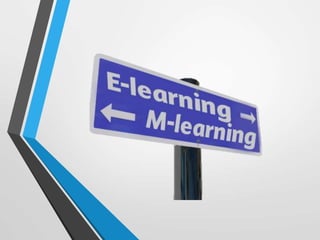
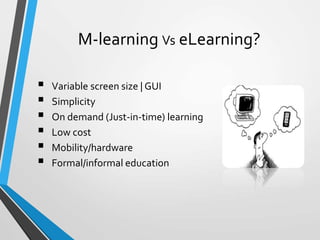
M-learning Vs eLearning?
 Variable screen size | GUI
 Simplicity
 On demand (Just-in-time) learning
 Low cost
 Mobility/hardware
 Formal/informal education
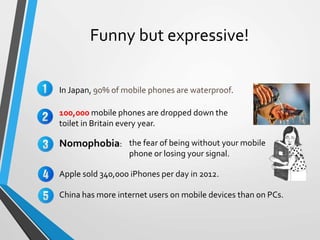
Funny but expressive!
In Japan, 90% of mobile phones are waterproof.
Apple sold 340,000 iPhones per day in 2012.
Nomophobia: the fear of being without your mobile
phone or losing your signal.
100,000 mobile phones are dropped down the
toilet in Britain every year.
China has more internet users on mobile devices than on PCs.
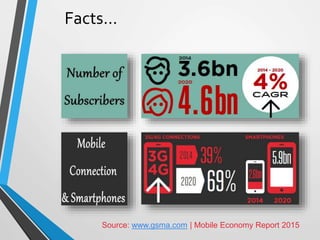
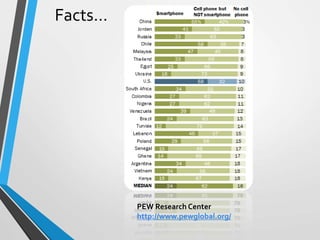
Facts…
Source: www.gsma.com | Mobile Economy Report 2015
Facts…
PEW Research Center
http://www.pewglobal.org/
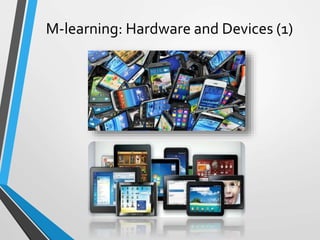
M-learning: Hardware and Devices (1)
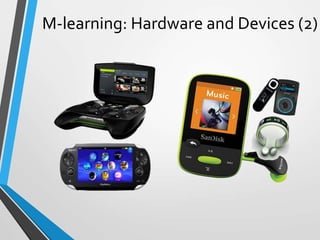
M-learning: Hardware and Devices (2)
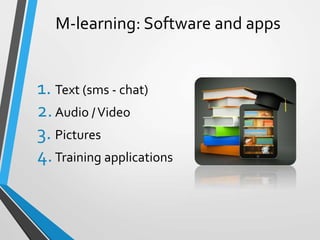
M-learning: Software and apps
1. Text (sms - chat)
2.Audio /Video
3. Pictures
4.Training applications
Mike. Sharples (Pachler, Bachmair & Cook, 2010)
1. Questioning of tools - « push learning »
« Learning2go » (England)
2.Learning « outside classrooms»
« Skattjakt Treasurehunt » (Sweden)
3. Learners’ mobility: « Contsens » Europe
A bit of history
“Over the past ten years mobile learning
has grown from a minor research interest
to a set of significant projects in schools,
workplaces, museums, cities and rural
areas around the world”.
Mike Sharples: Big Issues in Mobile Learning, 2006
Opportunities
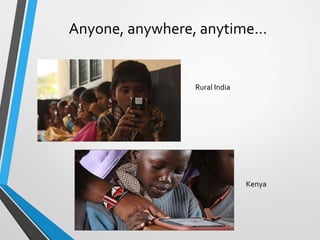
Anyone, anywhere, anytime…
Rural India
Kenya
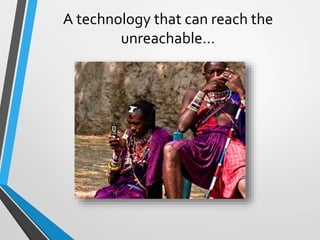
A technology that can reach the
unreachable…
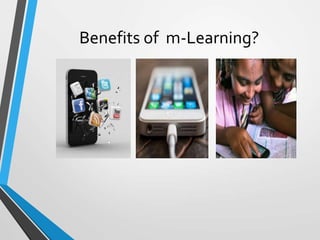
Benefits of m-Learning?
- Better accessibility to a larger audience
- Improved life chances for disadvantaged Social groups
- Improved teaching and CPD opportunities
- Revitalizing the curriculum
- Improved feedback from/to learners
- Rethinking teaching methods
- Turning learners into a valuable teaching resource
- Supporting learner retention, progression and transition
- Supporting continuing Knowledge updating and further study
- Supporting adaptability to the changing needs of learners
Uses of mobile devices in
classrooms??
Discussion question:
Can you think of possible uses / activities
that can be based on mobile devices in the
classroom??
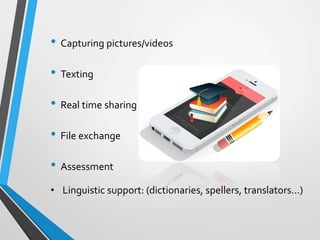
• Capturing pictures/videos
• Texting
• Real time sharing
• File exchange
• Assessment
• Linguistic support: (dictionaries, spellers, translators…)
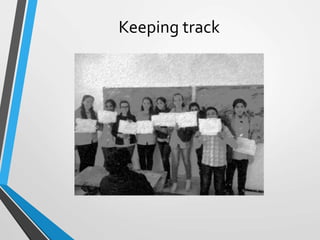
Keeping track
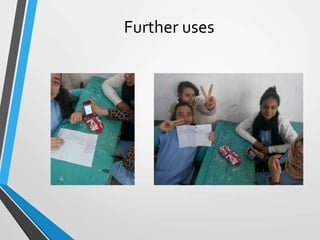
Further uses
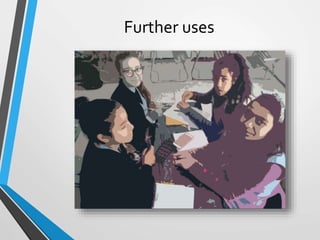
Further uses
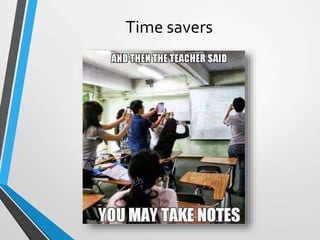
Time savers
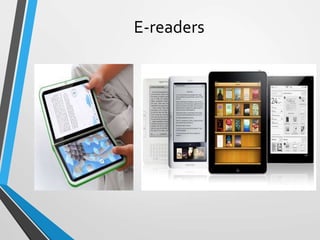
E-readers
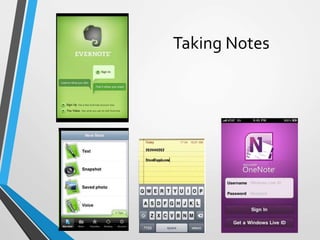
Taking Notes
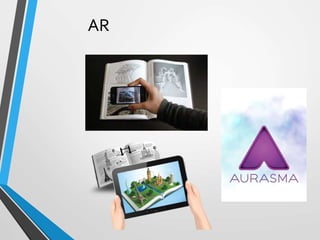
AR
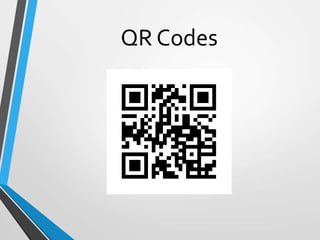
QR Codes
However, we still need to remind
them and teach them not to forget:
“Internet Seen as Positive Influence on education
but Negative on Morality in Emerging and
Developing Nations”.
PEW Research Center
http://www.pewglobal.org/
Resources
University Leaders: ACU, CTU, Open University,
International Academy of Design andTechnology
Organizations:
 LearningTown (mobile learning group)
http://www.learningtown.com/
 The eLearningGuild http://www.elearningguild.com/
 InternationalAssociation of Mobile Learning
mLearning Conferences: http://www.mlearning-conf.org/
 http://mlearnopedia.com/
 http://www.elearningguild.com/mLearning conference
Blog: handheldlearning
Books & Journals
• Instructional Design for M-Learning – David Metcalf
• Mobile Learning: A Handbook for Educators andTrainers – Kukulska &
Traxler
• Mobile Learning:Transforming the Delivery of Education and
Training (eBook of studies from AU Press) – Editor: MohamedAlly
• Mobile Learning: on-line journal
• Mobile Learning:A handbook for Educators andTrainers: Agnes
Kukulska-Hulme and JohnTraxler
• M-learning: texting (SMS) as a teaching & learning tool in higher arts
education
ThankYou!
hamdins@gmail.com

Mobile learning.. Trends and Opportunities

  • 1.
    Mobile Learning Hamdi Nsir KorbaPrep School February, 2016 Trends and Opportunities
  • 2.
    1. Trends 2. Opportunities 3.Classroom Practices
  • 3.
    Methods of learningthat involve the use of mobile phones and handheld computers A system of learning that uses mobile devices such as mobile/cell phones, small computers that can be carried, etc. so that people can learn anywhere at any time Definition:
  • 5.
    M-learning Vs eLearning? Variable screen size | GUI  Simplicity  On demand (Just-in-time) learning  Low cost  Mobility/hardware  Formal/informal education
  • 6.
    Funny but expressive! InJapan, 90% of mobile phones are waterproof. Apple sold 340,000 iPhones per day in 2012. Nomophobia: the fear of being without your mobile phone or losing your signal. 100,000 mobile phones are dropped down the toilet in Britain every year. China has more internet users on mobile devices than on PCs.
  • 7.
    Facts… Source: www.gsma.com |Mobile Economy Report 2015
  • 8.
  • 9.
  • 10.
  • 11.
    M-learning: Software andapps 1. Text (sms - chat) 2.Audio /Video 3. Pictures 4.Training applications
  • 12.
    Mike. Sharples (Pachler,Bachmair & Cook, 2010) 1. Questioning of tools - « push learning » « Learning2go » (England) 2.Learning « outside classrooms» « Skattjakt Treasurehunt » (Sweden) 3. Learners’ mobility: « Contsens » Europe A bit of history
  • 13.
    “Over the pastten years mobile learning has grown from a minor research interest to a set of significant projects in schools, workplaces, museums, cities and rural areas around the world”. Mike Sharples: Big Issues in Mobile Learning, 2006
  • 14.
  • 15.
  • 16.
    A technology thatcan reach the unreachable…
  • 17.
  • 18.
    Benefits of m-Learning? -Better accessibility to a larger audience - Improved life chances for disadvantaged Social groups - Improved teaching and CPD opportunities - Revitalizing the curriculum - Improved feedback from/to learners - Rethinking teaching methods - Turning learners into a valuable teaching resource - Supporting learner retention, progression and transition - Supporting continuing Knowledge updating and further study - Supporting adaptability to the changing needs of learners
  • 19.
    Uses of mobiledevices in classrooms??
  • 20.
    Discussion question: Can youthink of possible uses / activities that can be based on mobile devices in the classroom??
  • 21.
    • Capturing pictures/videos •Texting • Real time sharing • File exchange • Assessment • Linguistic support: (dictionaries, spellers, translators…)
  • 22.
  • 23.
  • 24.
  • 25.
  • 26.
  • 27.
  • 28.
  • 29.
  • 30.
    However, we stillneed to remind them and teach them not to forget:
  • 31.
    “Internet Seen asPositive Influence on education but Negative on Morality in Emerging and Developing Nations”. PEW Research Center http://www.pewglobal.org/
  • 33.
    Resources University Leaders: ACU,CTU, Open University, International Academy of Design andTechnology Organizations:  LearningTown (mobile learning group) http://www.learningtown.com/  The eLearningGuild http://www.elearningguild.com/  InternationalAssociation of Mobile Learning mLearning Conferences: http://www.mlearning-conf.org/  http://mlearnopedia.com/  http://www.elearningguild.com/mLearning conference Blog: handheldlearning
  • 34.
    Books & Journals •Instructional Design for M-Learning – David Metcalf • Mobile Learning: A Handbook for Educators andTrainers – Kukulska & Traxler • Mobile Learning:Transforming the Delivery of Education and Training (eBook of studies from AU Press) – Editor: MohamedAlly • Mobile Learning: on-line journal • Mobile Learning:A handbook for Educators andTrainers: Agnes Kukulska-Hulme and JohnTraxler • M-learning: texting (SMS) as a teaching & learning tool in higher arts education
  • 35.

Editor's Notes

  • #11 Games help the learners know better about their world and aqcuire new linguistic capacities and enrish their vocabulary and communicative abilities, For instance, boys in my classes are more likely to know about sports and to quickly know the meaning of frequently used terms in games such as: start, game over, time over, play, life, attack, build, restart, buy, engage, sell, defend, exit, quit,,,, Media player can also be used to enhance learners’ listening skills and offer them more and better opportunities to getexposed to target language,,,
  • #13 The 1st phase was initiated in the mid 1990’s
  • #16 Nokia has sponsored a MILLEE project teaching English literacy to rural children in India using mobile phone-based games, begining with 800 children in 40 villages in southern India’s Andhra Pradesh. MILLEE is also working with the University of Nairobi to explore how the games could be adapted to English literacy learning for rural children in Kenya. http://www.wired.com/2010/10/in-rural-china-students-use-phones-to-learn-to-read/
  • #17 http://www.wired.com/2010/10/in-rural-china-students-use-phones-to-learn-to-read/
  • #18 Social Media Oriented: learners can get the best of these networks and learn through as they get convinced of their vast educatinal benefits Mobiles are usually low cost and energy-saving devices: an apple phone for instance consumes 0,25 $ worth of electricity per year if fully charged once a day.
  • #23 The headmaster came to my class and distributed certificates to the best achievers at the end of the 1st term. I asked the students if they want to be photograhed and they were extremly happy to do it, Cameras within mobile devices can help promote the affective side of the teaching-learning process
  • #24 An activity in the class where the use of mobiles was allowed, The students were insdtructed to gather in groups and start designing a leaflet,, Mobiles helped them collect data and write from specific online resources, i,e wikipedia in the picture. They were highly encouraged to state their resources learn how to learn / state one’s reources and avoid palgiarism ,,,,
  • #25 Using mobiles in class can promote creativity and help the learners get inspired, Here in this picture, you can see a group of my ow students using the mobile to check some works on the net as they were busy creating a leaflet about the benefits of sports,,,
  • #26 Mobiles can be time and effort savers
  • #27 Mobiles can be time and effort savers
  • #28 Examples of apps that can change and even revolutionise the ways learners of different backgrounds can take notes, 1. Evenote 2. Android built-in note taking app 3. Microsoft’s OneNote
  • #29 AR: the letters stand for Augmented Reality
  • #30 Introduce the concept of Qr codes then ask a volunteer fro the audiance to scan the code on the slide and check what it leads to,,, For further understanding, the attandants are asked to answer the quiz made of QRs and previously given to them,