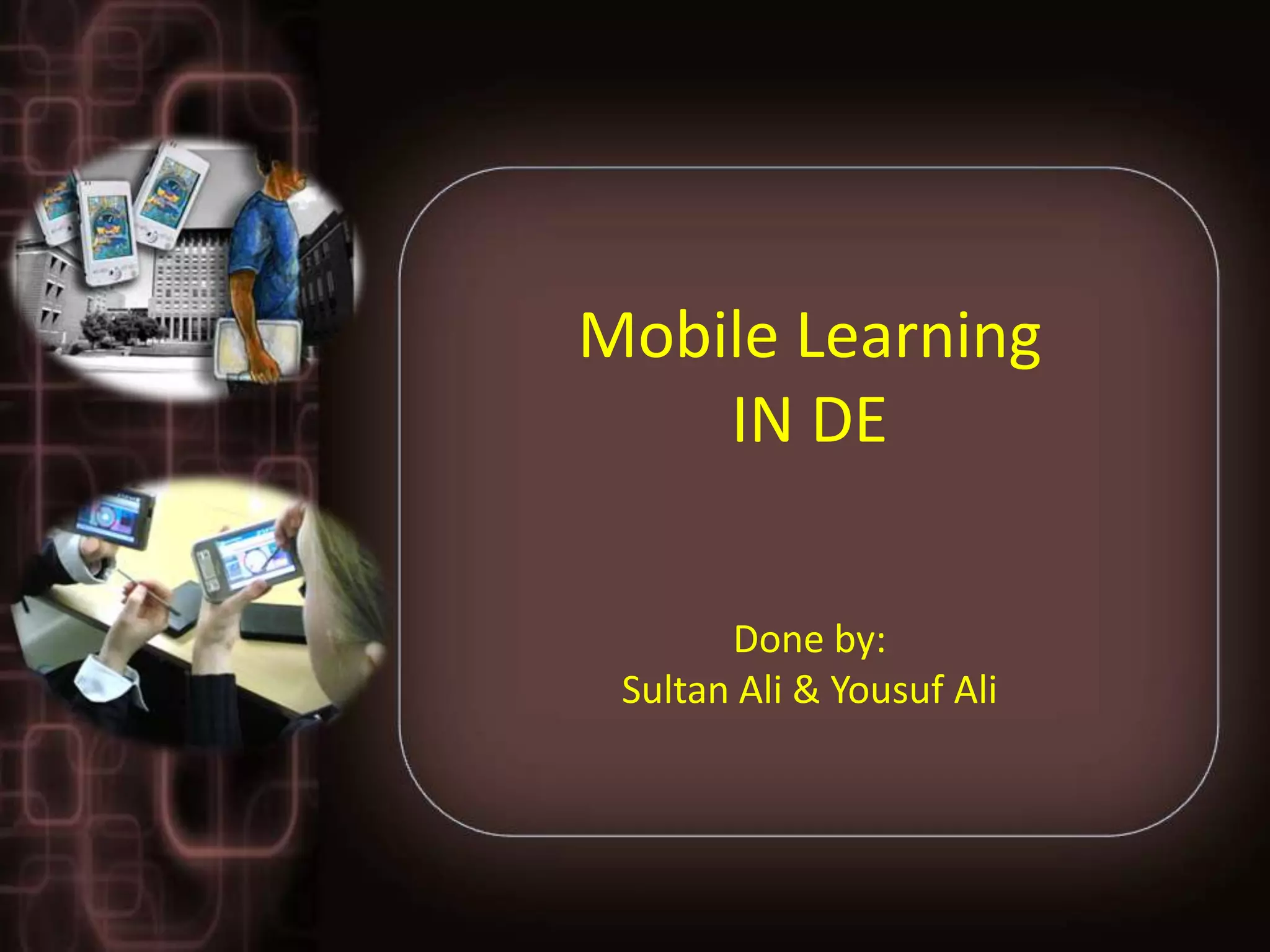
Mobile Learning
    IN DE

       Done by:
 Sultan Ali & Yousuf Ali
Outline

What is Mobile Learning?
Objectives of using the Mobile
Learning in DE.
Features of M-learning.
Advantages of M-learning.
Challenges of the Mobile Learning.
How the Mobile Learning are used to
deliver and support learning.
Example of using M-learning in
education.
What is Mobile Learning?

    Learning that happens across
 locations, or that takes advantage
of learning opportunities offered by
       portable technologies.
Objectives of using the Mobile
         Learning in DE:

 Enhances knowledge and skills.
 Improve communication skills.
 Available wherever and
whenever
 Easier access.
 Increases motivation .
Features of M-learning:

Enables learners to construct
understandings.
Enables knowledge building by
learners in different contexts.
M-learning is convenient.
M-learning is collaborative
M-learning is engaging and fun.
Advantages of M-learning:
 Interaction: students interaction with
instructors and among each other.
 Collaborative: Enables several
students work together on assignments
even while at distant location.
 Engaging learners: the new
generation likes mobile devices such as
PDAs, phones and game devices.
 Increases motivation : Owner Ship of
the handheld devices seems to increase
commitment to using and learning from
it.
Challenges of the Mobile Learning

There are two type related to M-learning
challenges which are:
•Technical challenges.
•Social and educational challenges.
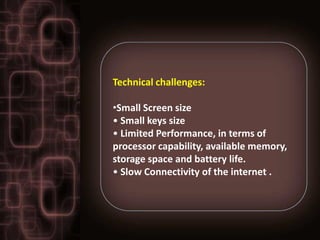
Technical challenges:

•Small Screen size
• Small keys size
• Limited Performance, in terms of
processor capability, available memory,
storage space and battery life.
• Slow Connectivity of the internet .
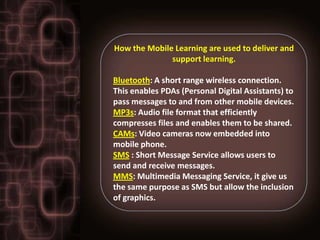
How the Mobile Learning are used to deliver and
              support learning.

Bluetooth: A short range wireless connection.
This enables PDAs (Personal Digital Assistants) to
pass messages to and from other mobile devices.
MP3s: Audio file format that efficiently
compresses files and enables them to be shared.
CAMs: Video cameras now embedded into
mobile phone.
SMS : Short Message Service allows users to
send and receive messages.
MMS: Multimedia Messaging Service, it give us
the same purpose as SMS but allow the inclusion
of graphics.
How the Mobile Learning are used to deliver and
              support learning.

Bluetooth: A short range wireless connection.
This enables PDAs (Personal Digital Assistants) to
pass messages to and from other mobile devices.
MP3s: Audio file format that efficiently
compresses files and enables them to be shared.
CAMs: Video cameras now embedded into
mobile phone.
SMS : Short Message Service allows users to
send and receive messages.
MMS: Multimedia Messaging Service, it give us
the same purpose as SMS but allow the inclusion
of graphics.
Example


http://www.slideshare.net/stevevosloo/
mobile-learning-south-african-examples
THANKS

M learing

  • 1.
    Mobile Learning IN DE Done by: Sultan Ali & Yousuf Ali
  • 2.
    Outline What is MobileLearning? Objectives of using the Mobile Learning in DE. Features of M-learning. Advantages of M-learning. Challenges of the Mobile Learning. How the Mobile Learning are used to deliver and support learning. Example of using M-learning in education.
  • 3.
    What is MobileLearning? Learning that happens across locations, or that takes advantage of learning opportunities offered by portable technologies.
  • 4.
    Objectives of usingthe Mobile Learning in DE:  Enhances knowledge and skills.  Improve communication skills.  Available wherever and whenever  Easier access.  Increases motivation .
  • 5.
    Features of M-learning: Enableslearners to construct understandings. Enables knowledge building by learners in different contexts. M-learning is convenient. M-learning is collaborative M-learning is engaging and fun.
  • 6.
    Advantages of M-learning: Interaction: students interaction with instructors and among each other.  Collaborative: Enables several students work together on assignments even while at distant location.  Engaging learners: the new generation likes mobile devices such as PDAs, phones and game devices.  Increases motivation : Owner Ship of the handheld devices seems to increase commitment to using and learning from it.
  • 7.
    Challenges of theMobile Learning There are two type related to M-learning challenges which are: •Technical challenges. •Social and educational challenges.
  • 8.
    Technical challenges: •Small Screensize • Small keys size • Limited Performance, in terms of processor capability, available memory, storage space and battery life. • Slow Connectivity of the internet .
  • 9.
    How the MobileLearning are used to deliver and support learning. Bluetooth: A short range wireless connection. This enables PDAs (Personal Digital Assistants) to pass messages to and from other mobile devices. MP3s: Audio file format that efficiently compresses files and enables them to be shared. CAMs: Video cameras now embedded into mobile phone. SMS : Short Message Service allows users to send and receive messages. MMS: Multimedia Messaging Service, it give us the same purpose as SMS but allow the inclusion of graphics.
  • 10.
    How the MobileLearning are used to deliver and support learning. Bluetooth: A short range wireless connection. This enables PDAs (Personal Digital Assistants) to pass messages to and from other mobile devices. MP3s: Audio file format that efficiently compresses files and enables them to be shared. CAMs: Video cameras now embedded into mobile phone. SMS : Short Message Service allows users to send and receive messages. MMS: Multimedia Messaging Service, it give us the same purpose as SMS but allow the inclusion of graphics.
  • 11.
  • 12.