Reflections on a 16 Year Research Journey from Mentoring, Metacognition and Music to  Mobile Learning CALRG, Open University  30th Anniversary  May 09   Email: john.cook@londonmet.ac.uk Home page: http://staffweb.londonmet.ac.uk/~cookj1/ Blog: http://blogs.londonmet.ac.uk/tel Twitter: http://twitter.com/johnnigelcook Slideshare: http://www.slideshare.net/johnnigelcook  Blip.fm: http://blip.fm/johnnigelcook   John Cook Learning Technology Research Institute,  London Metropolitan University
Structure Snapshot 1:  Cooperative Problem-Seeking Dialogues in Learning (Cook, 2000).  Snapshot 2:  Going for a Local Walkabout: Putting Urban Planning Education in Context with Mobile Phones (Cook, 2009) The song remains the same?
1. Cooperative, problem-seeking dialogue  (Cook, 2000).  does not focus on winning the argument or persuading your partner instead involves an acceptance by participants that they will attempt to  find and refine  a problem specification a problem specification is a description of a problem that is interesting or novel
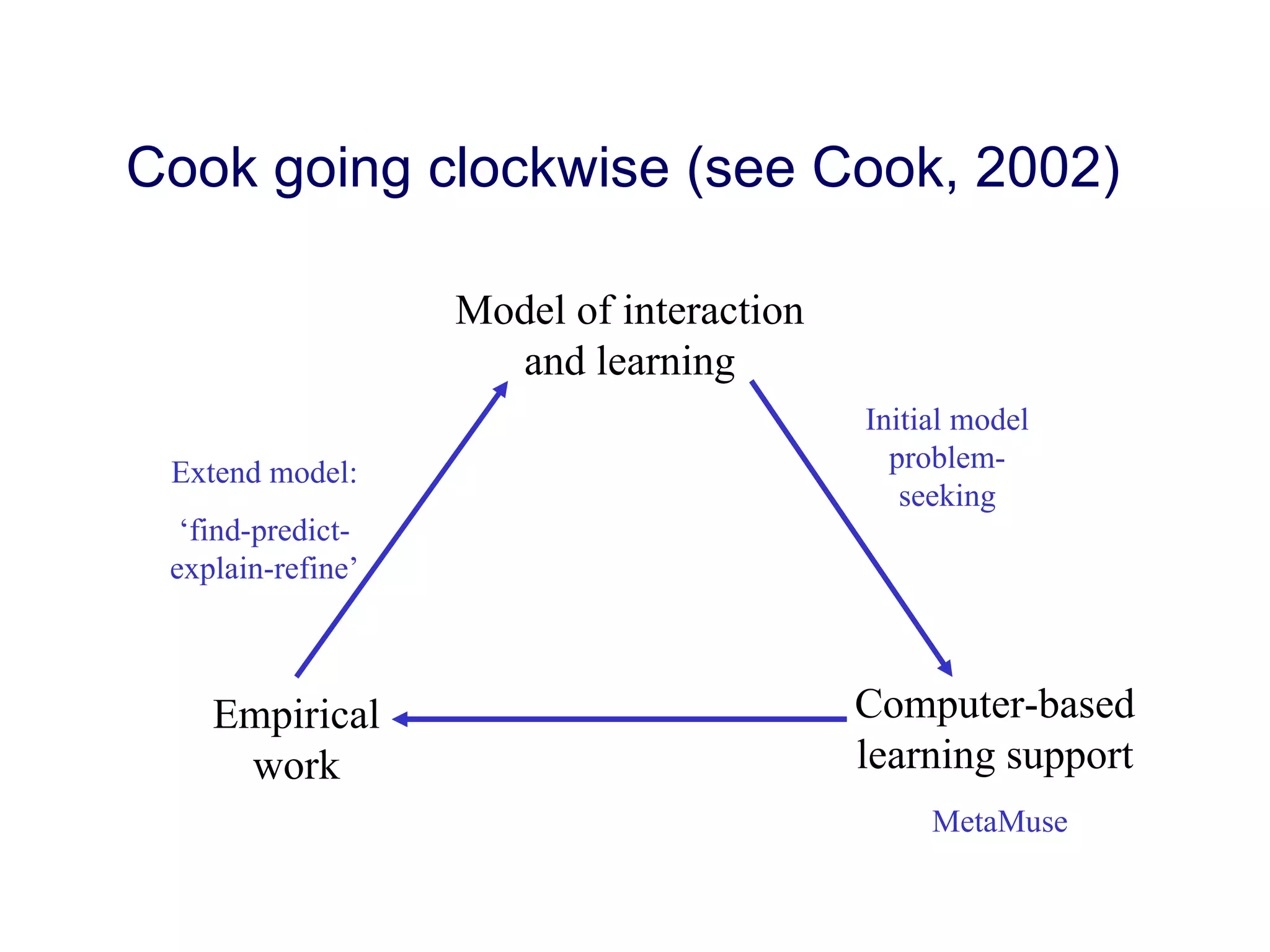
Cook going clockwise (see Cook, 2002) Model of interaction and learning Empirical work Computer-based learning support MetaMuse Initial model problem-seeking Extend model: ‘ find-predict-explain-refine’
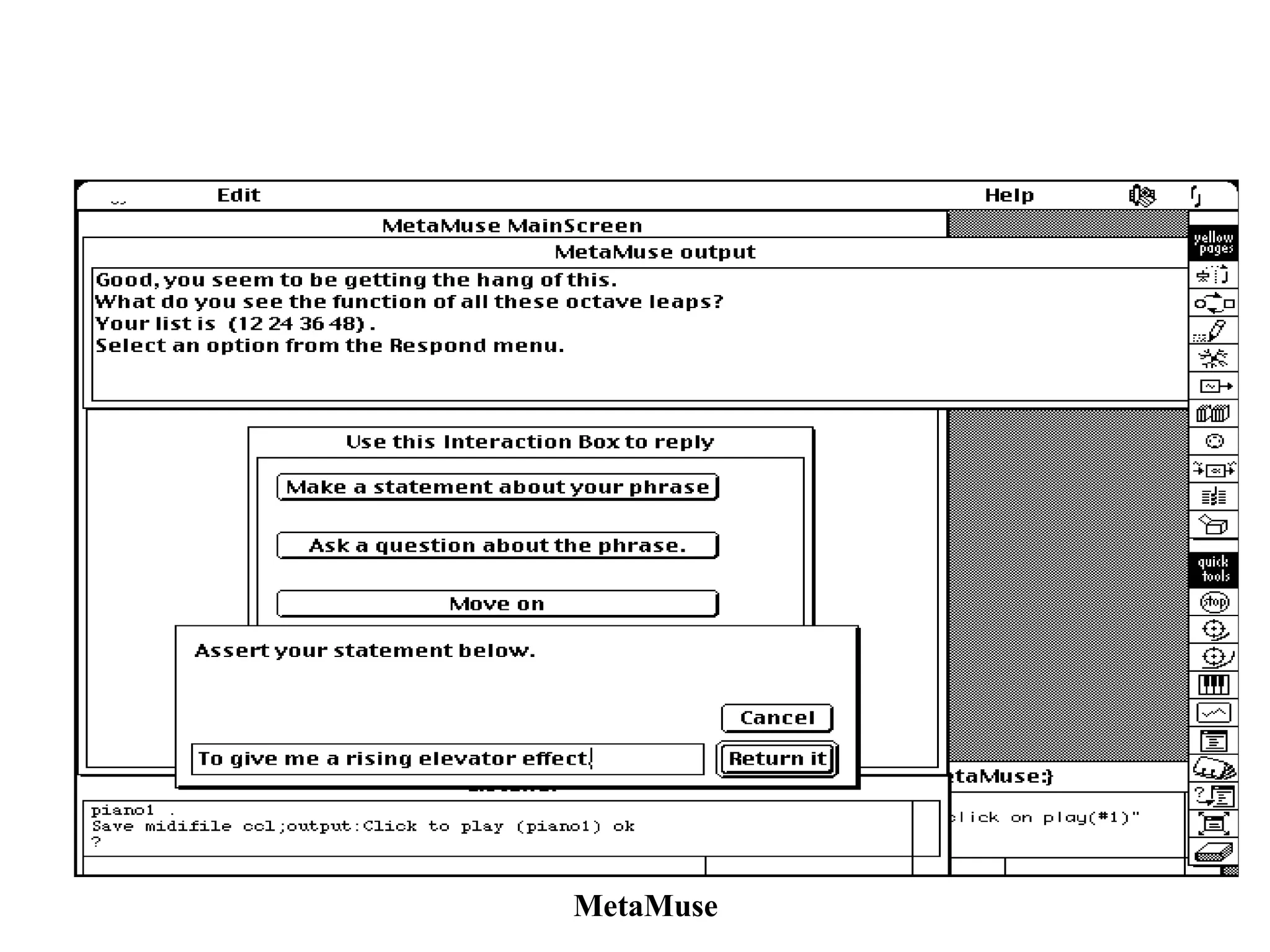
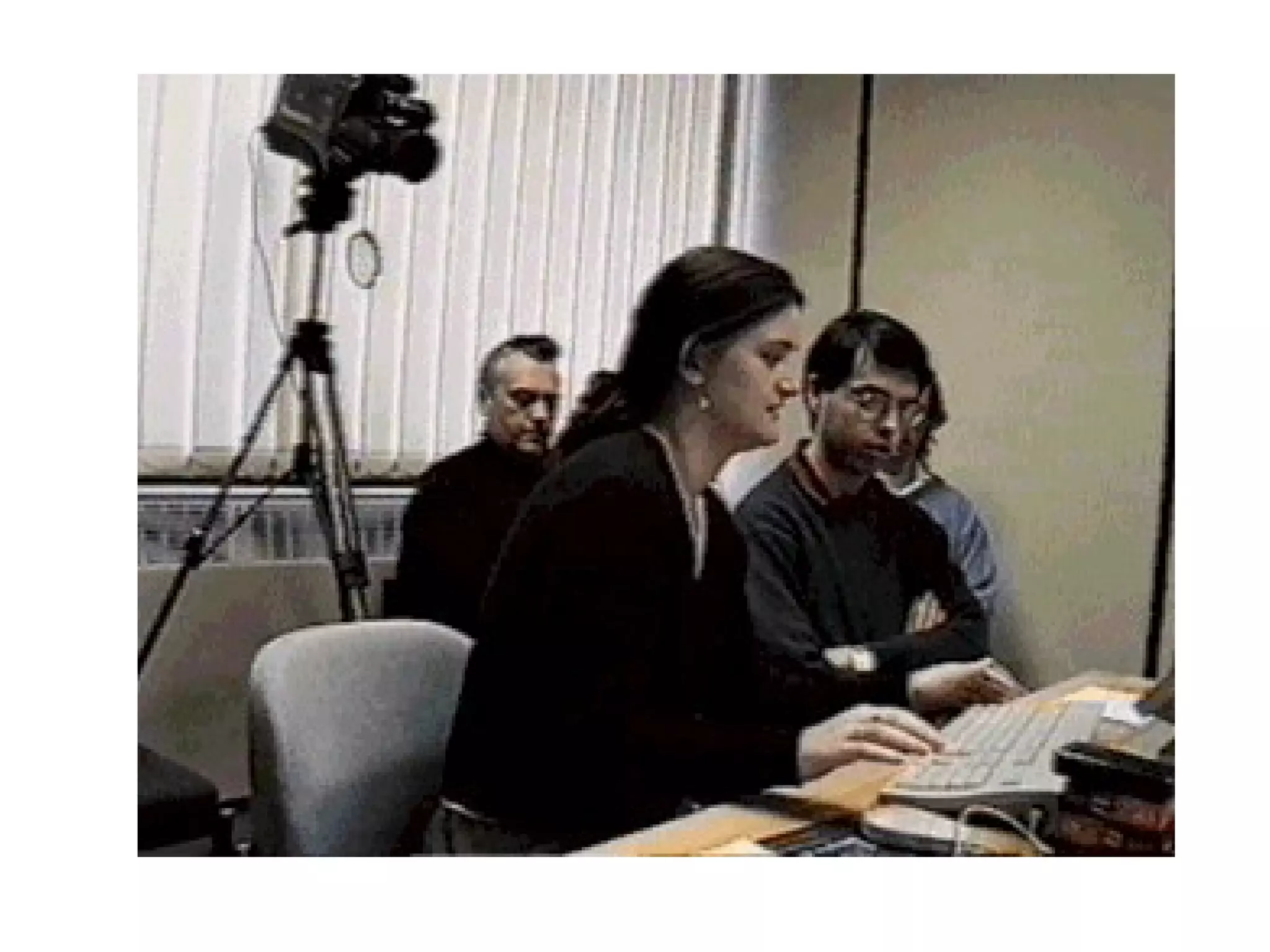
MetaMuse: Computational Implementation MetaMuse is a pedagogical agent that has been designed to  adaptively structure interactions between pairs of cooperating learners The design of the pedagogical agent was partially based on the results of a previous analysis of empirical data, e.g. State Transition Networks (STNs)
MetaMuse
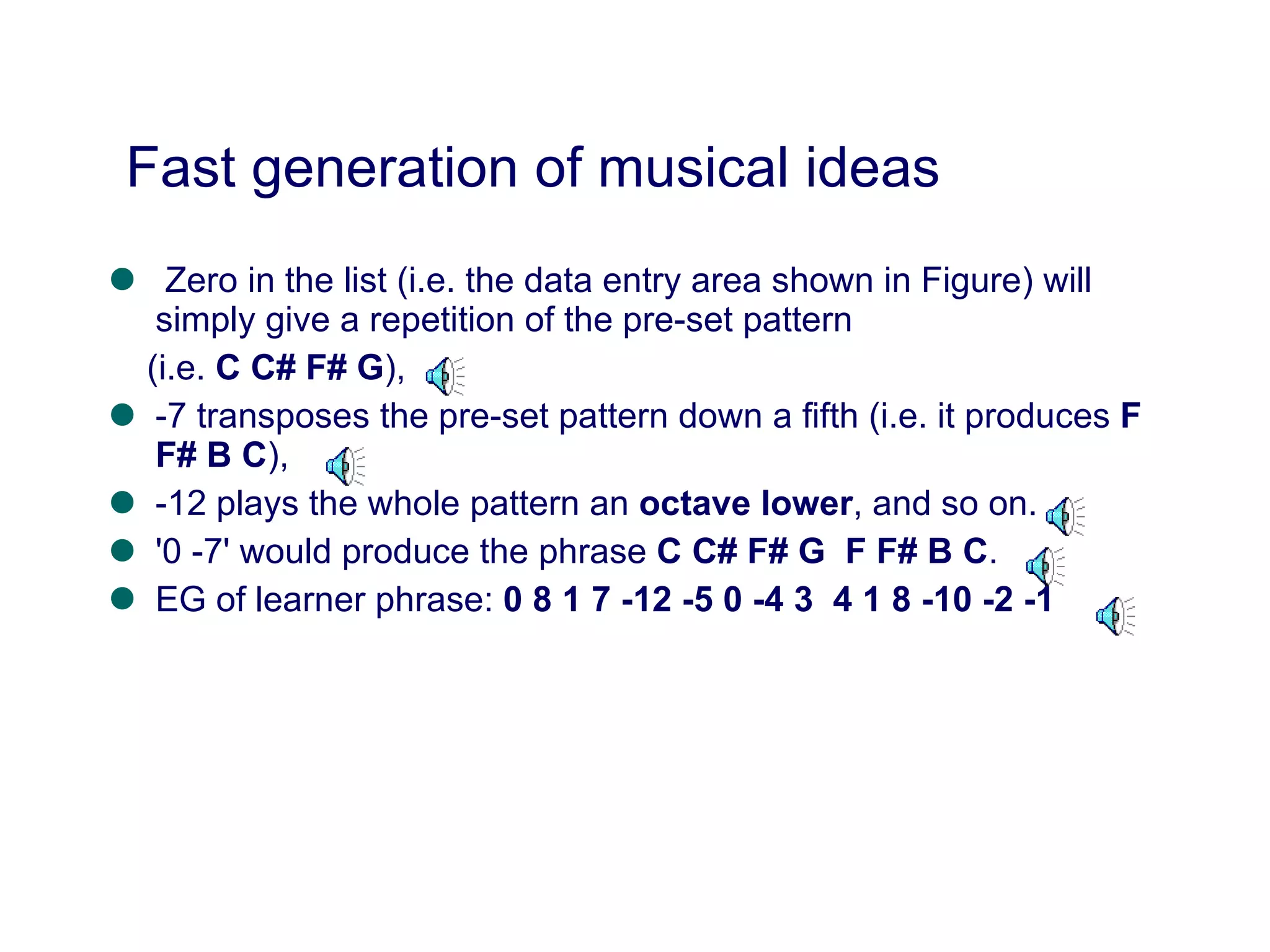
Zero in the list (i.e. the data entry area shown in Figure) will simply give a repetition of the pre-set pattern  (i.e.  C C# F# G ),  -7 transposes the pre-set pattern down a fifth (i.e. it produces  F F# B C ),  -12 plays the whole pattern an  octave lower , and so on. '0 -7' would produce the phrase  C C# F# G  F F# B C . EG of learner phrase:  0 8 1 7 -12 -5 0 -4 3  4 1 8 -10 -2 -1  Fast generation of musical ideas
 
Study Conclusions (2000) Claim that MetaMuse encouraged problem-seeking 90 occurrences when cooperative problem-seeking was identified in the dialogue data.  Low score of 10 occasions which were identified as occurrences of non-cooperative problem-seeking.
Future work (2000) Future work will focus on using our results to generate STNs that model how pairs of cooperating learners interacted successfully These prescriptive models of cooperation will be used as the basis for tutoring tactics when MetaMuse is pursuing a goal
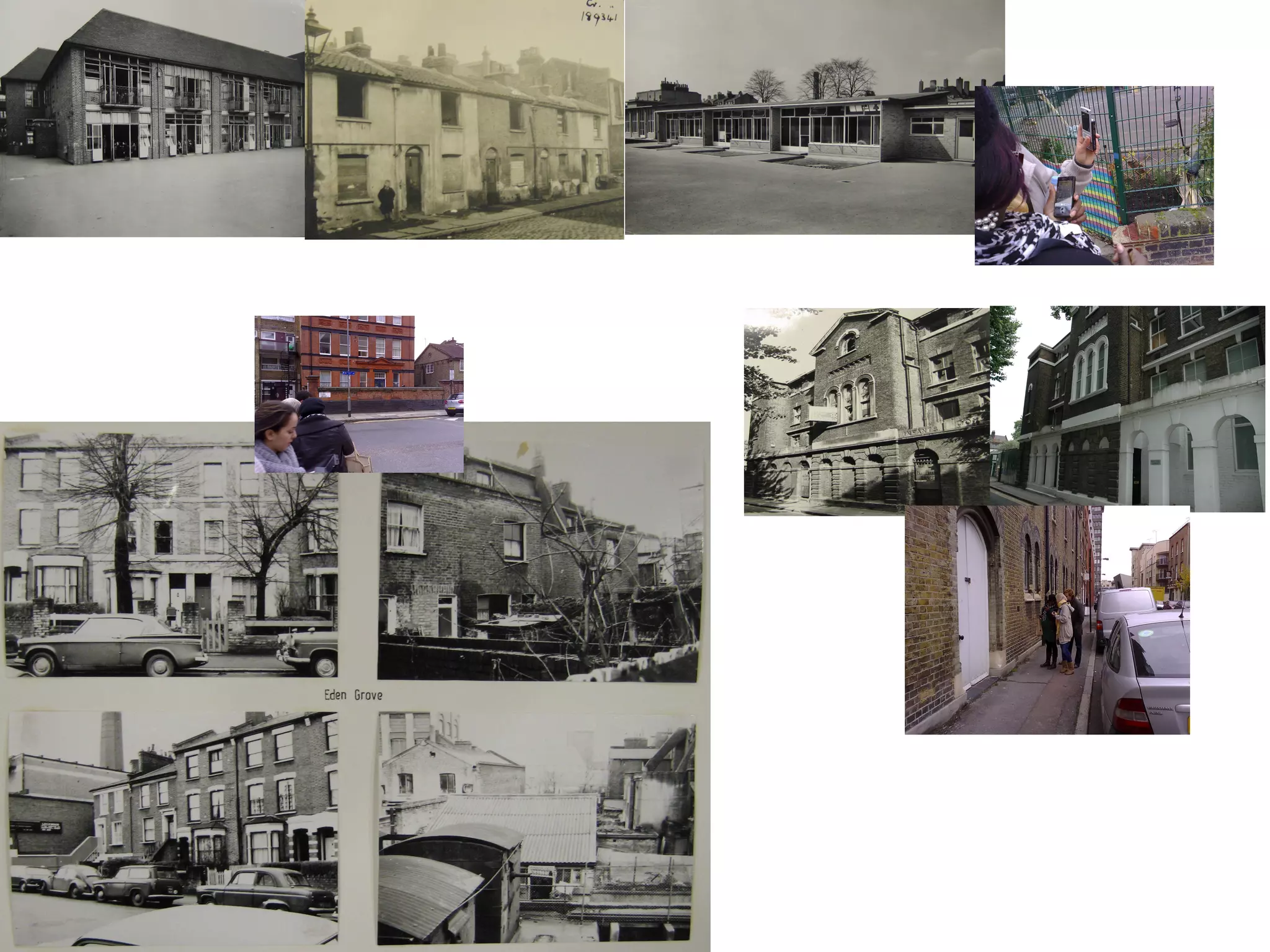
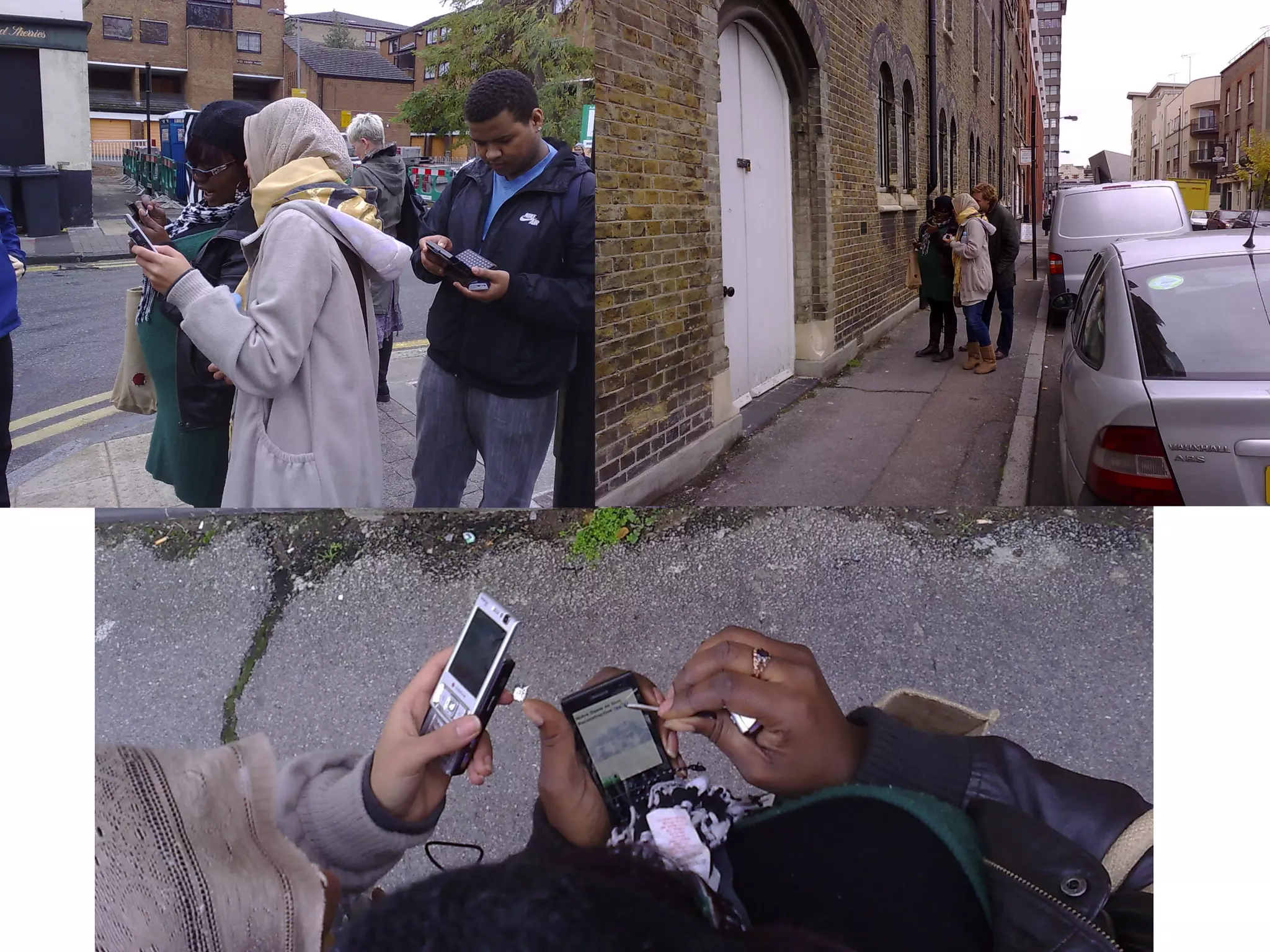
2. Going for a Local Walkabout: Putting Urban Planning Education in Context with Mobile Phones (Cook, 2009; also Smith, C., Cook, J. and Pratt-Adams, S., 2009) An urban area close to London Metropolitan University, from 1850 to the present day, is being used to explore how schools are signifiers of both urban change and continuity of educational policy and practice.  The aim of this project is to provide a contextualised, social and historical account of urban education, focusing on systems and beliefs that contribute to the construction of the surrounding discourses.  Another aim of this project is to scaffold the trainee teachers’ understanding of what is possible with mobile learning in terms of filed trips.  Part of EC funded CONTSENS project:  http://bit.ly/oU9bj
 
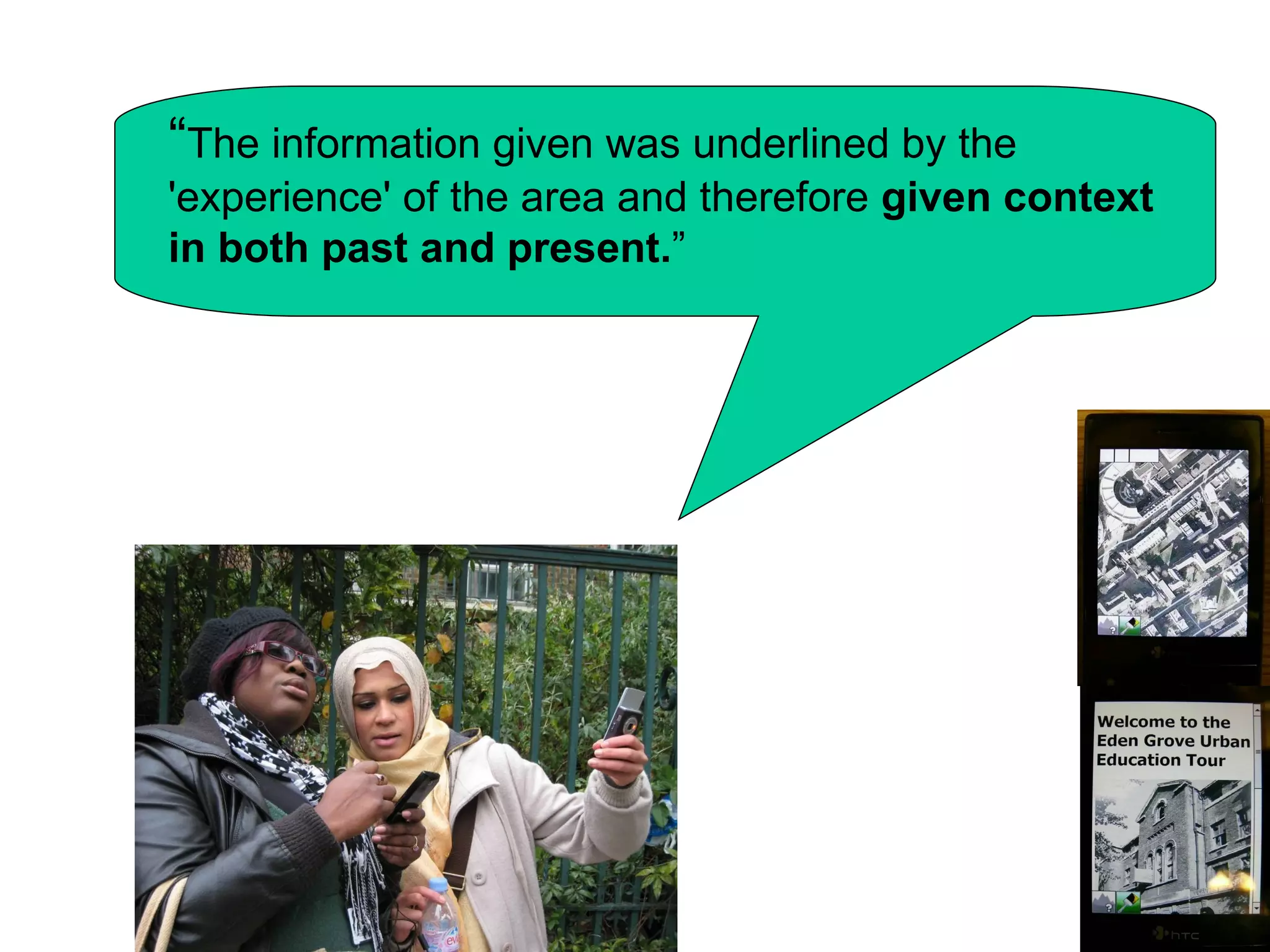
Outline of development/research process High end mobile phones  (HTC diamond + Nokia N95) used by small groups of 2 or 3 students at a time. They allowed real research to be done on the move. The  voice recorder on the phones  used to allow report writing and note making for final presentations to be captured quickly and efficiently.  Students could also produce  video podcasts  of themselves and even edit the videos they make on site using the phones.
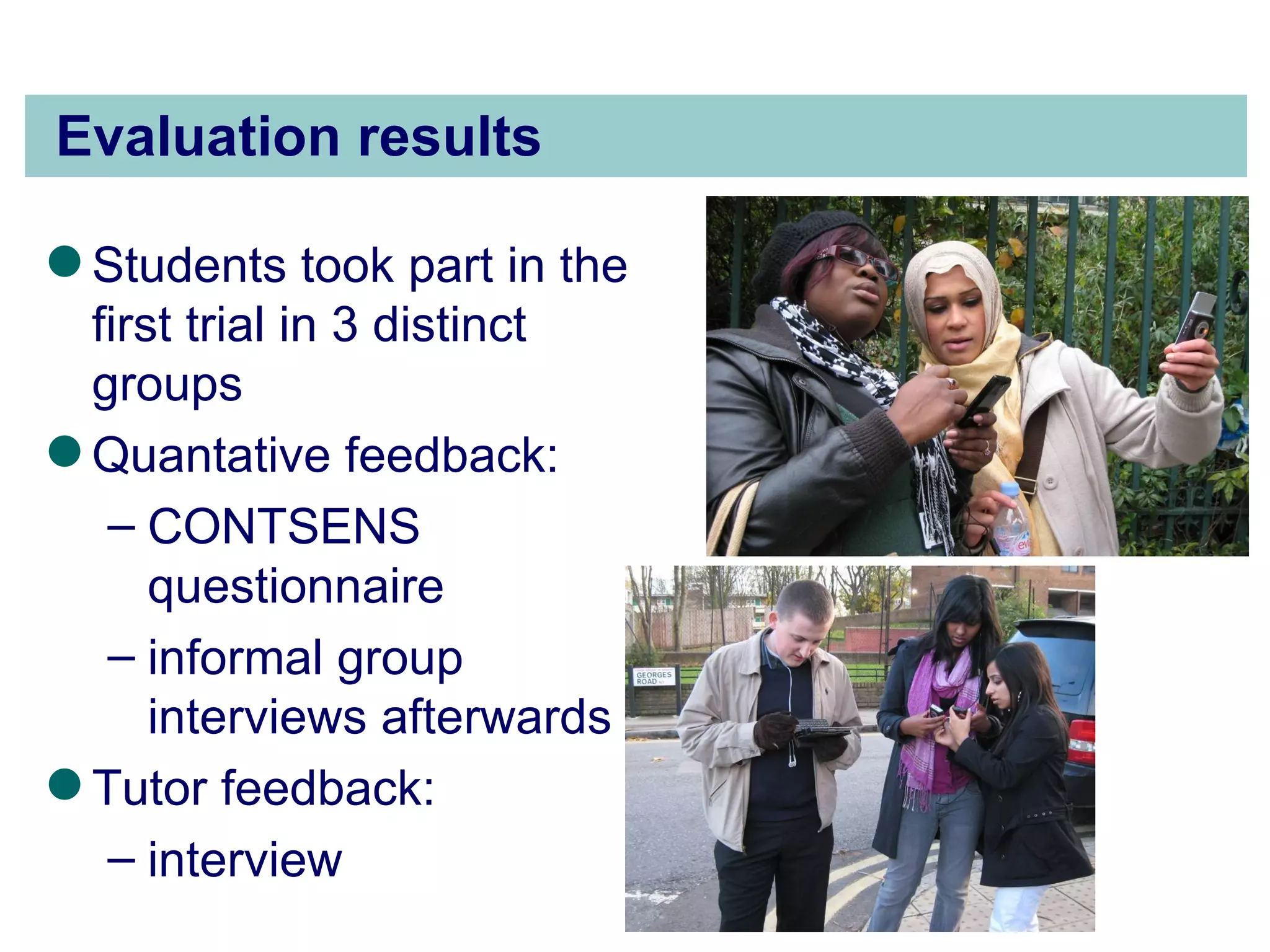
Evaluation results Students took part in the first trial in 3 distinct groups Quantative feedback: CONTSENS questionnaire informal group interviews afterwards Tutor feedback: interview
 
“ The information given was underlined by the 'experience' of the area and therefore  given context in both past and present. ”
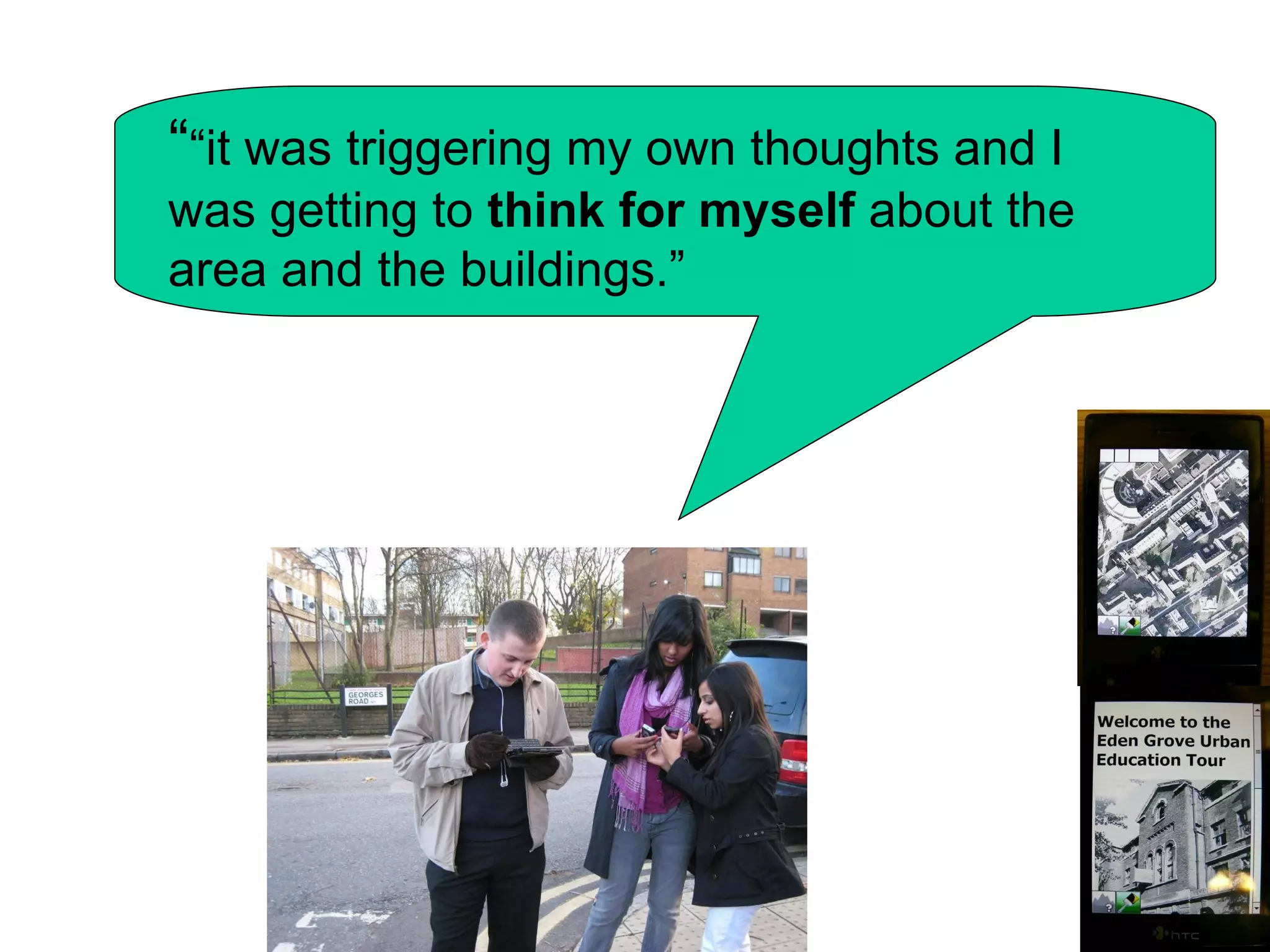
“ “ it was triggering my own thoughts and I was getting to  think for myself  about the area and the buildings. ”
Enhancement of the learning experience 91% thought the mobile device  enhanced the learning experience The information was  easy to assimilate  allowing more time to  concentrate on tasks .  Allowed instant  reflection in situ . The mobile tour promoted “ active learning ”  they were less passive than they would have been on a tutor-led tour  they were  not “merely taking in information ”  the mobile tour triggered their own thoughts and encouraged them to think more about the area
Future work (2009) Future work in this area will revolve around these context questions.  Will learners follow a ‘learning pathway’ across multiple contexts for learning?  During their activity, what will the learning trail left behind by learners tell us as they move from one learning context to the next?  Will it be possible to produce  intervention guidelines  that can be used (perhaps in modified forms) across many contexts?
Recent work Cook, J., Pachler, N. and Bradley, C. (2008). Bridging the Gap? Mobile Phones at the Interface between Informal and Formal Learning.  Journal of the Research Center for Educational Technology,  Spring. Available from  http:// www.rcetj.org /?type= art&id =87827&   Cook, J. (forthcoming). Learner Generated Contexts.  In B. Bachmair (Ed.)  Media Literacy in New Cultural Spaces (Medienbildung in Neuen Kulturräumen).   Germany. Cook, J. and Pachler, N. (2009). Appropriation of Mobile Phones in and Across Formal and Informal Learning. In R. Land and S. Bayne (Eds.),  Digital Difference.  Rotterdam: Sense Publishers. Pachler, N., Bachmair, B., Cook, J. and Kress, G. (in preparation, 2009).  Mobile Learning: Structures, Agency, Practices  . Springer. Due Autumn 2009.
3. The song remains the same? Users data still the centre of my inquiry As is the notion of adaptively structuring interactions between cooperating/collaborating learners:  model cooperating learners interaction these prescriptive models of cooperation will be used as the basis for heuristics to help learner achieve context sensitive goals (shift here from tutoring system to learner)   Link between theory, empirical work and ICT-based implementations remains key non-automated task But important research issues for me: Equity access to cultural resources for education Learner generated context Appropriation Mobility and learning pathways Informal learning
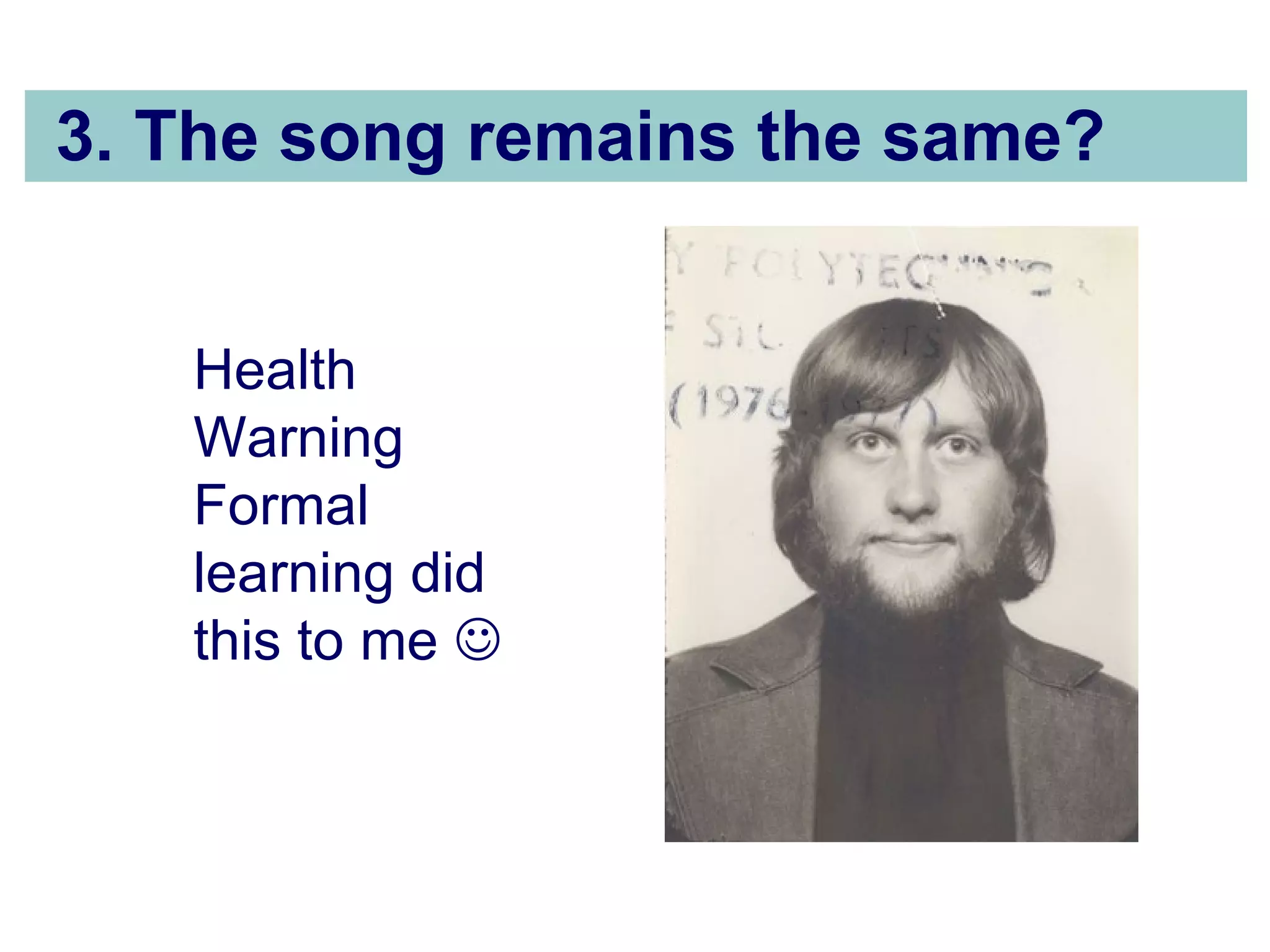
3. The song remains the same? Health Warning Formal learning did this to me  
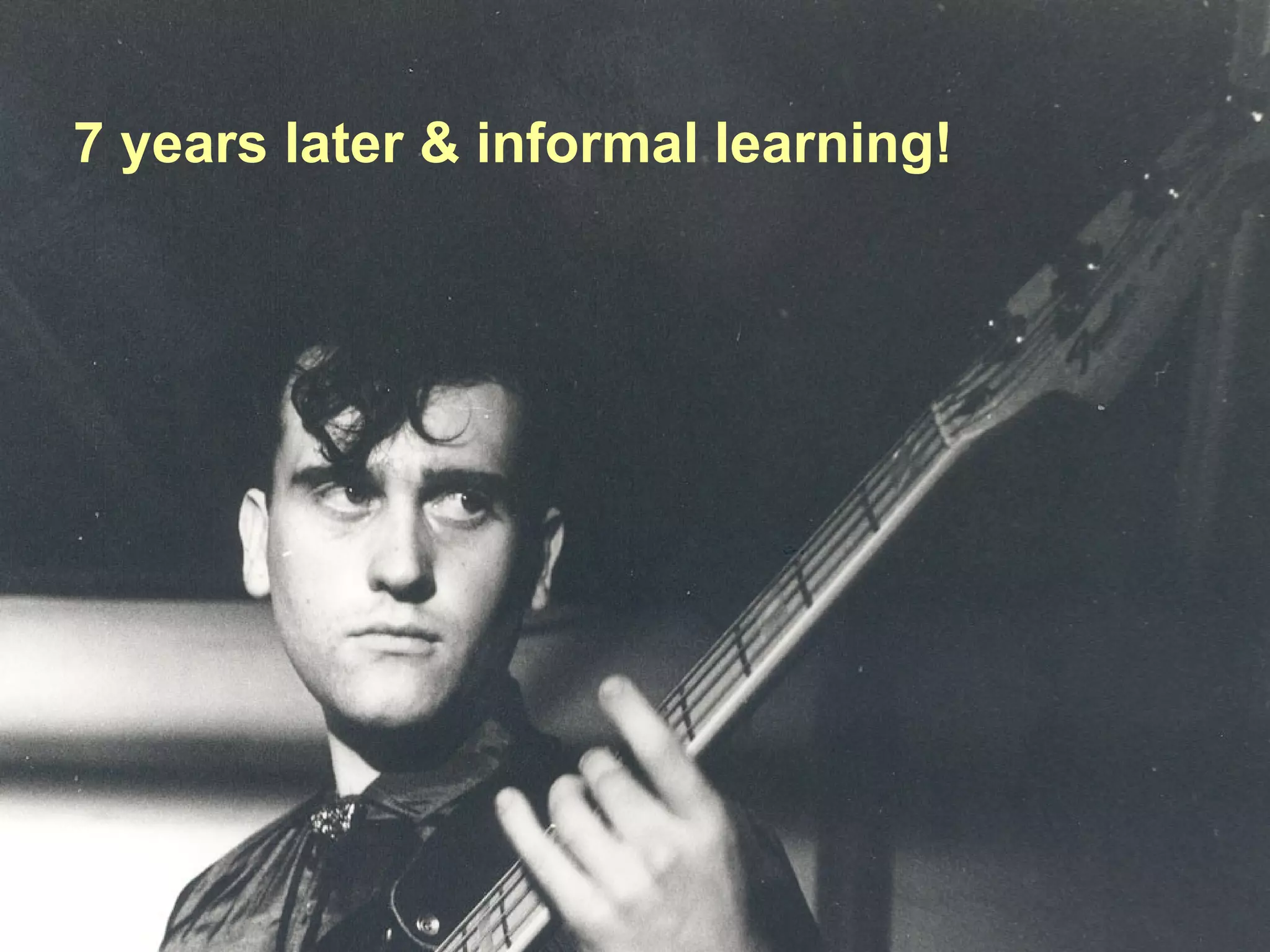
7 years later & informal learning!
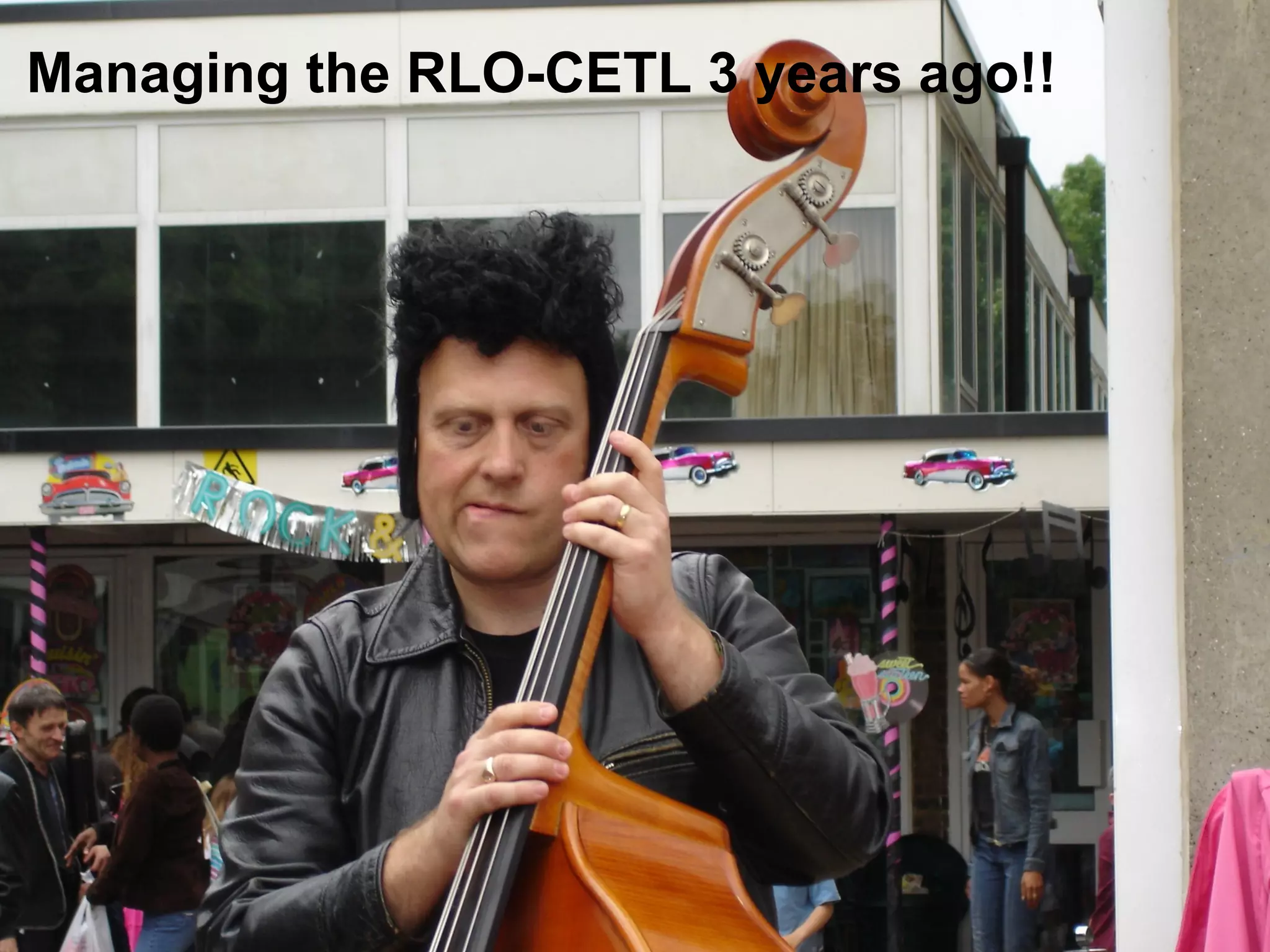
7 years later & informal learning! Managing the RLO-CETL 3 years ago!!
Reintegrated John? 10 months ago
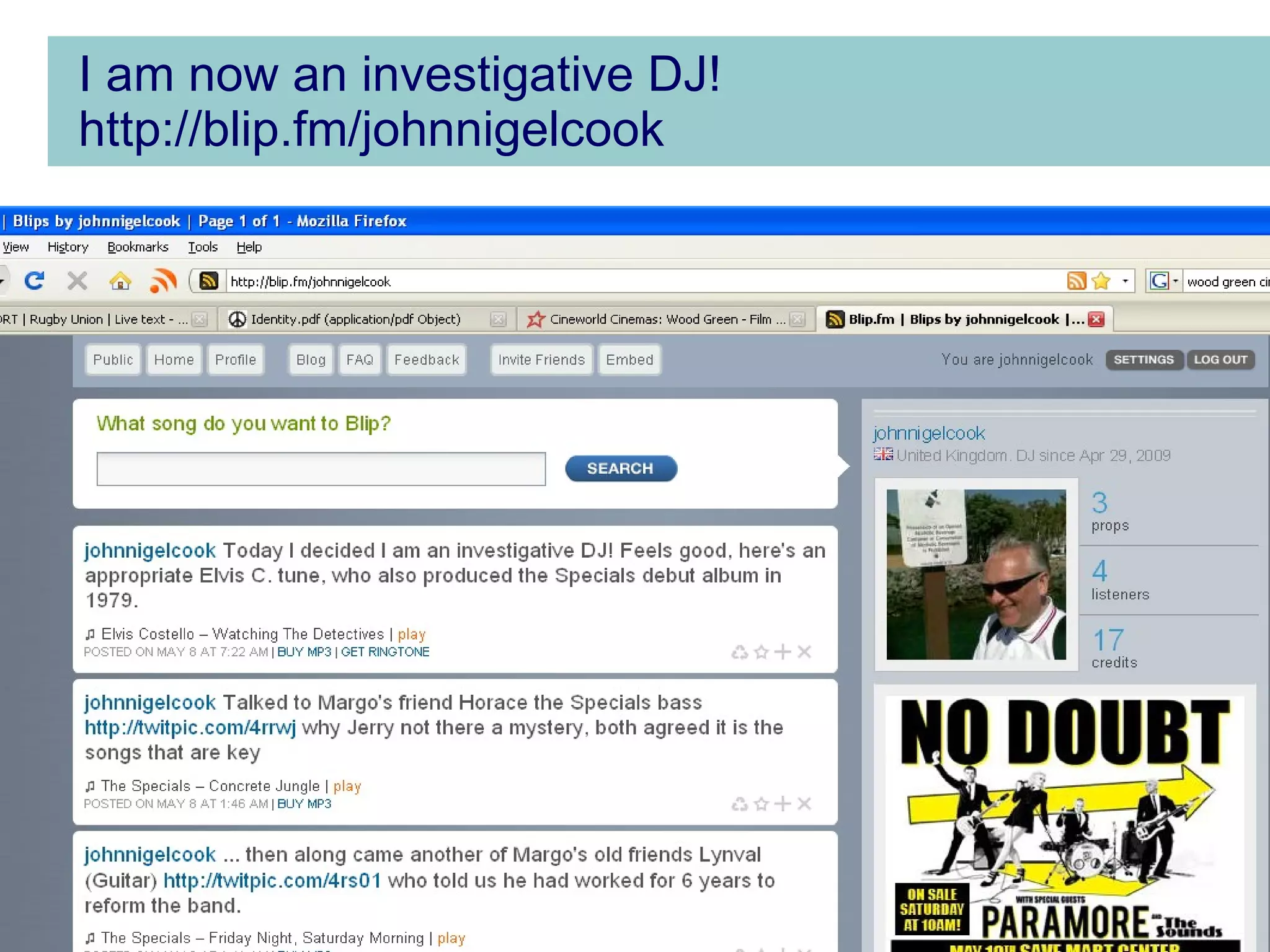
I am now an investigative DJ! http://blip.fm/johnnigelcook
References Cook, J. (forthcoming). Learner Generated Contexts.  In B. Bachmair (Ed.)  Media Literacy in New Cultural Spaces (Medienbildung in Neuen Kulturräumen).   Germany.  Cook, J. (2009).  Going for a Local Walkabout: Putting Urban Planning Education in Context with Mobile Phones.  Invited talk at LearnHigher CETL ‘M-Posium’ on Mobile Learning. April 22nd, Manchester Metropolitan University. Slides available from http://www.slideshare.net/johnnigelcook  Cook, J. (2002). The Role of Dialogue in Computer-Based Learning and Observing Learning: An Evolutionary Approach to Theory . Journal of Interactive Media in Education , 5. Paper online: www-jime.open.ac.uk/2002/5 Cook, J. (2000).  Cooperative Problem-Seeking Dialogues in Learning.  In Gauthier, G., Frasson, C. and VanLehn, K. (Eds.) Intelligent Tutoring Systems: 5th International Conference, ITS 2000 Montréal, Canada, June 2000 Proceedings, p. 615–624. Berlin Heidelberg New York: Springer-Verlag.  Cook, J. (1998). Mentoring, Metacognition and Music: Interaction Analyses and Implications for Intelligent Learning Environments. International Journal of Artificial Intelligence in Education, 9(1-2), 45–87. Abstract online: http://ihelp.usask.ca/iaied/ijaied/  Cook, J. and Pachler, N. (2009). Appropriation of Mobile Phones in and Across Formal and Informal Learning. In R. Land and S. Bayne (Eds.),  Digital Difference.  Rotterdam: Sense Publishers. Cook, J., Pachler, N. and Bradley, C. (2008). Bridging the Gap? Mobile Phones at the Interface between Informal and Formal Learning. Journal of the Research Center for Educational Technology, Spring. Available from  http:// www.rcetj.org /?type= art&id =87827&   Cook, J. and Smith, M. (2004). Beyond Formal Learning: Informal Community eLearning.  Computers and Education , CAL03 Special Issue, 43(1–2), 35–47. Pachler, N., Bachmair, B., Cook, J. and Kress, G. (in preparation, 2009).  Mobile Learning: Structures, Agency, Practices  . Springer. Due Autumn 2009. Smith, C., Cook, J. and Pratt-Adams, S. (2009).  Context Sensitive Mobile Learning: Designing a ‘Technoscape’ for Urban Planners.  Mobile Learning, Barcelona, 26-28 February.
Thank you Questions? & Discussion

Cook Calrg 09

  • 1.
    Reflections on a16 Year Research Journey from Mentoring, Metacognition and Music to Mobile Learning CALRG, Open University 30th Anniversary May 09 Email: john.cook@londonmet.ac.uk Home page: http://staffweb.londonmet.ac.uk/~cookj1/ Blog: http://blogs.londonmet.ac.uk/tel Twitter: http://twitter.com/johnnigelcook Slideshare: http://www.slideshare.net/johnnigelcook Blip.fm: http://blip.fm/johnnigelcook John Cook Learning Technology Research Institute, London Metropolitan University
  • 2.
    Structure Snapshot 1: Cooperative Problem-Seeking Dialogues in Learning (Cook, 2000). Snapshot 2: Going for a Local Walkabout: Putting Urban Planning Education in Context with Mobile Phones (Cook, 2009) The song remains the same?
  • 3.
    1. Cooperative, problem-seekingdialogue (Cook, 2000). does not focus on winning the argument or persuading your partner instead involves an acceptance by participants that they will attempt to find and refine a problem specification a problem specification is a description of a problem that is interesting or novel
  • 4.
    Cook going clockwise(see Cook, 2002) Model of interaction and learning Empirical work Computer-based learning support MetaMuse Initial model problem-seeking Extend model: ‘ find-predict-explain-refine’
  • 5.
    MetaMuse: Computational ImplementationMetaMuse is a pedagogical agent that has been designed to adaptively structure interactions between pairs of cooperating learners The design of the pedagogical agent was partially based on the results of a previous analysis of empirical data, e.g. State Transition Networks (STNs)
  • 6.
  • 7.
    Zero in thelist (i.e. the data entry area shown in Figure) will simply give a repetition of the pre-set pattern (i.e. C C# F# G ), -7 transposes the pre-set pattern down a fifth (i.e. it produces F F# B C ), -12 plays the whole pattern an octave lower , and so on. '0 -7' would produce the phrase C C# F# G F F# B C . EG of learner phrase: 0 8 1 7 -12 -5 0 -4 3 4 1 8 -10 -2 -1 Fast generation of musical ideas
  • 8.
  • 9.
    Study Conclusions (2000)Claim that MetaMuse encouraged problem-seeking 90 occurrences when cooperative problem-seeking was identified in the dialogue data. Low score of 10 occasions which were identified as occurrences of non-cooperative problem-seeking.
  • 10.
    Future work (2000)Future work will focus on using our results to generate STNs that model how pairs of cooperating learners interacted successfully These prescriptive models of cooperation will be used as the basis for tutoring tactics when MetaMuse is pursuing a goal
  • 11.
    2. Going fora Local Walkabout: Putting Urban Planning Education in Context with Mobile Phones (Cook, 2009; also Smith, C., Cook, J. and Pratt-Adams, S., 2009) An urban area close to London Metropolitan University, from 1850 to the present day, is being used to explore how schools are signifiers of both urban change and continuity of educational policy and practice. The aim of this project is to provide a contextualised, social and historical account of urban education, focusing on systems and beliefs that contribute to the construction of the surrounding discourses. Another aim of this project is to scaffold the trainee teachers’ understanding of what is possible with mobile learning in terms of filed trips. Part of EC funded CONTSENS project: http://bit.ly/oU9bj
  • 12.
  • 13.
    Outline of development/researchprocess High end mobile phones (HTC diamond + Nokia N95) used by small groups of 2 or 3 students at a time. They allowed real research to be done on the move. The voice recorder on the phones used to allow report writing and note making for final presentations to be captured quickly and efficiently. Students could also produce video podcasts of themselves and even edit the videos they make on site using the phones.
  • 14.
    Evaluation results Studentstook part in the first trial in 3 distinct groups Quantative feedback: CONTSENS questionnaire informal group interviews afterwards Tutor feedback: interview
  • 15.
  • 16.
    “ The informationgiven was underlined by the 'experience' of the area and therefore given context in both past and present. ”
  • 17.
    “ “ itwas triggering my own thoughts and I was getting to think for myself about the area and the buildings. ”
  • 18.
    Enhancement of thelearning experience 91% thought the mobile device enhanced the learning experience The information was easy to assimilate allowing more time to concentrate on tasks . Allowed instant reflection in situ . The mobile tour promoted “ active learning ” they were less passive than they would have been on a tutor-led tour they were not “merely taking in information ” the mobile tour triggered their own thoughts and encouraged them to think more about the area
  • 19.
    Future work (2009)Future work in this area will revolve around these context questions. Will learners follow a ‘learning pathway’ across multiple contexts for learning? During their activity, what will the learning trail left behind by learners tell us as they move from one learning context to the next? Will it be possible to produce intervention guidelines that can be used (perhaps in modified forms) across many contexts?
  • 20.
    Recent work Cook,J., Pachler, N. and Bradley, C. (2008). Bridging the Gap? Mobile Phones at the Interface between Informal and Formal Learning. Journal of the Research Center for Educational Technology, Spring. Available from http:// www.rcetj.org /?type= art&id =87827& Cook, J. (forthcoming). Learner Generated Contexts. In B. Bachmair (Ed.) Media Literacy in New Cultural Spaces (Medienbildung in Neuen Kulturräumen). Germany. Cook, J. and Pachler, N. (2009). Appropriation of Mobile Phones in and Across Formal and Informal Learning. In R. Land and S. Bayne (Eds.), Digital Difference. Rotterdam: Sense Publishers. Pachler, N., Bachmair, B., Cook, J. and Kress, G. (in preparation, 2009). Mobile Learning: Structures, Agency, Practices . Springer. Due Autumn 2009.
  • 21.
    3. The songremains the same? Users data still the centre of my inquiry As is the notion of adaptively structuring interactions between cooperating/collaborating learners: model cooperating learners interaction these prescriptive models of cooperation will be used as the basis for heuristics to help learner achieve context sensitive goals (shift here from tutoring system to learner) Link between theory, empirical work and ICT-based implementations remains key non-automated task But important research issues for me: Equity access to cultural resources for education Learner generated context Appropriation Mobility and learning pathways Informal learning
  • 22.
    3. The songremains the same? Health Warning Formal learning did this to me 
  • 23.
    7 years later& informal learning!
  • 24.
    7 years later& informal learning! Managing the RLO-CETL 3 years ago!!
  • 25.
  • 26.
    I am nowan investigative DJ! http://blip.fm/johnnigelcook
  • 27.
    References Cook, J.(forthcoming). Learner Generated Contexts. In B. Bachmair (Ed.) Media Literacy in New Cultural Spaces (Medienbildung in Neuen Kulturräumen). Germany. Cook, J. (2009). Going for a Local Walkabout: Putting Urban Planning Education in Context with Mobile Phones. Invited talk at LearnHigher CETL ‘M-Posium’ on Mobile Learning. April 22nd, Manchester Metropolitan University. Slides available from http://www.slideshare.net/johnnigelcook Cook, J. (2002). The Role of Dialogue in Computer-Based Learning and Observing Learning: An Evolutionary Approach to Theory . Journal of Interactive Media in Education , 5. Paper online: www-jime.open.ac.uk/2002/5 Cook, J. (2000). Cooperative Problem-Seeking Dialogues in Learning. In Gauthier, G., Frasson, C. and VanLehn, K. (Eds.) Intelligent Tutoring Systems: 5th International Conference, ITS 2000 Montréal, Canada, June 2000 Proceedings, p. 615–624. Berlin Heidelberg New York: Springer-Verlag. Cook, J. (1998). Mentoring, Metacognition and Music: Interaction Analyses and Implications for Intelligent Learning Environments. International Journal of Artificial Intelligence in Education, 9(1-2), 45–87. Abstract online: http://ihelp.usask.ca/iaied/ijaied/ Cook, J. and Pachler, N. (2009). Appropriation of Mobile Phones in and Across Formal and Informal Learning. In R. Land and S. Bayne (Eds.), Digital Difference. Rotterdam: Sense Publishers. Cook, J., Pachler, N. and Bradley, C. (2008). Bridging the Gap? Mobile Phones at the Interface between Informal and Formal Learning. Journal of the Research Center for Educational Technology, Spring. Available from http:// www.rcetj.org /?type= art&id =87827& Cook, J. and Smith, M. (2004). Beyond Formal Learning: Informal Community eLearning. Computers and Education , CAL03 Special Issue, 43(1–2), 35–47. Pachler, N., Bachmair, B., Cook, J. and Kress, G. (in preparation, 2009). Mobile Learning: Structures, Agency, Practices . Springer. Due Autumn 2009. Smith, C., Cook, J. and Pratt-Adams, S. (2009). Context Sensitive Mobile Learning: Designing a ‘Technoscape’ for Urban Planners. Mobile Learning, Barcelona, 26-28 February.
  • 28.

Editor's Notes

  • #2 Contact details: Professor John Cook, T10-01 Tower Building, North Campus, London Metropolitan University, 166-220 Holloway Road, London, N7 8DB Direct: +44 (0)20 7133 4341 john.cook@londonmet.ac.uk http://staffweb.londonmet.ac.uk/~cookj1/ http://twitter.com/johnnigelcook http://blogs.londonmet.ac.uk/tel http://www.facebook.com/home.php#/home.php?ref=home http://www.linkedin.com/myprofile?trk=hb_side_pro