Mobile Game Design
     The State of the Art
           by Martin Grider
Outline

Definitions (What is Mobile? What is Game Design?)
Interface and Device Considerations (Dos and Don’ts)
Game Genres, Popularity vs Traditional Popularity
Mobile Design Originality
Definitions: What is Mobile?
Mobile == Touchscreen Smartphones
(For our purposes.)


Personal, always-on, always connected, location aware,
intuitive (but “young”) UI, packed with additional input
methods. App stores.
Definitions: Game Designer

What is a game designer?
Wikipedia says: “A game designer is a person who designs
gameplay, conceiving and designing the rules and structure
of a game.”
Definitions: Game Design

What is Game Design?
Wikipedia says: “Game design, a subset of game
development, is the process of designing the content and
rules of a game in the pre-production stage and design of
gameplay, environment, storyline, and characters during
production stage.”
What is Game Design?


It’s an art of ideas.
Definitions: Tony Ventrice’s Layers
                                 [1]


Concept
Paradigm
Mechanics
User Interface
Definitions: Game “Verbs”

“actions that will
be performed by
the player during
the game”
see [2] (Top-Down
vs Bottom-Up)
Device Considerations
App stores encourage snap judgements. You must “wow”
your audience in the first 30 seconds of opening your app, or
you will loose them.
Design the game you want to play. Imagine yourself playing
it on the bus, or while waiting in line for the bank.
Consider the screen. Smaller real-estate should mean less
HUD, less interface “cruft”.
Device Considerations
Touch-based controls win over accelerometer controls the
same way mouse+keyboard-based FPS players win over
keyboard-based FPS players every time.
Always Connected means you have no excuse not to support
the metagame. (Game Center on iOS, OpenFeint & ??? on
Android)
Tutorials are a fail. You still need them, but minimize.
Device Considerations                     [3]


The following from Greg Costikyan’s “Mobile Design Basics”:
Handle interruptions gracefully
Go easy on sound (and gameplay MUST NOT depend on it)
Processing power (complicated simulations a problem)
He was talking about J2ME/Symbian, but it still applies.
Game Genres                       [4]


When It Comes To iPhone Games, What Sells Is Action,
Adventure, and Arcade (TechCrunch article citing a “report” by Distimo)
”While the biggest category is Puzzles (15 percent), Action
and Arcade both come in second with 11 percent each.”
“when you look the top grossing games, 22 percent are in
the Action category, 12 percent are in Arcade, and 9 percent
are Adventure”
Game Genres (Continued)   [4]


“the most expensive games are in the Role Playing category,
with an average price of $7.96. Action and Arcade games are
cheaper with average prices of $1.68 and $1.39
respectively.”
This report was from early 2010. Before Angry Birds hit #1.
Note that it is perfectly possible to have a “hit” game in any
genre. Board game apps are “niche”, but can sell quite well.
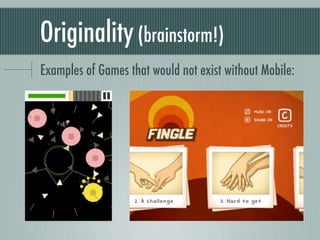
Originality (brainstorm!)
Examples of Games that would not exist without Mobile:
References
[1]        The Four Perspectives of Game Design: Insight from the Mobile Fringe
by Tony Ventrice -- http://www.gamasutra.com/view/feature/132427/the_four_perspectives_of_game_.php


[2]        Game Design Cognition: The Bottom-Up and Top-Down Approaches
by Gilliard Lopes & Rafael Kuhnen -- http://www.gamasutra.com/view/feature/130542/game_design_cognition_the_.php


[3]        Mobile Game Design Basics
by Greg Costikyan -- http://www.costik.com/presentations/mobile_game_design_basics.ppt


[4]   When It Comes To iPhone Games, What Sells Is Action, Adventure,
and Arcade by Erick Schonfeld -- http://techcrunch.com/2010/02/25/iphone-games-what-sells-distimo/
Thanks!

Mobile Game Design, by Martin Grider
http://chesstris.com/
martin@chesstris.com
@livingtech

Mobile game design

  • 1.
    Mobile Game Design The State of the Art by Martin Grider
  • 2.
    Outline Definitions (What isMobile? What is Game Design?) Interface and Device Considerations (Dos and Don’ts) Game Genres, Popularity vs Traditional Popularity Mobile Design Originality
  • 3.
    Definitions: What isMobile? Mobile == Touchscreen Smartphones (For our purposes.) Personal, always-on, always connected, location aware, intuitive (but “young”) UI, packed with additional input methods. App stores.
  • 4.
    Definitions: Game Designer Whatis a game designer? Wikipedia says: “A game designer is a person who designs gameplay, conceiving and designing the rules and structure of a game.”
  • 5.
    Definitions: Game Design Whatis Game Design? Wikipedia says: “Game design, a subset of game development, is the process of designing the content and rules of a game in the pre-production stage and design of gameplay, environment, storyline, and characters during production stage.”
  • 6.
    What is GameDesign? It’s an art of ideas.
  • 7.
    Definitions: Tony Ventrice’sLayers [1] Concept Paradigm Mechanics User Interface
  • 8.
    Definitions: Game “Verbs” “actionsthat will be performed by the player during the game” see [2] (Top-Down vs Bottom-Up)
  • 9.
    Device Considerations App storesencourage snap judgements. You must “wow” your audience in the first 30 seconds of opening your app, or you will loose them. Design the game you want to play. Imagine yourself playing it on the bus, or while waiting in line for the bank. Consider the screen. Smaller real-estate should mean less HUD, less interface “cruft”.
  • 10.
    Device Considerations Touch-based controlswin over accelerometer controls the same way mouse+keyboard-based FPS players win over keyboard-based FPS players every time. Always Connected means you have no excuse not to support the metagame. (Game Center on iOS, OpenFeint & ??? on Android) Tutorials are a fail. You still need them, but minimize.
  • 11.
    Device Considerations [3] The following from Greg Costikyan’s “Mobile Design Basics”: Handle interruptions gracefully Go easy on sound (and gameplay MUST NOT depend on it) Processing power (complicated simulations a problem) He was talking about J2ME/Symbian, but it still applies.
  • 12.
    Game Genres [4] When It Comes To iPhone Games, What Sells Is Action, Adventure, and Arcade (TechCrunch article citing a “report” by Distimo) ”While the biggest category is Puzzles (15 percent), Action and Arcade both come in second with 11 percent each.” “when you look the top grossing games, 22 percent are in the Action category, 12 percent are in Arcade, and 9 percent are Adventure”
  • 13.
    Game Genres (Continued) [4] “the most expensive games are in the Role Playing category, with an average price of $7.96. Action and Arcade games are cheaper with average prices of $1.68 and $1.39 respectively.” This report was from early 2010. Before Angry Birds hit #1. Note that it is perfectly possible to have a “hit” game in any genre. Board game apps are “niche”, but can sell quite well.
  • 14.
    Originality (brainstorm!) Examples ofGames that would not exist without Mobile:
  • 15.
    References [1] The Four Perspectives of Game Design: Insight from the Mobile Fringe by Tony Ventrice -- http://www.gamasutra.com/view/feature/132427/the_four_perspectives_of_game_.php [2] Game Design Cognition: The Bottom-Up and Top-Down Approaches by Gilliard Lopes & Rafael Kuhnen -- http://www.gamasutra.com/view/feature/130542/game_design_cognition_the_.php [3] Mobile Game Design Basics by Greg Costikyan -- http://www.costik.com/presentations/mobile_game_design_basics.ppt [4] When It Comes To iPhone Games, What Sells Is Action, Adventure, and Arcade by Erick Schonfeld -- http://techcrunch.com/2010/02/25/iphone-games-what-sells-distimo/
  • 16.
    Thanks! Mobile Game Design,by Martin Grider http://chesstris.com/ martin@chesstris.com @livingtech