ENHANCEMENT OF MEDIUM ACCESS
CONTROL FOR WIRELESS SENSOR
NETWORK
 DONE BY GUIDED BY
 K.MANOJKUMAR , Mr.S.ILANGOSAMBASIVAN,
II M.E(CS) prof.,ECE dept,SIET
Objective
 To propose a correlation based collaborative
MAC protocol –SCC-MAC
 To reduce energy consumption of the network
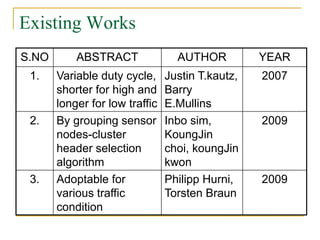
Existing Works
S.NO ABSTRACT AUTHOR YEAR
1. Variable duty cycle,
shorter for high and
longer for low traffic
Justin T.kautz,
Barry
E.Mullins
2007
2. By grouping sensor
nodes-cluster
header selection
algorithm
Inbo sim,
KoungJin
choi, koungJin
kwon
2009
3. Adoptable for
various traffic
condition
Philipp Hurni,
Torsten Braun
2009
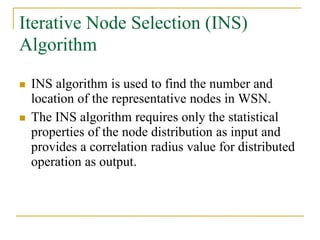
Blocks Diagram For Proposed
SCC-MAC Protocol
Iterative Node Selection (INS)
Algorithm
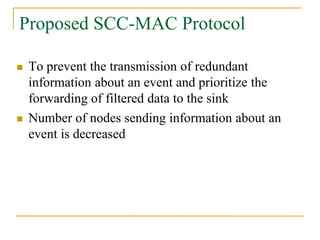
 INS algorithm is used to find the number and
location of the representative nodes in WSN.
 The INS algorithm requires only the statistical
properties of the node distribution as input and
provides a correlation radius value for distributed
operation as output.
Proposed SCC-MAC Protocol
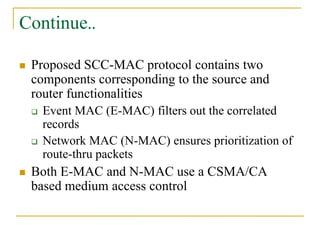
 To prevent the transmission of redundant
information about an event and prioritize the
forwarding of filtered data to the sink
 Number of nodes sending information about an
event is decreased
Continue..
 Proposed SCC-MAC protocol contains two
components corresponding to the source and
router functionalities
 Event MAC (E-MAC) filters out the correlated
records
 Network MAC (N-MAC) ensures prioritization of
route-thru packets
 Both E-MAC and N-MAC use a CSMA/CA
based medium access control
Continue..
 The information about correlation formation is
embedded inside the RTS/CTS/DATA/ACK
packets. No need of additional packets.
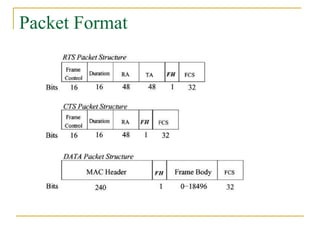
 A bit in the reserved space of RTS, CTS and
DATA packet structures is used as a new field
called First Hop (FH) Field.
 Based on information present in the FH field, E-
MAC and N-MAC will perform.
Packet Format
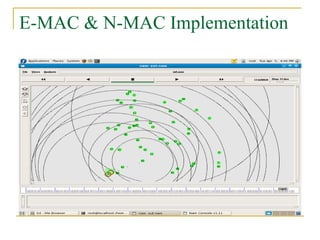
E-MAC & N-MAC Implementation
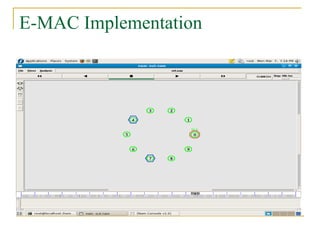
E-MAC Implementation
E-MAC & N-MAC Implementation
Output:1
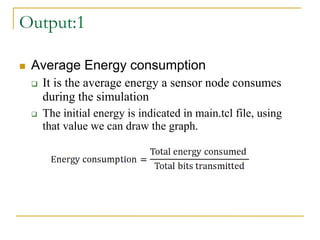
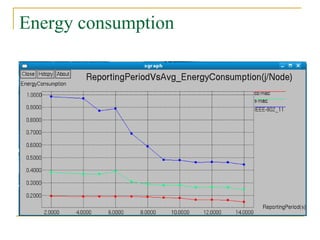
 Average Energy consumption
 It is the average energy a sensor node consumes
during the simulation
 The initial energy is indicated in main.tcl file, using
that value we can draw the graph.
Energy consumption
Output:2
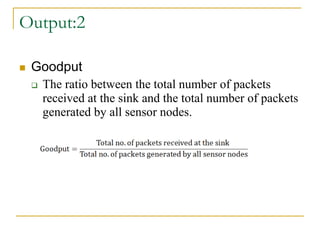
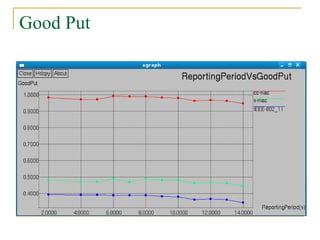
 Goodput
 The ratio between the total number of packets
received at the sink and the total number of packets
generated by all sensor nodes.
Good Put
Output:3
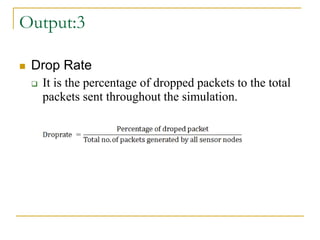
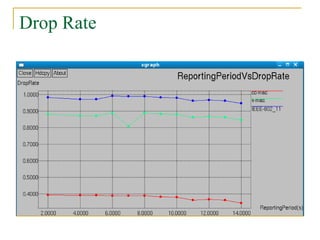
 Drop Rate
 It is the percentage of dropped packets to the total
packets sent throughout the simulation.
Drop Rate
Conclusion
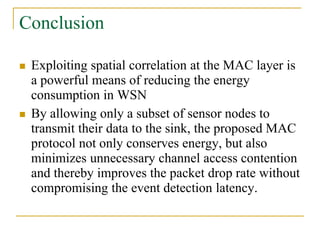
 Exploiting spatial correlation at the MAC layer is
a powerful means of reducing the energy
consumption in WSN
 By allowing only a subset of sensor nodes to
transmit their data to the sink, the proposed MAC
protocol not only conserves energy, but also
minimizes unnecessary channel access contention
and thereby improves the packet drop rate without
compromising the event detection latency.
Continue..
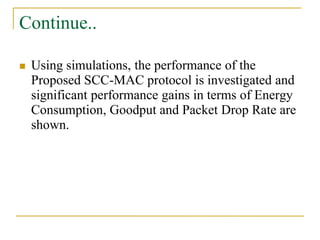
 Using simulations, the performance of the
Proposed SCC-MAC protocol is investigated and
significant performance gains in terms of Energy
Consumption, Goodput and Packet Drop Rate are
shown.
Future Work
 For multiple types of traffic in WSN, SCC-MAC
protocol can be modified using multiple
correlation radius values for each phenomenon.
 The quality of service requirements of various
types of sensor information needs to be
considered as a future work.
Reference
 [1]“Spatial Correlation-Based Collaborative Medium Access Control in
Wireless Sensor Networks”, Mehmet C. Vuran, Member, IEEE, and Ian F.
Akyildiz, Fellow, IEEE,2006
 [2] “An Adaptable Energy-Efficient Medium Access Control Protocol for
Wireless Sensor Networks”, Justin T. Kautz, Barry E. Mullins, Rusty O.
Baldwin, Scott R. Graham, 2007
 [3] “Energy Efficient Cluster header Selection Algorithm in WSN”, Inbo
Sim, KoungJin Choi, KoungJin Kwon and Jaiyong Lee, 2008
 [4] “On the Adaptivity of today’s Energy-Efficient MAC Protocols under
varying Traffic Conditions”, Philipp Hurni, Torsten Braun, 2009
 [5] “Energy Efficient and Delay Optimized TDMA Scheduling for
Clustered Wireless Sensor Networks”, Liqi Shi and Abraham O. Fapojuwo,
2009
Continue..
 [6] “Energy Efficient Cross-Layer MAC Protocol for Wireless Sensor
Networks”, Bouabdellah KECHAR, Ahmed LOUAZANI, Larbi SEKHRI,
Mohamed Faycal KHELFI, 2008
 [7] “Energy Efficient Token Based MAC Protocol for Wireless Sensor
Networks”, Soumya Ray, ,Subhasis Dash ,Nachiketa Tarasia ,Anuja Ajay,
Amulya Ratan Swain, 2011
 [8] “Wireless Sensor Networks:Delay Guarentee and Energy Efficient
MAC Protocols”, Marwan Ihsan Shukur, Lee Sheng Chyan, Vooi Voon
Yap, 2009
 [9] “ M. Gastpar and M. Vetterli, “Source-channel communication in
sensor networks,” Proc. 2nd Int. Workshop on Information Processing in
Sensor Networks (IPSN’03), vol. 219, pp. 162–177, 2003.
 [10] M. C. Vuran, Ö. B. Akan, and I. F. Akyildiz, “Spatio-temporal
correlation: theory and applications for wireless sensor networks,” Comput.
Netw. J. (Elsevier), vol. 45, no. 3, pp. 245–259, Jun. 2004

Continue..
 [11] Mehmet C. Vuran, Member and Ian F. Akyildiz, Fellow,” Spatial
Correlation-Based Collaborative Medium Access Control in Wireless
Sensor Networks”,2004
 [12] K. A. Arisha, M. A. Youssef, and M. Y. Younis, “Energy-aware
TDMA-based MAC for sensor networks,” Comput. Netw. J. (Elsevier), vol.
43, no. 5, pp. 539–694, Dec. 2003.
 [13] S. Bandyopadhyay and E. J. Coyle, “Spatio-temporal sampling rates
and energy efficiency in wireless sensor networks,” in Proc. IEEE
INFOCOM, Mar. 2004, vol. 3, pp. 1728–1739.
 [14] “Power, spatio-temporal bandwidth, and distortion in large sensor
networks,” IEEE J. Sel. Areas Commun., vol. 23, no. 4, pp. 745–754, Apr.
2005.
 [15] W. Ye, J. Heidemann, and D. Estrin, “Medium access control with
coordinated adaptive sleeping for wireless sensor networks,” IEEE/ACM
Trans. Netw., vol. 12, no. 3, pp. 493–506, Jun. 2004.
Thank you

mmm.ppt

  • 1.
    ENHANCEMENT OF MEDIUMACCESS CONTROL FOR WIRELESS SENSOR NETWORK  DONE BY GUIDED BY  K.MANOJKUMAR , Mr.S.ILANGOSAMBASIVAN, II M.E(CS) prof.,ECE dept,SIET
  • 2.
    Objective  To proposea correlation based collaborative MAC protocol –SCC-MAC  To reduce energy consumption of the network
  • 3.
    Existing Works S.NO ABSTRACTAUTHOR YEAR 1. Variable duty cycle, shorter for high and longer for low traffic Justin T.kautz, Barry E.Mullins 2007 2. By grouping sensor nodes-cluster header selection algorithm Inbo sim, KoungJin choi, koungJin kwon 2009 3. Adoptable for various traffic condition Philipp Hurni, Torsten Braun 2009
  • 4.
    Blocks Diagram ForProposed SCC-MAC Protocol
  • 5.
    Iterative Node Selection(INS) Algorithm  INS algorithm is used to find the number and location of the representative nodes in WSN.  The INS algorithm requires only the statistical properties of the node distribution as input and provides a correlation radius value for distributed operation as output.
  • 6.
    Proposed SCC-MAC Protocol To prevent the transmission of redundant information about an event and prioritize the forwarding of filtered data to the sink  Number of nodes sending information about an event is decreased
  • 7.
    Continue..  Proposed SCC-MACprotocol contains two components corresponding to the source and router functionalities  Event MAC (E-MAC) filters out the correlated records  Network MAC (N-MAC) ensures prioritization of route-thru packets  Both E-MAC and N-MAC use a CSMA/CA based medium access control
  • 8.
    Continue..  The informationabout correlation formation is embedded inside the RTS/CTS/DATA/ACK packets. No need of additional packets.  A bit in the reserved space of RTS, CTS and DATA packet structures is used as a new field called First Hop (FH) Field.  Based on information present in the FH field, E- MAC and N-MAC will perform.
  • 9.
  • 10.
    E-MAC & N-MACImplementation
  • 11.
  • 12.
    E-MAC & N-MACImplementation
  • 13.
    Output:1  Average Energyconsumption  It is the average energy a sensor node consumes during the simulation  The initial energy is indicated in main.tcl file, using that value we can draw the graph.
  • 14.
  • 15.
    Output:2  Goodput  Theratio between the total number of packets received at the sink and the total number of packets generated by all sensor nodes.
  • 16.
  • 17.
    Output:3  Drop Rate It is the percentage of dropped packets to the total packets sent throughout the simulation.
  • 18.
  • 19.
    Conclusion  Exploiting spatialcorrelation at the MAC layer is a powerful means of reducing the energy consumption in WSN  By allowing only a subset of sensor nodes to transmit their data to the sink, the proposed MAC protocol not only conserves energy, but also minimizes unnecessary channel access contention and thereby improves the packet drop rate without compromising the event detection latency.
  • 20.
    Continue..  Using simulations,the performance of the Proposed SCC-MAC protocol is investigated and significant performance gains in terms of Energy Consumption, Goodput and Packet Drop Rate are shown.
  • 21.
    Future Work  Formultiple types of traffic in WSN, SCC-MAC protocol can be modified using multiple correlation radius values for each phenomenon.  The quality of service requirements of various types of sensor information needs to be considered as a future work.
  • 22.
    Reference  [1]“Spatial Correlation-BasedCollaborative Medium Access Control in Wireless Sensor Networks”, Mehmet C. Vuran, Member, IEEE, and Ian F. Akyildiz, Fellow, IEEE,2006  [2] “An Adaptable Energy-Efficient Medium Access Control Protocol for Wireless Sensor Networks”, Justin T. Kautz, Barry E. Mullins, Rusty O. Baldwin, Scott R. Graham, 2007  [3] “Energy Efficient Cluster header Selection Algorithm in WSN”, Inbo Sim, KoungJin Choi, KoungJin Kwon and Jaiyong Lee, 2008  [4] “On the Adaptivity of today’s Energy-Efficient MAC Protocols under varying Traffic Conditions”, Philipp Hurni, Torsten Braun, 2009  [5] “Energy Efficient and Delay Optimized TDMA Scheduling for Clustered Wireless Sensor Networks”, Liqi Shi and Abraham O. Fapojuwo, 2009
  • 23.
    Continue..  [6] “EnergyEfficient Cross-Layer MAC Protocol for Wireless Sensor Networks”, Bouabdellah KECHAR, Ahmed LOUAZANI, Larbi SEKHRI, Mohamed Faycal KHELFI, 2008  [7] “Energy Efficient Token Based MAC Protocol for Wireless Sensor Networks”, Soumya Ray, ,Subhasis Dash ,Nachiketa Tarasia ,Anuja Ajay, Amulya Ratan Swain, 2011  [8] “Wireless Sensor Networks:Delay Guarentee and Energy Efficient MAC Protocols”, Marwan Ihsan Shukur, Lee Sheng Chyan, Vooi Voon Yap, 2009  [9] “ M. Gastpar and M. Vetterli, “Source-channel communication in sensor networks,” Proc. 2nd Int. Workshop on Information Processing in Sensor Networks (IPSN’03), vol. 219, pp. 162–177, 2003.  [10] M. C. Vuran, Ö. B. Akan, and I. F. Akyildiz, “Spatio-temporal correlation: theory and applications for wireless sensor networks,” Comput. Netw. J. (Elsevier), vol. 45, no. 3, pp. 245–259, Jun. 2004 
  • 24.
    Continue..  [11] MehmetC. Vuran, Member and Ian F. Akyildiz, Fellow,” Spatial Correlation-Based Collaborative Medium Access Control in Wireless Sensor Networks”,2004  [12] K. A. Arisha, M. A. Youssef, and M. Y. Younis, “Energy-aware TDMA-based MAC for sensor networks,” Comput. Netw. J. (Elsevier), vol. 43, no. 5, pp. 539–694, Dec. 2003.  [13] S. Bandyopadhyay and E. J. Coyle, “Spatio-temporal sampling rates and energy efficiency in wireless sensor networks,” in Proc. IEEE INFOCOM, Mar. 2004, vol. 3, pp. 1728–1739.  [14] “Power, spatio-temporal bandwidth, and distortion in large sensor networks,” IEEE J. Sel. Areas Commun., vol. 23, no. 4, pp. 745–754, Apr. 2005.  [15] W. Ye, J. Heidemann, and D. Estrin, “Medium access control with coordinated adaptive sleeping for wireless sensor networks,” IEEE/ACM Trans. Netw., vol. 12, no. 3, pp. 493–506, Jun. 2004.
  • 25.