Activity 1
Forming & Describing Mixtures
Let’s find out: How can you form mixtures?
Let’s use these materials: four glasses, tap water,
teaspoon, salt, powdered milk, oil,
gravel
Let’s do it this way:
1. Half-fill the four glasses with tap water.
2. Put a teaspoon of salt in one glass. Stir. Label it as “Mixture A.”
3. Put a teaspoon of powdered milk in another glass. Stir. Label it “Mixture B.”
4. Put a teaspoon of oil in the third glass. Stir. Label it as “Mixture C.”
5. Put a teaspoon of gravel in the fourth glass. Stir. Label it as “Mixture D.”
6. Leave the set-ups for about 1 minute. Observe each set-up. Compare them
7. Fill in the table below.
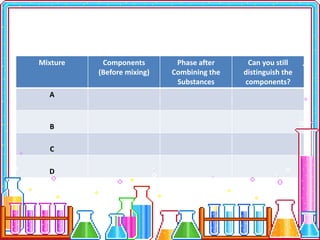
Mixture Components
(Before mixing)
Phase after
Combining the
Substances
Can you still
distinguish the
components?
A
B
C
D
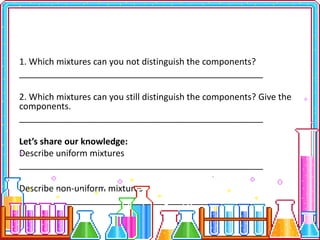
1. Which mixtures can you not distinguish the components?
__________________________________________________
2. Which mixtures can you still distinguish the components? Give the
components.
__________________________________________________
Let’s share our knowledge:
Describe uniform mixtures
__________________________________________________
Describe non-uniform mixtures
__________________________________________________
What are the characteristics of each mixture?
How do each mixture differ?
What did you learn in this activity?
Homogeneous refers to a substance that is
consistent or uniform throughout its volume.
They consist of a single phase, be it liquid, gas,
or solid, no matter where you sample them or
how closely you examine them.
Examples: Air is considered a homogeneous
mixture of gases.
A heterogeneous mixture is a mixture having a
non-uniform composition. The composition
varies from one region to another, with at least
two phases that remain separate from each
other, with clearly identifiable properties. If you
examine a sample of a heterogeneous mixture,
you can see the separate components.
Answer the Guide Questions:
 Are the mixtures the same?
How do they differ?
Describe uniform and non-uniform mixtures.
IV. ASSESSMENT
Directions: Describe uniform mixture.
Describe non-uniform mixture.
SCORING RUBRIC:
POINTS DESCRIPTION
5 • Students understanding of the concept is clearly evident.
• Student uses effective strategies to get accurate results.
• Student uses logical thinking to arrive at conclusion.
4 • Student understanding of the concept is evident.
• Student uses appropriate strategies to arrive at conclusion.
• Student shows thinking skills to arrive at conclusion.
3 • Student has limited understanding of a concept.
• Student uses strategies that are ineffective.
• Student attempts to show thinking skills.
1 • Student lacks understanding of the concept.
• Student makes no attempt to use a strategy.
• Student shows no understanding.
V. ASSIGNMENT
Write 3 examples of uniform mixtures and
another 2 examples of non-uniform
mixtures. Describe them.
Presentation1

Presentation1

  • 2.
    Activity 1 Forming &Describing Mixtures Let’s find out: How can you form mixtures? Let’s use these materials: four glasses, tap water, teaspoon, salt, powdered milk, oil, gravel Let’s do it this way: 1. Half-fill the four glasses with tap water. 2. Put a teaspoon of salt in one glass. Stir. Label it as “Mixture A.” 3. Put a teaspoon of powdered milk in another glass. Stir. Label it “Mixture B.” 4. Put a teaspoon of oil in the third glass. Stir. Label it as “Mixture C.” 5. Put a teaspoon of gravel in the fourth glass. Stir. Label it as “Mixture D.” 6. Leave the set-ups for about 1 minute. Observe each set-up. Compare them 7. Fill in the table below.
  • 3.
    Mixture Components (Before mixing) Phaseafter Combining the Substances Can you still distinguish the components? A B C D
  • 4.
    1. Which mixturescan you not distinguish the components? __________________________________________________ 2. Which mixtures can you still distinguish the components? Give the components. __________________________________________________ Let’s share our knowledge: Describe uniform mixtures __________________________________________________ Describe non-uniform mixtures __________________________________________________
  • 5.
    What are thecharacteristics of each mixture? How do each mixture differ? What did you learn in this activity?
  • 6.
    Homogeneous refers toa substance that is consistent or uniform throughout its volume. They consist of a single phase, be it liquid, gas, or solid, no matter where you sample them or how closely you examine them. Examples: Air is considered a homogeneous mixture of gases.
  • 7.
    A heterogeneous mixtureis a mixture having a non-uniform composition. The composition varies from one region to another, with at least two phases that remain separate from each other, with clearly identifiable properties. If you examine a sample of a heterogeneous mixture, you can see the separate components.
  • 13.
    Answer the GuideQuestions:  Are the mixtures the same? How do they differ? Describe uniform and non-uniform mixtures.
  • 14.
    IV. ASSESSMENT Directions: Describeuniform mixture. Describe non-uniform mixture. SCORING RUBRIC: POINTS DESCRIPTION 5 • Students understanding of the concept is clearly evident. • Student uses effective strategies to get accurate results. • Student uses logical thinking to arrive at conclusion. 4 • Student understanding of the concept is evident. • Student uses appropriate strategies to arrive at conclusion. • Student shows thinking skills to arrive at conclusion. 3 • Student has limited understanding of a concept. • Student uses strategies that are ineffective. • Student attempts to show thinking skills. 1 • Student lacks understanding of the concept. • Student makes no attempt to use a strategy. • Student shows no understanding.
  • 15.
    V. ASSIGNMENT Write 3examples of uniform mixtures and another 2 examples of non-uniform mixtures. Describe them.