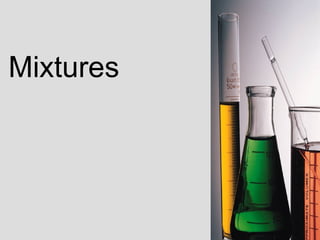
Mixtures
A mixture is a
 combination of two or
more substances where
  there is no chemical
combination or reaction.


    www.brainybetty.com    2
Mixtures combine
physically in no specific
     proportions.
    They just mix.


   www.brainybetty.com      3
Solids, liquids and gases
  can be combined to
    create a mixture.


    www.brainybetty.com     4
You make a mixture by
    adding at least one
material to another. When
you add material to a gas
or liquid, the material you
 add is called the solute
and the material you are
  adding to is called the
         solvent.
    www.brainybetty.com       5
When you create a
mixture, there are no new
  substances formed.
 Each part of a mixture
keeps its own properties.


    www.brainybetty.com   6
Mixtures can be
heterogeneous or
 homogeneous.


www.brainybetty.com   7
Heterogeneous mixtures
  are those where the
   substances are not
distributed evenly. They
usually involve a mixture
  of a solid in a solid.
 A mixture of stones in
 soil is an example of a
heterogeneous mixture.
    www.brainybetty.com     8
Homogeneous mixtures
  are those where the
 materials are evenly
distributed throughout.
Homogenized milk is an
        example.

   www.brainybetty.com    9
Mixtures can be
  classified into three
  types: suspension,
 colloidal and solution.
Some liquid mixtures are
       solutions.

    www.brainybetty.com   10
Suspension mixtures
 have larger particles and
are heterogeneous. Most
 mixtures are suspension
         mixtures.
Italian salad dressing is a
      good example.

    www.brainybetty.com   11
Colloidal mixtures fall
between suspension and
 solution mixtures. The
 ingredients in colloidal
mixtures are smaller and
 usually homogeneous.

    www.brainybetty.com   12
Solutions are
 homogeneous mixtures
     that consist of
microscopic particles and
   evenly spread out
       molecules.

    www.brainybetty.com   13
You can separate a
  simple mixture by
   physical means.
No chemical reaction is
       needed.


   www.brainybetty.com    14

Mixtures

  • 1.
  • 2.
    A mixture isa combination of two or more substances where there is no chemical combination or reaction. www.brainybetty.com 2
  • 3.
    Mixtures combine physically inno specific proportions. They just mix. www.brainybetty.com 3
  • 4.
    Solids, liquids andgases can be combined to create a mixture. www.brainybetty.com 4
  • 5.
    You make amixture by adding at least one material to another. When you add material to a gas or liquid, the material you add is called the solute and the material you are adding to is called the solvent. www.brainybetty.com 5
  • 6.
    When you createa mixture, there are no new substances formed. Each part of a mixture keeps its own properties. www.brainybetty.com 6
  • 7.
    Mixtures can be heterogeneousor homogeneous. www.brainybetty.com 7
  • 8.
    Heterogeneous mixtures are those where the substances are not distributed evenly. They usually involve a mixture of a solid in a solid. A mixture of stones in soil is an example of a heterogeneous mixture. www.brainybetty.com 8
  • 9.
    Homogeneous mixtures are those where the materials are evenly distributed throughout. Homogenized milk is an example. www.brainybetty.com 9
  • 10.
    Mixtures can be classified into three types: suspension, colloidal and solution. Some liquid mixtures are solutions. www.brainybetty.com 10
  • 11.
    Suspension mixtures havelarger particles and are heterogeneous. Most mixtures are suspension mixtures. Italian salad dressing is a good example. www.brainybetty.com 11
  • 12.
    Colloidal mixtures fall betweensuspension and solution mixtures. The ingredients in colloidal mixtures are smaller and usually homogeneous. www.brainybetty.com 12
  • 13.
    Solutions are homogeneousmixtures that consist of microscopic particles and evenly spread out molecules. www.brainybetty.com 13
  • 14.
    You can separatea simple mixture by physical means. No chemical reaction is needed. www.brainybetty.com 14