MITOSIS(CELL DIVISION)
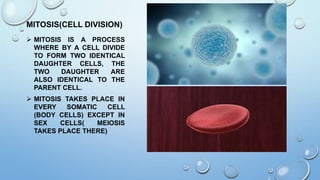
 MITOSIS IS A PROCESS
WHERE BY A CELL DIVIDE
TO FORM TWO IDENTICAL
DAUGHTER CELLS, THE
TWO DAUGHTER ARE
ALSO IDENTICAL TO THE
PARENT CELL.
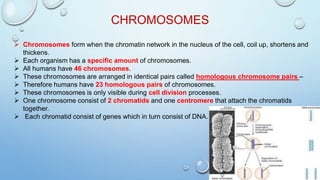
 MITOSIS TAKES PLACE IN
EVERY SOMATIC CELL
(BODY CELLS) EXCEPT IN
SEX CELLS( MEIOSIS
TAKES PLACE THERE)
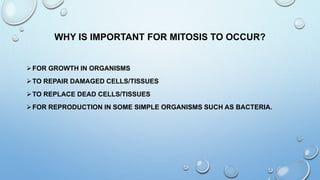
 Chromosomes form when the chromatin network in the nucleus of the cell, coil up, shortens and
thickens.
 Each organism has a specific amount of chromosomes.
 All humans have 46 chromosomes.
 These chromosomes are arranged in identical pairs called homologous chromosome pairs –
 Therefore humans have 23 homologous pairs of chromosomes.
 These chromosomes is only visible during cell division processes.
 One chromosome consist of 2 chromatids and one centromere that attach the chromatids
together.
 Each chromatid consist of genes which in turn consist of DNA.
CHROMOSOMES
THE PHASES OF THE CELL DIVISION CYCLE
INTERPHASE (INCLUDE G1- , S- [DNA SYNTHESIS] AND G2 PHASE)
MITOSIS
CYTOKINESIS
GROWTH
THE RESULTS IS TWO NEW IDENTICAL DAUGHTER CELLS
WHY IS IMPORTANT FOR MITOSIS TO OCCUR?
FOR GROWTH IN ORGANISMS
TO REPAIR DAMAGED CELLS/TISSUES
TO REPLACE DEAD CELLS/TISSUES
FOR REPRODUCTION IN SOME SIMPLE ORGANISMS SUCH AS BACTERIA.
MITOSIS CONSISTS OF THIS PHASES
INTERPHASE
PROPHASE
METAPHASE
ANAPHASE
TELOPHASE
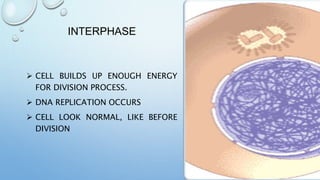
INTERPHASE
 CELL BUILDS UP ENOUGH ENERGY
FOR DIVISION PROCESS.
 DNA REPLICATION OCCURS
 CELL LOOK NORMAL, LIKE BEFORE
DIVISION
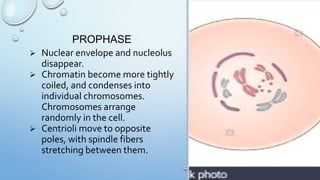
PROPHASE
 Nuclear envelope and nucleolus
disappear.
 Chromatin become more tightly
coiled, and condenses into
individual chromosomes.
Chromosomes arrange
randomly in the cell.
 Centrioli move to opposite
poles, with spindle fibers
stretching between them.
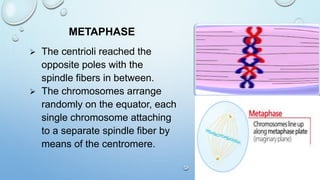
METAPHASE
 The centrioli reached the
opposite poles with the
spindle fibers in between.
 The chromosomes arrange
randomly on the equator, each
single chromosome attaching
to a separate spindle fiber by
means of the centromere.
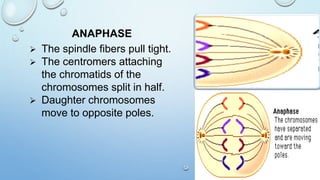
ANAPHASE
 The spindle fibers pull tight.
 The centromers attaching
the chromatids of the
chromosomes split in half.
 Daughter chromosomes
move to opposite poles.
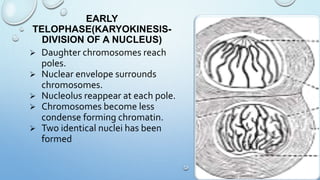
EARLY
TELOPHASE(KARYOKINESIS-
DIVISION OF A NUCLEUS)
 Daughter chromosomes reach
poles.
 Nuclear envelope surrounds
chromosomes.
 Nucleolus reappear at each pole.
 Chromosomes become less
condense forming chromatin.
 Two identical nuclei has been
formed
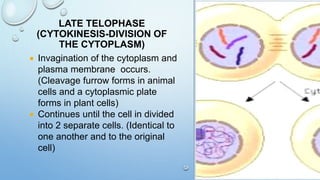
LATE TELOPHASE
(CYTOKINESIS-DIVISION OF
THE CYTOPLASM)
 Invagination of the cytoplasm and
plasma membrane occurs.
(Cleavage furrow forms in animal
cells and a cytoplasmic plate
forms in plant cells)
 Continues until the cell in divided
into 2 separate cells. (Identical to
one another and to the original
cell)
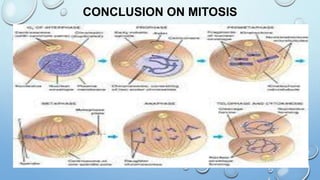
CONCLUSION ON MITOSIS
REFERENCE
HTTPS://WWW.SLIDESHARE.NET/LOUIEJANEELECCION/THE-CELL-CYCLE-
MITOSIS-109592570
HTTPS://WWW.SLIDESHARE.NET/FARRELLW/MITOSIS-POWERPOINT-11179257
HTTPS://WWW.SLIDESHARE.NET/STEVEN_IANNUCCILLI/CHAPTER-4CELL-
DIVISION-MITOSIS-DNA-PROTEIN-PRODUCTION
HTTPS://WWW.SLIDESHARE.NET/RCHOONG/POWERPOINT-MITOSIS-1
HTTPS://WWW.SLIDESHARE.NET/CATHERINEPATTERSON/CELL-DIVISION-
MITOSIS-AND-MEIOSIS-PRESENTATION

Mitosis