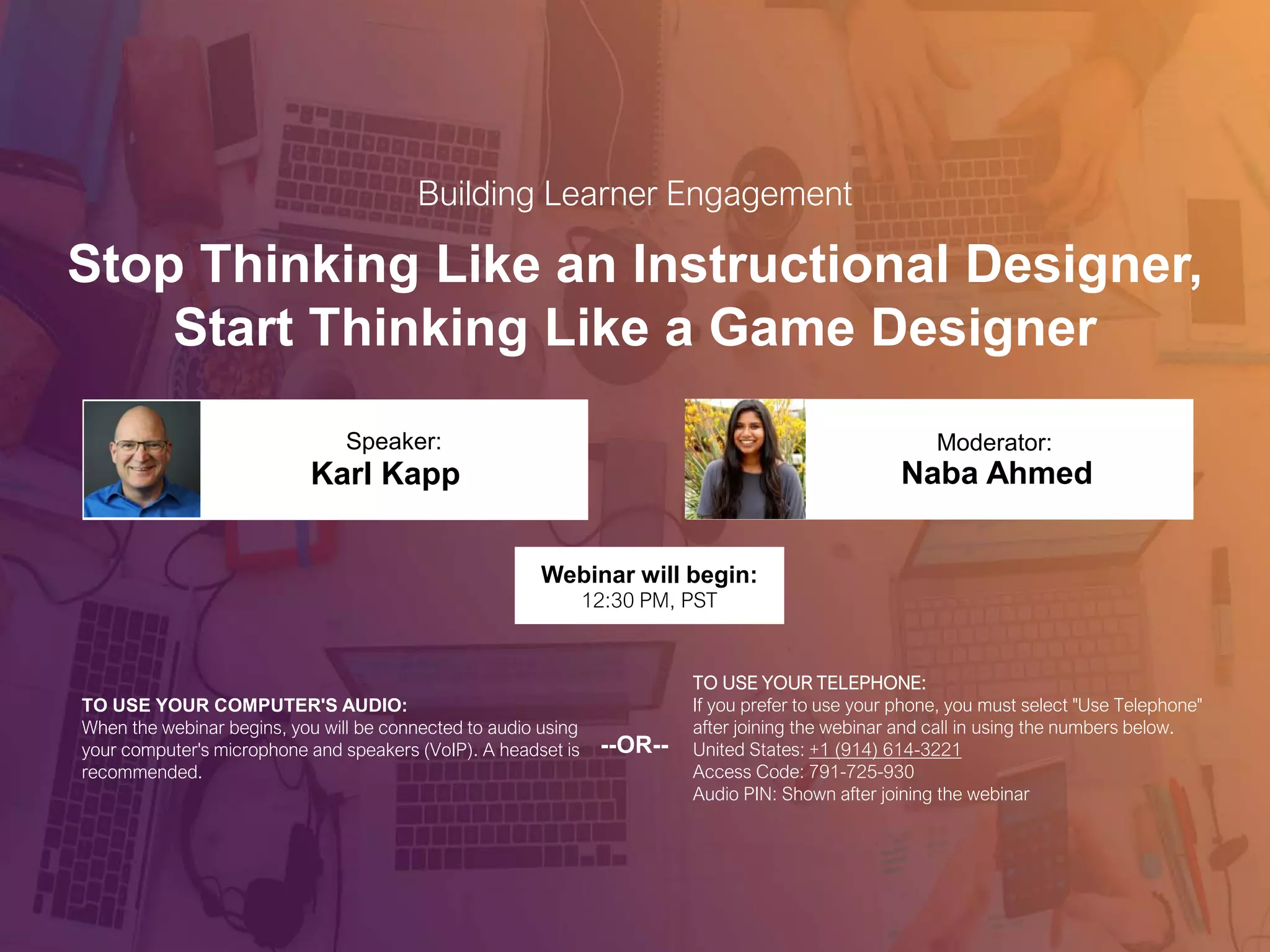
Stop Thinking Like an Instructional Designer,
Start Thinking Like a Game Designer
Joe Caprio
Speaker:
TO USE YOUR COMPUTER'S AUDIO:
When the webinar begins, you will be connected to audio using
your computer's microphone and speakers (VoIP). A headset is
recommended.
Webinar will begin:
12:30 PM, PST
TO USE YOUR TELEPHONE:
If you prefer to use your phone, you must select "Use Telephone"
after joining the webinar and call in using the numbers below.
United States: +1 (914) 614-3221
Access Code: 791-725-930
Audio PIN: Shown after joining the webinar
--OR--
Building Learner Engagement
Rob Jeppsen
Speaker:
Naba Ahmed
Moderator:
Karl Kapp
Speaker:
Designing Digitally analyzes your learning and development programs to
discover pain points and knowledge gaps, and then designs customized
strategies that will empower employees and allow you to meet set business
objectives. Whether you are looking for training to support a major initiative,
need general employee development courses, or just want to revamp your
existing efforts, they are here to help you succeed and become the
company you want to be.
3
Building Learner
Engagement
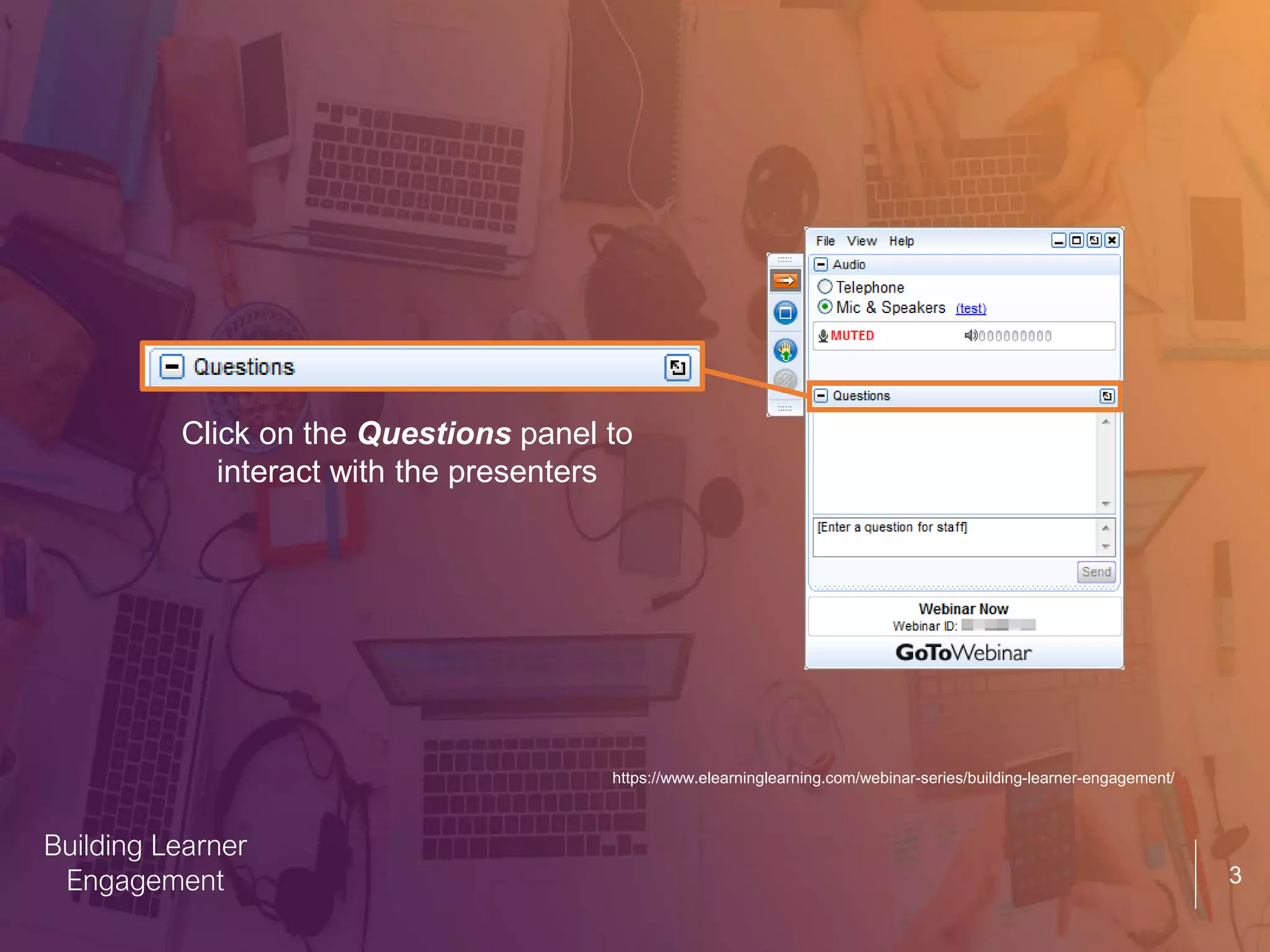
Click on the Questions panel to
interact with the presenters
https://www.elearninglearning.com/webinar-series/building-learner-engagement/
About Rob Jeppsen
With 23 years of direct sales and sales leadership, Rob has successful experience in every part of the sales process.
Rob is the Founder and CEO of Xvoyant, a Sales Leadership Technology Platform committed to helping organizations
develop world-class sales leaders. Xvoyant’s technology drives transformation across sales teams by powering 1:1
meetings with sales leaders and salespeople. Xvoyant creates alignment between Sales Leaders and Salespeople to
create measurable improvement in revenue while reducing administrative burden. Xvoyant services thousands of
managers in 62 countries around the world and recently was recognized with the Gold Stevie® Award for Sales
Technology Partner of the Year.
About Joe Caprio
Joe is the VP Sales of Chorus.ai. Prior to joining Chorus, Joe was a Chorus customer while leading the
sales team at InsightSquared. His focus was on scaling and enabling rapid growth sales teams. His
experience with conversation intelligence and experience in sales enablement created a perfect match of a
tactical practitioner with executive experience and insights.
Joe’s background is in training and development. He has a passion for hiring and training customer facing
reps. He loves to share best practices, learn from his customers, and distill down really powerful programs
for his own team and his customers’ teams as well.
Stop Thinking Like an Instructional Designer,
Start Thinking Like a Game Designer
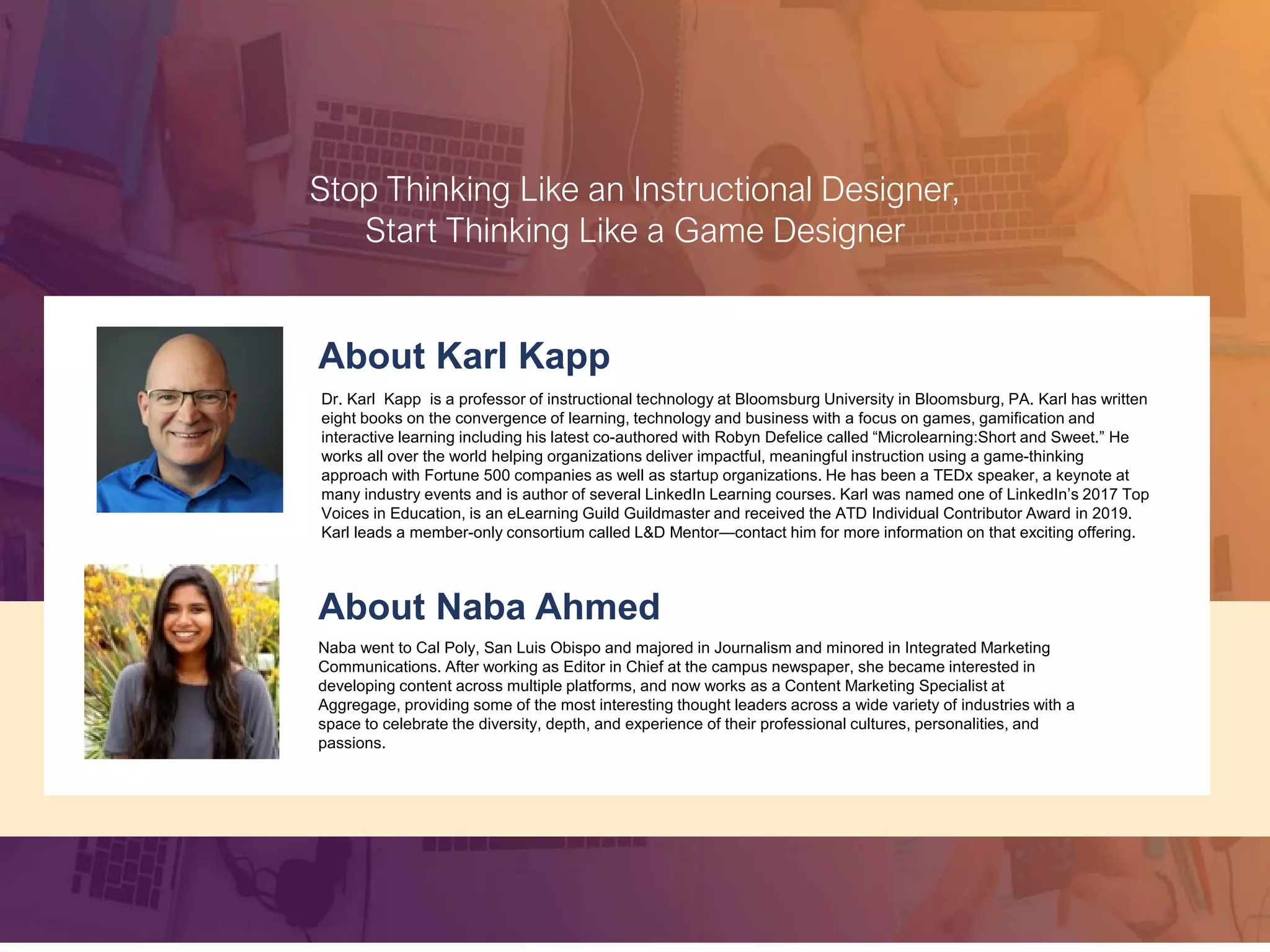
About Karl Kapp
Dr. Karl Kapp is a professor of instructional technology at Bloomsburg University in Bloomsburg, PA. Karl has written
eight books on the convergence of learning, technology and business with a focus on games, gamification and
interactive learning including his latest co-authored with Robyn Defelice called “Microlearning:Short and Sweet.” He
works all over the world helping organizations deliver impactful, meaningful instruction using a game-thinking
approach with Fortune 500 companies as well as startup organizations. He has been a TEDx speaker, a keynote at
many industry events and is author of several LinkedIn Learning courses. Karl was named one of LinkedIn’s 2017 Top
Voices in Education, is an eLearning Guild Guildmaster and received the ATD Individual Contributor Award in 2019.
Karl leads a member-only consortium called L&D Mentor—contact him for more information on that exciting offering.
About Naba Ahmed
Naba went to Cal Poly, San Luis Obispo and majored in Journalism and minored in Integrated Marketing
Communications. After working as Editor in Chief at the campus newspaper, she became interested in
developing content across multiple platforms, and now works as a Content Marketing Specialist at
Aggregage, providing some of the most interesting thought leaders across a wide variety of industries with a
space to celebrate the diversity, depth, and experience of their professional cultures, personalities, and
passions.
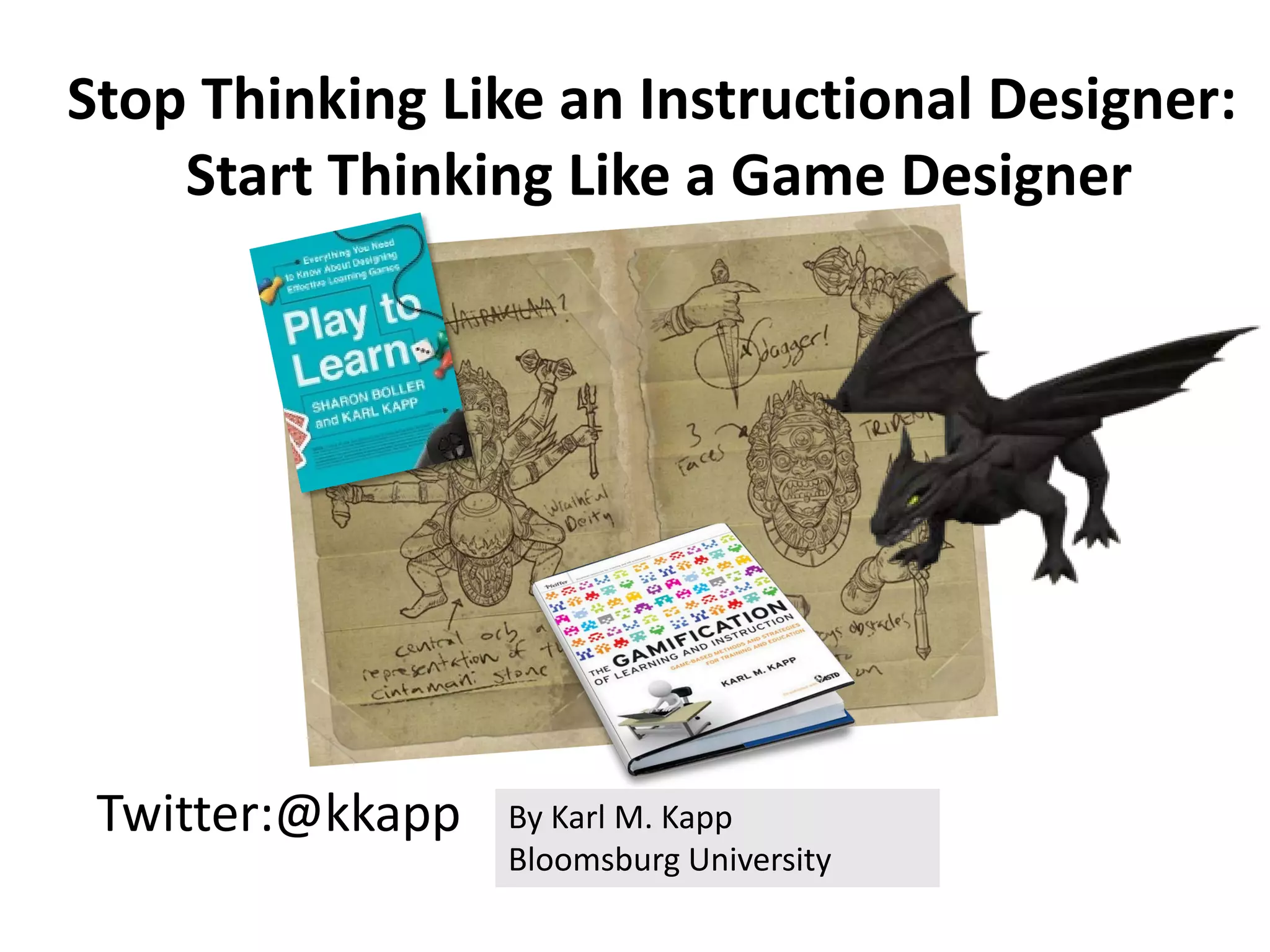
Stop Thinking Like an Instructional Designer:
Start Thinking Like a Game Designer
Twitter:@kkapp By Karl M. Kapp
Bloomsburg University
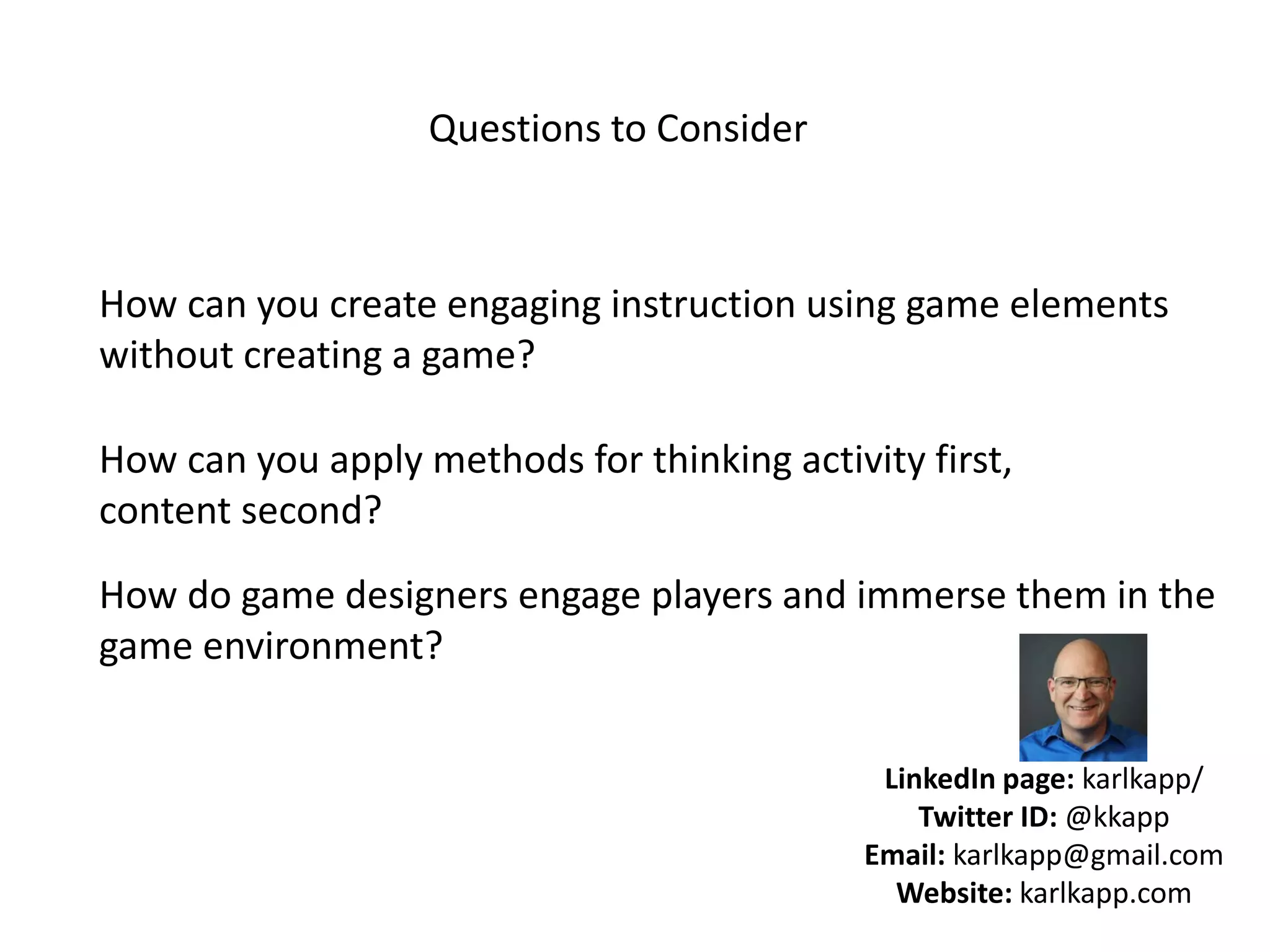
How can you create engaging instruction using game elements
without creating a game?
How can you apply methods for thinking activity first,
content second?
How do game designers engage players and immerse them in the
game environment?
Questions to Consider
LinkedIn page: karlkapp/
Twitter ID: @kkapp
Email: karlkapp@gmail.com
Website: karlkapp.com
Design takeaway
challenge.
You are a game designer at SuperGame Corporation
which has hit some hard times lately.
It’s Friday 4:59 PM you and your
colleague have only one thing
on your mind.
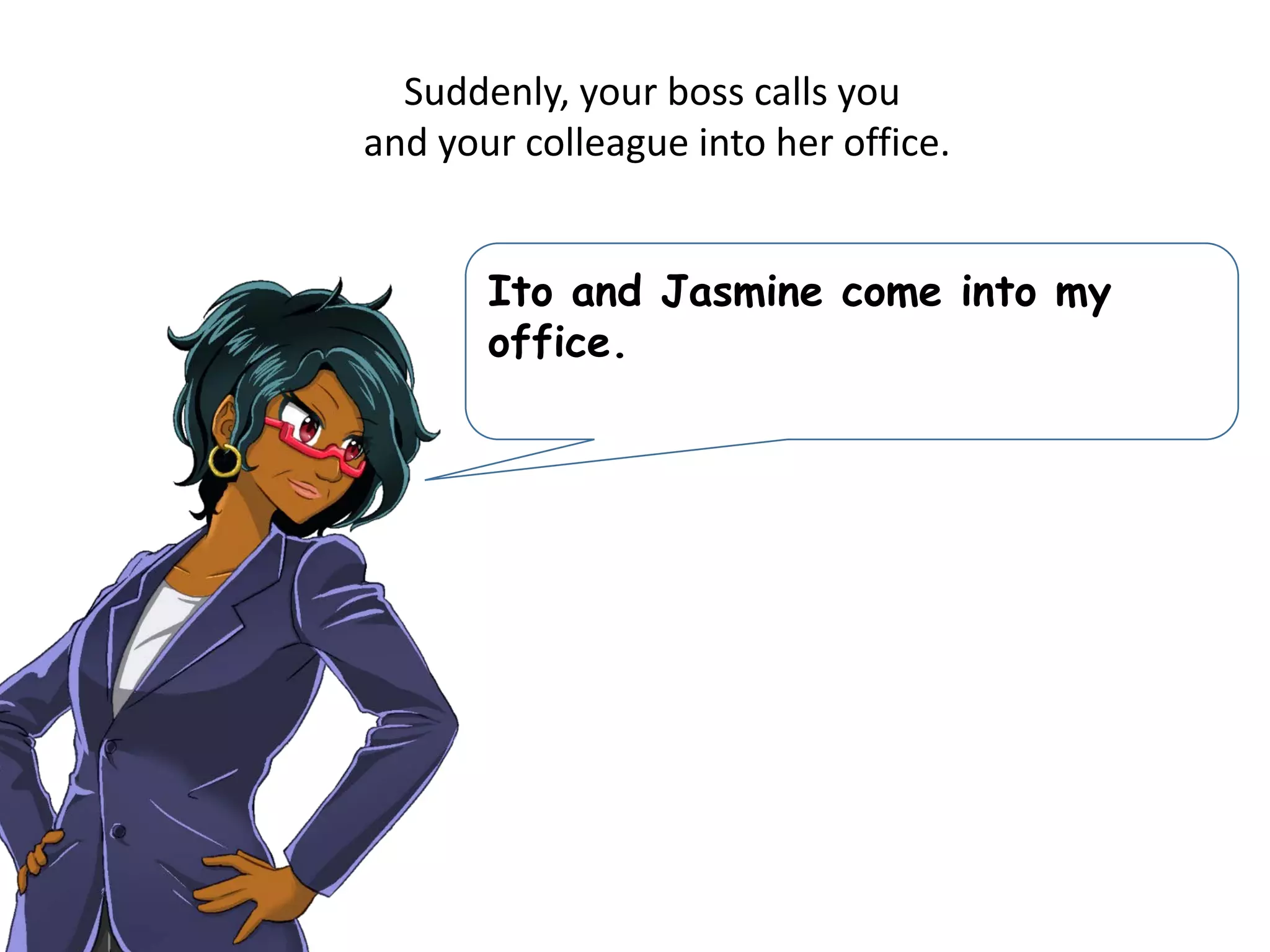
Suddenly, your boss calls you
and your colleague into her office.
Ito and Jasmine come into my
office.
Yes?
Yes?
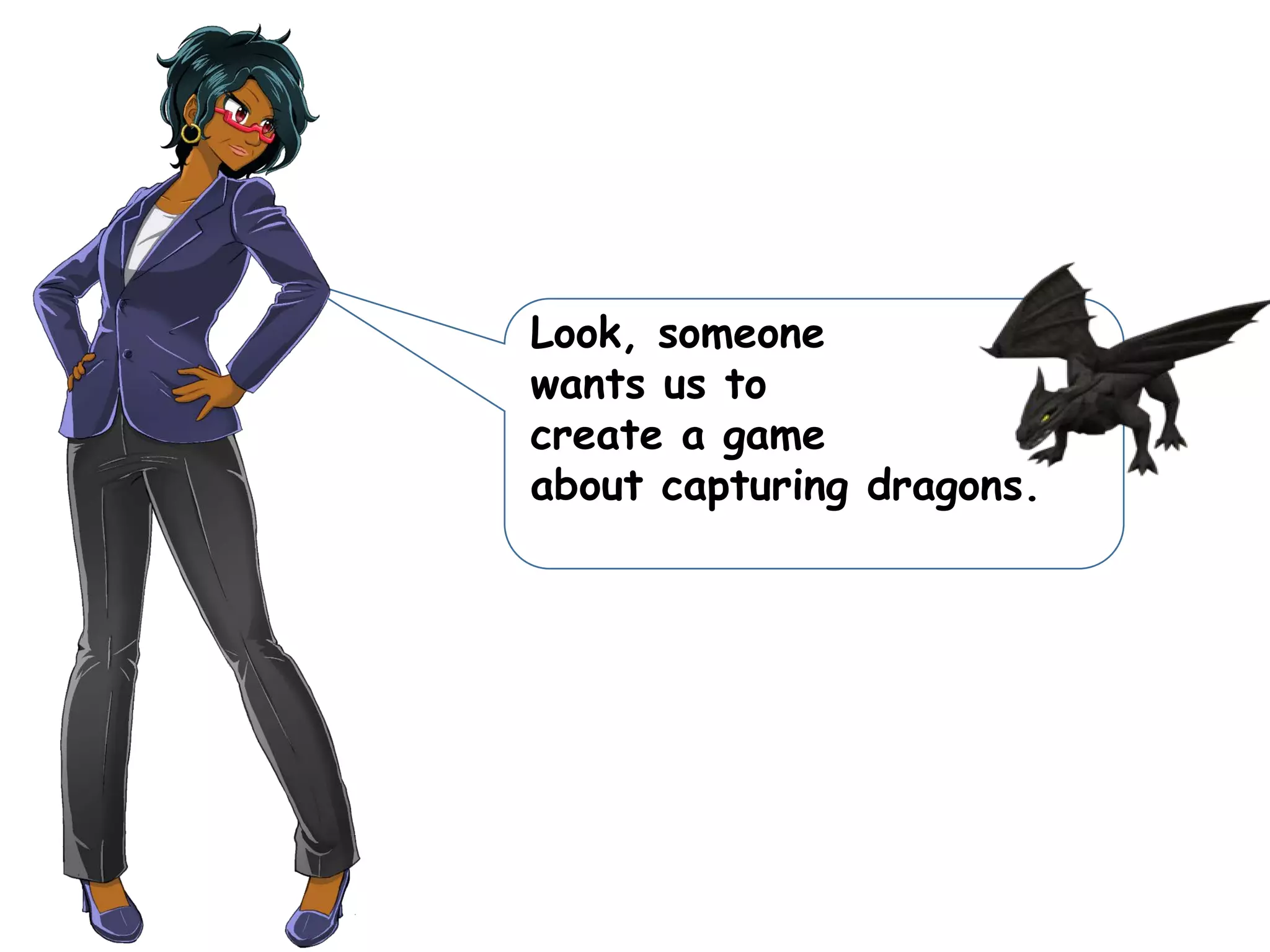
Look, someone
wants us to
create a game
about capturing dragons.
It appears to be a craze or
something.
Working name is…
“Dragónmon Go”
You are competing internally for the
project. Winning team earns the
right to work on the project.
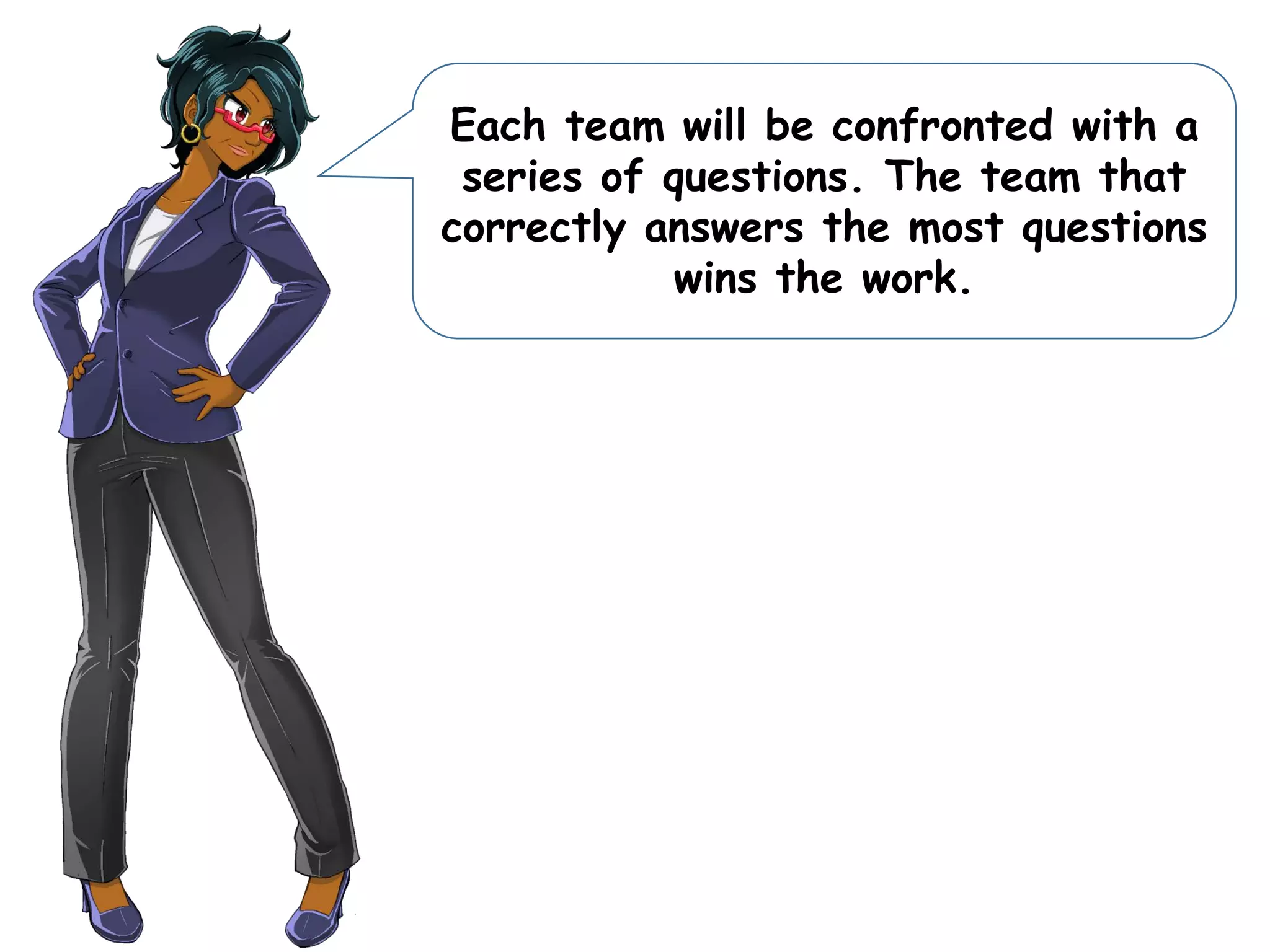
Each team will be confronted with a
series of questions. The team that
correctly answers the most questions
wins the work.
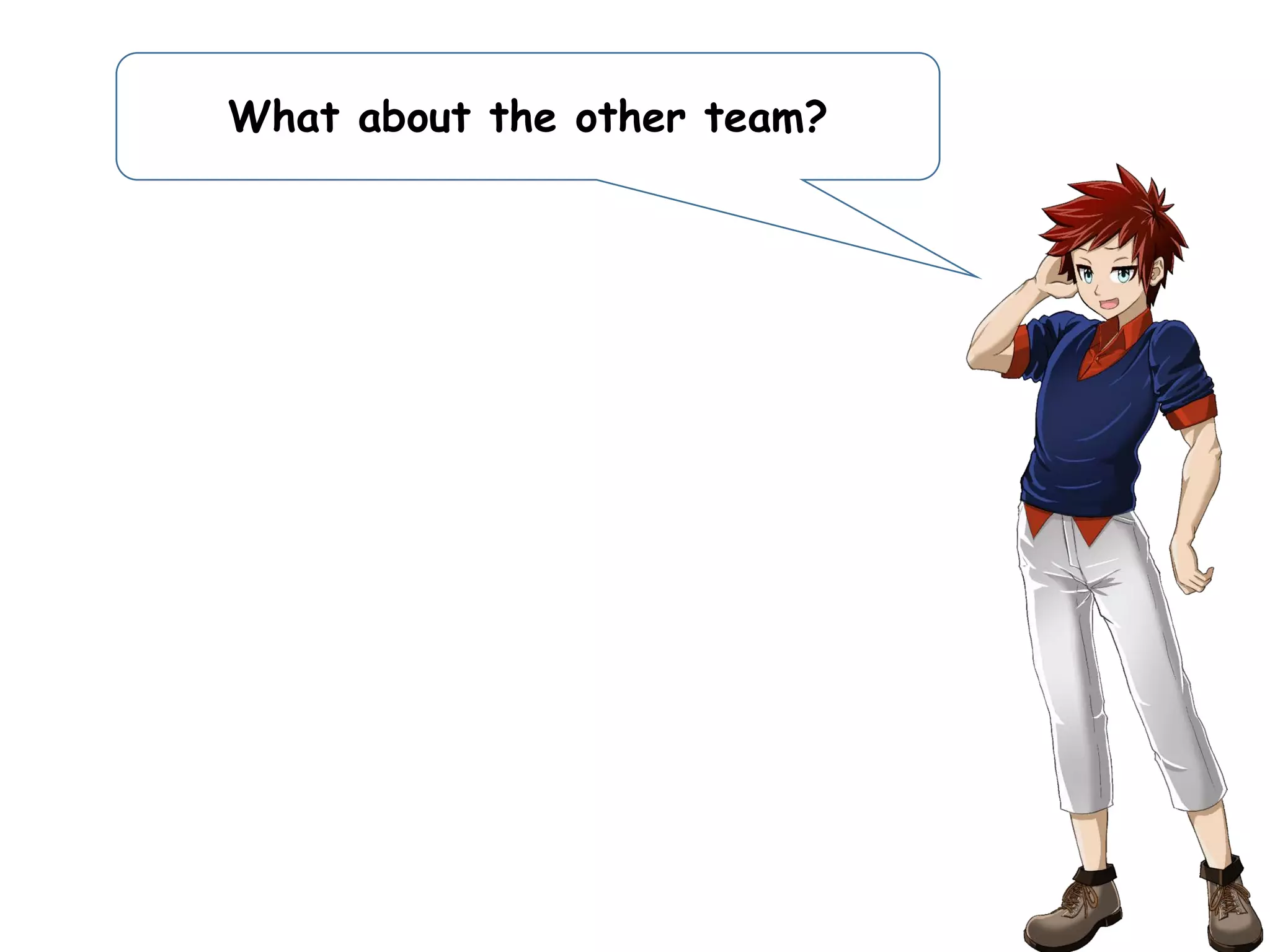
What about the other team?
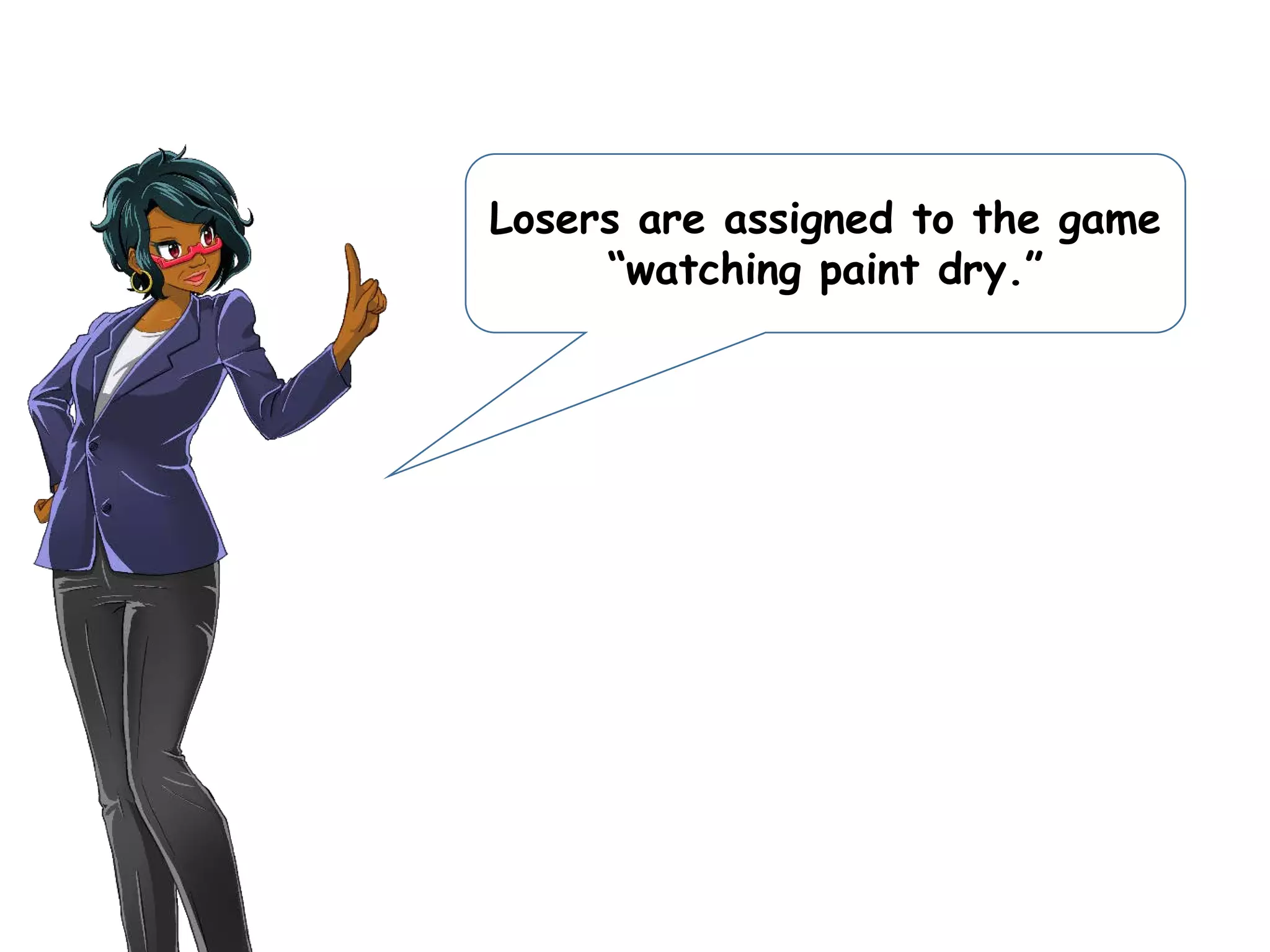
Losers are assigned to the game
“watching paint dry.”
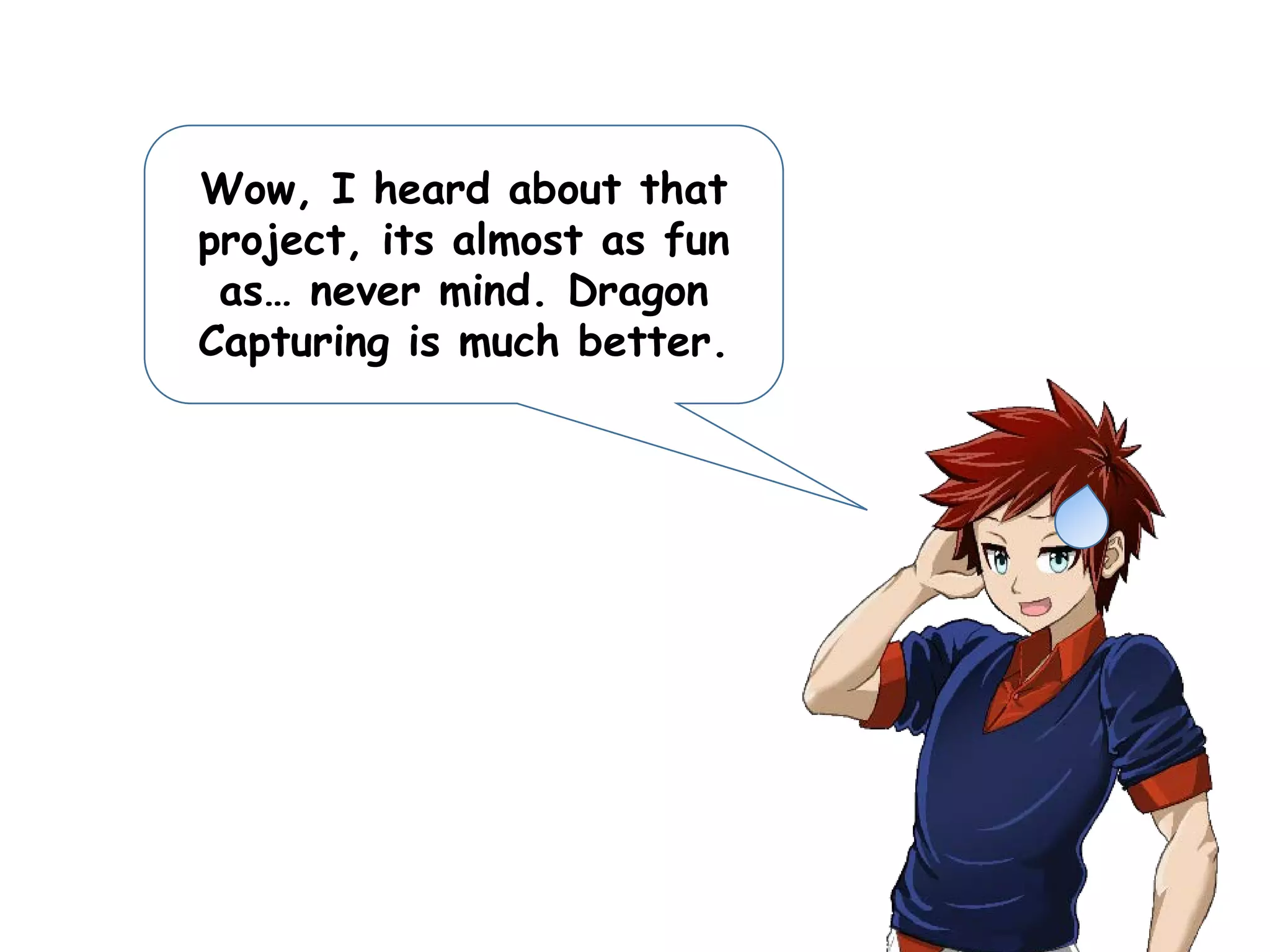
Wow, I heard about that
project, its almost as fun
as… never mind. Dragon
Capturing is much better.
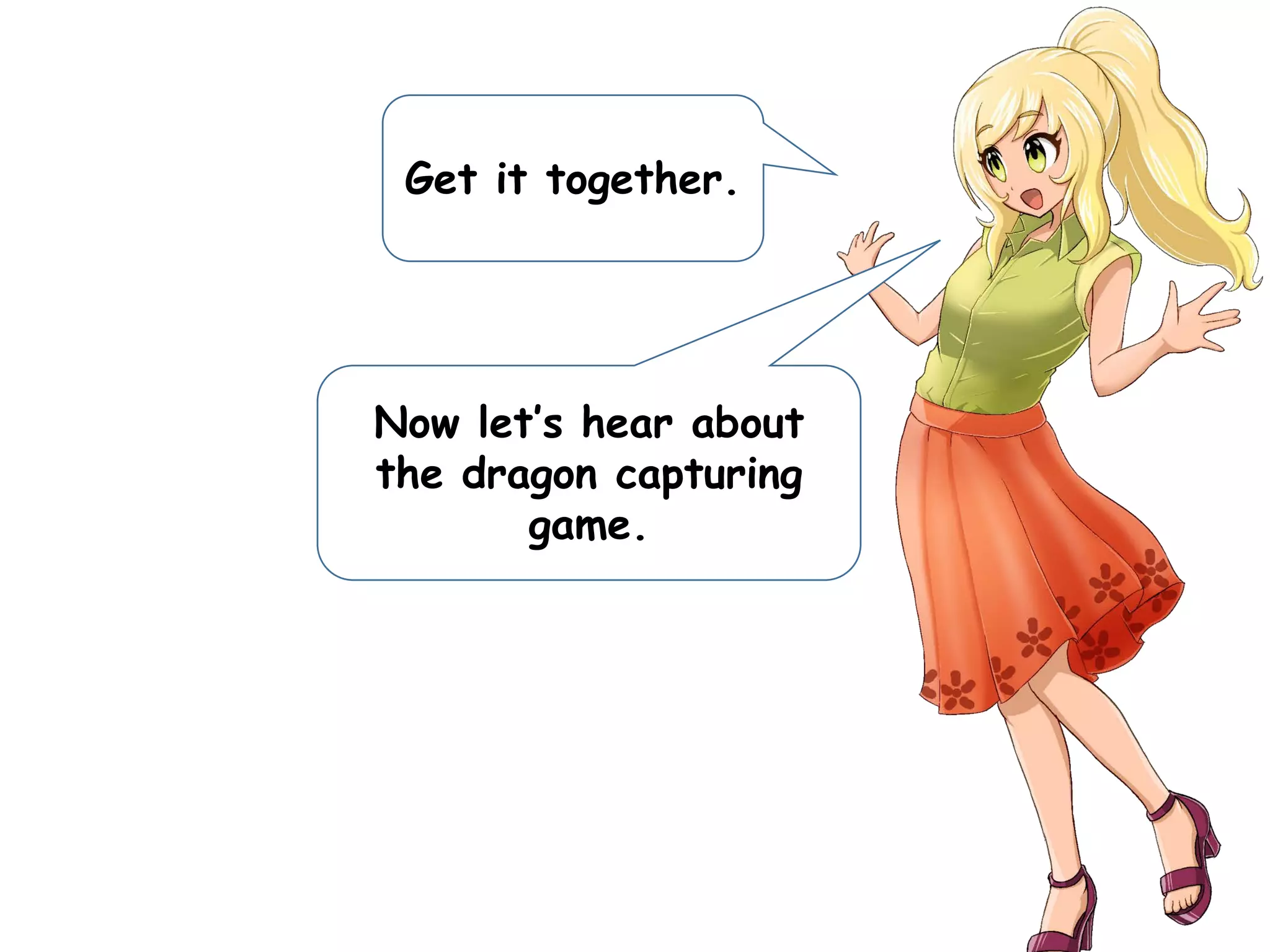
Get it together.
Now let’s hear about
the dragon capturing
game.
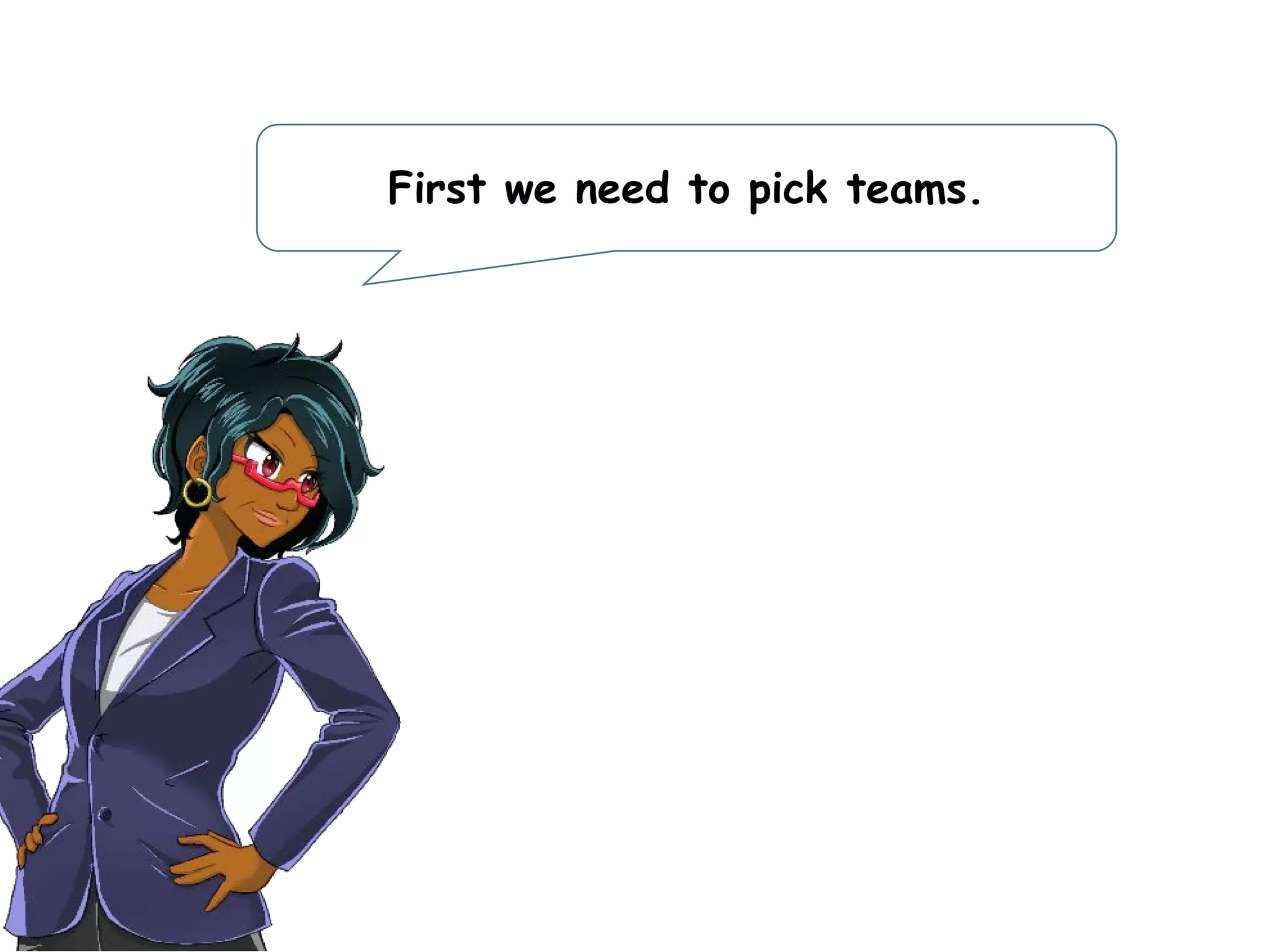
First we need to pick teams.
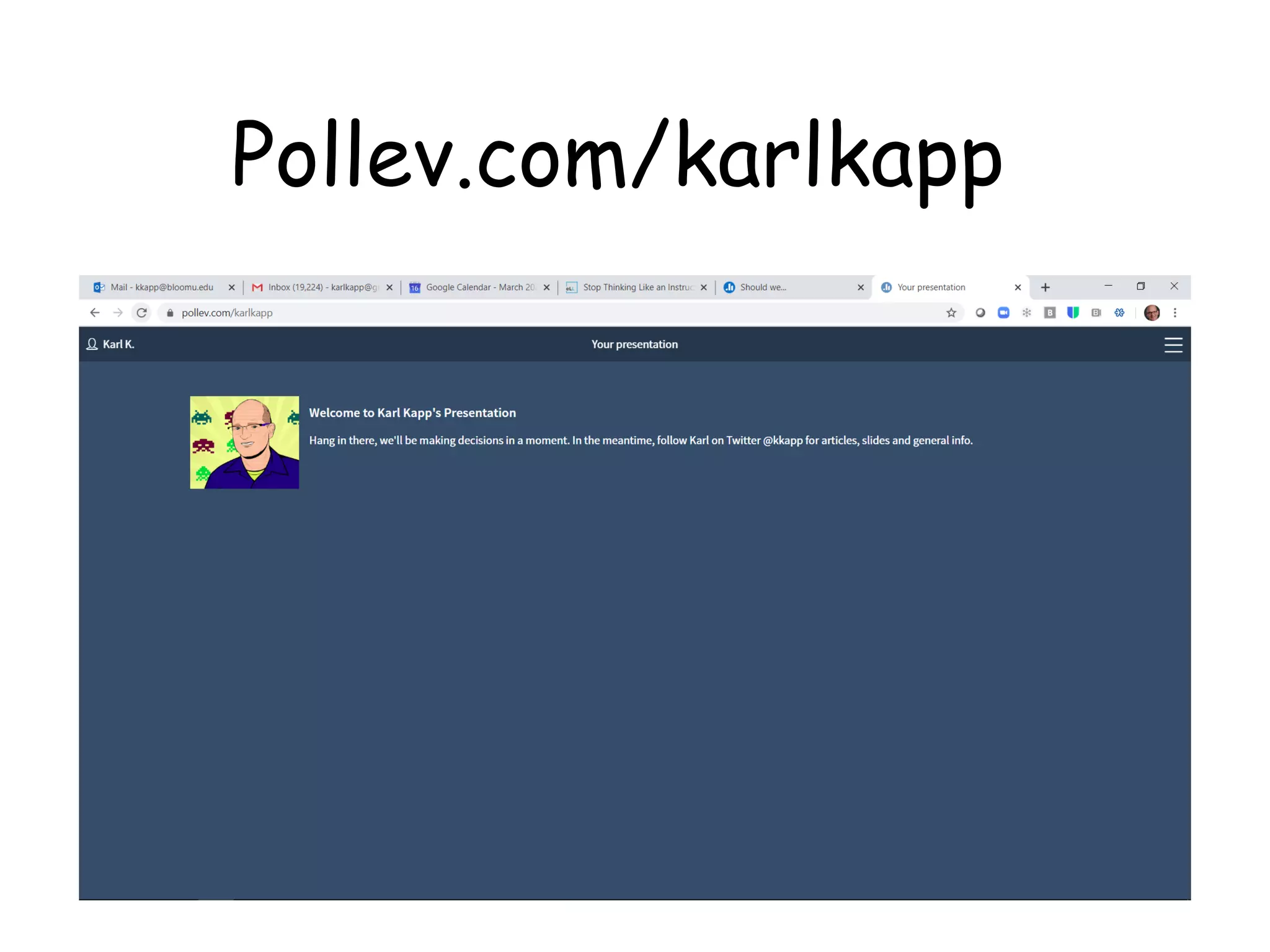
Pollev.com/karlkapp
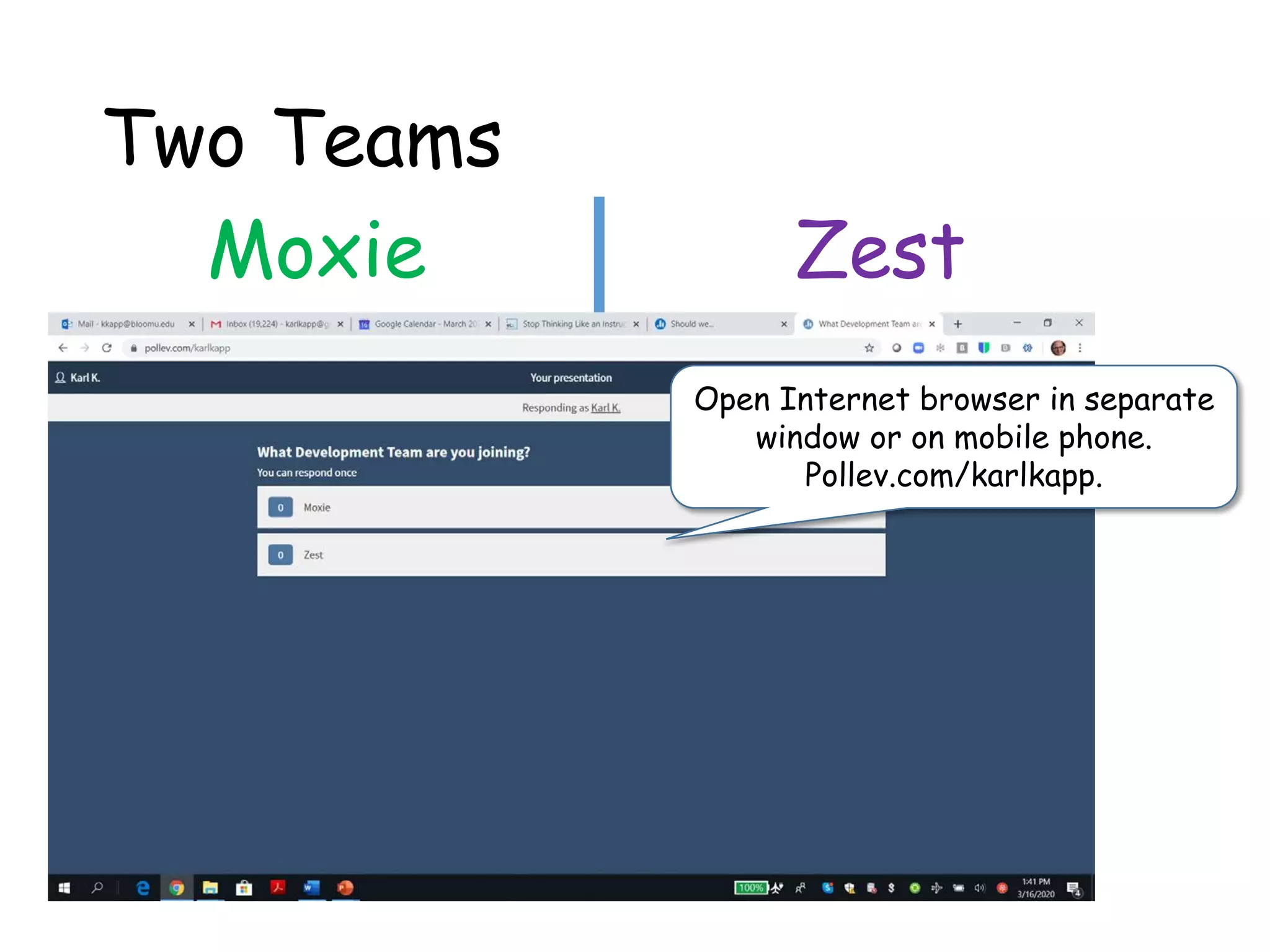
Two Teams
Moxie Zest
Open Internet browser in separate
window or on mobile phone.
Pollev.com/karlkapp.
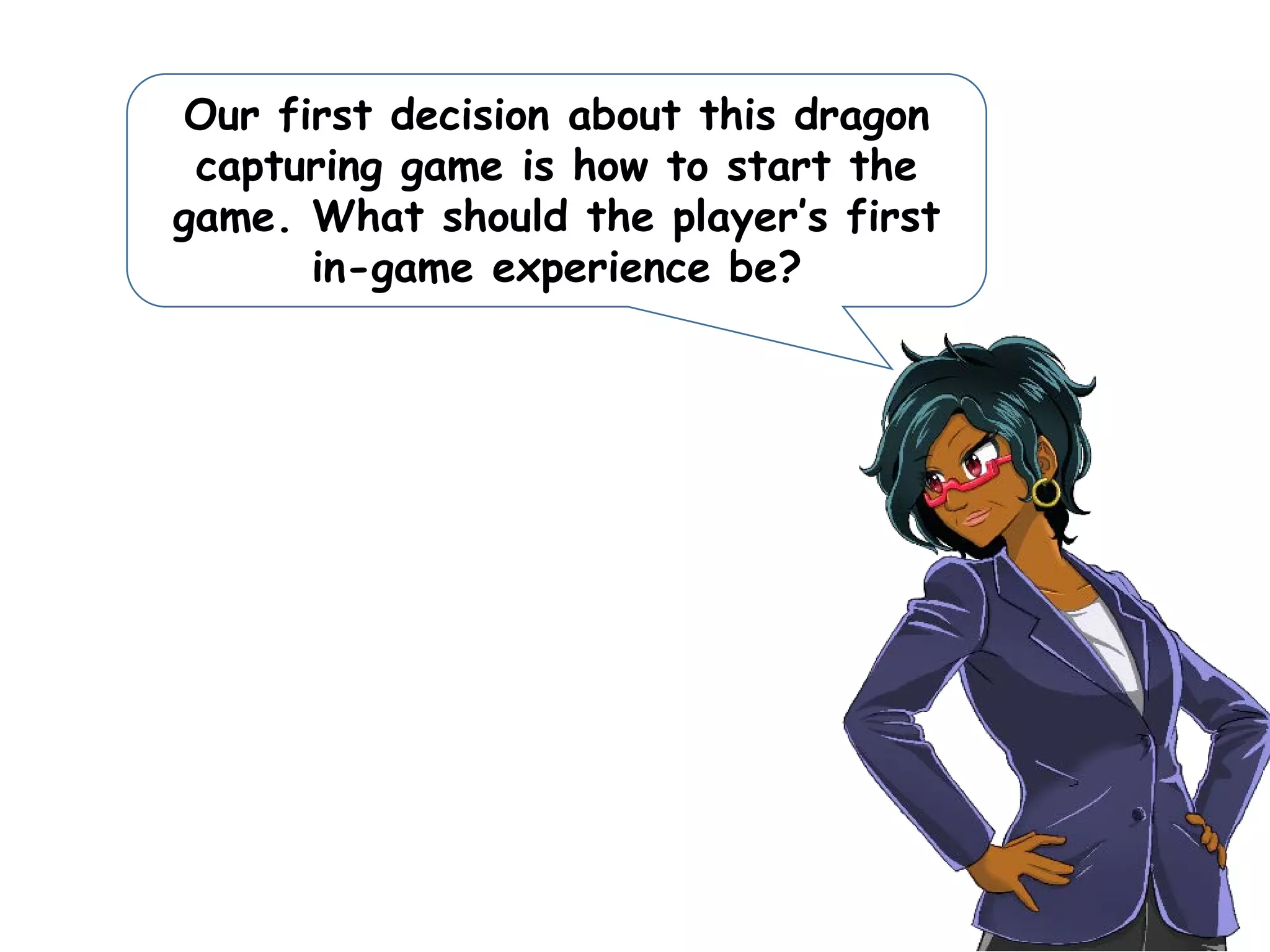
Our first decision about this dragon
capturing game is how to start the
game. What should the player’s first
in-game experience be?
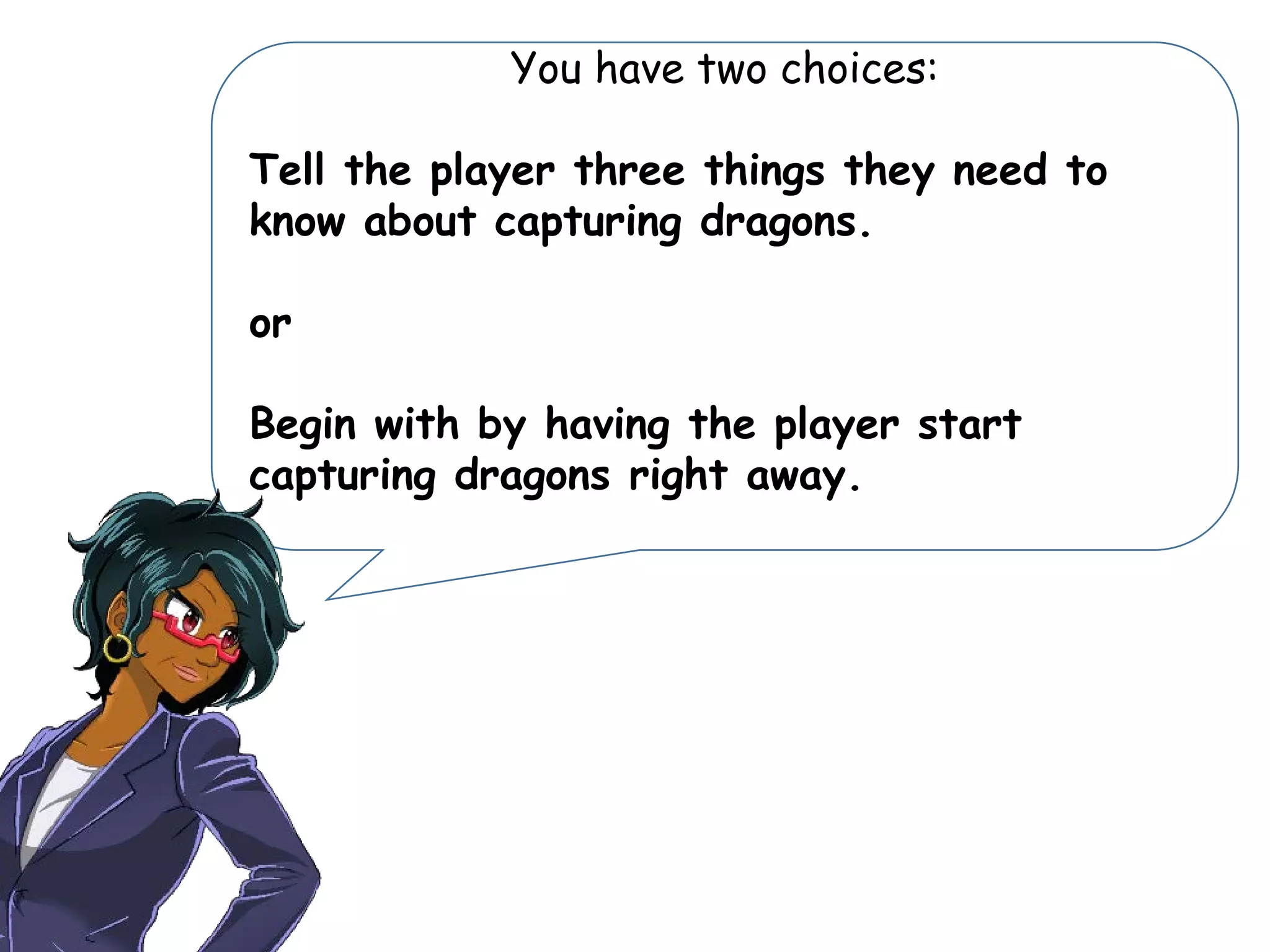
You have two choices:
Tell the player three things they need to
know about capturing dragons.
or
Begin with by having the player start
capturing dragons right away.
Why does this answer make
sense?
Not Sure?
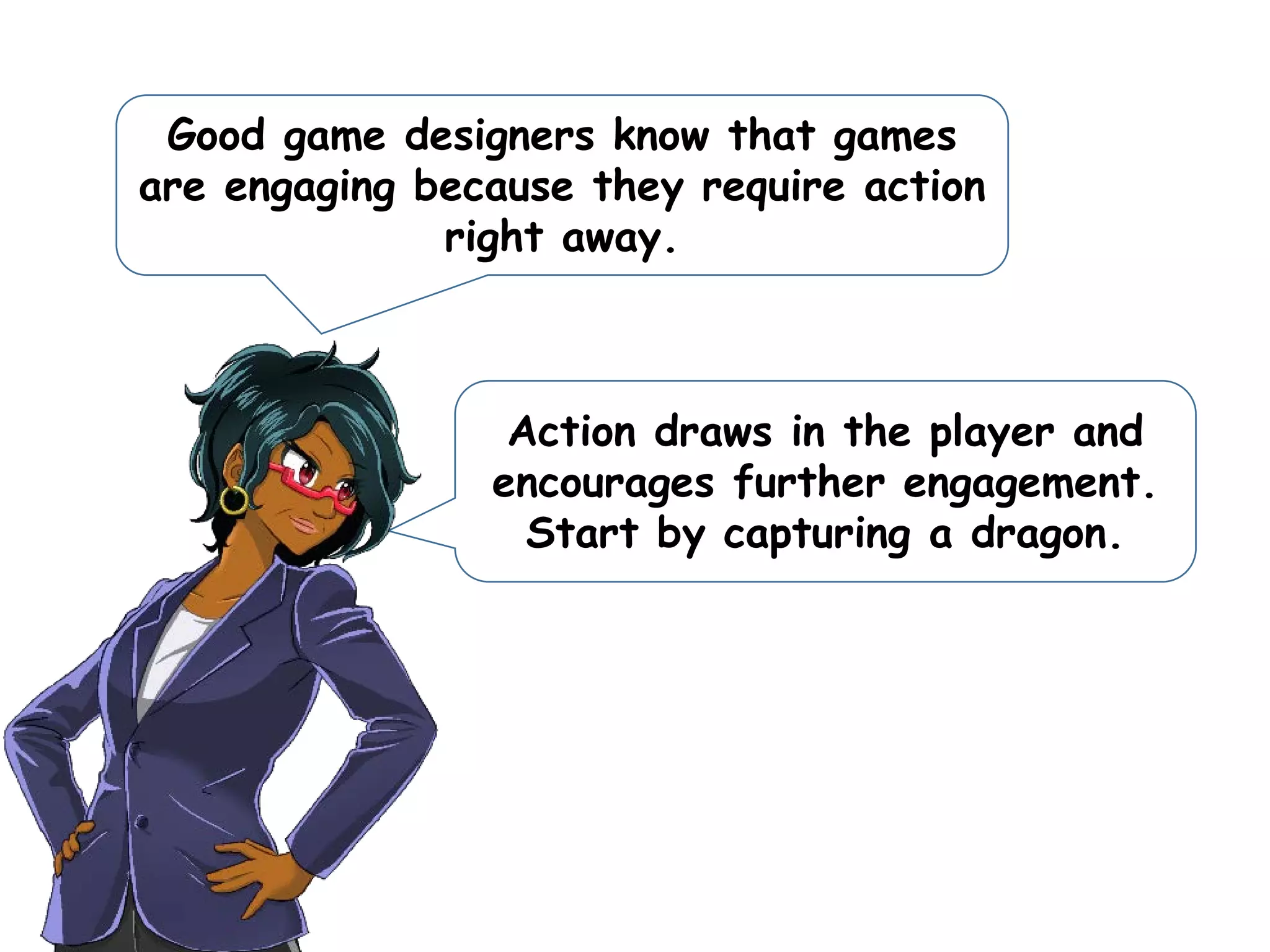
Good game designers know that games
are engaging because they require action
right away.
Action draws in the player and
encourages further engagement.
Start by capturing a dragon.
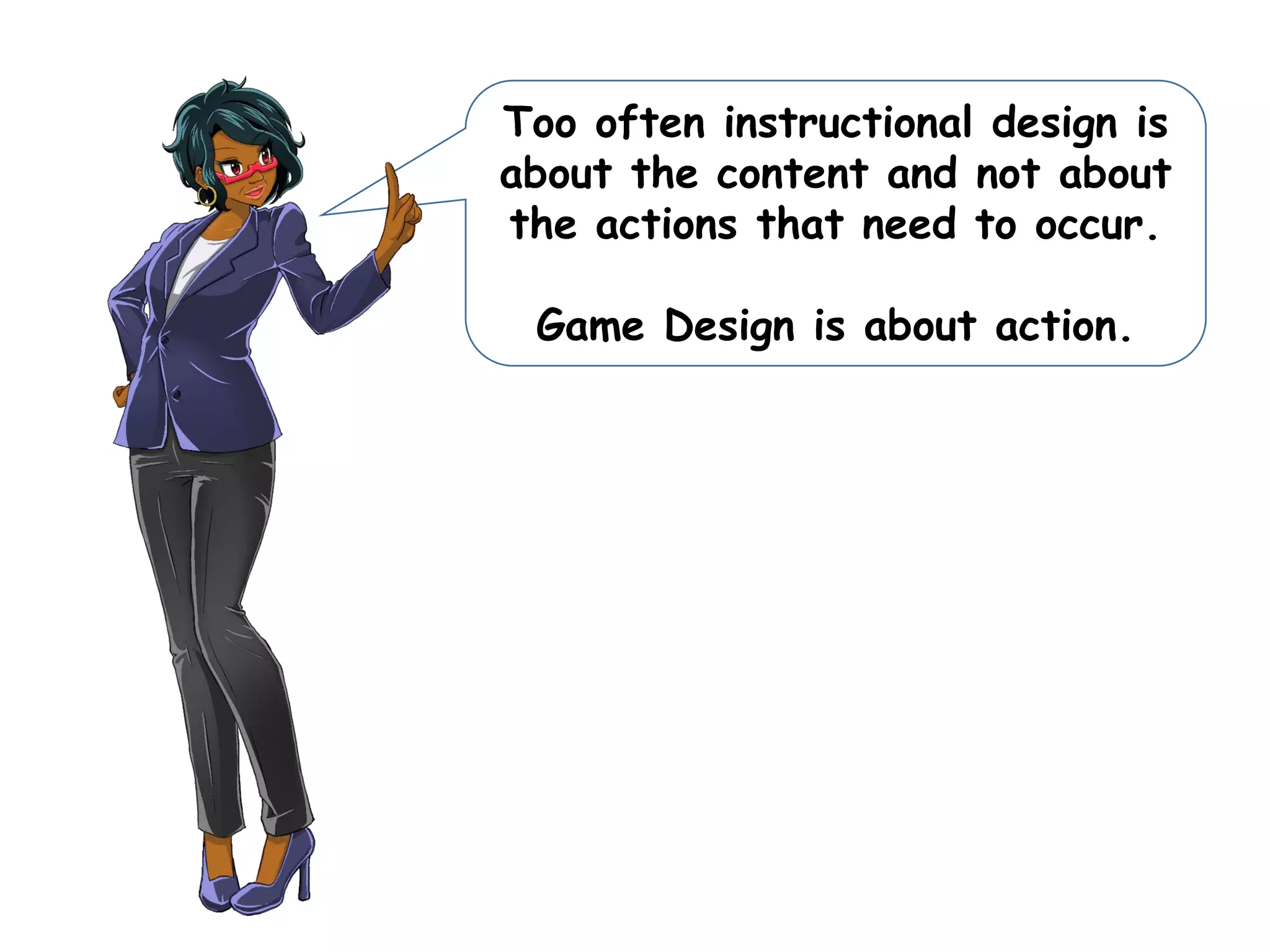
Too often instructional design is
about the content and not about
the actions that need to occur.
Game Design is about action.
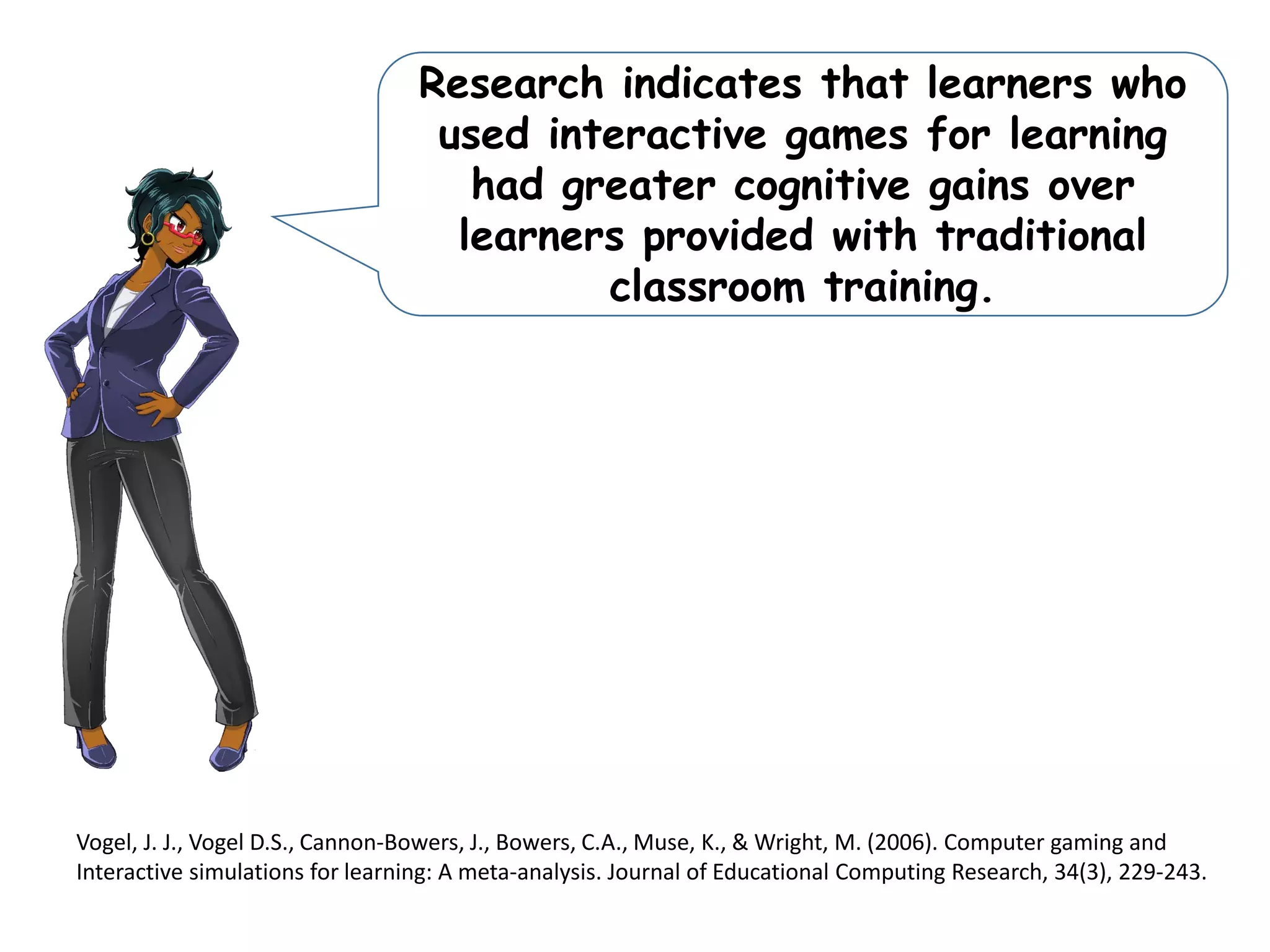
Research indicates that learners who
used interactive games for learning
had greater cognitive gains over
learners provided with traditional
classroom training.
Vogel, J. J., Vogel D.S., Cannon-Bowers, J., Bowers, C.A., Muse, K., & Wright, M. (2006). Computer gaming and
Interactive simulations for learning: A meta-analysis. Journal of Educational Computing Research, 34(3), 229-243.
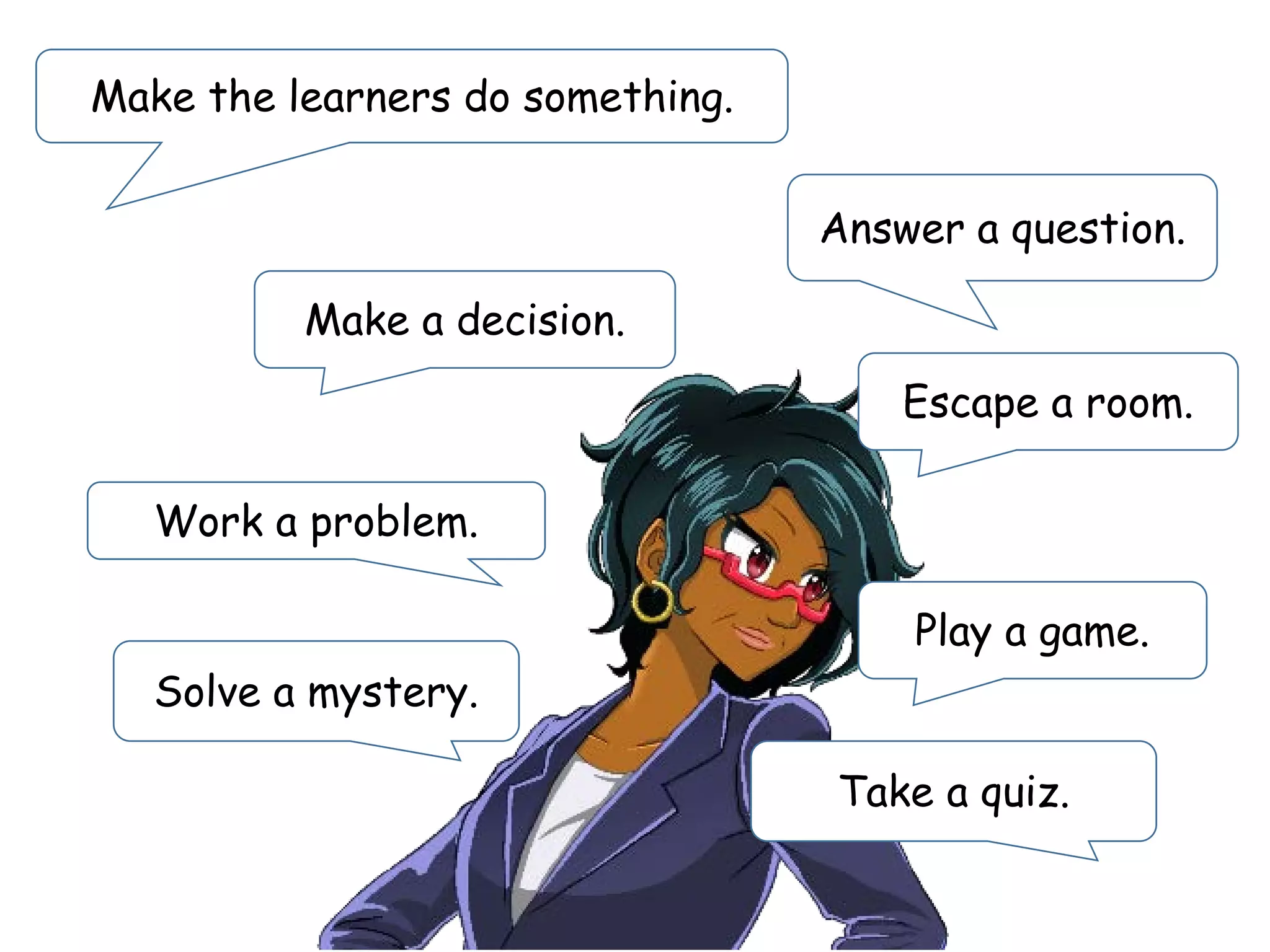
Solve a mystery.
Make the learners do something.
Answer a question.
Work a problem.
Make a decision.
Escape a room.
Play a game.
Take a quiz.
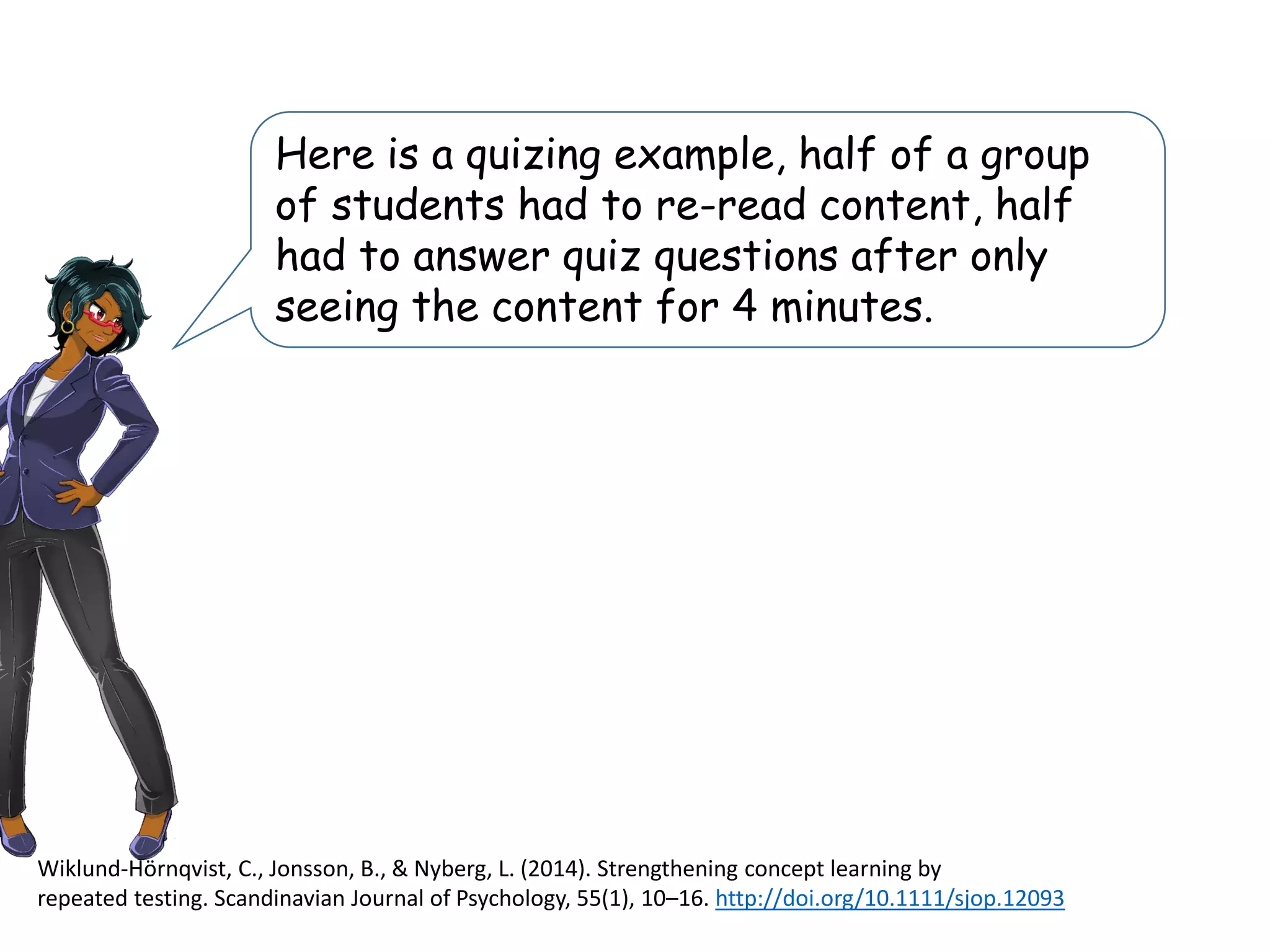
Here is a quizing example, half of a group
of students had to re-read content, half
had to answer quiz questions after only
seeing the content for 4 minutes.
Wiklund-Hörnqvist, C., Jonsson, B., & Nyberg, L. (2014). Strengthening concept learning by
repeated testing. Scandinavian Journal of Psychology, 55(1), 10–16. http://doi.org/10.1111/sjop.12093
Participants who had been tested
(rather than re-reading the material)
outperformed the other students.
Wiklund-Hörnqvist, C., Jonsson, B., & Nyberg, L. (2014). Strengthening concept learning by
repeated testing. Scandinavian Journal of Psychology, 55(1), 10–16. http://doi.org/10.1111/sjop.12093
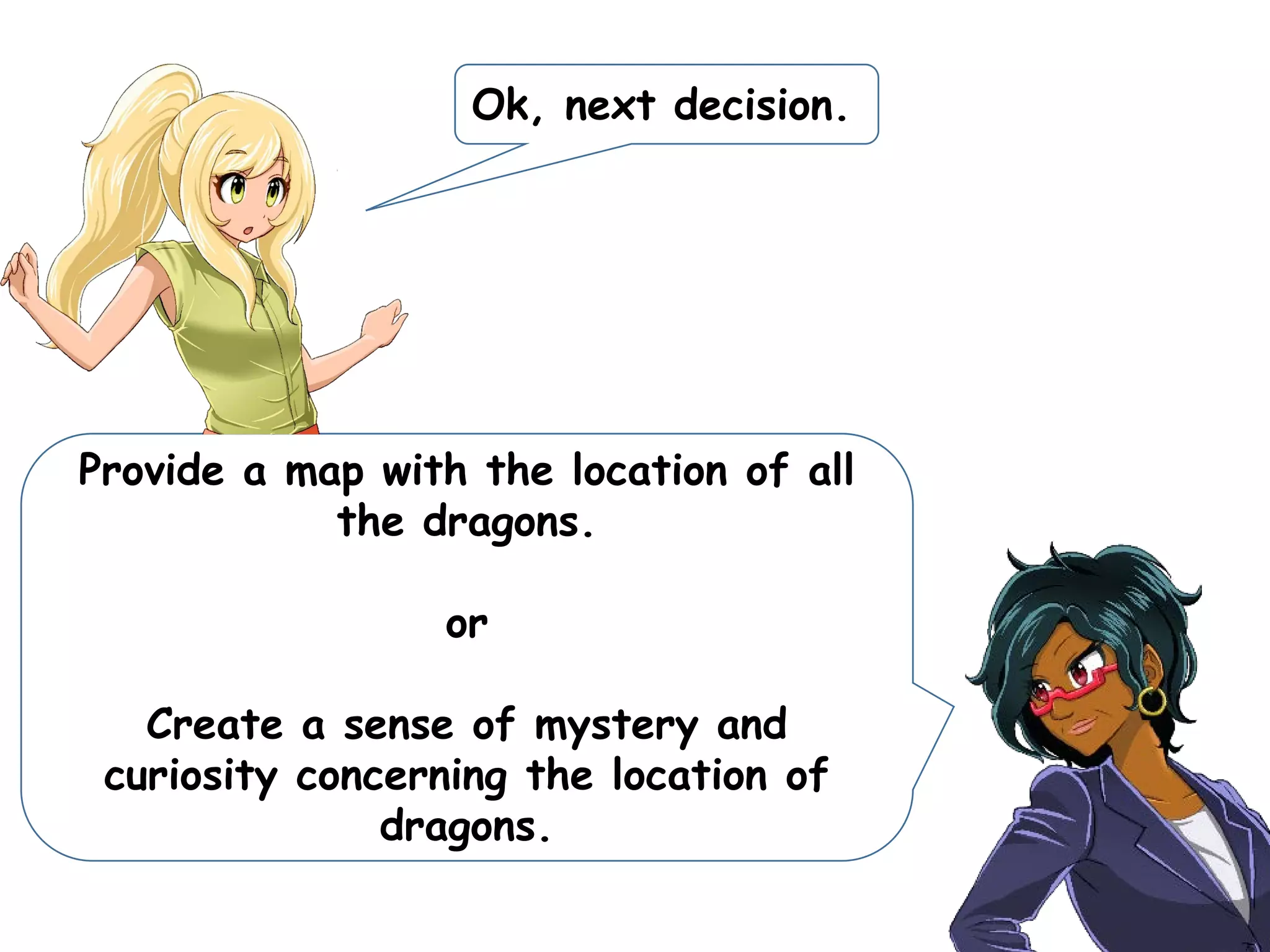
Ok, next decision.
Provide a map with the location of all
the dragons.
or
Create a sense of mystery and
curiosity concerning the location of
dragons.
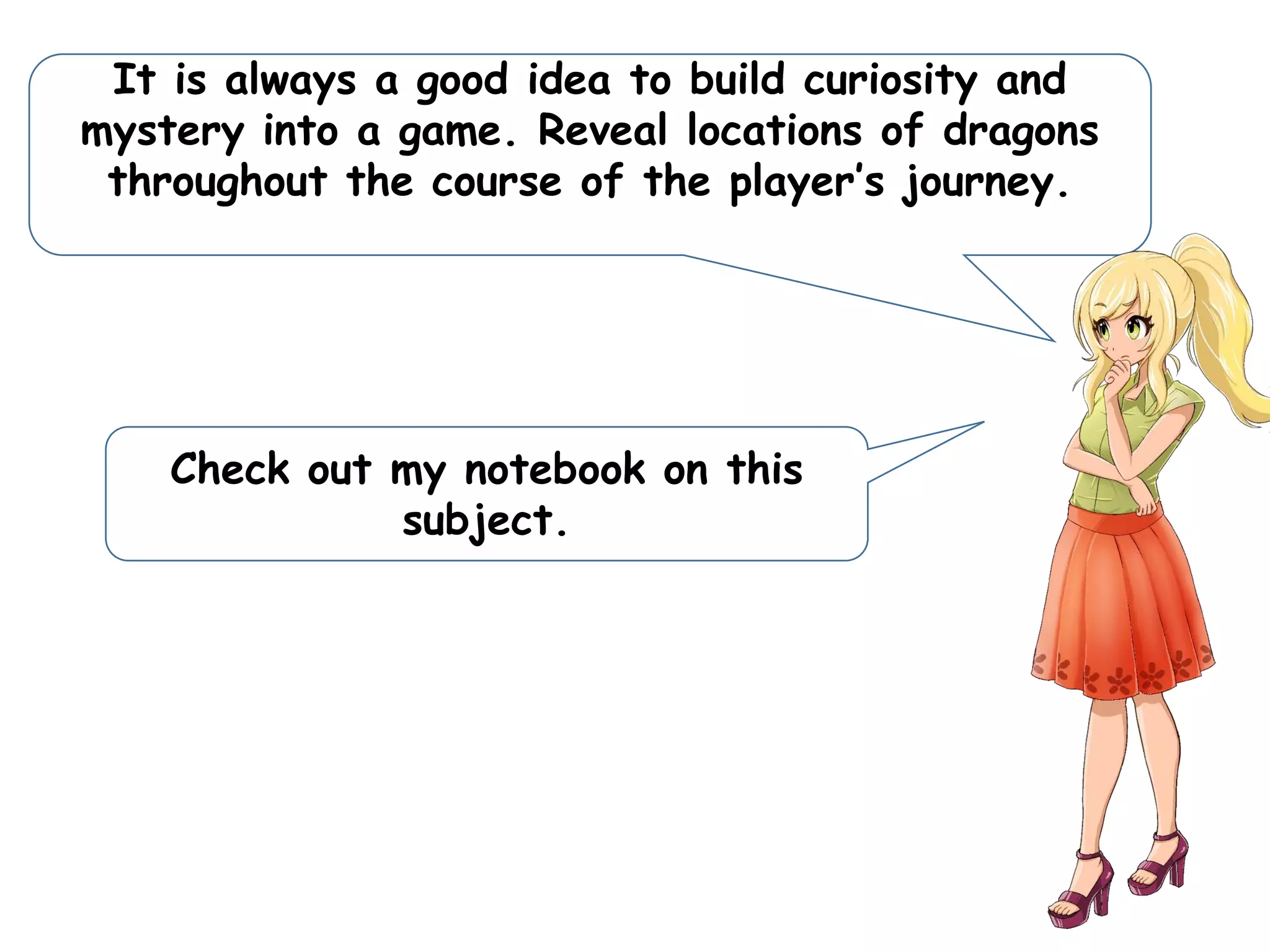
It is always a good idea to build curiosity and
mystery into a game. Reveal locations of dragons
throughout the course of the player’s journey.
Check out my notebook on this
subject.
A sense of suspense, mystery
and intrigue draws people into
games and can draw them into
learning as well.
OK, what do we decide next, should we:
Make the game easy so we don’t discourage the
players.
or
Make the game challenging, knowing some
players will fail the first few times.
Jones, B., Valdez, G., Norakowski, J., & Rasmussen, C. (1994). Designing learning and technology
for educational reform. North Central Regional Educational Laboratory. [Online]. Available:
http://www.ncrtec.org/capacity/profile/profwww.htm and Schlechty, P. C. (1997). Inventing
better schools: An action plan for educational reform. San Francisco, CA: Jossey-Bass. Chapter 2
“The Gamification of Learning and Instruction.”
It needs to be challenging.
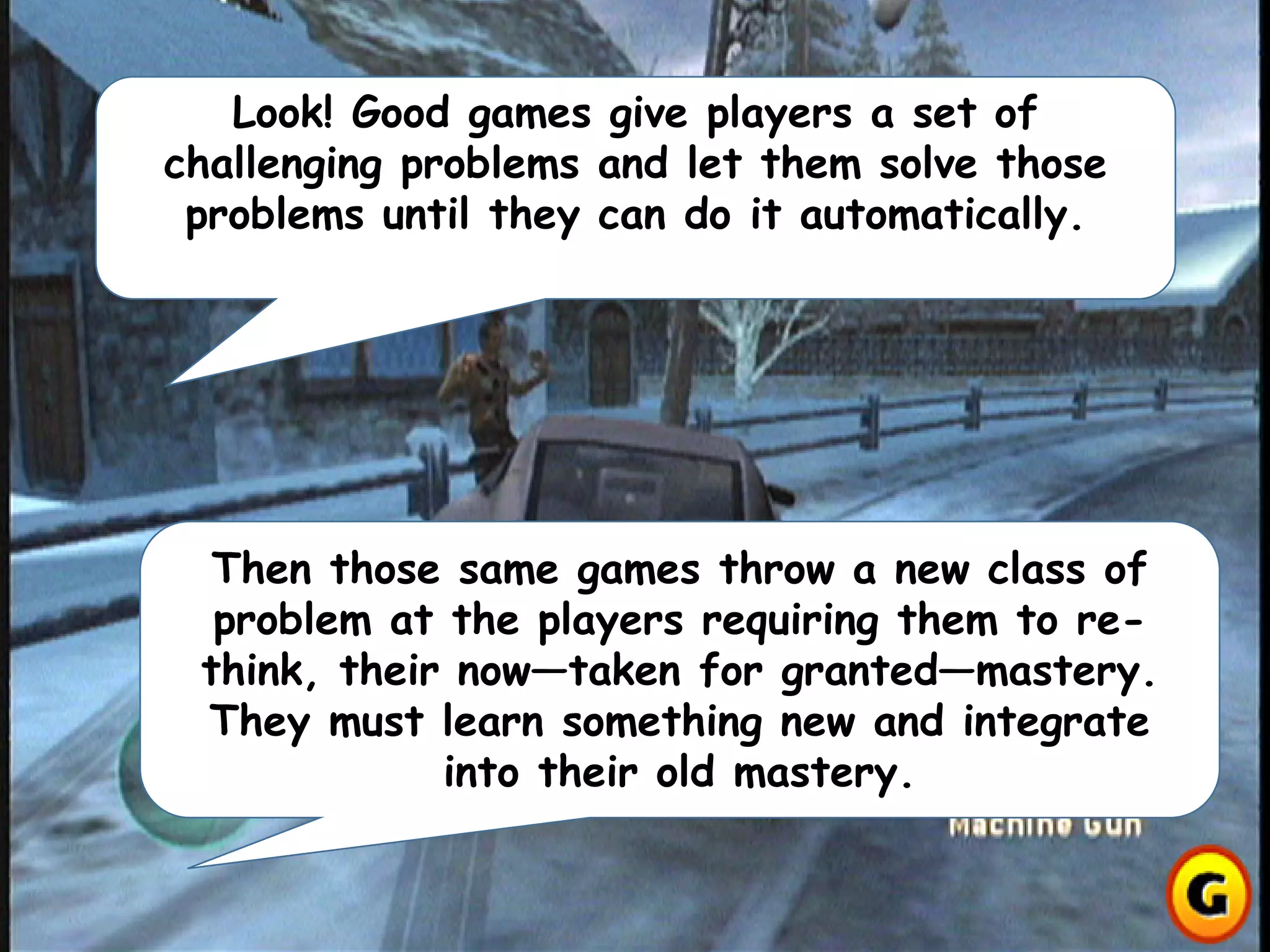
Look! Good games give players a set of
challenging problems and let them solve those
problems until they can do it automatically.
Then those same games throw a new class of
problem at the players requiring them to re-
think, their now—taken for granted—mastery.
They must learn something new and integrate
into their old mastery.
Well said!
Actually, my good friend James Paul
Gee said those words, I’m quoting
him.
Always good to cite
sources!
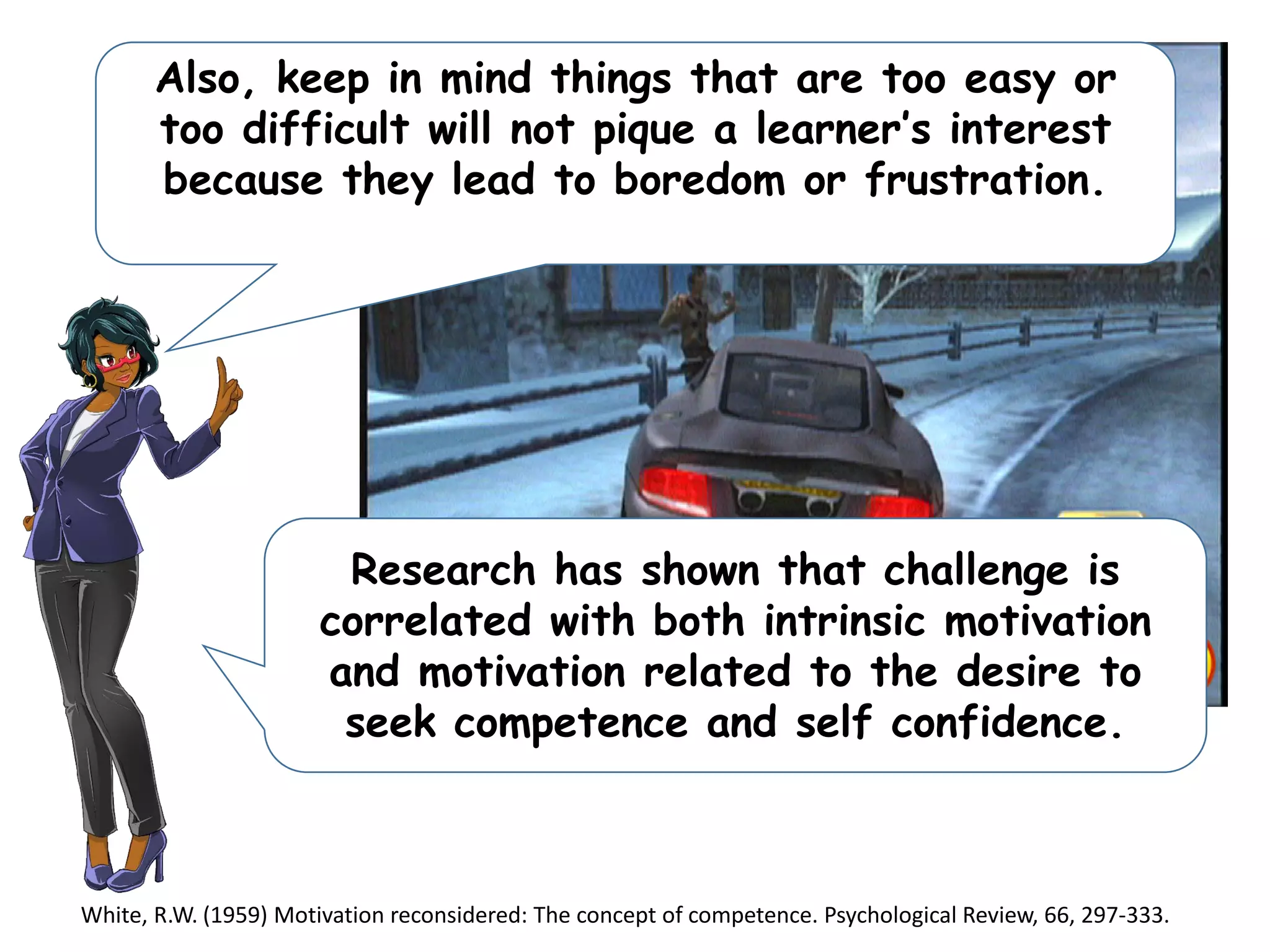
Also, keep in mind things that are too easy or
too difficult will not pique a learner’s interest
because they lead to boredom or frustration.
Research has shown that challenge is
correlated with both intrinsic motivation
and motivation related to the desire to
seek competence and self confidence.
White, R.W. (1959) Motivation reconsidered: The concept of competence. Psychological Review, 66, 297-333.
In fact, give them the
Kobayashi Maru of challenges.
Harsh!
Well, the next decision, should we:
Put the player at risk, they could die at
any moment.
or
Let the player safely explore the
environment.
Seriously, you are asking me
this question. The player needs
to be at risk.
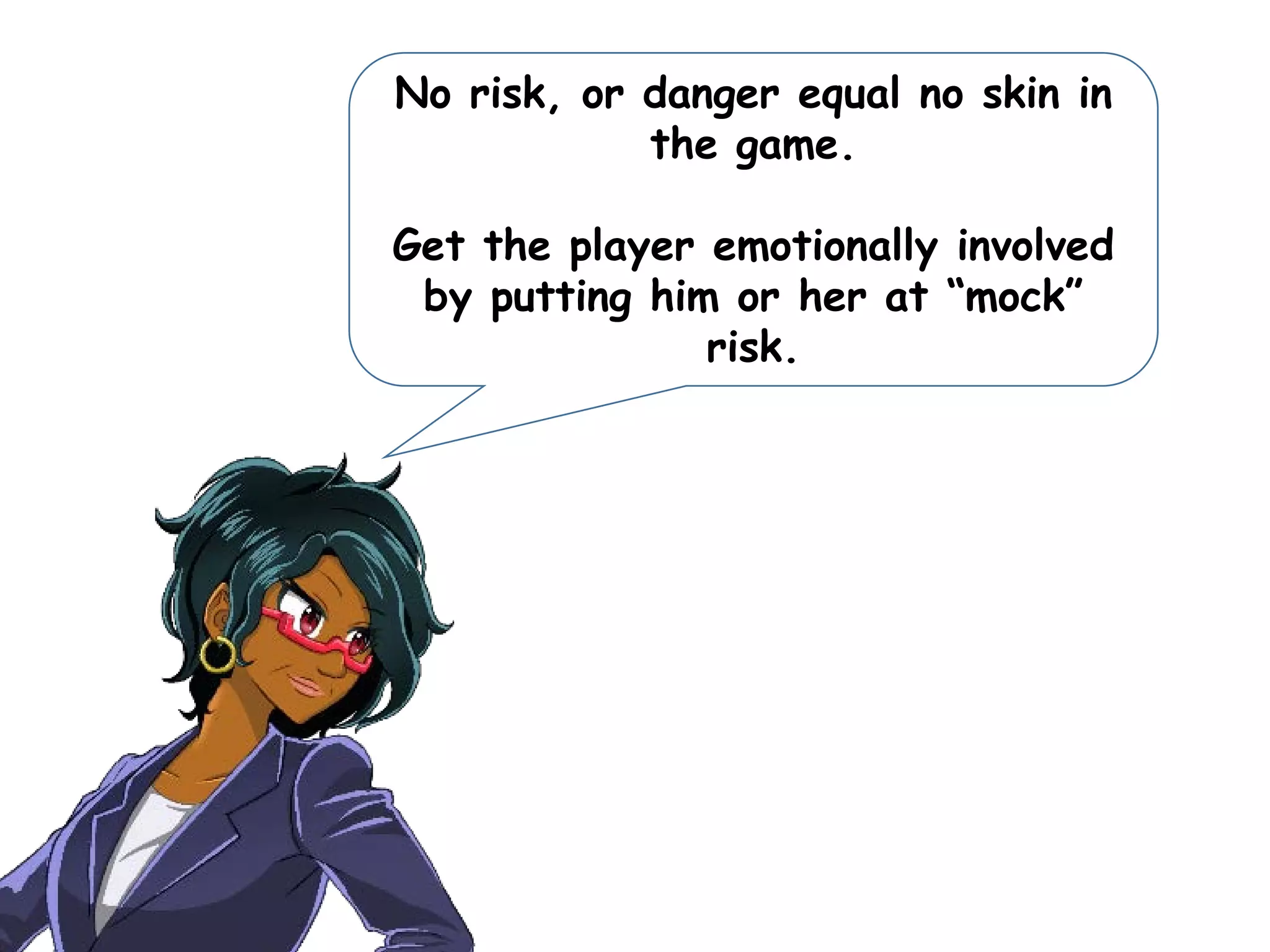
No risk, or danger equal no skin in
the game.
Get the player emotionally involved
by putting him or her at “mock”
risk.
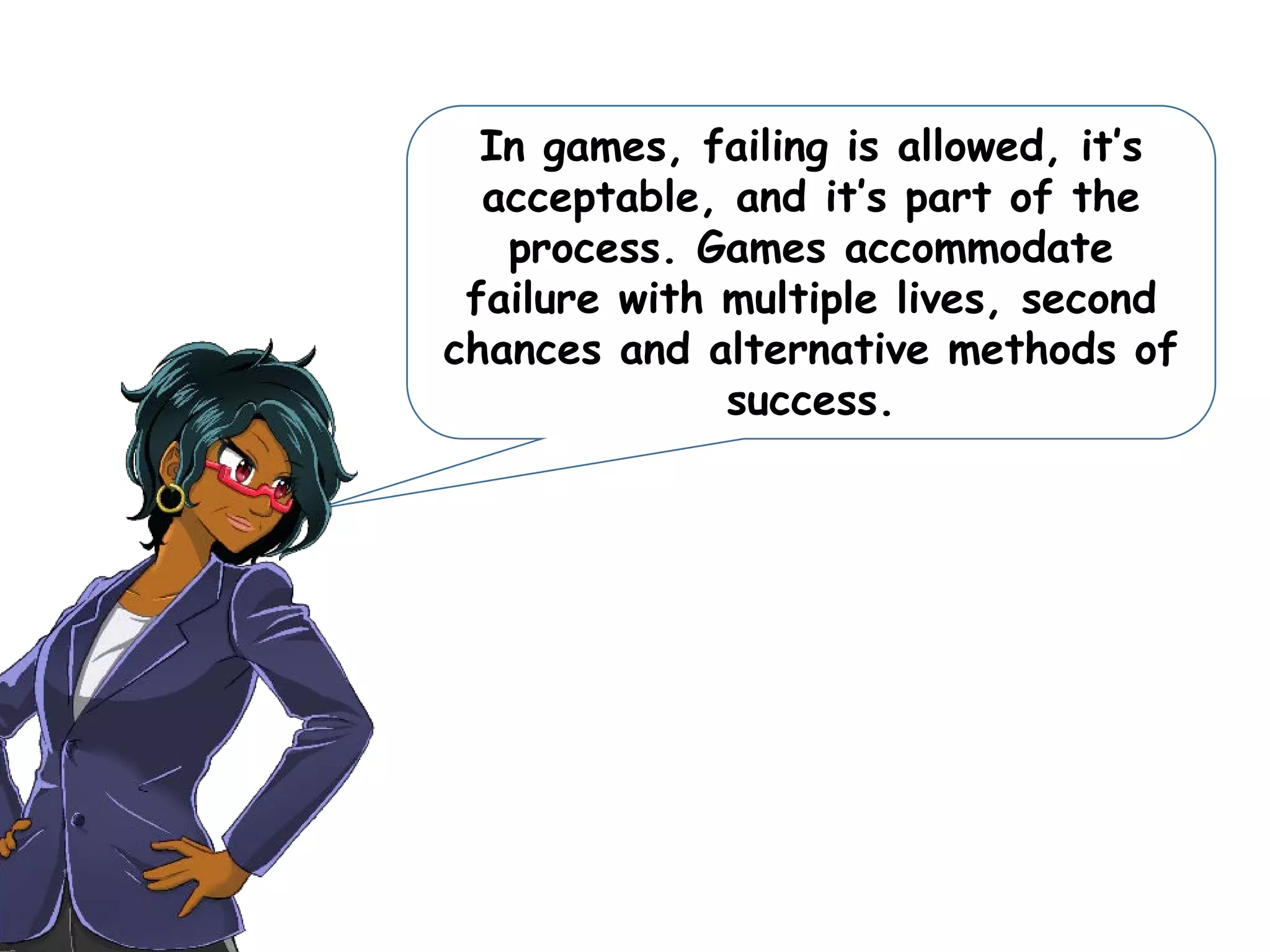
In games, failing is allowed, it’s
acceptable, and it’s part of the
process. Games accommodate
failure with multiple lives, second
chances and alternative methods of
success.
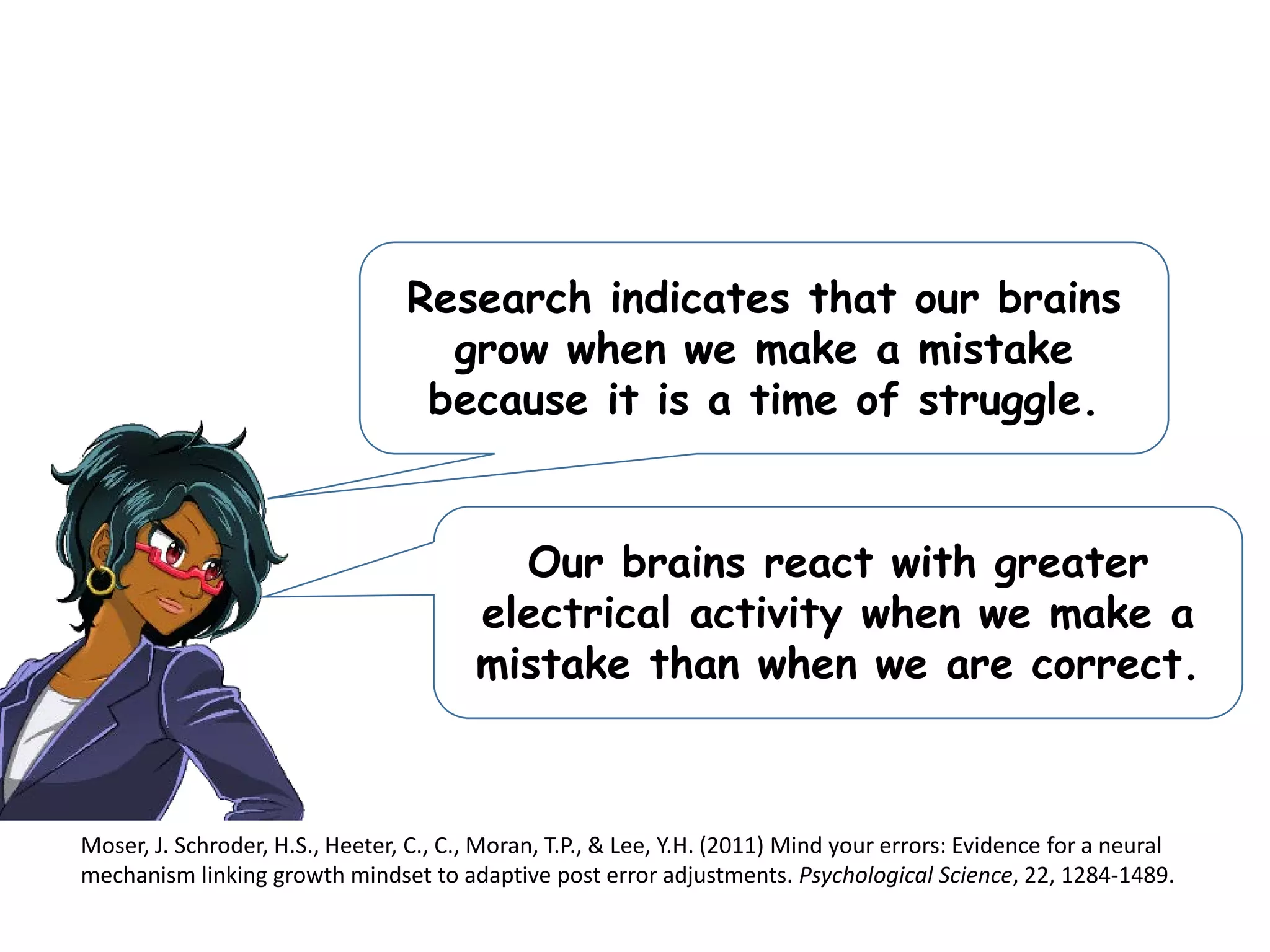
Research indicates that our brains
grow when we make a mistake
because it is a time of struggle.
Moser, J. Schroder, H.S., Heeter, C., C., Moran, T.P., & Lee, Y.H. (2011) Mind your errors: Evidence for a neural
mechanism linking growth mindset to adaptive post error adjustments. Psychological Science, 22, 1284-1489.
Our brains react with greater
electrical activity when we make a
mistake than when we are correct.
Do you punish failure in your
learning design or do you allow and
encourage the freedom to fail?
Lot of information, thanks. So
let me ask one more question.
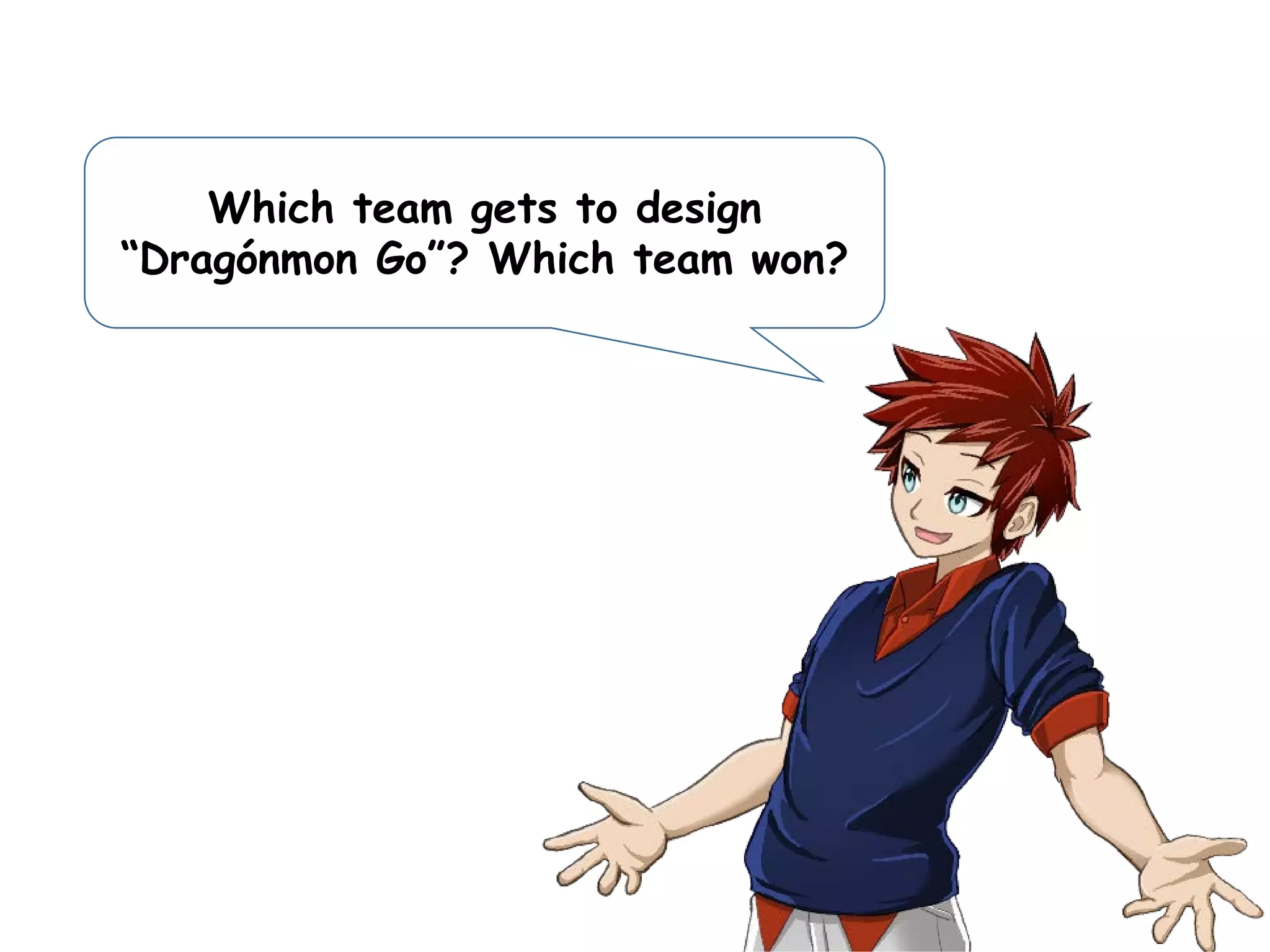
Which team gets to design
“Dragónmon Go”? Which team won?
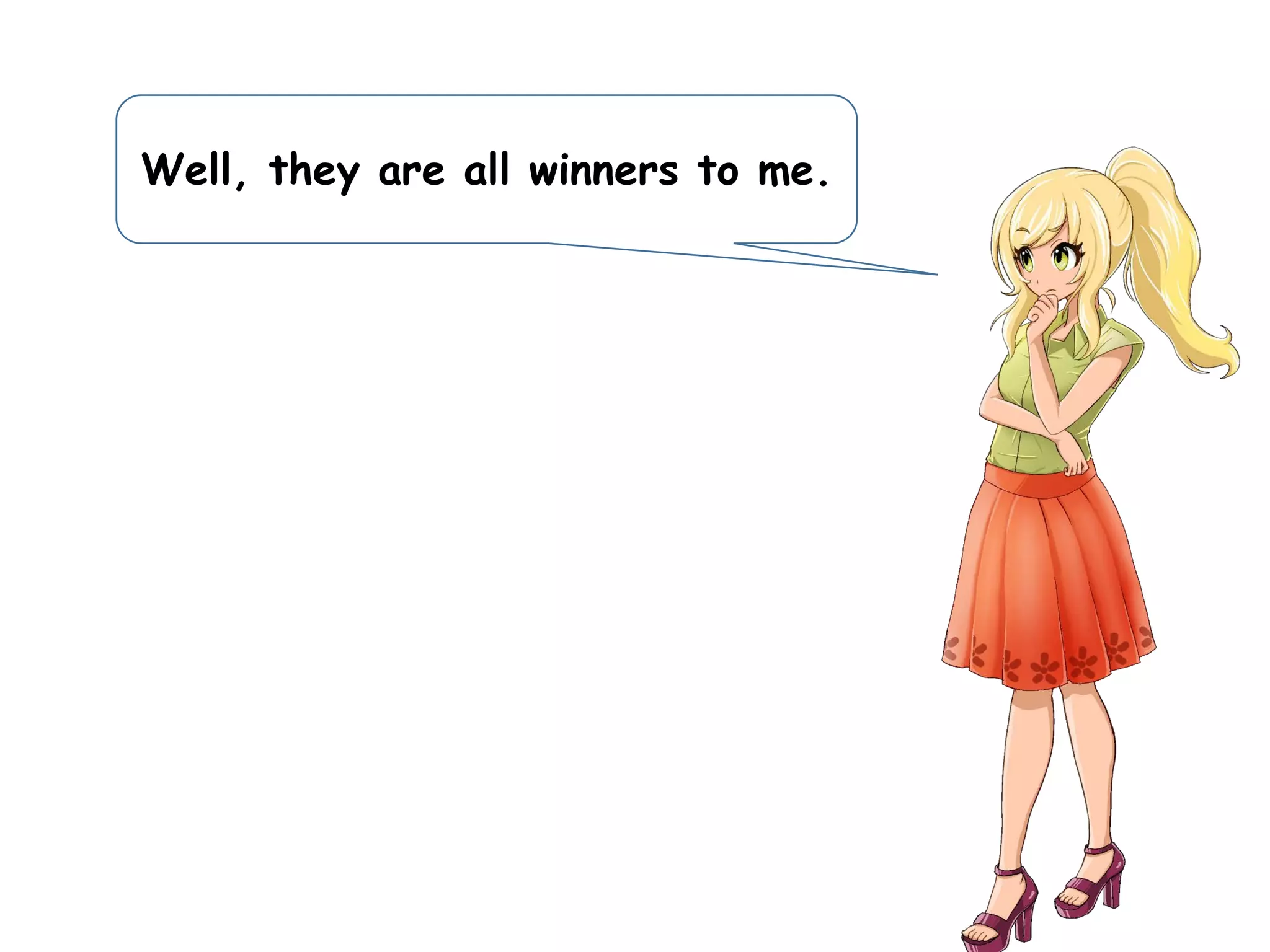
Well, they are all winners to me.
Ugh….
How about a
re-cap…
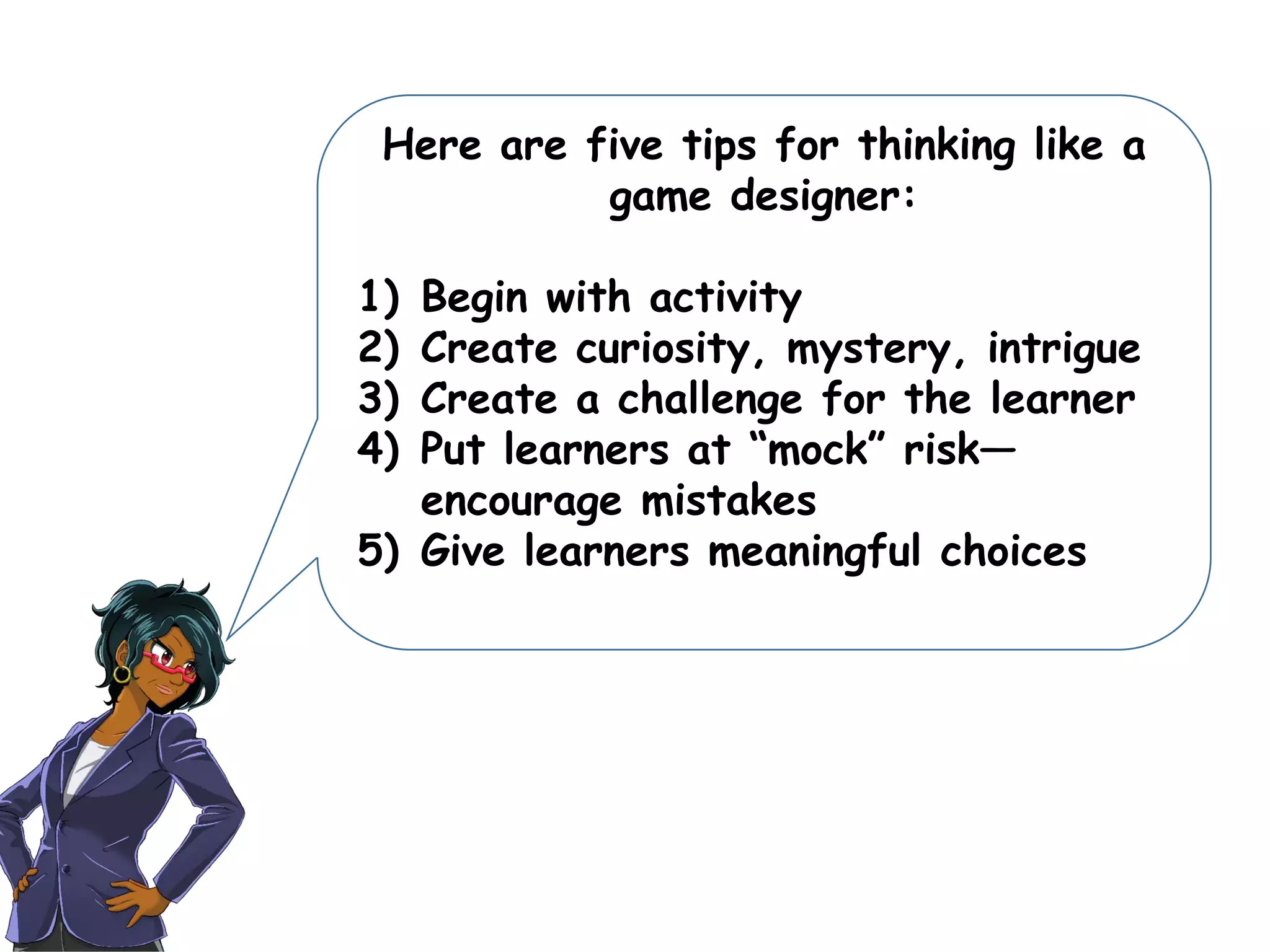
Here are five tips for thinking like a
game designer:
1) Begin with activity
2) Create curiosity, mystery, intrigue
3) Create a challenge for the learner
4) Put learners at “mock” risk—
encourage mistakes
5) Give learners meaningful choices
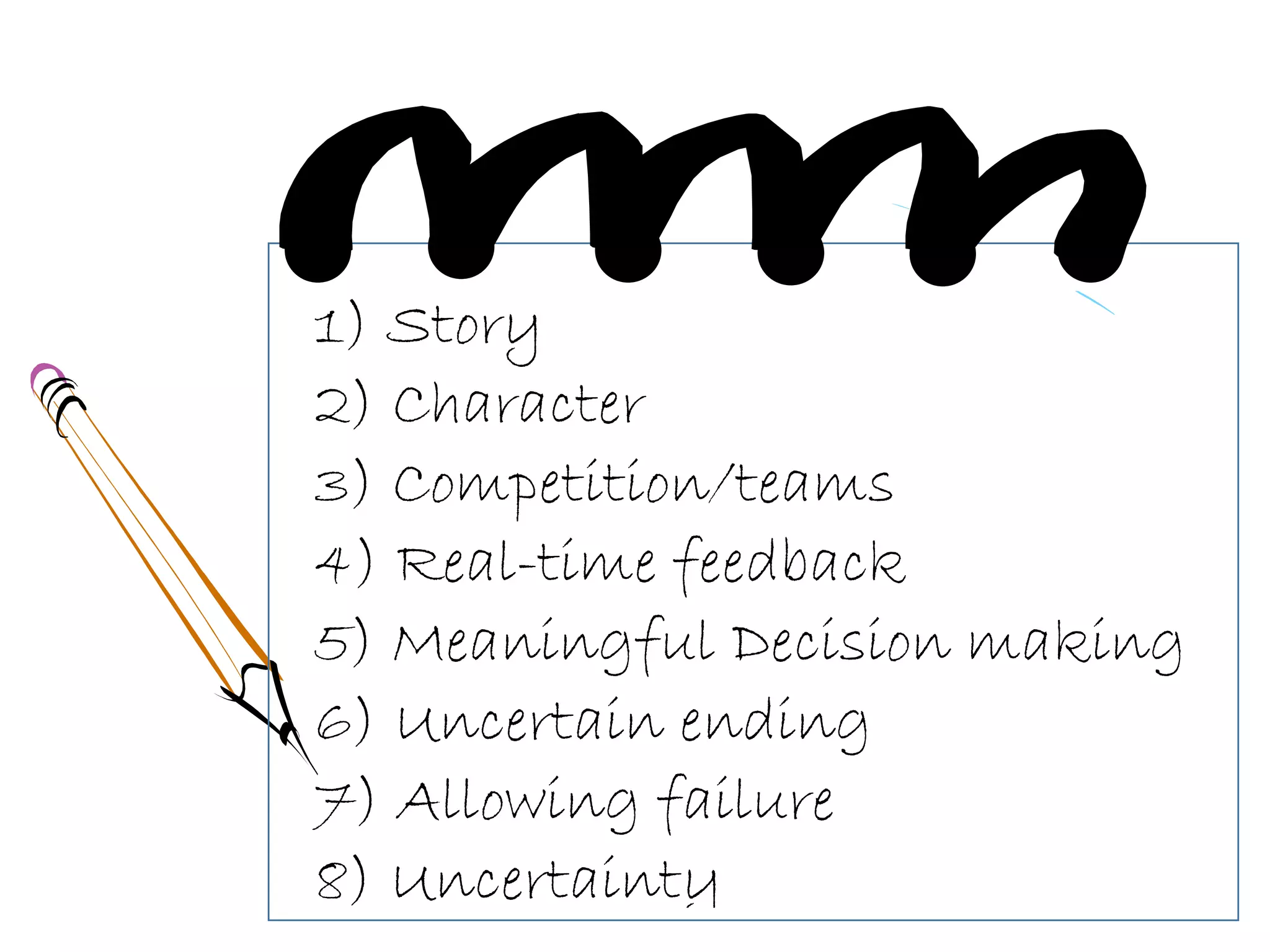
What game elements
were in this
presentation?
1) Story
2) Character
3) Competition/teams
4) Real-time feedback
5) Meaningful Decision making
6) Uncertain ending
7) Allowing failure
8) Uncertainty
Another Example
You can use more
realistic settings for
storytelling.
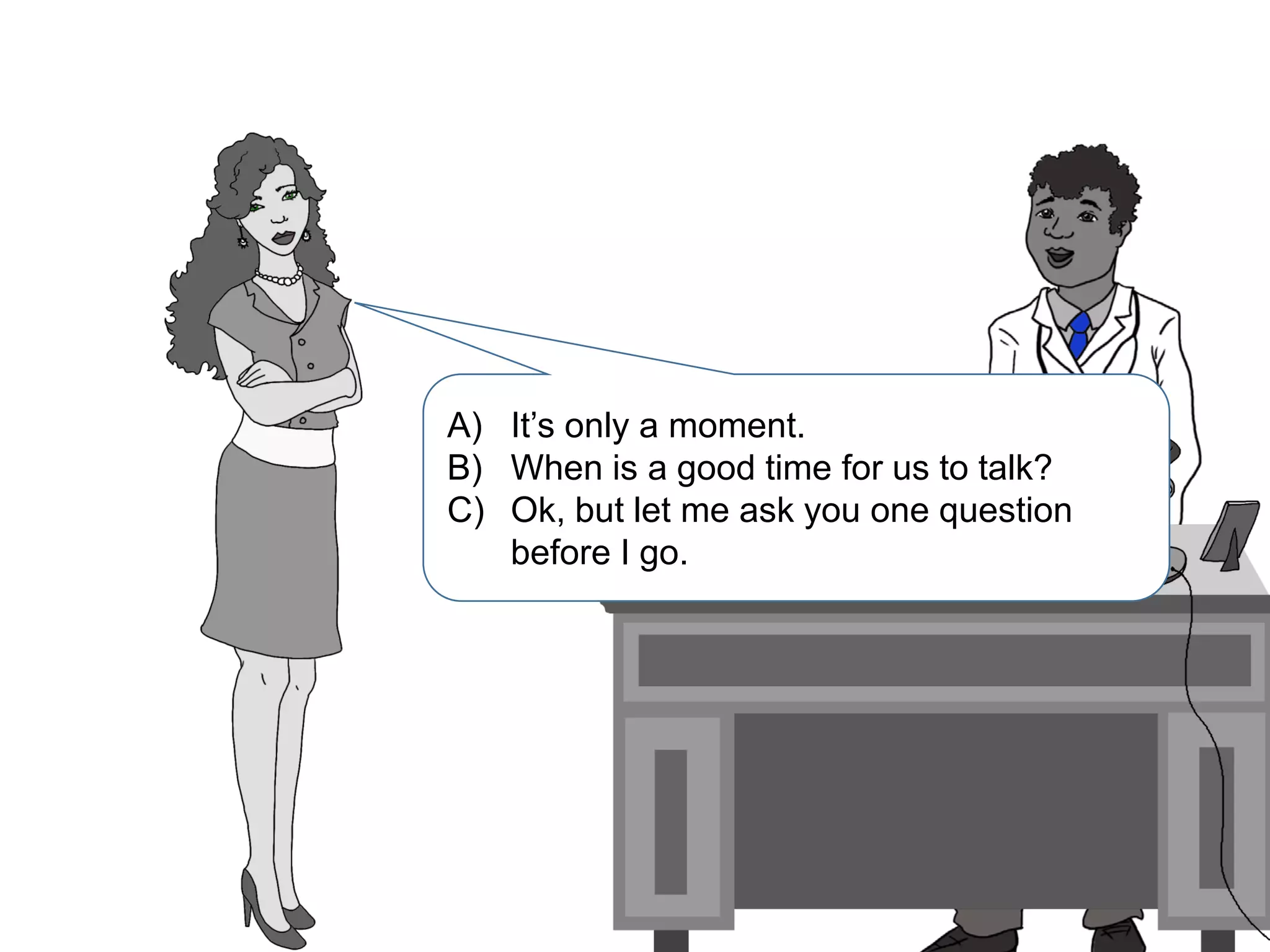
Can I have a moment
of your time?
Well, I am busy…
A) It’s only a moment.
B) When is a good time for us to talk?
C) Ok, but let me ask you one question
before I go.
Questions?
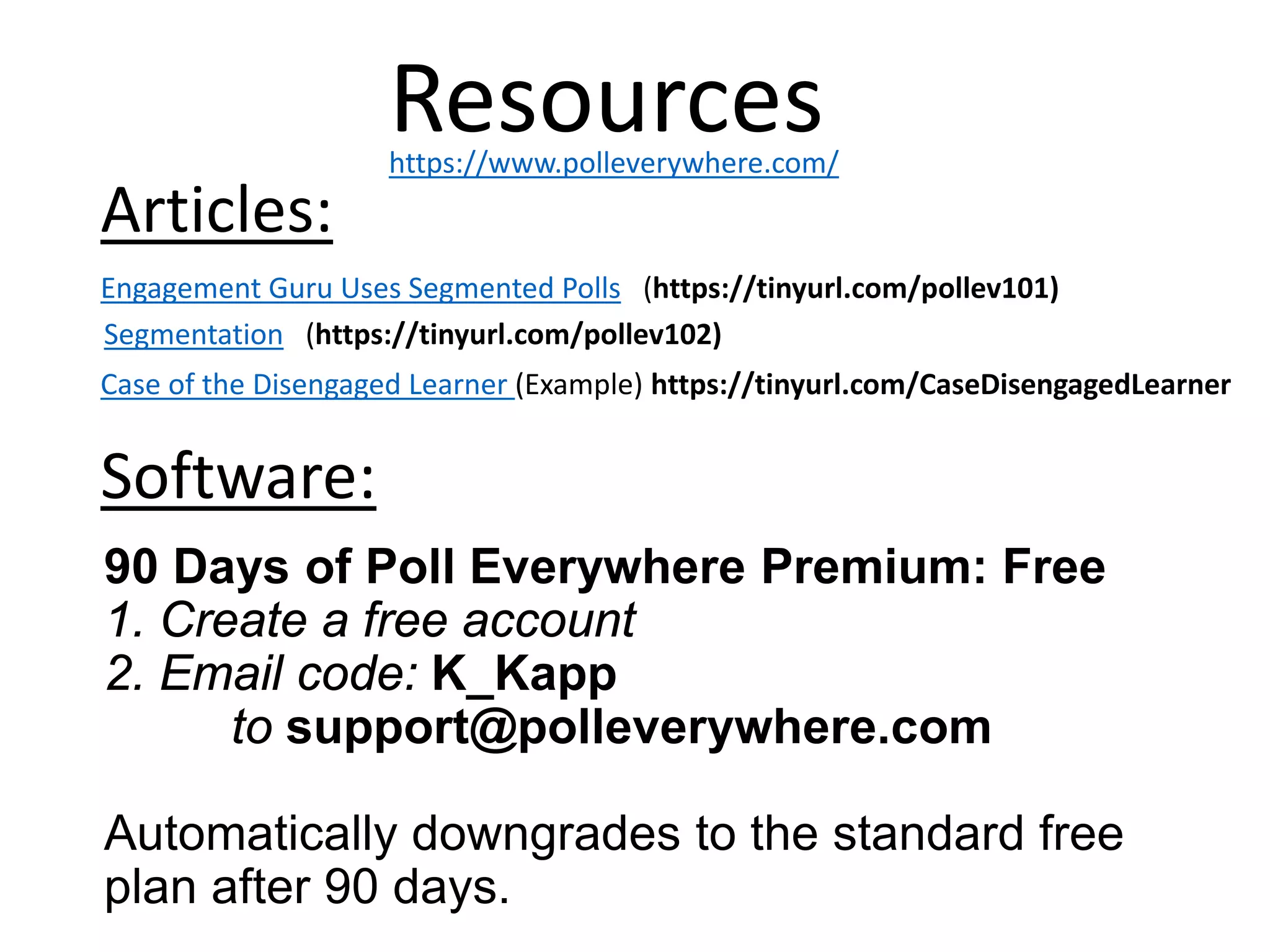
90 Days of Poll Everywhere Premium: Free
1. Create a free account
2. Email code: K_Kapp
to support@polleverywhere.com
Automatically downgrades to the standard free
plan after 90 days.
Resources
Engagement Guru Uses Segmented Polls (https://tinyurl.com/pollev101)
Articles:
Segmentation (https://tinyurl.com/pollev102)
Software:
https://www.polleverywhere.com/
Case of the Disengaged Learner (Example) https://tinyurl.com/CaseDisengagedLearner
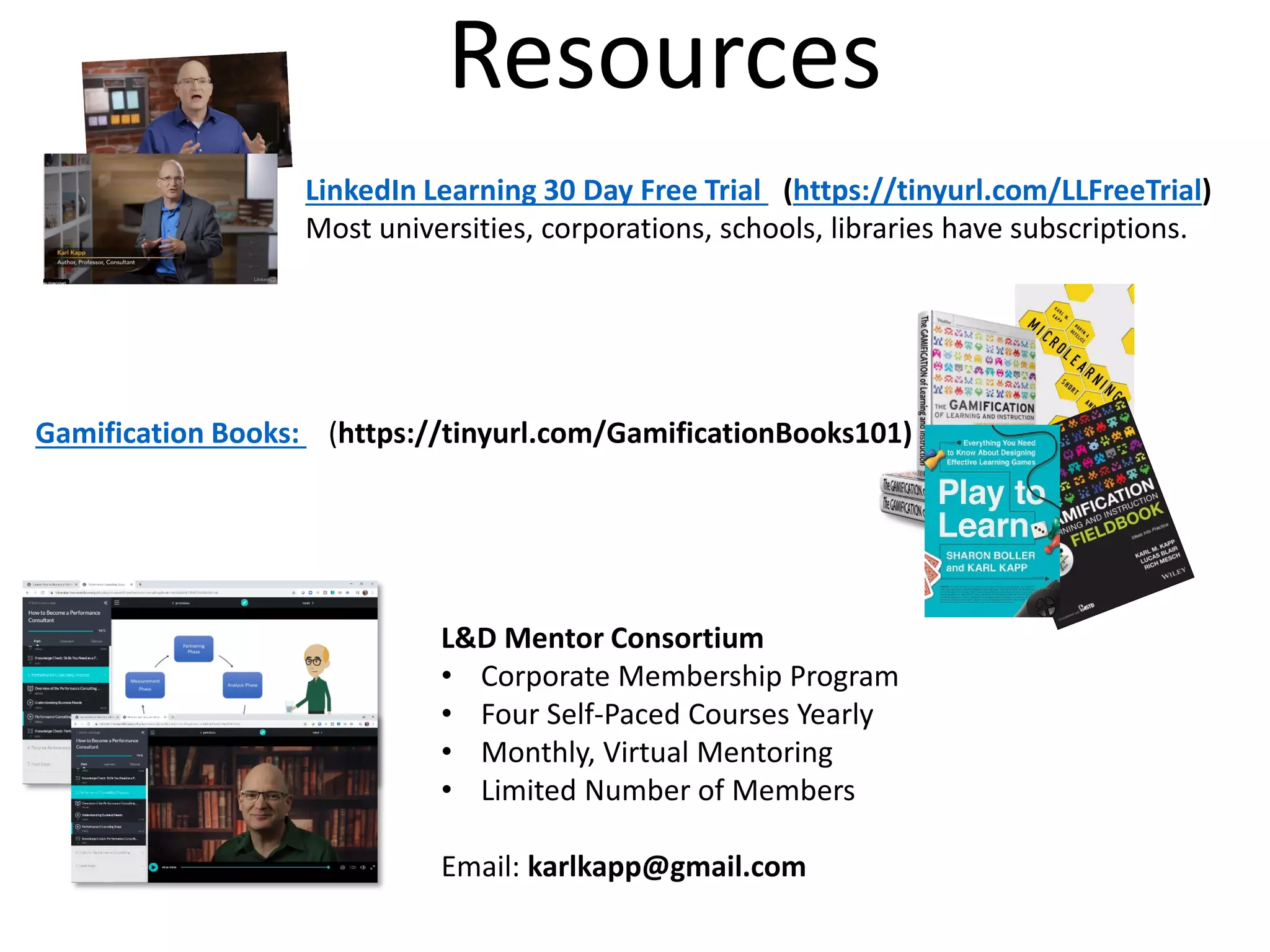
Resources
LinkedIn Learning 30 Day Free Trial (https://tinyurl.com/LLFreeTrial)
Most universities, corporations, schools, libraries have subscriptions.
Gamification Books: (https://tinyurl.com/GamificationBooks101)
L&D Mentor Consortium
• Corporate Membership Program
• Four Self-Paced Courses Yearly
• Monthly, Virtual Mentoring
• Limited Number of Members
Email: karlkapp@gmail.com
Questions?
CEO of Xvoyant
Linkedin page: robjeppsen/
Twitter ID: @robjeppsen
Email: Rob@Xvoyant.com
Website: xvoyant.com
Rob Jeppsen
Speaker:
Professor of Instructional Technology, Bloomsburg
University
LinkedIn page: karlkapp/
Twitter ID: @kkapp
Email: karlkapp@gmail.com
Website: karlkapp.com
Karl Kapp

Stop Thinking Like an Instructional Designer, Start Thinking Like a Game Designer

  • 1.
    Stop Thinking Likean Instructional Designer, Start Thinking Like a Game Designer Joe Caprio Speaker: TO USE YOUR COMPUTER'S AUDIO: When the webinar begins, you will be connected to audio using your computer's microphone and speakers (VoIP). A headset is recommended. Webinar will begin: 12:30 PM, PST TO USE YOUR TELEPHONE: If you prefer to use your phone, you must select "Use Telephone" after joining the webinar and call in using the numbers below. United States: +1 (914) 614-3221 Access Code: 791-725-930 Audio PIN: Shown after joining the webinar --OR-- Building Learner Engagement Rob Jeppsen Speaker: Naba Ahmed Moderator: Karl Kapp Speaker:
  • 2.
    Designing Digitally analyzesyour learning and development programs to discover pain points and knowledge gaps, and then designs customized strategies that will empower employees and allow you to meet set business objectives. Whether you are looking for training to support a major initiative, need general employee development courses, or just want to revamp your existing efforts, they are here to help you succeed and become the company you want to be.
  • 3.
    3 Building Learner Engagement Click onthe Questions panel to interact with the presenters https://www.elearninglearning.com/webinar-series/building-learner-engagement/
  • 4.
    About Rob Jeppsen With23 years of direct sales and sales leadership, Rob has successful experience in every part of the sales process. Rob is the Founder and CEO of Xvoyant, a Sales Leadership Technology Platform committed to helping organizations develop world-class sales leaders. Xvoyant’s technology drives transformation across sales teams by powering 1:1 meetings with sales leaders and salespeople. Xvoyant creates alignment between Sales Leaders and Salespeople to create measurable improvement in revenue while reducing administrative burden. Xvoyant services thousands of managers in 62 countries around the world and recently was recognized with the Gold Stevie® Award for Sales Technology Partner of the Year. About Joe Caprio Joe is the VP Sales of Chorus.ai. Prior to joining Chorus, Joe was a Chorus customer while leading the sales team at InsightSquared. His focus was on scaling and enabling rapid growth sales teams. His experience with conversation intelligence and experience in sales enablement created a perfect match of a tactical practitioner with executive experience and insights. Joe’s background is in training and development. He has a passion for hiring and training customer facing reps. He loves to share best practices, learn from his customers, and distill down really powerful programs for his own team and his customers’ teams as well. Stop Thinking Like an Instructional Designer, Start Thinking Like a Game Designer About Karl Kapp Dr. Karl Kapp is a professor of instructional technology at Bloomsburg University in Bloomsburg, PA. Karl has written eight books on the convergence of learning, technology and business with a focus on games, gamification and interactive learning including his latest co-authored with Robyn Defelice called “Microlearning:Short and Sweet.” He works all over the world helping organizations deliver impactful, meaningful instruction using a game-thinking approach with Fortune 500 companies as well as startup organizations. He has been a TEDx speaker, a keynote at many industry events and is author of several LinkedIn Learning courses. Karl was named one of LinkedIn’s 2017 Top Voices in Education, is an eLearning Guild Guildmaster and received the ATD Individual Contributor Award in 2019. Karl leads a member-only consortium called L&D Mentor—contact him for more information on that exciting offering. About Naba Ahmed Naba went to Cal Poly, San Luis Obispo and majored in Journalism and minored in Integrated Marketing Communications. After working as Editor in Chief at the campus newspaper, she became interested in developing content across multiple platforms, and now works as a Content Marketing Specialist at Aggregage, providing some of the most interesting thought leaders across a wide variety of industries with a space to celebrate the diversity, depth, and experience of their professional cultures, personalities, and passions.
  • 5.
    Stop Thinking Likean Instructional Designer: Start Thinking Like a Game Designer Twitter:@kkapp By Karl M. Kapp Bloomsburg University
  • 6.
    How can youcreate engaging instruction using game elements without creating a game? How can you apply methods for thinking activity first, content second? How do game designers engage players and immerse them in the game environment? Questions to Consider LinkedIn page: karlkapp/ Twitter ID: @kkapp Email: karlkapp@gmail.com Website: karlkapp.com
  • 7.
  • 9.
    You are agame designer at SuperGame Corporation which has hit some hard times lately.
  • 10.
    It’s Friday 4:59PM you and your colleague have only one thing on your mind.
  • 11.
    Suddenly, your bosscalls you and your colleague into her office. Ito and Jasmine come into my office.
  • 12.
  • 13.
    Look, someone wants usto create a game about capturing dragons.
  • 14.
    It appears tobe a craze or something.
  • 15.
  • 16.
    You are competinginternally for the project. Winning team earns the right to work on the project.
  • 17.
    Each team willbe confronted with a series of questions. The team that correctly answers the most questions wins the work.
  • 18.
    What about theother team?
  • 19.
    Losers are assignedto the game “watching paint dry.”
  • 20.
    Wow, I heardabout that project, its almost as fun as… never mind. Dragon Capturing is much better.
  • 21.
    Get it together. Nowlet’s hear about the dragon capturing game.
  • 22.
    First we needto pick teams.
  • 23.
  • 24.
    Two Teams Moxie Zest OpenInternet browser in separate window or on mobile phone. Pollev.com/karlkapp.
  • 25.
    Our first decisionabout this dragon capturing game is how to start the game. What should the player’s first in-game experience be?
  • 26.
    You have twochoices: Tell the player three things they need to know about capturing dragons. or Begin with by having the player start capturing dragons right away.
  • 27.
    Why does thisanswer make sense? Not Sure?
  • 28.
    Good game designersknow that games are engaging because they require action right away. Action draws in the player and encourages further engagement. Start by capturing a dragon.
  • 29.
    Too often instructionaldesign is about the content and not about the actions that need to occur. Game Design is about action.
  • 30.
    Research indicates thatlearners who used interactive games for learning had greater cognitive gains over learners provided with traditional classroom training. Vogel, J. J., Vogel D.S., Cannon-Bowers, J., Bowers, C.A., Muse, K., & Wright, M. (2006). Computer gaming and Interactive simulations for learning: A meta-analysis. Journal of Educational Computing Research, 34(3), 229-243.
  • 31.
    Solve a mystery. Makethe learners do something. Answer a question. Work a problem. Make a decision. Escape a room. Play a game. Take a quiz.
  • 32.
    Here is aquizing example, half of a group of students had to re-read content, half had to answer quiz questions after only seeing the content for 4 minutes. Wiklund-Hörnqvist, C., Jonsson, B., & Nyberg, L. (2014). Strengthening concept learning by repeated testing. Scandinavian Journal of Psychology, 55(1), 10–16. http://doi.org/10.1111/sjop.12093
  • 33.
    Participants who hadbeen tested (rather than re-reading the material) outperformed the other students. Wiklund-Hörnqvist, C., Jonsson, B., & Nyberg, L. (2014). Strengthening concept learning by repeated testing. Scandinavian Journal of Psychology, 55(1), 10–16. http://doi.org/10.1111/sjop.12093
  • 34.
    Ok, next decision. Providea map with the location of all the dragons. or Create a sense of mystery and curiosity concerning the location of dragons.
  • 35.
    It is alwaysa good idea to build curiosity and mystery into a game. Reveal locations of dragons throughout the course of the player’s journey. Check out my notebook on this subject.
  • 38.
    A sense ofsuspense, mystery and intrigue draws people into games and can draw them into learning as well.
  • 39.
    OK, what dowe decide next, should we: Make the game easy so we don’t discourage the players. or Make the game challenging, knowing some players will fail the first few times.
  • 40.
    Jones, B., Valdez,G., Norakowski, J., & Rasmussen, C. (1994). Designing learning and technology for educational reform. North Central Regional Educational Laboratory. [Online]. Available: http://www.ncrtec.org/capacity/profile/profwww.htm and Schlechty, P. C. (1997). Inventing better schools: An action plan for educational reform. San Francisco, CA: Jossey-Bass. Chapter 2 “The Gamification of Learning and Instruction.” It needs to be challenging.
  • 41.
    Look! Good gamesgive players a set of challenging problems and let them solve those problems until they can do it automatically. Then those same games throw a new class of problem at the players requiring them to re- think, their now—taken for granted—mastery. They must learn something new and integrate into their old mastery.
  • 42.
  • 43.
    Actually, my goodfriend James Paul Gee said those words, I’m quoting him.
  • 44.
    Always good tocite sources!
  • 45.
    Also, keep inmind things that are too easy or too difficult will not pique a learner’s interest because they lead to boredom or frustration. Research has shown that challenge is correlated with both intrinsic motivation and motivation related to the desire to seek competence and self confidence. White, R.W. (1959) Motivation reconsidered: The concept of competence. Psychological Review, 66, 297-333.
  • 46.
    In fact, givethem the Kobayashi Maru of challenges.
  • 47.
  • 48.
    Well, the nextdecision, should we: Put the player at risk, they could die at any moment. or Let the player safely explore the environment.
  • 49.
    Seriously, you areasking me this question. The player needs to be at risk.
  • 50.
    No risk, ordanger equal no skin in the game. Get the player emotionally involved by putting him or her at “mock” risk.
  • 51.
    In games, failingis allowed, it’s acceptable, and it’s part of the process. Games accommodate failure with multiple lives, second chances and alternative methods of success.
  • 52.
    Research indicates thatour brains grow when we make a mistake because it is a time of struggle. Moser, J. Schroder, H.S., Heeter, C., C., Moran, T.P., & Lee, Y.H. (2011) Mind your errors: Evidence for a neural mechanism linking growth mindset to adaptive post error adjustments. Psychological Science, 22, 1284-1489. Our brains react with greater electrical activity when we make a mistake than when we are correct.
  • 53.
    Do you punishfailure in your learning design or do you allow and encourage the freedom to fail?
  • 54.
    Lot of information,thanks. So let me ask one more question.
  • 55.
    Which team getsto design “Dragónmon Go”? Which team won?
  • 56.
    Well, they areall winners to me.
  • 57.
  • 58.
  • 59.
    Here are fivetips for thinking like a game designer: 1) Begin with activity 2) Create curiosity, mystery, intrigue 3) Create a challenge for the learner 4) Put learners at “mock” risk— encourage mistakes 5) Give learners meaningful choices
  • 60.
    What game elements werein this presentation?
  • 61.
    1) Story 2) Character 3)Competition/teams 4) Real-time feedback 5) Meaningful Decision making 6) Uncertain ending 7) Allowing failure 8) Uncertainty
  • 62.
  • 63.
    You can usemore realistic settings for storytelling.
  • 64.
    Can I havea moment of your time?
  • 65.
    Well, I ambusy…
  • 66.
    A) It’s onlya moment. B) When is a good time for us to talk? C) Ok, but let me ask you one question before I go.
  • 67.
  • 68.
    90 Days ofPoll Everywhere Premium: Free 1. Create a free account 2. Email code: K_Kapp to support@polleverywhere.com Automatically downgrades to the standard free plan after 90 days. Resources Engagement Guru Uses Segmented Polls (https://tinyurl.com/pollev101) Articles: Segmentation (https://tinyurl.com/pollev102) Software: https://www.polleverywhere.com/ Case of the Disengaged Learner (Example) https://tinyurl.com/CaseDisengagedLearner
  • 69.
    Resources LinkedIn Learning 30Day Free Trial (https://tinyurl.com/LLFreeTrial) Most universities, corporations, schools, libraries have subscriptions. Gamification Books: (https://tinyurl.com/GamificationBooks101) L&D Mentor Consortium • Corporate Membership Program • Four Self-Paced Courses Yearly • Monthly, Virtual Mentoring • Limited Number of Members Email: karlkapp@gmail.com
  • 70.
    Questions? CEO of Xvoyant Linkedinpage: robjeppsen/ Twitter ID: @robjeppsen Email: Rob@Xvoyant.com Website: xvoyant.com Rob Jeppsen Speaker: Professor of Instructional Technology, Bloomsburg University LinkedIn page: karlkapp/ Twitter ID: @kkapp Email: karlkapp@gmail.com Website: karlkapp.com Karl Kapp