Sabrin Baydoun 17198963 
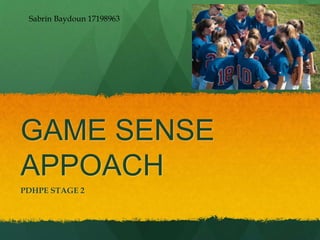
GAME SENSE 
APPOACH 
PDHPE STAGE 2
What is Game Sense? 
 As explained in Richard Light’s Book 
‘Game Sense’ (2013), this approach 
is necessary for coaching and 
teaching physical education. 
 Focuses on the game as the centre 
of the lesson. 
 Encourages skills found across 
different sports and physical 
activities, develops tactical 
performance. 
 “Teaching games for Understanding”
What does Game Sense 
involve? 
• Simply put, Game sense involves “designing a game or a 
sequence of games to achieve particular outcomes, asking 
questions to stimulate thinking and reflection, and ensuring that 
there are opportunities for group discussion, collaboration and the 
formulation of ideas/solutions that are tested and evaluated.” 
(Light 2013 p.48) 
• Game sense encourages teachers to view the lesson as a 
constructive approach, where teachers focus on learning rather 
than teaching to enhance the learning experience.
“Play with Purpose” 
 According to Pill (2012) Game sense develops 
tactical and strategic planning skills, which are 
necessary when playing sports. 
 Challenges traditional ideas where chiefly teaching 
the skill is important, to encouraging player 
participation, collaboration and decision making , 
which will result in teaching direct instructional 
strategies for the particular game being played. (Pill, 
2012)
Types of Games 
 Game Sense categorizes games into four categories. Each 
category has common principles within the games. The four 
categories are: 
1. Invasion Games e.g. Soccer, Netball, Oztag 
2. Target Games e.g. Golf, Archery, Bowls 
3. Court and Net Games e.g. Volleyball, Tennis, Badminton 
4. Striking and Fielding Games e.g. Cricket, Softball, Baseball
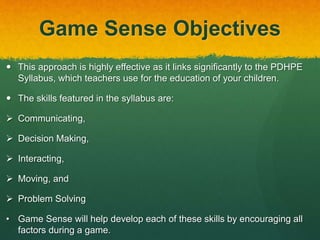
Game Sense Objectives 
 This approach is highly effective as it links significantly to the PDHPE 
Syllabus, which teachers use for the education of your children. 
 The skills featured in the syllabus are: 
 Communicating, 
 Decision Making, 
 Interacting, 
 Moving, and 
 Problem Solving 
• Game Sense will help develop each of these skills by encouraging all 
factors during a game.
Why Game Sense? 
 The Game Sense approach is a great approach for 
teaching PDHPE, as it enhances learning and thinking 
through fun and games. 
 The approach motivates children to participate in both 
physical and educational learning experiences. 
 Game sense allows teachers to coach the children using 
a variety of strategies to develop particular skills and 
create collaboration between the class. 
 Game sense allows learners to engage in decision 
making skills, which are necessary for future educational 
and physical experiences .
PDHPE RESOURCES 
 For further information on the PDHPE syllabus 
outcomes, and to access the syllabus itself, visit the 
NSW Board of Studies Website. 
 The link below will direct you to the K-6 PDHPE 
Syllabus: 
 http://k6.boardofstudies.nsw.edu.au/wps/portal/go/p 
ersonal-development-health-and-physical-education- 
pdhpe

Game sense presentation

  • 1.
    Sabrin Baydoun 17198963 GAME SENSE APPOACH PDHPE STAGE 2
  • 2.
    What is GameSense?  As explained in Richard Light’s Book ‘Game Sense’ (2013), this approach is necessary for coaching and teaching physical education.  Focuses on the game as the centre of the lesson.  Encourages skills found across different sports and physical activities, develops tactical performance.  “Teaching games for Understanding”
  • 3.
    What does GameSense involve? • Simply put, Game sense involves “designing a game or a sequence of games to achieve particular outcomes, asking questions to stimulate thinking and reflection, and ensuring that there are opportunities for group discussion, collaboration and the formulation of ideas/solutions that are tested and evaluated.” (Light 2013 p.48) • Game sense encourages teachers to view the lesson as a constructive approach, where teachers focus on learning rather than teaching to enhance the learning experience.
  • 4.
    “Play with Purpose”  According to Pill (2012) Game sense develops tactical and strategic planning skills, which are necessary when playing sports.  Challenges traditional ideas where chiefly teaching the skill is important, to encouraging player participation, collaboration and decision making , which will result in teaching direct instructional strategies for the particular game being played. (Pill, 2012)
  • 5.
    Types of Games  Game Sense categorizes games into four categories. Each category has common principles within the games. The four categories are: 1. Invasion Games e.g. Soccer, Netball, Oztag 2. Target Games e.g. Golf, Archery, Bowls 3. Court and Net Games e.g. Volleyball, Tennis, Badminton 4. Striking and Fielding Games e.g. Cricket, Softball, Baseball
  • 6.
    Game Sense Objectives  This approach is highly effective as it links significantly to the PDHPE Syllabus, which teachers use for the education of your children.  The skills featured in the syllabus are:  Communicating,  Decision Making,  Interacting,  Moving, and  Problem Solving • Game Sense will help develop each of these skills by encouraging all factors during a game.
  • 7.
    Why Game Sense?  The Game Sense approach is a great approach for teaching PDHPE, as it enhances learning and thinking through fun and games.  The approach motivates children to participate in both physical and educational learning experiences.  Game sense allows teachers to coach the children using a variety of strategies to develop particular skills and create collaboration between the class.  Game sense allows learners to engage in decision making skills, which are necessary for future educational and physical experiences .
  • 8.
    PDHPE RESOURCES For further information on the PDHPE syllabus outcomes, and to access the syllabus itself, visit the NSW Board of Studies Website.  The link below will direct you to the K-6 PDHPE Syllabus:  http://k6.boardofstudies.nsw.edu.au/wps/portal/go/p ersonal-development-health-and-physical-education- pdhpe