Game Sense
approach
Miss Wendy Ly | 6L
Disclaimer: Images are taken from google.
◦ It’s a student-centred, constructivist approach.
◦ This is where inquiry-based learning is consistent throughout our PDHPE lesson.
◦ Skills are still going to be developed in students, however, it’s all going to be
practising skills in a game context, rather than practising specific skills such as
dribbling or shooting in isolation.
◦ In the Game Sense approach, games are modified to cater to students and
the purpose of the lesson.
◦ Hence, students are developing their understanding of the game, rather than
specific skills.
◦ Over time, the games are modified and sequenced to gradually increase in
complexity.
(Light, Curry, & Mooney, 2014)
Goal: to create a learning environment that
is fun, positive, inclusive and comfortable.
The Game Sense approach is
learning through playing games.
All about Game
Sense
◦ Instead of loading students with instructions, inquiry questioning is used.
◦ Therefore, teachers take a passive role and act as the facilitators of the game. It’s through the
inquiry questions that encourage students to problem solve, investigate, explore, and participate in
decision making. This process is known as a student-oriented learning approach.
◦ Woolfolk and Margetts (2018) demonstrate the benefits of implementing this approach in the
classroom to optimise student learning. Students taking the active position in their learning allows
for increased engagement through exploring through their investigations and understanding.
◦ Furthermore, van Uum, Peeters, and Verhoeff (2019) emphasise that open-ended discussions
increase student engagement as they’re taking the active role in their learning. Open-ended
discussions encourage students to think tactically, deepening their overall learning and
understanding.
Game Sense
Students are in charge
of their own learning!
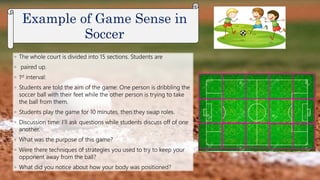
◦ The whole court is divided into 15 sections. Students are
◦ paired up.
◦ 1st interval:
◦ Students are told the aim of the game: One person is dribbling the
soccer ball with their feet while the other person is trying to take
the ball from them.
◦ Students play the game for 10 minutes, then they swap roles.
◦ Discussion time: I’ll ask questions while students discuss off of one
another.
◦ What was the purpose of this game?
◦ Were there techniques of strategies you used to try to keep your
opponent away from the ball?
◦ What did you notice about how your body was positioned?
Example of Game Sense in
Soccer
Benefits
Decreases anxiety,
embarrassment, exclusion, and
disengagement.
Increases motivation
All students are
participating at a time.
Increases students’
confidence.
Inclusive
◦ PDHPE is a very crucial component in children’s education. The PDHPE curriculum aims to provide students
with the understanding, knowledge, attitudes, and skills to make their own informed decisions and actions
towards their health, safety and wellbeing (NESA, 2018). Therefore, PDHPE holds great potential to optimise
student learning.
◦ To optimise student learning, I will incorporate PDHPE into various key learning areas such as Mathematics
and English. Morgan (2008) describes the injustice PDHPE faces in regards to its dedicated time per teaching
week allocated (NESA, 2018). This may result in many teachers and students viewing PDHPE as insignificant.
Therefore, through integration, students will not be deprived of the subject and deepen their understanding.
Morgan (2008) emphasises the benefits of this as it allows students thinking and inquiring at a deeper level
and understanding.
◦ Furthermore, with the implementation of Game Sense, character strengths such as creativity, curiosity, zest,
fairness, and love of learning will also be strengthened. Peterson and Seligman (2004) outline the value and
benefits of building onto children’s character strengths to optimise their learning. These character strengths
are already natural in children, therefore building from them will allow transformative learning for life.
My rationale
◦ I am implementing into our class because it optimises student learning through providing a safe,
fair, positive, and inclusive learning environment.
◦ It allows students to practice and develop their fundamental movement skills through playing
games.
◦ Games are modified to fit students’ learning needs and levels. This ensures that all students of all
different ability levels can benefit from Game Sense and develop their skills.
◦ The game sense approach allows for structuring and scaffolding the games played. This allows me
to as a teacher to stop the games at specific intervals to encourage reflection and discussion
through inquiry questioning.
◦ Furthermore, implementing the Game Sense approach will allow me to
cover the specific content and outcomes of the NESA PDHPE
Syllabus (NESA, 2018).
Implementing Game Sense into 6L
◦ ACARA. (2019). Fundamental movement skills. Retrieved from https://www.australiancurriculum.edu.au/f-10-
curriculum/health-and-physical-education/Glossary/?term=fundamental+movement+skills
◦ Light, R., Curry, C., & Mooney, A. (2014). Game sense as a model for delivering quality teaching in physical
education. Asia-Pacific Journal of Health, Sport and Physical Education, 5(1), 67-81. doi
10.1080/18377122.2014.868291
◦ Margetts, K. & Woolfolk, A. (2018). Educational Psychology. Australia: Pearson.
◦ Morgan, P. (2008). Teacher Perceptions of Physical Education in the Primary School: Attitudes, Values and
Curriculum Preferences. Physical Educator, 65(1), 46-56. Retrieved from https://search-proquest-
com.ezproxy.uws.edu.au/docview/232998916?accountid=36155&rfr_id=info%3Axri%2Fsid%3Aprimo
◦ NESA. (2018). Personal development, health and physical education K-10 Syllabus. Retrieved from
https://educationstandards.nsw.edu.au/wps/portal/nesa/k-10/learning-areas/pdhpe/pdhpe-k-10-2018
◦ Peterson, C. & Seligman, M. E. P. (2004). Character strengths and virtues: A handbook and classification.
Washington, DC: American Psychological Association.
◦ Van Uum, M.S.J., Peeters, M. & Verhoeff. (2019) Professionalising primary school teachers in guiding inquire-based
learning. Research in Science Education, 1-28. Retrieved from https://doi-org.ezproxy.uws.edu.au/10.1007/s11165-
019-9818-z
References
References

Game Sense

  • 1.
    Game Sense approach Miss WendyLy | 6L Disclaimer: Images are taken from google.
  • 2.
    ◦ It’s astudent-centred, constructivist approach. ◦ This is where inquiry-based learning is consistent throughout our PDHPE lesson. ◦ Skills are still going to be developed in students, however, it’s all going to be practising skills in a game context, rather than practising specific skills such as dribbling or shooting in isolation. ◦ In the Game Sense approach, games are modified to cater to students and the purpose of the lesson. ◦ Hence, students are developing their understanding of the game, rather than specific skills. ◦ Over time, the games are modified and sequenced to gradually increase in complexity. (Light, Curry, & Mooney, 2014) Goal: to create a learning environment that is fun, positive, inclusive and comfortable. The Game Sense approach is learning through playing games. All about Game Sense
  • 3.
    ◦ Instead ofloading students with instructions, inquiry questioning is used. ◦ Therefore, teachers take a passive role and act as the facilitators of the game. It’s through the inquiry questions that encourage students to problem solve, investigate, explore, and participate in decision making. This process is known as a student-oriented learning approach. ◦ Woolfolk and Margetts (2018) demonstrate the benefits of implementing this approach in the classroom to optimise student learning. Students taking the active position in their learning allows for increased engagement through exploring through their investigations and understanding. ◦ Furthermore, van Uum, Peeters, and Verhoeff (2019) emphasise that open-ended discussions increase student engagement as they’re taking the active role in their learning. Open-ended discussions encourage students to think tactically, deepening their overall learning and understanding. Game Sense Students are in charge of their own learning!
  • 4.
    ◦ The wholecourt is divided into 15 sections. Students are ◦ paired up. ◦ 1st interval: ◦ Students are told the aim of the game: One person is dribbling the soccer ball with their feet while the other person is trying to take the ball from them. ◦ Students play the game for 10 minutes, then they swap roles. ◦ Discussion time: I’ll ask questions while students discuss off of one another. ◦ What was the purpose of this game? ◦ Were there techniques of strategies you used to try to keep your opponent away from the ball? ◦ What did you notice about how your body was positioned? Example of Game Sense in Soccer
  • 5.
    Benefits Decreases anxiety, embarrassment, exclusion,and disengagement. Increases motivation All students are participating at a time. Increases students’ confidence. Inclusive
  • 6.
    ◦ PDHPE isa very crucial component in children’s education. The PDHPE curriculum aims to provide students with the understanding, knowledge, attitudes, and skills to make their own informed decisions and actions towards their health, safety and wellbeing (NESA, 2018). Therefore, PDHPE holds great potential to optimise student learning. ◦ To optimise student learning, I will incorporate PDHPE into various key learning areas such as Mathematics and English. Morgan (2008) describes the injustice PDHPE faces in regards to its dedicated time per teaching week allocated (NESA, 2018). This may result in many teachers and students viewing PDHPE as insignificant. Therefore, through integration, students will not be deprived of the subject and deepen their understanding. Morgan (2008) emphasises the benefits of this as it allows students thinking and inquiring at a deeper level and understanding. ◦ Furthermore, with the implementation of Game Sense, character strengths such as creativity, curiosity, zest, fairness, and love of learning will also be strengthened. Peterson and Seligman (2004) outline the value and benefits of building onto children’s character strengths to optimise their learning. These character strengths are already natural in children, therefore building from them will allow transformative learning for life. My rationale
  • 7.
    ◦ I amimplementing into our class because it optimises student learning through providing a safe, fair, positive, and inclusive learning environment. ◦ It allows students to practice and develop their fundamental movement skills through playing games. ◦ Games are modified to fit students’ learning needs and levels. This ensures that all students of all different ability levels can benefit from Game Sense and develop their skills. ◦ The game sense approach allows for structuring and scaffolding the games played. This allows me to as a teacher to stop the games at specific intervals to encourage reflection and discussion through inquiry questioning. ◦ Furthermore, implementing the Game Sense approach will allow me to cover the specific content and outcomes of the NESA PDHPE Syllabus (NESA, 2018). Implementing Game Sense into 6L
  • 8.
    ◦ ACARA. (2019).Fundamental movement skills. Retrieved from https://www.australiancurriculum.edu.au/f-10- curriculum/health-and-physical-education/Glossary/?term=fundamental+movement+skills ◦ Light, R., Curry, C., & Mooney, A. (2014). Game sense as a model for delivering quality teaching in physical education. Asia-Pacific Journal of Health, Sport and Physical Education, 5(1), 67-81. doi 10.1080/18377122.2014.868291 ◦ Margetts, K. & Woolfolk, A. (2018). Educational Psychology. Australia: Pearson. ◦ Morgan, P. (2008). Teacher Perceptions of Physical Education in the Primary School: Attitudes, Values and Curriculum Preferences. Physical Educator, 65(1), 46-56. Retrieved from https://search-proquest- com.ezproxy.uws.edu.au/docview/232998916?accountid=36155&rfr_id=info%3Axri%2Fsid%3Aprimo ◦ NESA. (2018). Personal development, health and physical education K-10 Syllabus. Retrieved from https://educationstandards.nsw.edu.au/wps/portal/nesa/k-10/learning-areas/pdhpe/pdhpe-k-10-2018 ◦ Peterson, C. & Seligman, M. E. P. (2004). Character strengths and virtues: A handbook and classification. Washington, DC: American Psychological Association. ◦ Van Uum, M.S.J., Peeters, M. & Verhoeff. (2019) Professionalising primary school teachers in guiding inquire-based learning. Research in Science Education, 1-28. Retrieved from https://doi-org.ezproxy.uws.edu.au/10.1007/s11165- 019-9818-z References References