GAME SENSE APPROACH 
GUIDE FOR PARENTS 
By Marriam Americanos
WHAT IS A GAME SENSE 
APPROACH? 
 Game Sense was developed in Australia in the mid 1990s and is categorized 
under the teaching games for understanding model (Pill, 2012). 
 The purpose of Games Sense is to to play a game first and then skill 
development will occur subsequently, after players have a greater 
understanding of the game itself. The game is the focus of the lesson, rather 
then the execution of skills, as players are given the opportunity to discover 
what specific skills are needed to achieve results. (Pill, 2012). 
 A Game Sense Approach is quite different to the traditional way of teaching 
games, as there is less emphasis placed on mastering technique and more 
emphasis placed on playing and understanding the game (Light, 2012).
Generally, teachers that use a game sense approach start with simple games and 
activities and progressively build upon these games by adding more variations, in 
turn making them more challenging (Light, 2012). 
An essential component of Game Sense is the posing of questions by the teacher 
after the game/activity has finished, such as: 
 Where were the best places to run to receive the ball? 
 What made it difficult to receive the ball? 
 How did you overcome these challenges? What did you do? 
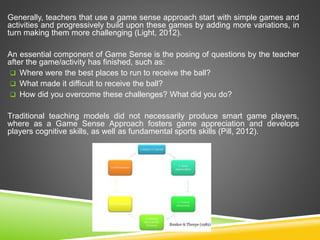
Traditional teaching models did not necessarily produce smart game players, 
where as a Game Sense Approach fosters game appreciation and develops 
players cognitive skills, as well as fundamental sports skills (Pill, 2012).
FOUR GAME SENSE CATEGORIES 
The Game Sense approach categorizes team games into 4 areas: 
 Target; golf, archery, darts, bocce 
 Striking (or fielding); baseball, cricket, softball 
 Net and Wall; volleyball, tennis, badminton 
 Invasion (or territory); football, soccer, hockey, netball
RATIONALE & DISCUSSION 
 What are the benefits of Game Sense for my child? 
 What would Game Sense look like in a PDHPE lesson? 
 How is Game Sense related to the syllabus?
WHAT ARE THE BENEFITS OF 
GAME SENSE FOR MY CHILD? 
 Engaging and appealing way for students to develop their cognitive skills 
and fundamental movement skills, whilst simply ‘playing’ a game. 
 Employs a questioning component, rather then a feedback component, 
allowing students to identify what worked well for them in the game and 
what they could improve on, ultimately encouraging self reflection and 
critical thinking. 
 Provides students with the opportunity to take control over their learning, 
which often leads to more meaningful learning. This is also referred to as 
a learner centered approach. 
 Players acquire cognitive skills that are transferable into real life settings, 
such as decision making, teamwork and strategizing.
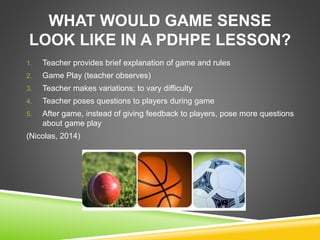
WHAT WOULD GAME SENSE 
LOOK LIKE IN A PDHPE LESSON? 
1. Teacher provides brief explanation of game and rules 
2. Game Play (teacher observes) 
3. Teacher makes variations; to vary difficulty 
4. Teacher poses questions to players during game 
5. After game, instead of giving feedback to players, pose more questions 
about game play 
(Nicolas, 2014)
HOW IS GAME SENSE RELATED 
TO THE SYLLABUS? 
Students will build upon all 5 skills outcomes outlined in the PDHPE 
Syllabus for Stage 2 (Year 3-4): 
 Communicating (COS2.1)- Students will be encouraged to participate in 
class discussions about their involvement in the games. 
 Decision Making (DMS2.2)- Students will be provided with the 
opportunity to make their own decisions regarding game play, and will 
learn how to make decisions within a group. 
 Interacting (INS2.3)- Students will be exposed to interactive activities 
where they will need to demonstrate tolerance of students with ranging 
physical abilities and social interaction skills. 
 Moving (MOS2.4)- Students will demonstrate an ability to execute a 
variety of fundamental movements to familiar and new games. 
 Problem Solving (PSS2.5)- Students will be encouraged to use a range 
of problem solving strategies during the game and after the game, during 
the questioning component. The teacher will pose questions to the class, 
to trigger students to problem solve.
REFERENCES 
Light, R. (2012). Games Sense: Pedagogy for Performance, Participation and Enjoyment. Retrieved from 
http://www.eblib.com. 
Nicolas, R. (2014). The Skill Based Approach vs. The Game Sense Approach. Retrieved from 
http://www.rogettenicolas.com/reflective-blogs 
NSW Board of Studies. (2007). Personal Development, Health and Physical Education K-6 Syllabus. Sydney, 
Australia. 
Pill, S. (2012). Teaching Game Sense in Soccer. Journal of Physical Education, Recreation & Dance, 83(3), 42-52. 
doi 10.1080/07303084.2012.10598746

Game Sense Approach

  • 1.
    GAME SENSE APPROACH GUIDE FOR PARENTS By Marriam Americanos
  • 2.
    WHAT IS AGAME SENSE APPROACH?  Game Sense was developed in Australia in the mid 1990s and is categorized under the teaching games for understanding model (Pill, 2012).  The purpose of Games Sense is to to play a game first and then skill development will occur subsequently, after players have a greater understanding of the game itself. The game is the focus of the lesson, rather then the execution of skills, as players are given the opportunity to discover what specific skills are needed to achieve results. (Pill, 2012).  A Game Sense Approach is quite different to the traditional way of teaching games, as there is less emphasis placed on mastering technique and more emphasis placed on playing and understanding the game (Light, 2012).
  • 3.
    Generally, teachers thatuse a game sense approach start with simple games and activities and progressively build upon these games by adding more variations, in turn making them more challenging (Light, 2012). An essential component of Game Sense is the posing of questions by the teacher after the game/activity has finished, such as:  Where were the best places to run to receive the ball?  What made it difficult to receive the ball?  How did you overcome these challenges? What did you do? Traditional teaching models did not necessarily produce smart game players, where as a Game Sense Approach fosters game appreciation and develops players cognitive skills, as well as fundamental sports skills (Pill, 2012).
  • 4.
    FOUR GAME SENSECATEGORIES The Game Sense approach categorizes team games into 4 areas:  Target; golf, archery, darts, bocce  Striking (or fielding); baseball, cricket, softball  Net and Wall; volleyball, tennis, badminton  Invasion (or territory); football, soccer, hockey, netball
  • 5.
    RATIONALE & DISCUSSION  What are the benefits of Game Sense for my child?  What would Game Sense look like in a PDHPE lesson?  How is Game Sense related to the syllabus?
  • 6.
    WHAT ARE THEBENEFITS OF GAME SENSE FOR MY CHILD?  Engaging and appealing way for students to develop their cognitive skills and fundamental movement skills, whilst simply ‘playing’ a game.  Employs a questioning component, rather then a feedback component, allowing students to identify what worked well for them in the game and what they could improve on, ultimately encouraging self reflection and critical thinking.  Provides students with the opportunity to take control over their learning, which often leads to more meaningful learning. This is also referred to as a learner centered approach.  Players acquire cognitive skills that are transferable into real life settings, such as decision making, teamwork and strategizing.
  • 7.
    WHAT WOULD GAMESENSE LOOK LIKE IN A PDHPE LESSON? 1. Teacher provides brief explanation of game and rules 2. Game Play (teacher observes) 3. Teacher makes variations; to vary difficulty 4. Teacher poses questions to players during game 5. After game, instead of giving feedback to players, pose more questions about game play (Nicolas, 2014)
  • 8.
    HOW IS GAMESENSE RELATED TO THE SYLLABUS? Students will build upon all 5 skills outcomes outlined in the PDHPE Syllabus for Stage 2 (Year 3-4):  Communicating (COS2.1)- Students will be encouraged to participate in class discussions about their involvement in the games.  Decision Making (DMS2.2)- Students will be provided with the opportunity to make their own decisions regarding game play, and will learn how to make decisions within a group.  Interacting (INS2.3)- Students will be exposed to interactive activities where they will need to demonstrate tolerance of students with ranging physical abilities and social interaction skills.  Moving (MOS2.4)- Students will demonstrate an ability to execute a variety of fundamental movements to familiar and new games.  Problem Solving (PSS2.5)- Students will be encouraged to use a range of problem solving strategies during the game and after the game, during the questioning component. The teacher will pose questions to the class, to trigger students to problem solve.
  • 9.
    REFERENCES Light, R.(2012). Games Sense: Pedagogy for Performance, Participation and Enjoyment. Retrieved from http://www.eblib.com. Nicolas, R. (2014). The Skill Based Approach vs. The Game Sense Approach. Retrieved from http://www.rogettenicolas.com/reflective-blogs NSW Board of Studies. (2007). Personal Development, Health and Physical Education K-6 Syllabus. Sydney, Australia. Pill, S. (2012). Teaching Game Sense in Soccer. Journal of Physical Education, Recreation & Dance, 83(3), 42-52. doi 10.1080/07303084.2012.10598746