Logic and Critical ThinkingMisleading Uses of Language
4 Categories of Misleading Uses of Language that create “spin” on a message:SlantersWord ChoicesFine PrintEvasionsLanguage that conceals dubious claims.  Replacing words or phrases for emotional affect.Qualifying claims in significant ways.Distancing oneself from the negative.
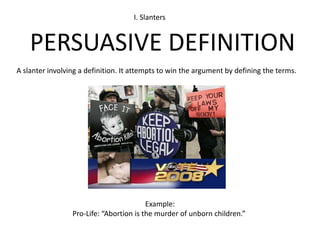
I. SlantersPERSUASIVE DEFINITIONA slanter involving a definition. It attempts to win the argument by defining the terms.Example:Pro-Life: “Abortion is the murder of unborn children.”
LOADED QUESTIONA slanter involving a question. It sets someone up so that no matter how it’s answered, they’re wrong, or guilty.The only way out of a loaded question is to challenge the question itself.Teacher to Student who didn’t do well: “Why didn’t you try on this test?”
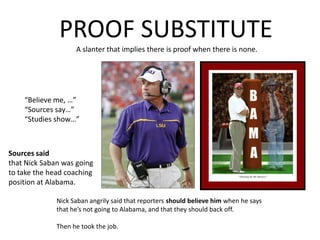
PROOF SUBSTITUTEA slanter that implies there is proof when there is none. “Believe me, …”“Sources say…”“Studies show…”Sources saidthat Nick Saban was goingto take the head coachingposition at Alabama.Nick Saban angrily said that reporters should believe him when he says that he’s not going to Alabama, and that they should back off.Then he took the job.
INNUENDOA slanter that implies criticism without directly saying it.When told that Joe committed the crime, Henry said, “Well he was from Oakland, you know.”
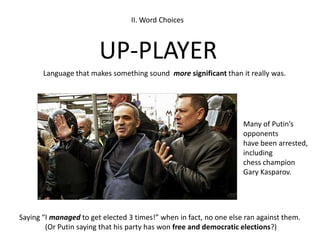
II. Word ChoicesUP-PLAYERLanguage that makes something sound  moresignificant than it really was.Many of Putin’s opponents have been arrested,including chess championGary Kasparov.Saying “I managed to get elected 3 times!” when in fact, no one else ran against them.(Or Putin saying that his party has won free and democratic elections?)
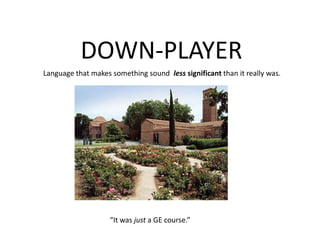
DOWN-PLAYERLanguage that makes something sound  lesssignificant than it really was.“It was just a GE course.”
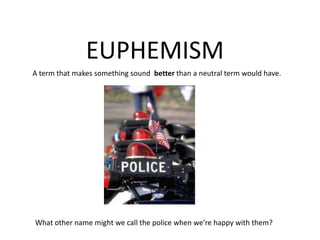
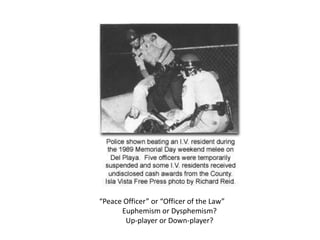
EUPHEMISMA term that makes something sound  better than a neutral term would have.What other name might we call the police when we’re happy with them?
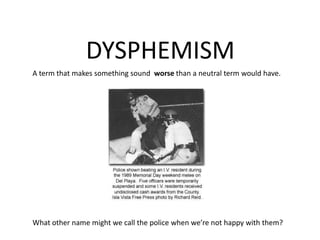
DYSPHEMISMA term that makes something sound  worse than a neutral term would have.What other name might we call the police when we’re not happy with them?
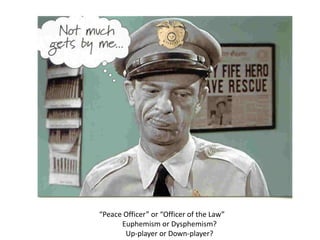
“Peace Officer” or “Officer of the Law”Euphemism or Dysphemism?Up-player or Down-player?
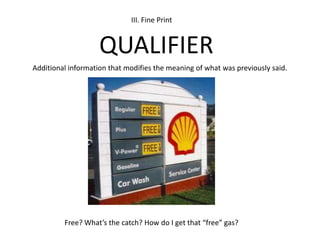
III. Fine PrintQUALIFIERAdditional information that modifies the meaning of what was previously said.Free? What’s the catch? How do I get that “free” gas?
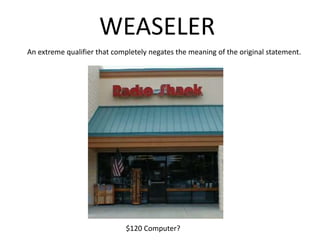
WEASELERAn extreme qualifier that completely negates the meaning of the original statement.$120 Computer?
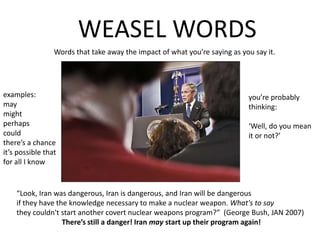
WEASEL WORDSWords that take away the impact of what you’re saying as you say it.examples:maymightperhapscouldthere’s a chance it’s possible thatfor all I knowyou’re probablythinking:‘Well, do you meanit or not?’“Look, Iran was dangerous, Iran is dangerous, and Iran will be dangerous if they have the knowledge necessary to make a nuclear weapon. What's to say they couldn't start another covert nuclear weapons program?”  (George Bush, JAN 2007)There’s still a danger! Iran may start up their program again!
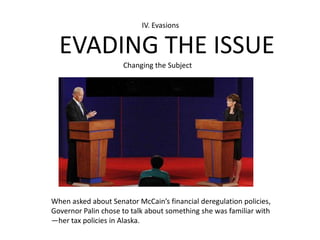
IV. EvasionsEVADING THE ISSUEChanging the SubjectWhen asked about Senator McCain’s financial deregulation policies, Governor Palin chose to talk about something she was familiar with—her tax policies in Alaska.
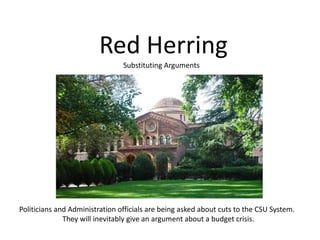
Red HerringSubstituting ArgumentsPoliticians and Administration officials are being asked about cuts to the CSU System.They will inevitably give an argument about a budget crisis.
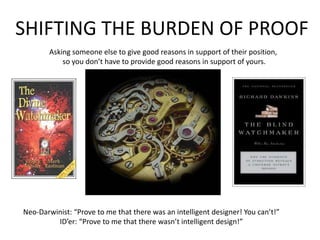
SHIFTING THE BURDEN OF PROOFAsking someone else to give good reasons in support of their position, so you don’t have to provide good reasons in support of yours.Neo-Darwinist: “Prove to me that there was an intelligent designer! You can’t!”ID’er: “Prove to me that there wasn’t intelligent design!”
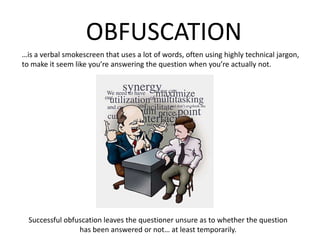
OBFUSCATION…is a verbal smokescreen that uses a lot of words, often using highly technical jargon, to make it seem like you’re answering the question when you’re actually not.Successful obfuscation leaves the questioner unsure as to whether the questionhas been answered or not… at least temporarily.

Misleading Language

  • 1.
    Logic and CriticalThinkingMisleading Uses of Language
  • 2.
    4 Categories ofMisleading Uses of Language that create “spin” on a message:SlantersWord ChoicesFine PrintEvasionsLanguage that conceals dubious claims. Replacing words or phrases for emotional affect.Qualifying claims in significant ways.Distancing oneself from the negative.
  • 3.
    I. SlantersPERSUASIVE DEFINITIONAslanter involving a definition. It attempts to win the argument by defining the terms.Example:Pro-Life: “Abortion is the murder of unborn children.”
  • 4.
    LOADED QUESTIONA slanterinvolving a question. It sets someone up so that no matter how it’s answered, they’re wrong, or guilty.The only way out of a loaded question is to challenge the question itself.Teacher to Student who didn’t do well: “Why didn’t you try on this test?”
  • 5.
    PROOF SUBSTITUTEA slanterthat implies there is proof when there is none. “Believe me, …”“Sources say…”“Studies show…”Sources saidthat Nick Saban was goingto take the head coachingposition at Alabama.Nick Saban angrily said that reporters should believe him when he says that he’s not going to Alabama, and that they should back off.Then he took the job.
  • 6.
    INNUENDOA slanter thatimplies criticism without directly saying it.When told that Joe committed the crime, Henry said, “Well he was from Oakland, you know.”
  • 7.
    II. Word ChoicesUP-PLAYERLanguagethat makes something sound moresignificant than it really was.Many of Putin’s opponents have been arrested,including chess championGary Kasparov.Saying “I managed to get elected 3 times!” when in fact, no one else ran against them.(Or Putin saying that his party has won free and democratic elections?)
  • 8.
    DOWN-PLAYERLanguage that makessomething sound lesssignificant than it really was.“It was just a GE course.”
  • 9.
    EUPHEMISMA term thatmakes something sound better than a neutral term would have.What other name might we call the police when we’re happy with them?
  • 10.
    DYSPHEMISMA term thatmakes something sound worse than a neutral term would have.What other name might we call the police when we’re not happy with them?
  • 11.
    “Peace Officer” or“Officer of the Law”Euphemism or Dysphemism?Up-player or Down-player?
  • 12.
    “Peace Officer” or“Officer of the Law”Euphemism or Dysphemism?Up-player or Down-player?
  • 13.
    III. Fine PrintQUALIFIERAdditionalinformation that modifies the meaning of what was previously said.Free? What’s the catch? How do I get that “free” gas?
  • 14.
    WEASELERAn extreme qualifierthat completely negates the meaning of the original statement.$120 Computer?
  • 15.
    WEASEL WORDSWords thattake away the impact of what you’re saying as you say it.examples:maymightperhapscouldthere’s a chance it’s possible thatfor all I knowyou’re probablythinking:‘Well, do you meanit or not?’“Look, Iran was dangerous, Iran is dangerous, and Iran will be dangerous if they have the knowledge necessary to make a nuclear weapon. What's to say they couldn't start another covert nuclear weapons program?” (George Bush, JAN 2007)There’s still a danger! Iran may start up their program again!
  • 16.
    IV. EvasionsEVADING THEISSUEChanging the SubjectWhen asked about Senator McCain’s financial deregulation policies, Governor Palin chose to talk about something she was familiar with—her tax policies in Alaska.
  • 17.
    Red HerringSubstituting ArgumentsPoliticiansand Administration officials are being asked about cuts to the CSU System.They will inevitably give an argument about a budget crisis.
  • 18.
    SHIFTING THE BURDENOF PROOFAsking someone else to give good reasons in support of their position, so you don’t have to provide good reasons in support of yours.Neo-Darwinist: “Prove to me that there was an intelligent designer! You can’t!”ID’er: “Prove to me that there wasn’t intelligent design!”
  • 19.
    OBFUSCATION…is a verbalsmokescreen that uses a lot of words, often using highly technical jargon, to make it seem like you’re answering the question when you’re actually not.Successful obfuscation leaves the questioner unsure as to whether the questionhas been answered or not… at least temporarily.