

By Maria Stella Solon
WHAT IS DBMS?
 Before answering this question. Let’s
learn the key Terminologies of DBMS.
DATA
 Data is a Latin word meaning which is
plural in format and has “Datum” as its
singular format, layman may describe
data as “Raw facts and Figures”
 0-9
 A-Z
 Special Characters etc.
INFORMATION
 On processing raw facts and figures(DATA )
the outcome is in the form of meaningful
information.
 Information is the key to “Decision Making”
EXPLANATION
DERIVATION
DATA INFORMATION KNOWLEDGE
EXPERIENCE WISDOM
DATABASE
 Database is defined as the systematic
and organized information of data, for
effective and efficient retrieval and
modification of data as and when
required.
DATABASE
CENTRALIZED DISTRIBUTED
DATABASE
ADMINISTRATOR
 Database Administrator is an expert or
team of experts who works as a
manager of the Database and is
responsible for:
 Security
 Data Backup
 Data Recovery
 Troubleshooting, etc.
EXPLANATION
DBMS
 Database Management System is
collection of program schedules, that
allows one to store, fetch(retrieve),
modify or update data stored in
Database. One can create or drop
database using DBMS.Cthe popular
forms are:
 Oracle, Sybase, MySQL, Microsoft SQL
Server
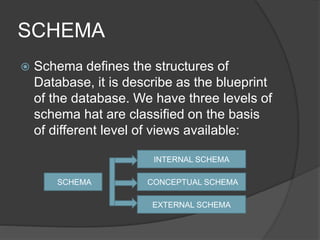
SCHEMA
 Schema defines the structures of
Database, it is describe as the blueprint
of the database. We have three levels of
schema hat are classified on the basis
of different level of views available:
SCHEMA
INTERNAL SCHEMA
CONCEPTUAL SCHEMA
EXTERNAL SCHEMA
PRIMARY KEY
 Primary Key – is used to recognized a
record uniquely. A primary key must be:
 Unique – Value in primary column
cannot be repeated.
 Not Null – The Primary Key cannot have
a null value i.e. The primary key cannot
be left blank.
FOREIGN KEY
 Foreign Key - is the key is used to link
two functions in table(Table) in a
database.
 In simple if we assume two tables Table
A and Table B, the primary key of Table
A will act as the foreign key in Table B.
THANK YOU !

Database Management System

  • 1.
  • 2.
    WHAT IS DBMS? Before answering this question. Let’s learn the key Terminologies of DBMS.
  • 3.
    DATA  Data isa Latin word meaning which is plural in format and has “Datum” as its singular format, layman may describe data as “Raw facts and Figures”  0-9  A-Z  Special Characters etc.
  • 4.
    INFORMATION  On processingraw facts and figures(DATA ) the outcome is in the form of meaningful information.  Information is the key to “Decision Making”
  • 5.
  • 6.
  • 7.
    DATABASE  Database isdefined as the systematic and organized information of data, for effective and efficient retrieval and modification of data as and when required. DATABASE CENTRALIZED DISTRIBUTED
  • 8.
    DATABASE ADMINISTRATOR  Database Administratoris an expert or team of experts who works as a manager of the Database and is responsible for:  Security  Data Backup  Data Recovery  Troubleshooting, etc.
  • 9.
  • 10.
    DBMS  Database ManagementSystem is collection of program schedules, that allows one to store, fetch(retrieve), modify or update data stored in Database. One can create or drop database using DBMS.Cthe popular forms are:  Oracle, Sybase, MySQL, Microsoft SQL Server
  • 11.
    SCHEMA  Schema definesthe structures of Database, it is describe as the blueprint of the database. We have three levels of schema hat are classified on the basis of different level of views available: SCHEMA INTERNAL SCHEMA CONCEPTUAL SCHEMA EXTERNAL SCHEMA
  • 12.
    PRIMARY KEY  PrimaryKey – is used to recognized a record uniquely. A primary key must be:  Unique – Value in primary column cannot be repeated.  Not Null – The Primary Key cannot have a null value i.e. The primary key cannot be left blank.
  • 13.
    FOREIGN KEY  ForeignKey - is the key is used to link two functions in table(Table) in a database.  In simple if we assume two tables Table A and Table B, the primary key of Table A will act as the foreign key in Table B.
  • 14.