Computer Networks
1.Computer Networks A number of computers connected to one another is called a computer network A network is a set of technologies including H/W, S/W and media- that can be used to connect computer systems together for Communicating with each other (email, instant messaging etc.) Exchanging information Share resources in real time
Uses of Networks Simultaneous Access Commonly used data and resources can be kept on a central location, called Network Server, from where users can simultaneously access.  If data is stored centrally, it is called a  file server Programs also can be centrally located in the server, which can be accessed by users on the network- Client server model Applications also can be centrally located on server ( Application Server)or in clients in distributed mode of processing. Shared Peripheral devices-  colour laser printers (either directly to network or through Print Server), scanners, fax etc. Personal Communications-  email, instant messaging, teleconferencing Video conferencing- real time communication over adistance by people at two or more sites using video picture- cameras, mic, speakers, monitors etc. Audio conferencing- digital audio between groups of participants Data- conferencing- to have shared workspace on their computer desktops- shared “whiteboards”, where they can draw, write, import or manipulate images con real time. Used in conjunction with video and audio conferencing VOIP- Voice over internet protocol- cheap audio communication on long distance calls Easier Backup- Keep backup on shared storage devices
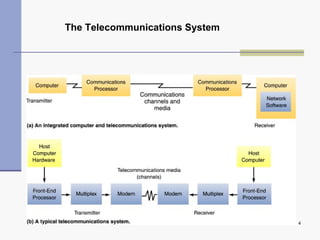
The Telecommunications System
2. The Telecommunications system Telecommunications system: Combination of hardware and software that  transmits information (text, data, graphics, and voice) from one location to another.  Its components are: Hardware –  computers, communications processors like modems Communications media  – physical media through which electronic signals are transmitted incl wireless media Communications Networks  – links amongst computers and communication devices Communications software  – s/w that controls the entire telecommunications system and the entire transmission process Data Communications providers  – firms providing data communication services Communications protocols  – rules for transmitting information across the system Communications applications  – EDI, teleconferencing etc.
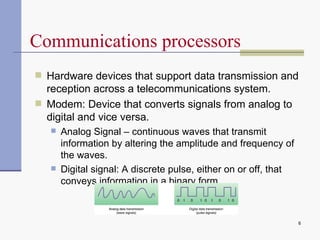
Hardware devices that support data transmission and reception across a telecommunications system. Modem:  Device that converts signals from analog to digital and vice versa. Analog Signal – continuous waves that transmit information by altering the amplitude and frequency of the waves. Digital signal: A discrete pulse, either on or off, that conveys information in a binary form.  Communications processors
Multiplexer:  Electronic device that allows a single communications channel to carry data transmission simultaneously from many sources. Front-end processor:  A small secondary computer, dedicated solely to communication, that manages all routing communications with peripheral devices.
Communication media and channels  Communication channel . Pathway for communicating data form one location to another. Cable Media Broadcast Media
Cable media :  Communications channels that use physical wires or cables to transmit data and information. Twisted pair wire  – strands of copper wire twisted in pairs –inexpensive, widely available, easy to work with, unobtrusive – slow(low bandwidth- 10Mbps), subject to interference, easily tapped (low security) Coaxial Cable  – insulated and shielded copper wire – higher bandwidth(100Mbps), less susceptible to interference- expensive, easily tapped 9low to medium security), difficult to work with Fibre optic cable-   Thousand of very thin filaments of glass fibers, surround by cladding, that transmit information via light pulses generated by lasers – high bandwidth (6 Tbps) , theoretically upto 25Tbps– difficult to work with.
Broadcast ( wireless) media:  Communication channels that use electromagnetic media (the ‘’airwaves’’) to transmit data. Microwave transmission . Communication channel that uses  towers  to send  wireless signals ; used for  high-volume ,  long-distance ,  point-to-point communication  on line of sight (every 30 miles you need towers to receive , amplify and retransmit)
Satellite transmission . Communications channel that uses orbiting satellites to send digital transmission point-to-point. Geostationary satellites at 22,300miles above. Three satellites sufficient to give global coverage. GEO- Geostationary earth orbit Medium earth orbit (MEO) satellites- 6000 miles above, orbits inclined to equator.  Low earth orbit (LEO) satellites – 400-700 miles above- require less power- cellular telephones- low battery power reqd to reach (Iridium Satellites) Propagation delay . Brief pause between the sending and receipt of a satellite transmission (about 0.25 second).
Radio transmission(R.F)  Communications channel that uses radio wave frequencies to send data directly between transmitters and receivers over short distances. Satellite radio (digital radio).  Form of radio transmission that offers uninterrupted, near CD-quality music beamed to your radio from space. Infrared.  Red light not commonly visible to human eyes; can be modulated or pulsed for conveying information.
Distributed processing . Network architecture that divides processing work between two or more computers, linked together in a network. Client/ server computing . Form of distributed processing in which some machines (servers) perform computing functions for end –user PCs (clients). Peer- to–peer processing . A type of client/ server distributed processing that allows  two or more computers to pool their resources, making each computer both a client and a server 3. Network processing strategies
Local area  network (LAN).  Network  that connects communications devices in a limited geographical region within 2000’ (e.g., a building ), so that every user device on the network can communicate with every other device. Topology.  The  physical layout and connectivity of a network   Bus Topology Star Topology Ring Topology Mesh Topology 4. Types of computer networks Hierarchical Topology Hybrid Topology
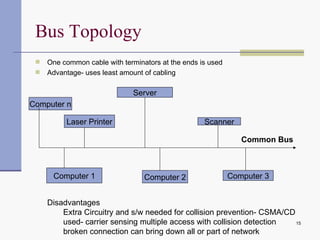
Bus Topology One common cable with terminators at the ends is used Advantage- uses least amount of cabling Server Computer 1 Computer 2 Computer 3 Laser Printer Scanner Computer n Common Bus Disadvantages  Extra Circuitry and s/w needed for collision prevention- CSMA/CD used- carrier sensing multiple access with collision detection broken connection can bring down all or part of network
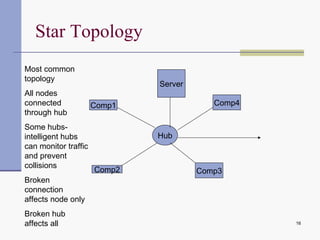
Star Topology Hub Server Comp1 Comp2 Comp3 Comp4 Most common topology All nodes connected through hub Some hubs- intelligent hubs can monitor traffic and prevent collisions Broken connection affects node only Broken hub affects all
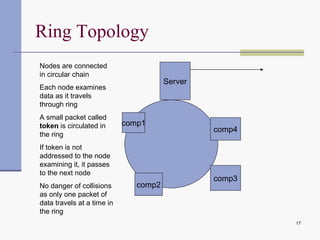
Ring Topology Server comp1 comp2 comp3 comp4 Nodes are connected in circular chain Each node examines data as it travels through ring A small packet called  token  is circulated in the ring If token is not addressed to the node examining it, it passes to the next node No danger of collisions as only one packet of data travels at a time in the ring
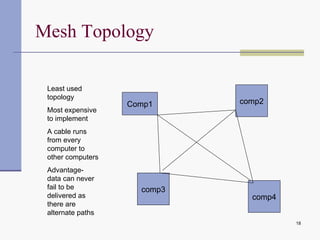
Mesh Topology Comp1 comp2 comp3 comp4 Least used topology Most expensive to implement A cable runs from every computer to other computers Advantage- data can never fail to be delivered as there are alternate paths
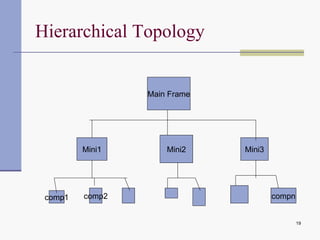
Hierarchical Topology Main Frame Mini1 Mini2 Mini3 comp1 comp2 compn
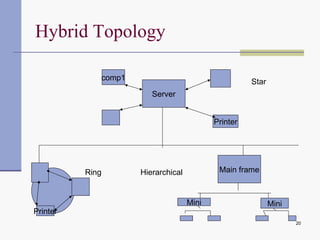
Hybrid Topology Server comp1 Printer Printer Main frame Mini Mini Star Ring Hierarchical
LAN technology File server.  A repository of various software and data  files for the network, which determines who gets access to what and in what sequence Network interface card . Hardware that specifics  the data  transmission rate, the size of message units, the addressing information attached to each message and network topology. Gateway.  A communications processor that connects dissimilar networks by translating from one set of protocols to another Bridge.  A communications processor that connects two networks of the same type. Router.  A communications processor that routes message through several connected LANs or to a wide area network.
Lan Technology- contd. LANs employ Base Band technology or Broad Band Technology In base band entire cable capacity used to transmit a single digitally coded signal In broad band, several signals can be carried by the cable at the same time at different frequencies
WLANs: Technologies (e.g., Bluetooth and wifi) that provide LAN connectivity over short distance, typically limited to less than 150 meters. Bluetooth . A wireless technology that  enables temporary, short-range connection between wireless devices and enables these devices to communicate with each other via low-power radio frequencies. Max transmission speed 720Kbps Wi-Fi (Wireless Fidelity).  A wireless technology that can transmit information at a range up to 300 feet; another name for the 802.11b standard on which most WLANs run. Wireless local area networks (WLANs)
A  long- haul broad band (analog)networks, generally provided by a common telecommunications carrier, that covers a wide geographic area.They can use any of the five topologies and can include switched and dedicated lines, microwave and satellite communications. They are generally star type  Value-added network (VAN).  A private, data-only network that is managed by an outside third party and used by multiple organizations to obtain economies in the cost of network service and network management. Wide area networks (WAN)
Virtual private network (VPN).  A WAN  operated by a common carrier; provides a gateway between a corporate LAN and the Internet. Tunnelling.  The process of sending data over the Internet in encrypted form. Wide area networks (WAN) cont…
Enterprise Networking  Interconnected multiple LANs and WANs.

Computer Networks1

  • 1.
  • 2.
    1.Computer Networks Anumber of computers connected to one another is called a computer network A network is a set of technologies including H/W, S/W and media- that can be used to connect computer systems together for Communicating with each other (email, instant messaging etc.) Exchanging information Share resources in real time
  • 3.
    Uses of NetworksSimultaneous Access Commonly used data and resources can be kept on a central location, called Network Server, from where users can simultaneously access. If data is stored centrally, it is called a file server Programs also can be centrally located in the server, which can be accessed by users on the network- Client server model Applications also can be centrally located on server ( Application Server)or in clients in distributed mode of processing. Shared Peripheral devices- colour laser printers (either directly to network or through Print Server), scanners, fax etc. Personal Communications- email, instant messaging, teleconferencing Video conferencing- real time communication over adistance by people at two or more sites using video picture- cameras, mic, speakers, monitors etc. Audio conferencing- digital audio between groups of participants Data- conferencing- to have shared workspace on their computer desktops- shared “whiteboards”, where they can draw, write, import or manipulate images con real time. Used in conjunction with video and audio conferencing VOIP- Voice over internet protocol- cheap audio communication on long distance calls Easier Backup- Keep backup on shared storage devices
  • 4.
  • 5.
    2. The Telecommunicationssystem Telecommunications system: Combination of hardware and software that transmits information (text, data, graphics, and voice) from one location to another. Its components are: Hardware – computers, communications processors like modems Communications media – physical media through which electronic signals are transmitted incl wireless media Communications Networks – links amongst computers and communication devices Communications software – s/w that controls the entire telecommunications system and the entire transmission process Data Communications providers – firms providing data communication services Communications protocols – rules for transmitting information across the system Communications applications – EDI, teleconferencing etc.
  • 6.
    Hardware devices thatsupport data transmission and reception across a telecommunications system. Modem: Device that converts signals from analog to digital and vice versa. Analog Signal – continuous waves that transmit information by altering the amplitude and frequency of the waves. Digital signal: A discrete pulse, either on or off, that conveys information in a binary form. Communications processors
  • 7.
    Multiplexer: Electronicdevice that allows a single communications channel to carry data transmission simultaneously from many sources. Front-end processor: A small secondary computer, dedicated solely to communication, that manages all routing communications with peripheral devices.
  • 8.
    Communication media andchannels Communication channel . Pathway for communicating data form one location to another. Cable Media Broadcast Media
  • 9.
    Cable media : Communications channels that use physical wires or cables to transmit data and information. Twisted pair wire – strands of copper wire twisted in pairs –inexpensive, widely available, easy to work with, unobtrusive – slow(low bandwidth- 10Mbps), subject to interference, easily tapped (low security) Coaxial Cable – insulated and shielded copper wire – higher bandwidth(100Mbps), less susceptible to interference- expensive, easily tapped 9low to medium security), difficult to work with Fibre optic cable- Thousand of very thin filaments of glass fibers, surround by cladding, that transmit information via light pulses generated by lasers – high bandwidth (6 Tbps) , theoretically upto 25Tbps– difficult to work with.
  • 10.
    Broadcast ( wireless)media: Communication channels that use electromagnetic media (the ‘’airwaves’’) to transmit data. Microwave transmission . Communication channel that uses towers to send wireless signals ; used for high-volume , long-distance , point-to-point communication on line of sight (every 30 miles you need towers to receive , amplify and retransmit)
  • 11.
    Satellite transmission .Communications channel that uses orbiting satellites to send digital transmission point-to-point. Geostationary satellites at 22,300miles above. Three satellites sufficient to give global coverage. GEO- Geostationary earth orbit Medium earth orbit (MEO) satellites- 6000 miles above, orbits inclined to equator. Low earth orbit (LEO) satellites – 400-700 miles above- require less power- cellular telephones- low battery power reqd to reach (Iridium Satellites) Propagation delay . Brief pause between the sending and receipt of a satellite transmission (about 0.25 second).
  • 12.
    Radio transmission(R.F) Communications channel that uses radio wave frequencies to send data directly between transmitters and receivers over short distances. Satellite radio (digital radio). Form of radio transmission that offers uninterrupted, near CD-quality music beamed to your radio from space. Infrared. Red light not commonly visible to human eyes; can be modulated or pulsed for conveying information.
  • 13.
    Distributed processing .Network architecture that divides processing work between two or more computers, linked together in a network. Client/ server computing . Form of distributed processing in which some machines (servers) perform computing functions for end –user PCs (clients). Peer- to–peer processing . A type of client/ server distributed processing that allows two or more computers to pool their resources, making each computer both a client and a server 3. Network processing strategies
  • 14.
    Local area network (LAN). Network that connects communications devices in a limited geographical region within 2000’ (e.g., a building ), so that every user device on the network can communicate with every other device. Topology. The physical layout and connectivity of a network Bus Topology Star Topology Ring Topology Mesh Topology 4. Types of computer networks Hierarchical Topology Hybrid Topology
  • 15.
    Bus Topology Onecommon cable with terminators at the ends is used Advantage- uses least amount of cabling Server Computer 1 Computer 2 Computer 3 Laser Printer Scanner Computer n Common Bus Disadvantages Extra Circuitry and s/w needed for collision prevention- CSMA/CD used- carrier sensing multiple access with collision detection broken connection can bring down all or part of network
  • 16.
    Star Topology HubServer Comp1 Comp2 Comp3 Comp4 Most common topology All nodes connected through hub Some hubs- intelligent hubs can monitor traffic and prevent collisions Broken connection affects node only Broken hub affects all
  • 17.
    Ring Topology Servercomp1 comp2 comp3 comp4 Nodes are connected in circular chain Each node examines data as it travels through ring A small packet called token is circulated in the ring If token is not addressed to the node examining it, it passes to the next node No danger of collisions as only one packet of data travels at a time in the ring
  • 18.
    Mesh Topology Comp1comp2 comp3 comp4 Least used topology Most expensive to implement A cable runs from every computer to other computers Advantage- data can never fail to be delivered as there are alternate paths
  • 19.
    Hierarchical Topology MainFrame Mini1 Mini2 Mini3 comp1 comp2 compn
  • 20.
    Hybrid Topology Servercomp1 Printer Printer Main frame Mini Mini Star Ring Hierarchical
  • 21.
    LAN technology Fileserver. A repository of various software and data files for the network, which determines who gets access to what and in what sequence Network interface card . Hardware that specifics the data transmission rate, the size of message units, the addressing information attached to each message and network topology. Gateway. A communications processor that connects dissimilar networks by translating from one set of protocols to another Bridge. A communications processor that connects two networks of the same type. Router. A communications processor that routes message through several connected LANs or to a wide area network.
  • 22.
    Lan Technology- contd.LANs employ Base Band technology or Broad Band Technology In base band entire cable capacity used to transmit a single digitally coded signal In broad band, several signals can be carried by the cable at the same time at different frequencies
  • 23.
    WLANs: Technologies (e.g.,Bluetooth and wifi) that provide LAN connectivity over short distance, typically limited to less than 150 meters. Bluetooth . A wireless technology that enables temporary, short-range connection between wireless devices and enables these devices to communicate with each other via low-power radio frequencies. Max transmission speed 720Kbps Wi-Fi (Wireless Fidelity). A wireless technology that can transmit information at a range up to 300 feet; another name for the 802.11b standard on which most WLANs run. Wireless local area networks (WLANs)
  • 24.
    A long-haul broad band (analog)networks, generally provided by a common telecommunications carrier, that covers a wide geographic area.They can use any of the five topologies and can include switched and dedicated lines, microwave and satellite communications. They are generally star type Value-added network (VAN). A private, data-only network that is managed by an outside third party and used by multiple organizations to obtain economies in the cost of network service and network management. Wide area networks (WAN)
  • 25.
    Virtual private network(VPN). A WAN operated by a common carrier; provides a gateway between a corporate LAN and the Internet. Tunnelling. The process of sending data over the Internet in encrypted form. Wide area networks (WAN) cont…
  • 26.
    Enterprise Networking Interconnected multiple LANs and WANs.