Study Material
WIRELESS TECHNOLOGIES
(ITEC 353)
Level-6
Reference:
William Stalling, “Wireless
Communications and Networks, 2nd
Edition, 2004, Pearson, ISBN-
13: 978-8132231561
Chapter 1
Wireles transmission fundamentals
• Wireless Technology provides the ability to
communicate between two or more entities over
distances without the use of wires or cables
• Over the last century, advances in wireless
technologies have led to the radio, the television,
the mobile telephone, and communications
satellites. All types of information can now be
sent to almost every corner of the world.
Recently, a great deal of attention has been
focused on satellite communications, wireless
networking, and cellular technology.
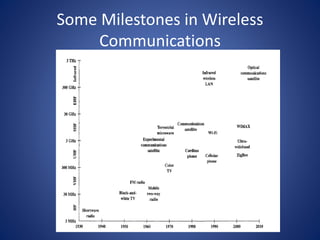
Some Milestones in Wireless
Communications
The Global Cellular Network
• The key second-generation wireless systems
are the Global System for Mobile
Communications (GSM), Personal
Communications Service (PCS) IS-136, and PCS
IS-95. The PCS standard IS-136 uses time
division multiple access (TDMA) while IS-95
uses code division multiple access (CDMA).
The GSM and PCS IS-136 use dedicated
channels at 9.6 kbps to deliver the data
service.
Broadband
• Broadband wireless service shares the same
advantages of all wireless services:
convenience and reduced cost. Operators can
deploy the service faster than a fixed service and
without the cost of a cable plant. The service is
also mobile and can be deployed almost
anywhere.
Bluetooth is a wireless networking specification
that defines wireless communications between
devices such as laptops, PDAs, and mobile
phones.
Future Trends
• WiMAX is similar to Wi-Fi. Both create hot spots, but while Wi-Fi can cover
• several hundred meters,WiMAX has a range of 40 to 50 km. Thus,WiMAX provides a wireless
alternative to cable, DSL, and TlIEl for last-mile broadband access. It will also be used as
complimentary technology to connect 802.11 hot spots to the Internet.
•
• Mobile-Fi is similar to the mobile version of WiMAX in terms of technology. The objective with
Mobile-Fi is to provide Internet access to mobile users at data rates even higher than those
available in today's home broadband links. Thus, a Mobile-Fi user could enjoy broadband Internet
access while traveling in a moving car or train.
•
• ZigBee functions at a relatively low data rate over relatively short distances, compared to Wi-Fi. The
objective is to develop products that are very low cost, with low power consumption and low data
rate. ZigBee technology enables the coordination of communication among thousands of tiny
sensors, which can be scattered throughout offices, farms, or factories, picking up bits of
information about temperature, chemicals, water, or motion.
•
• Ultrawideband : Ultrawideband enables the movement of massive files at
• high data rates over short distances. For example, in the home, Ultrawideband would allow the
user to transfer hours of video from a PC to a TV without any messy cords.
Trouble with wireless
• Two standards for digital cellular service. Internationally, there is at
least one more. A device using PCS IS-136 will not work in an area
where the deployed technology is PCS IS-95.
• Inability to use Bluetooth and 802.11 in the same device.
• Device limitations also restrict the free flow of data.
• The small display on a mobile telephone is inadequate for
displaying more than a few lines of text.
• Mobile wireless devices cannot access the vast majority of WWW
sites on the Internet.
• The browsers use a special language, wireless markup language
(WML), instead of the de facto standard HTML.
• No one wireless device will be able to meet every need.
• The potential of wireless can be met but not with a single product.
What is Wireless Communication?
• Communication Systems can be Wired or
Wireless and the medium used for
communication can be Guided or Unguided. In
Wired Communication, the medium is a
physical path like Co-axial Cables, Twisted Pair
Cables and Optical Fiber Links etc. which
guides the signal to propagate from one point
to other.
2 Advantages of Wireless
Communication
• Cost
• The cost of installing wires, cables and other infrastructure
is eliminated in wireless communication and hence
lowering the overall cost of the system compared to wired
communication system
• Mobility
• As mentioned earlier, mobility is the main advantage of
wireless communication system. It offers the freedom to
move around while still connected to network.
• Ease of Installation
• The setup and installation of wireless communication
network’s equipment and infrastructure is very easy as we
need not worry about the hassle of cables.
Advantages of Wireless
Communication
• Reliability
• Since there are no cables and wires involved in wireless
communication, there is no chance of communication
failure due to damage of these cables, which may be
caused by environmental conditions, cable splice and
natural diminution of metallic conductors.
• Disaster Recovery
• In case of accidents due to fire, floods or other
disasters, the loss of communication infrastructure in
wireless communication system can be minimal.
Disadvantages of Wireless
Communication
• Interference
Wireless Communication systems use open space as
the medium for transmitting signals.
• Security
One of the main concerns of wireless communication is
Security of the data. Since the signals are transmitted
in open space
• Health Concerns
Continuous exposure to any type of radiation can be
hazardous. Even though the levels of RF energy that
can cause the damage are not accurately established
Types of Wireless Communication
Systems
• Television and Radio Broadcasting
• Satellite Communication
• Radar
• Mobile Telephone System (Cellular Communication)
• Global Positioning System (GPS)
• Infrared Communication
• WLAN (Wi-Fi)
• Bluetooth
• ZigBee
• Paging
• Cordless Phones
• Radio Frequency Identification (RFID)
Bluetooth
• Bluetooth is a short-range wireless technology
standard that is used for exchanging data
between fixed and mobile devices over short
distances using UHF radio waves in the ISM
bands, from 2.402 GHz to 2.48 GHz, and
building personal area networks (PANs).
Bluetooth Usage
• Access Points for Data and Voice
• Cable replacement
• Ad hoc networking − Ad hoc networks are
formed impromptu by the network devices
bypassing the need for a central access point
like a router.
Bluetooth Applications
• In laptops, notebooks and wireless PCs
• In mobile phones and PDAs (personal digital assistant).
• In printers.
• In wireless headsets.
• In wireless PANs (personal area networks) and even LANs
(local area networks)
• To transfer data files, videos, and images and MP3 or MP4.
• In wireless peripheral devices like mouse and keyboards.
• In data logging equipment.
• In the short-range transmission of data from sensors
devices to sensor nodes like mobile phones.
Transmission Fundamentals
• An electromagnetic signal is a function of time, but it can also be
expressed as a function of frequency; that is, the signal consists of
components of different frequencies.
• an electromagnetic signal can be either analog or digital.
• An analog signal is one in which the signal intensity varies in a smooth
fashion over time. In other words, there are no breaks or discontinuities in
the signal.
• A digital signal is one in which the signal intensity maintains a constant
level for some period of time and then changes to another constant level
• These two terms are used frequently in data communications in at least
three contexts: data, signals, and transmission.
• Data as entities that convey meaning, or information.
• Signals are electric or electromagnetic representations of data.
• Transmission is the communication of data by the propagation and
processing of signals.
•
Analog and Digital Signaling
• An analog signal is a continuously varying
electromagnetic wave that may be propagated
over a variety of media, depending on frequency;
examples are copper wire media, such as twisted
pair and coaxial cable; fiber optic cable; and
atmosphere or space propagation (wireless).
• A digital signal is a sequence of voltage pulses
that may be transmitted over a copper wire
medium; for example, a constant positive voltage
level may represent binary 0 and a constant
negative voltage level may represent binary l.
Analog and Digital transmission
• Analog transmission is a means of transmitting analog signals
without regard to their content; the signals may represent analog
data (e.g., voice) or digital data (e.g., data that pass through a
modem). In either case, the analog signal will suffer attenuation
that limits the length of the transmission link. To achieve longer
distances, the analog transmission system includes amplifiers that
boost the energy in the signal.
• Digital transmission, in contrast, is concerned with the content of
the signal.We have mentioned that a digital signal can be
propagated only a limited distance before attenuation endangers
the integrity of the data. To achieve greater distances,
• repeaters are used. A repeater receives the digital signal, recovers
the pattern of ones and zeros, and retransmits a new signal.
Channel Capacity
• The maximum rate at which data can be transmitted over a given
communication path, or channel, under given conditions is referred to as
the channel capacity.
•
• There are four concepts here that we are trying to relate to one another:
• Data rate: This is the rate, in bits per second (bps), at which data can be
communicated.
• Bandwidth: This is the bandwidth of the transmitted signal as constrained
by the transmitter and the nature of the transmission medium, expressed
in cycles per second, or Hertz.
• Noise: For this discussion, we are concerned with the average level of
noise over the communications path.
• Error rate: This is the rate at which errors occur, where an error is the
reception of a 1 when a 0 was transmitted or the reception of a 0 when a
1 was transmitted.
•
Nyquist Bandwidth
• The Nyquist rate or frequency is the minimum rate at
which a finite bandwidth signal needs to be sampled
to retain all of the information. For a bandwidth of
span B, the Nyquist frequency is just 2 B. If a time
series is sampled at regular time intervals dt, then the
Nyquist rate is just 1/(2 dt ).
• Nyquist formula: data rate = 2 * bandwidth * log2 (M)
; where M is the modulation level (eg., M=4 for QPSK ).
... The required bandwidth is related to bit rate and the
modulation order M. It is so that the double sided
bandwidth w = symbol rate= bit rate rb/ divided by the
number of bit per symbol n.
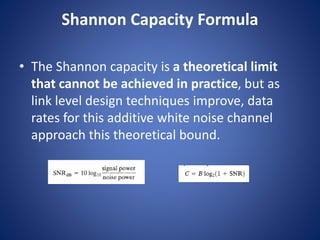
Shannon Capacity Formula
• The Shannon capacity is a theoretical limit
that cannot be achieved in practice, but as
link level design techniques improve, data
rates for this additive white noise channel
approach this theoretical bound.

Chapter 1.pptx

  • 1.
    Study Material WIRELESS TECHNOLOGIES (ITEC353) Level-6 Reference: William Stalling, “Wireless Communications and Networks, 2nd Edition, 2004, Pearson, ISBN- 13: 978-8132231561
  • 2.
    Chapter 1 Wireles transmissionfundamentals • Wireless Technology provides the ability to communicate between two or more entities over distances without the use of wires or cables • Over the last century, advances in wireless technologies have led to the radio, the television, the mobile telephone, and communications satellites. All types of information can now be sent to almost every corner of the world. Recently, a great deal of attention has been focused on satellite communications, wireless networking, and cellular technology.
  • 3.
    Some Milestones inWireless Communications
  • 4.
    The Global CellularNetwork • The key second-generation wireless systems are the Global System for Mobile Communications (GSM), Personal Communications Service (PCS) IS-136, and PCS IS-95. The PCS standard IS-136 uses time division multiple access (TDMA) while IS-95 uses code division multiple access (CDMA). The GSM and PCS IS-136 use dedicated channels at 9.6 kbps to deliver the data service.
  • 5.
    Broadband • Broadband wirelessservice shares the same advantages of all wireless services: convenience and reduced cost. Operators can deploy the service faster than a fixed service and without the cost of a cable plant. The service is also mobile and can be deployed almost anywhere. Bluetooth is a wireless networking specification that defines wireless communications between devices such as laptops, PDAs, and mobile phones.
  • 6.
    Future Trends • WiMAXis similar to Wi-Fi. Both create hot spots, but while Wi-Fi can cover • several hundred meters,WiMAX has a range of 40 to 50 km. Thus,WiMAX provides a wireless alternative to cable, DSL, and TlIEl for last-mile broadband access. It will also be used as complimentary technology to connect 802.11 hot spots to the Internet. • • Mobile-Fi is similar to the mobile version of WiMAX in terms of technology. The objective with Mobile-Fi is to provide Internet access to mobile users at data rates even higher than those available in today's home broadband links. Thus, a Mobile-Fi user could enjoy broadband Internet access while traveling in a moving car or train. • • ZigBee functions at a relatively low data rate over relatively short distances, compared to Wi-Fi. The objective is to develop products that are very low cost, with low power consumption and low data rate. ZigBee technology enables the coordination of communication among thousands of tiny sensors, which can be scattered throughout offices, farms, or factories, picking up bits of information about temperature, chemicals, water, or motion. • • Ultrawideband : Ultrawideband enables the movement of massive files at • high data rates over short distances. For example, in the home, Ultrawideband would allow the user to transfer hours of video from a PC to a TV without any messy cords.
  • 7.
    Trouble with wireless •Two standards for digital cellular service. Internationally, there is at least one more. A device using PCS IS-136 will not work in an area where the deployed technology is PCS IS-95. • Inability to use Bluetooth and 802.11 in the same device. • Device limitations also restrict the free flow of data. • The small display on a mobile telephone is inadequate for displaying more than a few lines of text. • Mobile wireless devices cannot access the vast majority of WWW sites on the Internet. • The browsers use a special language, wireless markup language (WML), instead of the de facto standard HTML. • No one wireless device will be able to meet every need. • The potential of wireless can be met but not with a single product.
  • 8.
    What is WirelessCommunication? • Communication Systems can be Wired or Wireless and the medium used for communication can be Guided or Unguided. In Wired Communication, the medium is a physical path like Co-axial Cables, Twisted Pair Cables and Optical Fiber Links etc. which guides the signal to propagate from one point to other.
  • 9.
    2 Advantages ofWireless Communication • Cost • The cost of installing wires, cables and other infrastructure is eliminated in wireless communication and hence lowering the overall cost of the system compared to wired communication system • Mobility • As mentioned earlier, mobility is the main advantage of wireless communication system. It offers the freedom to move around while still connected to network. • Ease of Installation • The setup and installation of wireless communication network’s equipment and infrastructure is very easy as we need not worry about the hassle of cables.
  • 10.
    Advantages of Wireless Communication •Reliability • Since there are no cables and wires involved in wireless communication, there is no chance of communication failure due to damage of these cables, which may be caused by environmental conditions, cable splice and natural diminution of metallic conductors. • Disaster Recovery • In case of accidents due to fire, floods or other disasters, the loss of communication infrastructure in wireless communication system can be minimal.
  • 11.
    Disadvantages of Wireless Communication •Interference Wireless Communication systems use open space as the medium for transmitting signals. • Security One of the main concerns of wireless communication is Security of the data. Since the signals are transmitted in open space • Health Concerns Continuous exposure to any type of radiation can be hazardous. Even though the levels of RF energy that can cause the damage are not accurately established
  • 12.
    Types of WirelessCommunication Systems • Television and Radio Broadcasting • Satellite Communication • Radar • Mobile Telephone System (Cellular Communication) • Global Positioning System (GPS) • Infrared Communication • WLAN (Wi-Fi) • Bluetooth • ZigBee • Paging • Cordless Phones • Radio Frequency Identification (RFID)
  • 13.
    Bluetooth • Bluetooth isa short-range wireless technology standard that is used for exchanging data between fixed and mobile devices over short distances using UHF radio waves in the ISM bands, from 2.402 GHz to 2.48 GHz, and building personal area networks (PANs).
  • 14.
    Bluetooth Usage • AccessPoints for Data and Voice • Cable replacement • Ad hoc networking − Ad hoc networks are formed impromptu by the network devices bypassing the need for a central access point like a router.
  • 15.
    Bluetooth Applications • Inlaptops, notebooks and wireless PCs • In mobile phones and PDAs (personal digital assistant). • In printers. • In wireless headsets. • In wireless PANs (personal area networks) and even LANs (local area networks) • To transfer data files, videos, and images and MP3 or MP4. • In wireless peripheral devices like mouse and keyboards. • In data logging equipment. • In the short-range transmission of data from sensors devices to sensor nodes like mobile phones.
  • 16.
    Transmission Fundamentals • Anelectromagnetic signal is a function of time, but it can also be expressed as a function of frequency; that is, the signal consists of components of different frequencies. • an electromagnetic signal can be either analog or digital. • An analog signal is one in which the signal intensity varies in a smooth fashion over time. In other words, there are no breaks or discontinuities in the signal. • A digital signal is one in which the signal intensity maintains a constant level for some period of time and then changes to another constant level • These two terms are used frequently in data communications in at least three contexts: data, signals, and transmission. • Data as entities that convey meaning, or information. • Signals are electric or electromagnetic representations of data. • Transmission is the communication of data by the propagation and processing of signals. •
  • 17.
    Analog and DigitalSignaling • An analog signal is a continuously varying electromagnetic wave that may be propagated over a variety of media, depending on frequency; examples are copper wire media, such as twisted pair and coaxial cable; fiber optic cable; and atmosphere or space propagation (wireless). • A digital signal is a sequence of voltage pulses that may be transmitted over a copper wire medium; for example, a constant positive voltage level may represent binary 0 and a constant negative voltage level may represent binary l.
  • 18.
    Analog and Digitaltransmission • Analog transmission is a means of transmitting analog signals without regard to their content; the signals may represent analog data (e.g., voice) or digital data (e.g., data that pass through a modem). In either case, the analog signal will suffer attenuation that limits the length of the transmission link. To achieve longer distances, the analog transmission system includes amplifiers that boost the energy in the signal. • Digital transmission, in contrast, is concerned with the content of the signal.We have mentioned that a digital signal can be propagated only a limited distance before attenuation endangers the integrity of the data. To achieve greater distances, • repeaters are used. A repeater receives the digital signal, recovers the pattern of ones and zeros, and retransmits a new signal.
  • 19.
    Channel Capacity • Themaximum rate at which data can be transmitted over a given communication path, or channel, under given conditions is referred to as the channel capacity. • • There are four concepts here that we are trying to relate to one another: • Data rate: This is the rate, in bits per second (bps), at which data can be communicated. • Bandwidth: This is the bandwidth of the transmitted signal as constrained by the transmitter and the nature of the transmission medium, expressed in cycles per second, or Hertz. • Noise: For this discussion, we are concerned with the average level of noise over the communications path. • Error rate: This is the rate at which errors occur, where an error is the reception of a 1 when a 0 was transmitted or the reception of a 0 when a 1 was transmitted. •
  • 20.
    Nyquist Bandwidth • TheNyquist rate or frequency is the minimum rate at which a finite bandwidth signal needs to be sampled to retain all of the information. For a bandwidth of span B, the Nyquist frequency is just 2 B. If a time series is sampled at regular time intervals dt, then the Nyquist rate is just 1/(2 dt ). • Nyquist formula: data rate = 2 * bandwidth * log2 (M) ; where M is the modulation level (eg., M=4 for QPSK ). ... The required bandwidth is related to bit rate and the modulation order M. It is so that the double sided bandwidth w = symbol rate= bit rate rb/ divided by the number of bit per symbol n.
  • 21.
    Shannon Capacity Formula •The Shannon capacity is a theoretical limit that cannot be achieved in practice, but as link level design techniques improve, data rates for this additive white noise channel approach this theoretical bound.