MADATSST
&
MUKUND INGLE
PRESENTS
Mr. Mukund B.
Ingle
IMPORTANCE OF MINERALS
 Day to day articles: Articles those we
use in our day to day life are made of
some of the minerals
 Even food that we eat contains minerals
 For the development of the country, we
need varieties of minerals.
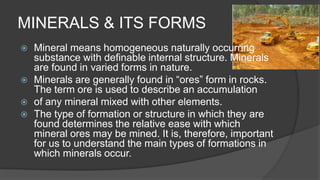
MINERALS & ITS FORMS
 Mineral means homogeneous naturally occurring
substance with definable internal structure. Minerals
are found in varied forms in nature.
 Minerals are generally found in “ores” form in rocks.
The term ore is used to describe an accumulation
 of any mineral mixed with other elements.
 The type of formation or structure in which they are
found determines the relative ease with which
mineral ores may be mined. It is, therefore, important
for us to understand the main types of formations in
which minerals occur.
MINERALS & ITS FORMS
 Minerals generally occur in following forms:
 Veins & Loads: Formed in igneous and metamorphic rocks in cracks, faults
and joints. If occurs in small known as ‘veins’ and in large size known as
‘loads’. Generally found in liquid form but as they rise, they cool. Ex. tin,
copper, zinc and lead
 Beds & Layers: They occur in sedimentary rocks. They are formed in
horizontal strata by deposition and accumulation process. Ex. Coal, gypsum,
potash salt & sodium salt. In arid region it is formed by evaporation process.
 Residual Weathered mass material: It occurs due to decomposition of surface
rocks and the removal of soluble constitutes and mineral is left behind. Ex.
Bauxite
 Alluvial Deposits: It occurs in sands of river valley and at the base of hills.
They are also called ‘placer deposits’. Ex. silver, gold, tin and platinum
 Ocean water: Ocean water contains various minerals and oceanic beds are
also great source of minerals. Ex. Common salt, magnesium, bromine and
manganese nodules.
INDIA IS RICH IN MINERALS
 These variations are occurred due to vast
availability and distribution of geographical
condition.
 Peninsula Rocks – coal and iron
 Sedimentary rocks – petroleum deposits
and non-ferrous minerals
 Alluvial plains – economic minerals
 Mountains and coastal area
IRON ORE
 Basic mineral and backbone of industrial development
 Magnetite: 1. 70% iron content 2. Excellent magnetic
qualities 3. Good for electrical industries
 Hematite: 1. 50-60% iron content 2. Less magnetic qualities
3. Important industrial iron ore
 The major iron ore belts
 Odisha-Jharkhand belt
 Durg-Bastar-Chandrapur belt
 Ballari-Chitradurga-Chikkamagaluru- Tumakuru belt
 Maharashtra-Goa belt
 Basic raw material for iron and steel industry
MANGANESE & COPPER
 MANGANESE
 Used in Iron and steel industry, bleaching powder, insecticide and paints
 Odisha is the largest producer of manganese ores in India. It accounted
for one-third of the country’s total production in 2000-01.
 COPPER
 It is malleable, ductile and good conductor.
 Used in electrical cable, electronics and chemical industry
 Places found - The Balaghat mines in Madhya Pradesh, Khetri mines in
Rajasthan and Singhbhum district of Jharkhand are leading producers of
copper.
MICA
 It splits easily in thin sheets and found in different colours.
 It is non-metallic mineral, found in series of plates and
leaves.
 It has excellent di-electric strength, low power loss factor,
insulating properties and resistance to high voltage so it
used in electrical and electronics industries.
 Important places where it is found are Chota Nagpur
Plateau, Gaya-Hazaribagh belt and Ajmer in Rajasthan
and Nellore in Andhra Pradesh are major mica producing
areas.
BAUXITE & LIMESTONES
 BAUXCITE
 Important source of Aluminum. It contains alumina.
 Formed by the decomposition procedure of various rocks that
contain aluminum silicates.
 Aluminum is strong and light weight, good conductor as well
malleable.
 Found in the Amarkantak plateau, Maikal hills and the plateau
region of Bilaspur-Katni, Panchpatmali deposits in Koraput and
Odisha
 LIMESTONE
 It is found with combination with rocks composed of Calcium
carbonates or Magnesium carbonates.
 It is found in Sedimentary rocks.
 It is used in cement industry and essential for smelting of iron.
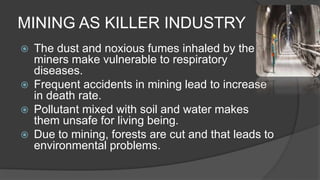
MINING AS KILLER INDUSTRY
 The dust and noxious fumes inhaled by the
miners make vulnerable to respiratory
diseases.
 Frequent accidents in mining lead to increase
in death rate.
 Pollutant mixed with soil and water makes
them unsafe for living being.
 Due to mining, forests are cut and that leads to
environmental problems.
CONSERVATION OF MINERALS
 The total volume of workable mineral deposits is an insignificant
fraction i.e. one per cent of the earth’s crust. We are rapidly
consuming mineral resources that required millions of years to be
created and concentrated.
 The geological processes of mineral formation are so slow that the
rates of replenishment are infinitely small in comparison to the
present rates of consumption.
 Mineral resources are, therefore, finite and non-renewable. Rich
mineral deposits are our country’s extremely valuable but short-
lived possessions.
 Continued extraction of ores leads to increasing costs as mineral
extraction comes from greater depths along with decrease in
quality.
HOW TO CONSERV MINERALS?
 A concerted effort has to be made in order to
use our mineral resources in a planned and
sustainable manner.
 Improved technologies need to be constantly
evolved to allow use of low grade ores at low
costs.
 Recycling of metals, using scrap metals and
other substitutes are steps in conserving our
mineral resources for the future
TYPES OF ENERGY
RESOURCESConventional Source of Energy Non-conventional Source of Energy
1. The source that was known to men for
the longer period of time.
1. The source that is discovered recently
2. This is non-renewable source of
energy
2. This is renewable source of energy
3. This leads to lots of environmental
problems
3. It is eco-friendly source of energy
4. It does not need complex machinery. 4. It needs more complex technology.
5. Wood, cow dung, coal, petroleum are
some examples of this type
5. Solar, wind, tidal, biogas are some
examples of this type
COAL
 Coal is abundantly available in India and for energy need we depend more on
coal.
 Coal is formed due to compression of plant material over millions of years.
 Forms of coal
 Peat is formed by decaying of plants in swamps. It contains low carbon and high moisture
with low heating capacity
 Lignite is a low grade brown coal, which is soft with high moisture content.
 Coal that has been buried deep and subjected to increased temperatures is bituminous
coal.
 It is the most popular coal in commercial use.
 Metallurgical coal is high grade bituminous coal which has a special value for
smelting iron in blast furnaces. Anthracite is the highest quality hard coal.
 By ages coal is divided into two types
 Gondawana Coal that is 200 million years old and
 Tertiary coal that is 55 million years old.
 Remember coal is a bulky material, which loses weight on use as it is reduced to
ash. Hence, heavy industries and thermal power stations are located on or near
the coalfields
PETROLEUM
 Mineral oil is second most important energy source in
India after coal.
 It is used not only for heat and light but it also provides
important raw materials for various industries.
 Oil refineries work as a nodal industry for synthetic
textile, fertilizer and numerous chemical industries.
 Most of the oil occurrences in India are associated with
anticlines and faults in limestone or sandstones.
 Oil sources in India Mumbai High – 63%, 18% - Gujarat
and 16% - Assam.
NATURAL GAS
 It is important clean energy resource and found
with and without petroleum.
 Ii is used as the source of energy as well as raw
material for various industries.
 Huge natural gas stores have discovered in river
valleys and various gulfs.
 HVJ is the most important gas pipeline which is
1700km. long and passes through important
industries.
ELECTRICITY
 Electricity has such a wide range of applications in today’s world that,
it’s per capita consumption is considered as an index of development.
 Electricity can be generated by various ways i.e. Hydro, Thermal and
Nuclear
 Hydro electricity is generated by fast flowing water, which is a
renewable resource.
 Thermal electricity is generated by using coal, petroleum and natural
gas. The thermal power stations use non-renewable fossil fuels for
generating electricity.
 It is obtained by altering the structure of atoms. When such an
alteration is made, much energy is released in the form of heat and
this is used to generate electric power.
NONCONVENTIONAL ENERGY RESOURCES
 Solar Energy
 India is a tropical country. It has enormous possibilities of tapping solar energy.
 Photovoltaic technology converts sunlight directly into electricity. Solar energy is fast
becoming popular in rural and remote areas.
 Wind Power
 India has great potential of wind power. The largest wind farm cluster is located in Tamil
Nadu from Nagarcoil to Madurai.
 Nagarcoil and Jaisalmer are well known for effective use of wind energy in the country.
 Biogas
 Shrubs, farm waste, animal and human waste are used to produce biogas for domestic
consumption in rural areas.
 Decomposition of organic matter yields gas, which has higher thermal efficiency in
comparison to kerosene, dung cake and charcoal.
NONCONVENTIONAL ENERGY RESOURCES
 Tidal Energy
 Oceanic tides can be used to generate electricity. Floodgate dams are built
across inlets. During high tide water flows into the inlet and gets trapped
when the gate is closed.
 After the tide falls outside the flood gate, the water retained by the floodgate
flows back to the sea via a pipe that carries it through a power-generating
turbine.
 Geo Thermal Energy
 Geo thermal energy refers to the heat and electricity produced by using the
heat from the interior of the Earth.
 Two experimental projects have been set up in India to harness geothermal
energy. One is located in the Parvati valley near Manikarn in Himachal
Pradesh and the other is located in the Puga Valley, Ladakh.
CONSERVATION OF ENERGY RESOURCES
 Energy is a basic requirement for economic development.
Every sector of the national economy – agriculture, industry,
transport, commercial and domestic – needs inputs of energy.
 In this background, there is an urgent need to develop a
sustainable path of energy development. Promotion of energy
conservation and increased use of renewable energy sources
are the twin planks of sustainable energy.
 India is presently one of the least energy efficient countries in
the world. We have to adopt a cautious approach for the
judicious use of our limited energy resources. After all,
“energy saved is energy produced”.
THANK YOU
&
BEST OF LUCK

Minerals & Energy Resources

  • 1.
  • 2.
  • 3.
    IMPORTANCE OF MINERALS Day to day articles: Articles those we use in our day to day life are made of some of the minerals  Even food that we eat contains minerals  For the development of the country, we need varieties of minerals.
  • 4.
    MINERALS & ITSFORMS  Mineral means homogeneous naturally occurring substance with definable internal structure. Minerals are found in varied forms in nature.  Minerals are generally found in “ores” form in rocks. The term ore is used to describe an accumulation  of any mineral mixed with other elements.  The type of formation or structure in which they are found determines the relative ease with which mineral ores may be mined. It is, therefore, important for us to understand the main types of formations in which minerals occur.
  • 5.
    MINERALS & ITSFORMS  Minerals generally occur in following forms:  Veins & Loads: Formed in igneous and metamorphic rocks in cracks, faults and joints. If occurs in small known as ‘veins’ and in large size known as ‘loads’. Generally found in liquid form but as they rise, they cool. Ex. tin, copper, zinc and lead  Beds & Layers: They occur in sedimentary rocks. They are formed in horizontal strata by deposition and accumulation process. Ex. Coal, gypsum, potash salt & sodium salt. In arid region it is formed by evaporation process.  Residual Weathered mass material: It occurs due to decomposition of surface rocks and the removal of soluble constitutes and mineral is left behind. Ex. Bauxite  Alluvial Deposits: It occurs in sands of river valley and at the base of hills. They are also called ‘placer deposits’. Ex. silver, gold, tin and platinum  Ocean water: Ocean water contains various minerals and oceanic beds are also great source of minerals. Ex. Common salt, magnesium, bromine and manganese nodules.
  • 6.
    INDIA IS RICHIN MINERALS  These variations are occurred due to vast availability and distribution of geographical condition.  Peninsula Rocks – coal and iron  Sedimentary rocks – petroleum deposits and non-ferrous minerals  Alluvial plains – economic minerals  Mountains and coastal area
  • 7.
    IRON ORE  Basicmineral and backbone of industrial development  Magnetite: 1. 70% iron content 2. Excellent magnetic qualities 3. Good for electrical industries  Hematite: 1. 50-60% iron content 2. Less magnetic qualities 3. Important industrial iron ore  The major iron ore belts  Odisha-Jharkhand belt  Durg-Bastar-Chandrapur belt  Ballari-Chitradurga-Chikkamagaluru- Tumakuru belt  Maharashtra-Goa belt  Basic raw material for iron and steel industry
  • 8.
    MANGANESE & COPPER MANGANESE  Used in Iron and steel industry, bleaching powder, insecticide and paints  Odisha is the largest producer of manganese ores in India. It accounted for one-third of the country’s total production in 2000-01.  COPPER  It is malleable, ductile and good conductor.  Used in electrical cable, electronics and chemical industry  Places found - The Balaghat mines in Madhya Pradesh, Khetri mines in Rajasthan and Singhbhum district of Jharkhand are leading producers of copper.
  • 9.
    MICA  It splitseasily in thin sheets and found in different colours.  It is non-metallic mineral, found in series of plates and leaves.  It has excellent di-electric strength, low power loss factor, insulating properties and resistance to high voltage so it used in electrical and electronics industries.  Important places where it is found are Chota Nagpur Plateau, Gaya-Hazaribagh belt and Ajmer in Rajasthan and Nellore in Andhra Pradesh are major mica producing areas.
  • 10.
    BAUXITE & LIMESTONES BAUXCITE  Important source of Aluminum. It contains alumina.  Formed by the decomposition procedure of various rocks that contain aluminum silicates.  Aluminum is strong and light weight, good conductor as well malleable.  Found in the Amarkantak plateau, Maikal hills and the plateau region of Bilaspur-Katni, Panchpatmali deposits in Koraput and Odisha  LIMESTONE  It is found with combination with rocks composed of Calcium carbonates or Magnesium carbonates.  It is found in Sedimentary rocks.  It is used in cement industry and essential for smelting of iron.
  • 11.
    MINING AS KILLERINDUSTRY  The dust and noxious fumes inhaled by the miners make vulnerable to respiratory diseases.  Frequent accidents in mining lead to increase in death rate.  Pollutant mixed with soil and water makes them unsafe for living being.  Due to mining, forests are cut and that leads to environmental problems.
  • 12.
    CONSERVATION OF MINERALS The total volume of workable mineral deposits is an insignificant fraction i.e. one per cent of the earth’s crust. We are rapidly consuming mineral resources that required millions of years to be created and concentrated.  The geological processes of mineral formation are so slow that the rates of replenishment are infinitely small in comparison to the present rates of consumption.  Mineral resources are, therefore, finite and non-renewable. Rich mineral deposits are our country’s extremely valuable but short- lived possessions.  Continued extraction of ores leads to increasing costs as mineral extraction comes from greater depths along with decrease in quality.
  • 13.
    HOW TO CONSERVMINERALS?  A concerted effort has to be made in order to use our mineral resources in a planned and sustainable manner.  Improved technologies need to be constantly evolved to allow use of low grade ores at low costs.  Recycling of metals, using scrap metals and other substitutes are steps in conserving our mineral resources for the future
  • 14.
    TYPES OF ENERGY RESOURCESConventionalSource of Energy Non-conventional Source of Energy 1. The source that was known to men for the longer period of time. 1. The source that is discovered recently 2. This is non-renewable source of energy 2. This is renewable source of energy 3. This leads to lots of environmental problems 3. It is eco-friendly source of energy 4. It does not need complex machinery. 4. It needs more complex technology. 5. Wood, cow dung, coal, petroleum are some examples of this type 5. Solar, wind, tidal, biogas are some examples of this type
  • 15.
    COAL  Coal isabundantly available in India and for energy need we depend more on coal.  Coal is formed due to compression of plant material over millions of years.  Forms of coal  Peat is formed by decaying of plants in swamps. It contains low carbon and high moisture with low heating capacity  Lignite is a low grade brown coal, which is soft with high moisture content.  Coal that has been buried deep and subjected to increased temperatures is bituminous coal.  It is the most popular coal in commercial use.  Metallurgical coal is high grade bituminous coal which has a special value for smelting iron in blast furnaces. Anthracite is the highest quality hard coal.  By ages coal is divided into two types  Gondawana Coal that is 200 million years old and  Tertiary coal that is 55 million years old.  Remember coal is a bulky material, which loses weight on use as it is reduced to ash. Hence, heavy industries and thermal power stations are located on or near the coalfields
  • 16.
    PETROLEUM  Mineral oilis second most important energy source in India after coal.  It is used not only for heat and light but it also provides important raw materials for various industries.  Oil refineries work as a nodal industry for synthetic textile, fertilizer and numerous chemical industries.  Most of the oil occurrences in India are associated with anticlines and faults in limestone or sandstones.  Oil sources in India Mumbai High – 63%, 18% - Gujarat and 16% - Assam.
  • 17.
    NATURAL GAS  Itis important clean energy resource and found with and without petroleum.  Ii is used as the source of energy as well as raw material for various industries.  Huge natural gas stores have discovered in river valleys and various gulfs.  HVJ is the most important gas pipeline which is 1700km. long and passes through important industries.
  • 18.
    ELECTRICITY  Electricity hassuch a wide range of applications in today’s world that, it’s per capita consumption is considered as an index of development.  Electricity can be generated by various ways i.e. Hydro, Thermal and Nuclear  Hydro electricity is generated by fast flowing water, which is a renewable resource.  Thermal electricity is generated by using coal, petroleum and natural gas. The thermal power stations use non-renewable fossil fuels for generating electricity.  It is obtained by altering the structure of atoms. When such an alteration is made, much energy is released in the form of heat and this is used to generate electric power.
  • 19.
    NONCONVENTIONAL ENERGY RESOURCES Solar Energy  India is a tropical country. It has enormous possibilities of tapping solar energy.  Photovoltaic technology converts sunlight directly into electricity. Solar energy is fast becoming popular in rural and remote areas.  Wind Power  India has great potential of wind power. The largest wind farm cluster is located in Tamil Nadu from Nagarcoil to Madurai.  Nagarcoil and Jaisalmer are well known for effective use of wind energy in the country.  Biogas  Shrubs, farm waste, animal and human waste are used to produce biogas for domestic consumption in rural areas.  Decomposition of organic matter yields gas, which has higher thermal efficiency in comparison to kerosene, dung cake and charcoal.
  • 20.
    NONCONVENTIONAL ENERGY RESOURCES Tidal Energy  Oceanic tides can be used to generate electricity. Floodgate dams are built across inlets. During high tide water flows into the inlet and gets trapped when the gate is closed.  After the tide falls outside the flood gate, the water retained by the floodgate flows back to the sea via a pipe that carries it through a power-generating turbine.  Geo Thermal Energy  Geo thermal energy refers to the heat and electricity produced by using the heat from the interior of the Earth.  Two experimental projects have been set up in India to harness geothermal energy. One is located in the Parvati valley near Manikarn in Himachal Pradesh and the other is located in the Puga Valley, Ladakh.
  • 21.
    CONSERVATION OF ENERGYRESOURCES  Energy is a basic requirement for economic development. Every sector of the national economy – agriculture, industry, transport, commercial and domestic – needs inputs of energy.  In this background, there is an urgent need to develop a sustainable path of energy development. Promotion of energy conservation and increased use of renewable energy sources are the twin planks of sustainable energy.  India is presently one of the least energy efficient countries in the world. We have to adopt a cautious approach for the judicious use of our limited energy resources. After all, “energy saved is energy produced”.
  • 22.