MADATSST
&
MUKUND INGLE
PRESENT
Mr. Mukund B. Ingle
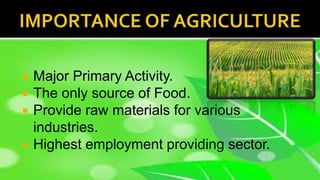
 Major Primary Activity.
 The only source of Food.
 Provide raw materials for various
industries.
 Highest employment providing sector.
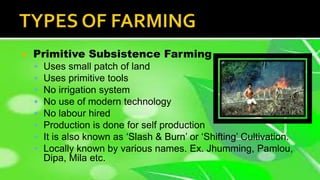
 Primitive Subsistence Farming
 Uses small patch of land
 Uses primitive tools
 No irrigation system
 No use of modern technology
 No labour hired
 Production is done for self production
 It is also known as ‘Slash & Burn’ or ‘Shifting’ Cultivation.
 Locally known by various names. Ex. Jhumming, Pamlou,
Dipa, Mila etc.
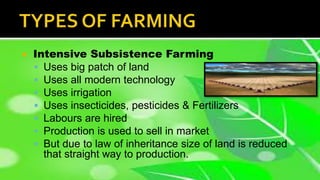
 Intensive Subsistence Farming
 Uses big patch of land
 Uses all modern technology
 Uses irrigation
 Uses insecticides, pesticides & Fertilizers
 Labours are hired
 Production is used to sell in market
 But due to law of inheritance size of land is reduced
that straight way to production.
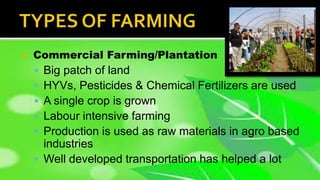
 Commercial Farming/Plantation
 Big patch of land
 HYVs, Pesticides & Chemical Fertilizers are used
 A single crop is grown
 Labour intensive farming
 Production is used as raw materials in agro based
industries
 Well developed transportation has helped a lot
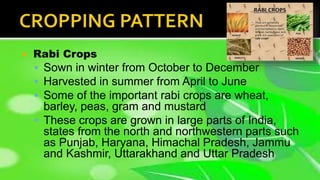
 Rabi Crops
 Sown in winter from October to December
 Harvested in summer from April to June
 Some of the important rabi crops are wheat,
barley, peas, gram and mustard
 These crops are grown in large parts of India,
states from the north and northwestern parts such
as Punjab, Haryana, Himachal Pradesh, Jammu
and Kashmir, Uttarakhand and Uttar Pradesh
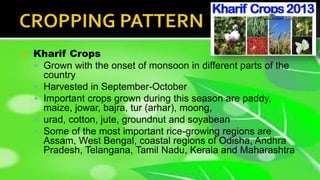
 Kharif Crops
 Grown with the onset of monsoon in different parts of the
country
 Harvested in September-October
 Important crops grown during this season are paddy,
maize, jowar, bajra, tur (arhar), moong,
 urad, cotton, jute, groundnut and soyabean
 Some of the most important rice-growing regions are
Assam, West Bengal, coastal regions of Odisha, Andhra
Pradesh, Telangana, Tamil Nadu, Kerala and Maharashtra
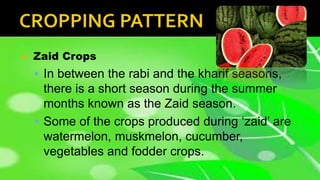
 Zaid Crops
 In between the rabi and the kharif seasons,
there is a short season during the summer
months known as the Zaid season.
 Some of the crops produced during ‘zaid’ are
watermelon, muskmelon, cucumber,
vegetables and fodder crops.
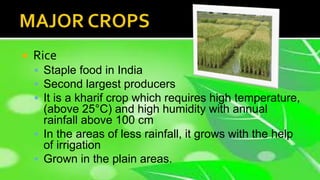
 Rice
 Staple food in India
 Second largest producers
 It is a kharif crop which requires high temperature,
(above 25°C) and high humidity with annual
rainfall above 100 cm
 In the areas of less rainfall, it grows with the help
of irrigation
 Grown in the plain areas.
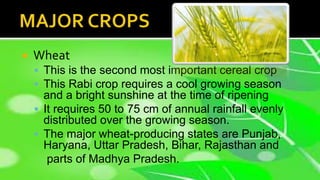
 Wheat
 This is the second most important cereal crop
 This Rabi crop requires a cool growing season
and a bright sunshine at the time of ripening
 It requires 50 to 75 cm of annual rainfall evenly
distributed over the growing season.
 The major wheat-producing states are Punjab,
Haryana, Uttar Pradesh, Bihar, Rajasthan and
parts of Madhya Pradesh.
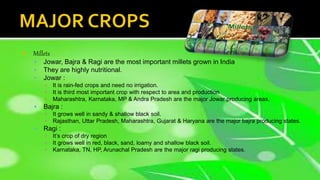
 Millets
 Jowar, Bajra & Ragi are the most important millets grown in India
 They are highly nutritional.
 Jowar :
▪ It is rain-fed crops and need no irrigation.
▪ It is third most important crop with respect to area and production
▪ Maharashtra, Karnataka, MP & Andra Pradesh are the major Jowar producing areas.
 Bajra :
▪ It grows well in sandy & shallow black soil.
▪ Rajasthan, Uttar Pradesh, Maharashtra, Gujarat & Haryana are the major bajra producing states.
 Ragi :
▪ It’s crop of dry region
▪ It grows well in red, black, sand, loamy and shallow black soil.
▪ Karnataka, TN, HP, Arunachal Pradesh are the major ragi producing states.
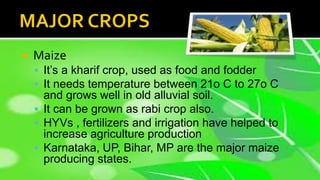
 Maize
 It’s a kharif crop, used as food and fodder
 It needs temperature between 21o C to 27o C
and grows well in old alluvial soil.
 It can be grown as rabi crop also.
 HYVs , fertilizers and irrigation have helped to
increase agriculture production
 Karnataka, UP, Bihar, MP are the major maize
producing states.
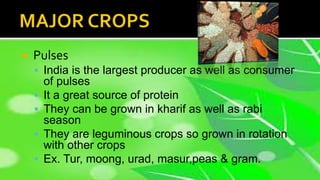
 Pulses
 India is the largest producer as well as consumer
of pulses
 It a great source of protein
 They can be grown in kharif as well as rabi
season
 They are leguminous crops so grown in rotation
with other crops
 Ex. Tur, moong, urad, masur,peas & gram.
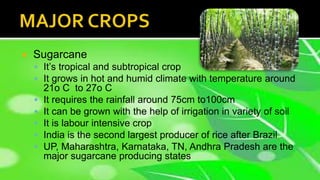
 Sugarcane
 It’s tropical and subtropical crop
 It grows in hot and humid climate with temperature around
21o C to 27o C
 It requires the rainfall around 75cm to100cm
 It can be grown with the help of irrigation in variety of soil
 It is labour intensive crop
 India is the second largest producer of rice after Brazil
 UP, Maharashtra, Karnataka, TN, Andhra Pradesh are the
major sugarcane producing states
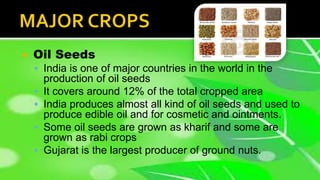
 Oil Seeds
 India is one of major countries in the world in the
production of oil seeds
 It covers around 12% of the total cropped area
 India produces almost all kind of oil seeds and used to
produce edible oil and for cosmetic and ointments.
 Some oil seeds are grown as kharif and some are
grown as rabi crops
 Gujarat is the largest producer of ground nuts.
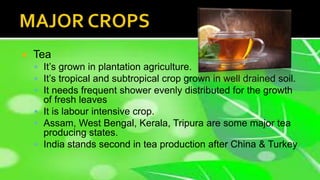
 Tea
 It’s grown in plantation agriculture.
 It’s tropical and subtropical crop grown in well drained soil.
 It needs frequent shower evenly distributed for the growth
of fresh leaves
 It is labour intensive crop.
 Assam, West Bengal, Kerala, Tripura are some major tea
producing states.
 India stands second in tea production after China & Turkey
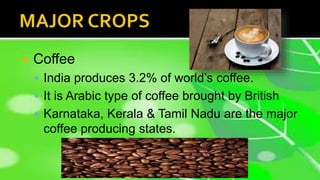
 Coffee
 India produces 3.2% of world’s coffee.
 It is Arabic type of coffee brought by British
 Karnataka, Kerala & Tamil Nadu are the major
coffee producing states.
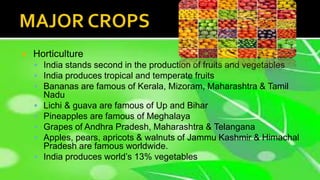
 Horticulture
 India stands second in the production of fruits and vegetables
 India produces tropical and temperate fruits
 Bananas are famous of Kerala, Mizoram, Maharashtra & Tamil
Nadu
 Lichi & guava are famous of Up and Bihar
 Pineapples are famous of Meghalaya
 Grapes of Andhra Pradesh, Maharashtra & Telangana
 Apples, pears, apricots & walnuts of Jammu Kashmir & Himachal
Pradesh are famous worldwide.
 India produces world’s 13% vegetables
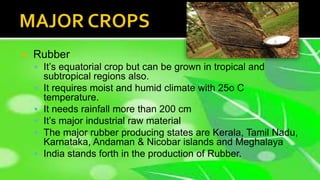
 Rubber
 It’s equatorial crop but can be grown in tropical and
subtropical regions also.
 It requires moist and humid climate with 25o C
temperature.
 It needs rainfall more than 200 cm
 It’s major industrial raw material
 The major rubber producing states are Kerala, Tamil Nadu,
Karnataka, Andaman & Nicobar islands and Meghalaya
 India stands forth in the production of Rubber.
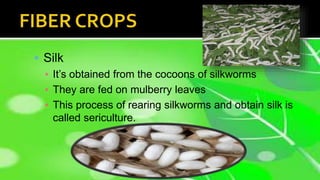
 Silk
▪ It’s obtained from the cocoons of silkworms
▪ They are fed on mulberry leaves
▪ This process of rearing silkworms and obtain silk is
called sericulture.
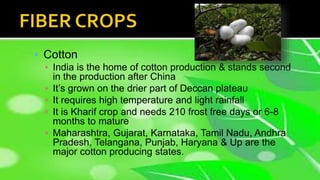
 Cotton
▪ India is the home of cotton production & stands second
in the production after China
▪ It’s grown on the drier part of Deccan plateau
▪ It requires high temperature and light rainfall
▪ It is Kharif crop and needs 210 frost free days or 6-8
months to mature
▪ Maharashtra, Gujarat, Karnataka, Tamil Nadu, Andhra
Pradesh, Telangana, Punjab, Haryana & Up are the
major cotton producing states.
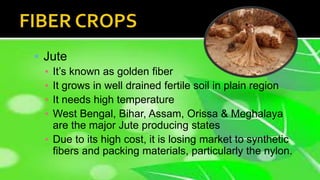
 Jute
▪ It’s known as golden fiber
▪ It grows in well drained fertile soil in plain region
▪ It needs high temperature
▪ West Bengal, Bihar, Assam, Orissa & Meghalaya
are the major Jute producing states
▪ Due to its high cost, it is losing market to synthetic
fibers and packing materials, particularly the nylon.
 Land Reforms
▪ Abolishing ‘Zamindari’
▪ Land Distribution
▪ Land Ceiling
 Technological Reforms
▪ Green Revolution
▪ Use of ‘HYVs’
▪ Modern Equipment
▪ Irrigation Facilities
▪ Fertilizers and Pesticides
▪ White Revolution
▪ Quality Breeds of cattle
▪ Supplementary to agriculture
 Institutional Reforms
▪ Opening of banks and cooperatives
▪ KCC and Personal Accidental Insurance
▪ Opening of Agriculture colleges and Universities
▪ Using Radio, TVs and satellites for agriculture
education.
▪ Agriculture research center
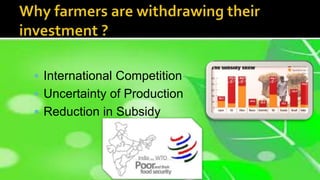
 International Competition
 Uncertainty of Production
 Reduction in Subsidy
Agriculture ppt

Agriculture ppt

  • 1.
  • 2.
  • 3.
     Major PrimaryActivity.  The only source of Food.  Provide raw materials for various industries.  Highest employment providing sector.
  • 4.
     Primitive SubsistenceFarming  Uses small patch of land  Uses primitive tools  No irrigation system  No use of modern technology  No labour hired  Production is done for self production  It is also known as ‘Slash & Burn’ or ‘Shifting’ Cultivation.  Locally known by various names. Ex. Jhumming, Pamlou, Dipa, Mila etc.
  • 5.
     Intensive SubsistenceFarming  Uses big patch of land  Uses all modern technology  Uses irrigation  Uses insecticides, pesticides & Fertilizers  Labours are hired  Production is used to sell in market  But due to law of inheritance size of land is reduced that straight way to production.
  • 6.
     Commercial Farming/Plantation Big patch of land  HYVs, Pesticides & Chemical Fertilizers are used  A single crop is grown  Labour intensive farming  Production is used as raw materials in agro based industries  Well developed transportation has helped a lot
  • 7.
     Rabi Crops Sown in winter from October to December  Harvested in summer from April to June  Some of the important rabi crops are wheat, barley, peas, gram and mustard  These crops are grown in large parts of India, states from the north and northwestern parts such as Punjab, Haryana, Himachal Pradesh, Jammu and Kashmir, Uttarakhand and Uttar Pradesh
  • 8.
     Kharif Crops Grown with the onset of monsoon in different parts of the country  Harvested in September-October  Important crops grown during this season are paddy, maize, jowar, bajra, tur (arhar), moong,  urad, cotton, jute, groundnut and soyabean  Some of the most important rice-growing regions are Assam, West Bengal, coastal regions of Odisha, Andhra Pradesh, Telangana, Tamil Nadu, Kerala and Maharashtra
  • 9.
     Zaid Crops In between the rabi and the kharif seasons, there is a short season during the summer months known as the Zaid season.  Some of the crops produced during ‘zaid’ are watermelon, muskmelon, cucumber, vegetables and fodder crops.
  • 10.
     Rice  Staplefood in India  Second largest producers  It is a kharif crop which requires high temperature, (above 25°C) and high humidity with annual rainfall above 100 cm  In the areas of less rainfall, it grows with the help of irrigation  Grown in the plain areas.
  • 11.
     Wheat  Thisis the second most important cereal crop  This Rabi crop requires a cool growing season and a bright sunshine at the time of ripening  It requires 50 to 75 cm of annual rainfall evenly distributed over the growing season.  The major wheat-producing states are Punjab, Haryana, Uttar Pradesh, Bihar, Rajasthan and parts of Madhya Pradesh.
  • 12.
     Millets  Jowar,Bajra & Ragi are the most important millets grown in India  They are highly nutritional.  Jowar : ▪ It is rain-fed crops and need no irrigation. ▪ It is third most important crop with respect to area and production ▪ Maharashtra, Karnataka, MP & Andra Pradesh are the major Jowar producing areas.  Bajra : ▪ It grows well in sandy & shallow black soil. ▪ Rajasthan, Uttar Pradesh, Maharashtra, Gujarat & Haryana are the major bajra producing states.  Ragi : ▪ It’s crop of dry region ▪ It grows well in red, black, sand, loamy and shallow black soil. ▪ Karnataka, TN, HP, Arunachal Pradesh are the major ragi producing states.
  • 13.
     Maize  It’sa kharif crop, used as food and fodder  It needs temperature between 21o C to 27o C and grows well in old alluvial soil.  It can be grown as rabi crop also.  HYVs , fertilizers and irrigation have helped to increase agriculture production  Karnataka, UP, Bihar, MP are the major maize producing states.
  • 14.
     Pulses  Indiais the largest producer as well as consumer of pulses  It a great source of protein  They can be grown in kharif as well as rabi season  They are leguminous crops so grown in rotation with other crops  Ex. Tur, moong, urad, masur,peas & gram.
  • 15.
     Sugarcane  It’stropical and subtropical crop  It grows in hot and humid climate with temperature around 21o C to 27o C  It requires the rainfall around 75cm to100cm  It can be grown with the help of irrigation in variety of soil  It is labour intensive crop  India is the second largest producer of rice after Brazil  UP, Maharashtra, Karnataka, TN, Andhra Pradesh are the major sugarcane producing states
  • 16.
     Oil Seeds India is one of major countries in the world in the production of oil seeds  It covers around 12% of the total cropped area  India produces almost all kind of oil seeds and used to produce edible oil and for cosmetic and ointments.  Some oil seeds are grown as kharif and some are grown as rabi crops  Gujarat is the largest producer of ground nuts.
  • 17.
     Tea  It’sgrown in plantation agriculture.  It’s tropical and subtropical crop grown in well drained soil.  It needs frequent shower evenly distributed for the growth of fresh leaves  It is labour intensive crop.  Assam, West Bengal, Kerala, Tripura are some major tea producing states.  India stands second in tea production after China & Turkey
  • 18.
     Coffee  Indiaproduces 3.2% of world’s coffee.  It is Arabic type of coffee brought by British  Karnataka, Kerala & Tamil Nadu are the major coffee producing states.
  • 19.
     Horticulture  Indiastands second in the production of fruits and vegetables  India produces tropical and temperate fruits  Bananas are famous of Kerala, Mizoram, Maharashtra & Tamil Nadu  Lichi & guava are famous of Up and Bihar  Pineapples are famous of Meghalaya  Grapes of Andhra Pradesh, Maharashtra & Telangana  Apples, pears, apricots & walnuts of Jammu Kashmir & Himachal Pradesh are famous worldwide.  India produces world’s 13% vegetables
  • 20.
     Rubber  It’sequatorial crop but can be grown in tropical and subtropical regions also.  It requires moist and humid climate with 25o C temperature.  It needs rainfall more than 200 cm  It’s major industrial raw material  The major rubber producing states are Kerala, Tamil Nadu, Karnataka, Andaman & Nicobar islands and Meghalaya  India stands forth in the production of Rubber.
  • 21.
     Silk ▪ It’sobtained from the cocoons of silkworms ▪ They are fed on mulberry leaves ▪ This process of rearing silkworms and obtain silk is called sericulture.
  • 22.
     Cotton ▪ Indiais the home of cotton production & stands second in the production after China ▪ It’s grown on the drier part of Deccan plateau ▪ It requires high temperature and light rainfall ▪ It is Kharif crop and needs 210 frost free days or 6-8 months to mature ▪ Maharashtra, Gujarat, Karnataka, Tamil Nadu, Andhra Pradesh, Telangana, Punjab, Haryana & Up are the major cotton producing states.
  • 23.
     Jute ▪ It’sknown as golden fiber ▪ It grows in well drained fertile soil in plain region ▪ It needs high temperature ▪ West Bengal, Bihar, Assam, Orissa & Meghalaya are the major Jute producing states ▪ Due to its high cost, it is losing market to synthetic fibers and packing materials, particularly the nylon.
  • 24.
     Land Reforms ▪Abolishing ‘Zamindari’ ▪ Land Distribution ▪ Land Ceiling
  • 25.
     Technological Reforms ▪Green Revolution ▪ Use of ‘HYVs’ ▪ Modern Equipment ▪ Irrigation Facilities ▪ Fertilizers and Pesticides ▪ White Revolution ▪ Quality Breeds of cattle ▪ Supplementary to agriculture
  • 26.
     Institutional Reforms ▪Opening of banks and cooperatives ▪ KCC and Personal Accidental Insurance ▪ Opening of Agriculture colleges and Universities ▪ Using Radio, TVs and satellites for agriculture education. ▪ Agriculture research center
  • 27.
     International Competition Uncertainty of Production  Reduction in Subsidy