MADATSST
&
MUKUND INGLE
PRESENTS
Mr. Mukund B.
Ingle
MEANING & SIGNIFICANCE
 Production of goods in large quantities after processing from raw materials to
more valuable products is called manufacturing.
 Manufacturing industries not only help in modernising agriculture, which
forms the backbone of our economy, they also reduce the heavy dependence
of people on agricultural income.
 Industrial development is a precondition for eradication of unemployment
and poverty from our country. It was also aimed at bringing down regional
disparities by establishing industries in tribal and backward areas.
 Export of manufactured goods expands trade and commerce, and brings in
much needed foreign exchange.
 Countries that transform their raw materials into a wide variety of furnished
goods of higher value are prosperous.

CONTRIBUTION IN NATIONAL ECONOMY
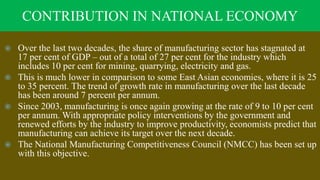
 Over the last two decades, the share of manufacturing sector has stagnated at
17 per cent of GDP – out of a total of 27 per cent for the industry which
includes 10 per cent for mining, quarrying, electricity and gas.
 This is much lower in comparison to some East Asian economies, where it is 25
to 35 percent. The trend of growth rate in manufacturing over the last decade
has been around 7 percent per annum.
 Since 2003, manufacturing is once again growing at the rate of 9 to 10 per cent
per annum. With appropriate policy interventions by the government and
renewed efforts by the industry to improve productivity, economists predict that
manufacturing can achieve its target over the next decade.
 The National Manufacturing Competitiveness Council (NMCC) has been set up
with this objective.
FACTORS OF LOCATION OF INDUSTRY
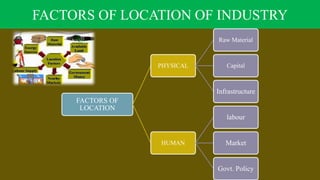
FACTORS OF
LOCATION
PHYSICAL
Raw Material
Capital
Infrastructure
HUMAN
labour
Market
Govt. Policy
CLASSIFICATION OF INDUSTRY
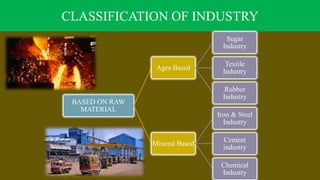
BASED ON RAW
MATERIAL
Agro Based
Sugar
Industry
Textile
Industry
Rubber
Industry
Mineral Based
Iron & Steel
Industry
Cement
industry
Chemical
Industry
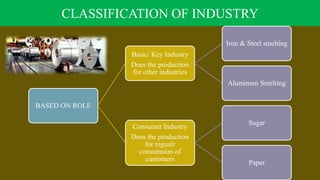
CLASSIFICATION OF INDUSTRY
BASED ON ROLE
Basic/ Key Industry
Does the production
for other industries
Iron & Steel smelting
Aluminum Smelting
Consumer Industry
Does the production
for regualr
consumsion of
customers
Sugar
Paper
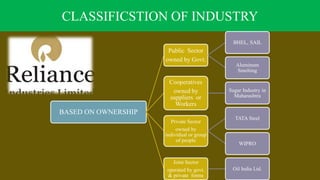
CLASSIFICSTION OF INDUSTRY
BASED ON OWNERSHIP
Public Sector
owned by Govt.
BHEL, SAIL
Aluminum
Smelting
Cooperatives
owned by
suppliers or
Workers
Sugar Industry in
Maharashtra
Private Sector
owned by
individual or group
of people
TATA Steel
WIPRO
Joint Sector
operated by govt.
& private forms
Oil India Ltd.
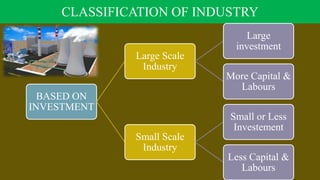
CLASSIFICATION OF INDUSTRY
BASED ON
INVESTMENT
Large Scale
Industry
Large
investment
More Capital &
Labours
Small Scale
Industry
Small or Less
Investement
Less Capital &
Labours
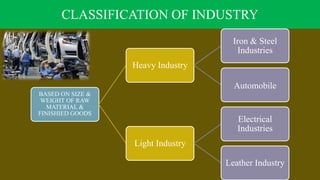
CLASSIFICATION OF INDUSTRY
BASED ON SIZE &
WEIGHT OF RAW
MATERIAL &
FINISHIED GOODS
Heavy Industry
Iron & Steel
Industries
Automobile
Light Industry
Electrical
Industries
Leather Industry
COTTON TEXTILE INDUSTRY
 It contributes 14% in industrial production, generates 35 million jobs, holds 4% in GDP
and earns 24.6% foreign exchanges.
 It is the only self-reliant and value added industry (each stage adds value from fiber to
yarn
 Cotton Industry:
 First cotton was established in Mumbai in 1854. Indian Cotton industry is doing
good in all Private, Public and Cooperatives too.
 This industry provides a living to farmers, cotton boll pluckers and workers engaged
in ginning, spinning, weaving, dyeing, designing, packaging, tailoring and sewing.
 The industry by creating demands supports many other industries, such as, chemicals
and dyes, mill stores, packaging materials and engineering works.
COTTON TEXTILE INDUSTRY
 This industry is located more in Maharashtra due to
following reasons:-
○ Raw Material: This region is cotton growing region due to black
soil available.
○ Moist Climate : It helps for spinning well
○ Infrastructure: This region has better transport, market and
capital available
○ Port: Mumbai Port helps for transporting things out of India
○ Labour: Rural regions have ample and cheap labours available.
COTTON TEXTILE INDUSTRY
 Challenges:-
○ Many of our spinners export cotton yarn while apparel/garment
manufactures have to import fabric.
○ Acute competition from Chain
○ Power supply is erratic and machinery needs to be upgraded in
the weaving and processing sectors in particular.
○ Other problems are the low output of labour and stiff
competition with the synthetic fibre industry.
JUTE TEXTILE INDUSTRY
 India stands second in production and export of Jute after Bangladesh
 In 2010-11 the jute industry was supporting 3.7 lakh workers directly and another 40 lakhs
small and marginal farmers who were engaged in cultivation.
 Jute industry in India is located mostly in West Bengal:
○ Proximity of the jute producing areas,
○ Inexpensive water transport, supported by a good network of railways, roadways and
waterways to facilitate movement of raw material to the mills,
○ Abundant water for processing raw jute,
○ Cheap labour from West Bengal and adjoining states of Bihar, Orissa and Uttar Pradesh.
○ Kolkata as a large urban center provides banking, insurance and port facilities for export of
jute goods.
JUTE TEXTILE INDUSTRY
 Challenges faced by Jute Industry
○ Challenges faced by the industry include stiff competition in the
international market from synthetic substitutes and from other
competitors like Bangladesh, Brazil, Philippines, Egypt and Thailand.
 Jute Policy 2005
○ In 2005, National Jute Policy was formulated with the objective of
increasing productivity, improving quality, ensuring good prices to the
jute farmers and enhancing the yield per hectare.
○ The growing global concern for environment friendly, biodegradable
materials, has once again opened the opportunity for jute products.
SUGAR INDUSTRY
 India is second largest producer of sugar but holds first
in the production of ‘Gur’ and ‘Khandsari’.
 Uttar Pradesh is the largest producer of sugar:
 Raw Material
 Labour
 Water
 Transport
 This industry is seasonal in nature so, it is ideally suited
to the cooperative sector.
SUGAR INDUSTRY
 This industry is shifting towards south especially in
Maharashtra:
 This is because the cane produced here has a higher sucrose
content. The cooler climate also ensures a longer crushing
season. Moreover, the cooperatives are more successful in
these states.
 Challenges
 Major challenges include the seasonal nature of the industry,
 Old and inefficient methods of production,
 transport delay in reaching cane to factories and
 The need to maximize the use of baggase.
IRON & STEEL INDUSTRY
 The iron and steel Industry is the basic industry since all the other
industries — heavy, medium and light, depend on it for their machinery.
Steel is needed to manufacture a variety of engineering goods,
construction material, defense, medical, telephonic, scientific equipment
and a variety of consumer goods.
 Iron ore, coking coal and lime stone are required in the ratio of
approximately 4 : 2 : 1. Some quantities of manganese, are also required
to harden the steel.
 In 2010-11 with 72.2 million tones of steel production, India ranked 4th
among the world crude steel producers. It is the largest producer of
sponge iron. In 2010-11 per capita consumption of steel in the country
was only around 49 kg per annum against the world average of 182 kg.
IRON & STEEL INDUSTRY
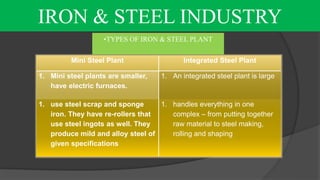
Mini Steel Plant Integrated Steel Plant
1. Mini steel plants are smaller,
have electric furnaces.
1. An integrated steel plant is large
1. use steel scrap and sponge
iron. They have re-rollers that
use steel ingots as well. They
produce mild and alloy steel of
given specifications
1. handles everything in one
complex – from putting together
raw material to steel making,
rolling and shaping
•TYPES OF IRON & STEEL PLANT
IRON & STEEL INDUSTRY
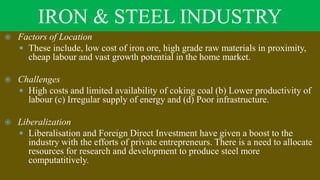
 Factors of Location
 These include, low cost of iron ore, high grade raw materials in proximity,
cheap labour and vast growth potential in the home market.
 Challenges
 High costs and limited availability of coking coal (b) Lower productivity of
labour (c) Irregular supply of energy and (d) Poor infrastructure.
 Liberalization
 Liberalisation and Foreign Direct Investment have given a boost to the
industry with the efforts of private entrepreneurs. There is a need to allocate
resources for research and development to produce steel more
computatitively.
ALUMINIUM INDUSTRY
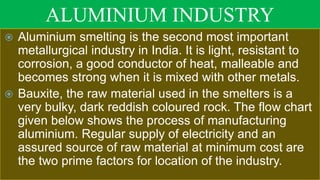
 Aluminium smelting is the second most important
metallurgical industry in India. It is light, resistant to
corrosion, a good conductor of heat, malleable and
becomes strong when it is mixed with other metals.
 Bauxite, the raw material used in the smelters is a
very bulky, dark reddish coloured rock. The flow chart
given below shows the process of manufacturing
aluminium. Regular supply of electricity and an
assured source of raw material at minimum cost are
the two prime factors for location of the industry.
CHEMICAL INDUSTRY
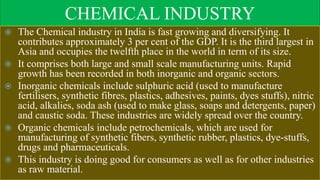
 The Chemical industry in India is fast growing and diversifying. It
contributes approximately 3 per cent of the GDP. It is the third largest in
Asia and occupies the twelfth place in the world in term of its size.
 It comprises both large and small scale manufacturing units. Rapid
growth has been recorded in both inorganic and organic sectors.
 Inorganic chemicals include sulphuric acid (used to manufacture
fertilisers, synthetic fibres, plastics, adhesives, paints, dyes stuffs), nitric
acid, alkalies, soda ash (used to make glass, soaps and detergents, paper)
and caustic soda. These industries are widely spread over the country.
 Organic chemicals include petrochemicals, which are used for
manufacturing of synthetic fibers, synthetic rubber, plastics, dye-stuffs,
drugs and pharmaceuticals.
 This industry is doing good for consumers as well as for other industries
as raw material.
FERTILIZER INDUSTRY
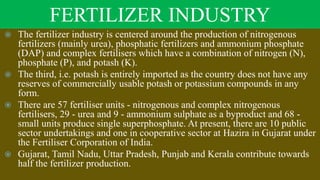
 The fertilizer industry is centered around the production of nitrogenous
fertilizers (mainly urea), phosphatic fertilizers and ammonium phosphate
(DAP) and complex fertilisers which have a combination of nitrogen (N),
phosphate (P), and potash (K).
 The third, i.e. potash is entirely imported as the country does not have any
reserves of commercially usable potash or potassium compounds in any
form.
 There are 57 fertiliser units - nitrogenous and complex nitrogenous
fertilisers, 29 - urea and 9 - ammonium sulphate as a byproduct and 68 -
small units produce single superphosphate. At present, there are 10 public
sector undertakings and one in cooperative sector at Hazira in Gujarat under
the Fertiliser Corporation of India.
 Gujarat, Tamil Nadu, Uttar Pradesh, Punjab and Kerala contribute towards
half the fertilizer production.
CEMENT INDUSTRY
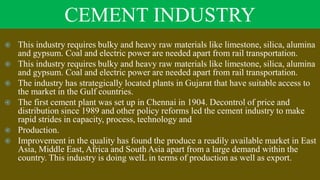
 This industry requires bulky and heavy raw materials like limestone, silica, alumina
and gypsum. Coal and electric power are needed apart from rail transportation.
 This industry requires bulky and heavy raw materials like limestone, silica, alumina
and gypsum. Coal and electric power are needed apart from rail transportation.
 The industry has strategically located plants in Gujarat that have suitable access to
the market in the Gulf countries.
 The first cement plant was set up in Chennai in 1904. Decontrol of price and
distribution since 1989 and other policy reforms led the cement industry to make
rapid strides in capacity, process, technology and
 Production.
 Improvement in the quality has found the produce a readily available market in East
Asia, Middle East, Africa and South Asia apart from a large demand within the
country. This industry is doing welL in terms of production as well as export.
AUTOMOBILE INDUSTRY
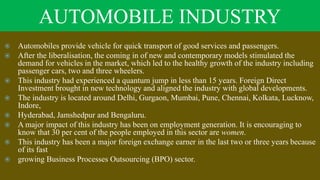
 Automobiles provide vehicle for quick transport of good services and passengers.
 After the liberalisation, the coming in of new and contemporary models stimulated the
demand for vehicles in the market, which led to the healthy growth of the industry including
passenger cars, two and three wheelers.
 This industry had experienced a quantum jump in less than 15 years. Foreign Direct
Investment brought in new technology and aligned the industry with global developments.
 The industry is located around Delhi, Gurgaon, Mumbai, Pune, Chennai, Kolkata, Lucknow,
Indore,
 Hyderabad, Jamshedpur and Bengaluru.
 A major impact of this industry has been on employment generation. It is encouraging to
know that 30 per cent of the people employed in this sector are women.
 This industry has been a major foreign exchange earner in the last two or three years because
of its fast
 growing Business Processes Outsourcing (BPO) sector.
INDUSTRIAL POLLUTION
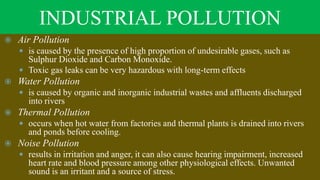
 Air Pollution
 is caused by the presence of high proportion of undesirable gases, such as
Sulphur Dioxide and Carbon Monoxide.
 Toxic gas leaks can be very hazardous with long-term effects
 Water Pollution
 is caused by organic and inorganic industrial wastes and affluents discharged
into rivers
 Thermal Pollution
 occurs when hot water from factories and thermal plants is drained into rivers
and ponds before cooling.
 Noise Pollution
 results in irritation and anger, it can also cause hearing impairment, increased
heart rate and blood pressure among other physiological effects. Unwanted
sound is an irritant and a source of stress.
CONTROL OF ENVIRONMENTAL DEGRADATION
 i) Minimising use water for processing by reusing and
recycling it in two or more successive stages
 (ii) harvesting of rainwater to meet water requirements
 (iii) treating hot water and effluents before releasing them
in rivers and ponds. Treatment of 3254 industrial effluents
can be done in three phases:-
 (a) Primary treatment by mechanical means. This involves
screening, grinding, flocculation and sedimentation.
 (b) Secondary treatment by biological process
 (c) Tertiary treatment by biological, chemical and physical
processes. This involves recycling of wastewater.
Manufacturing industries

Manufacturing industries

  • 1.
  • 2.
  • 3.
    MEANING & SIGNIFICANCE Production of goods in large quantities after processing from raw materials to more valuable products is called manufacturing.  Manufacturing industries not only help in modernising agriculture, which forms the backbone of our economy, they also reduce the heavy dependence of people on agricultural income.  Industrial development is a precondition for eradication of unemployment and poverty from our country. It was also aimed at bringing down regional disparities by establishing industries in tribal and backward areas.  Export of manufactured goods expands trade and commerce, and brings in much needed foreign exchange.  Countries that transform their raw materials into a wide variety of furnished goods of higher value are prosperous. 
  • 4.
    CONTRIBUTION IN NATIONALECONOMY  Over the last two decades, the share of manufacturing sector has stagnated at 17 per cent of GDP – out of a total of 27 per cent for the industry which includes 10 per cent for mining, quarrying, electricity and gas.  This is much lower in comparison to some East Asian economies, where it is 25 to 35 percent. The trend of growth rate in manufacturing over the last decade has been around 7 percent per annum.  Since 2003, manufacturing is once again growing at the rate of 9 to 10 per cent per annum. With appropriate policy interventions by the government and renewed efforts by the industry to improve productivity, economists predict that manufacturing can achieve its target over the next decade.  The National Manufacturing Competitiveness Council (NMCC) has been set up with this objective.
  • 5.
    FACTORS OF LOCATIONOF INDUSTRY FACTORS OF LOCATION PHYSICAL Raw Material Capital Infrastructure HUMAN labour Market Govt. Policy
  • 6.
    CLASSIFICATION OF INDUSTRY BASEDON RAW MATERIAL Agro Based Sugar Industry Textile Industry Rubber Industry Mineral Based Iron & Steel Industry Cement industry Chemical Industry
  • 7.
    CLASSIFICATION OF INDUSTRY BASEDON ROLE Basic/ Key Industry Does the production for other industries Iron & Steel smelting Aluminum Smelting Consumer Industry Does the production for regualr consumsion of customers Sugar Paper
  • 8.
    CLASSIFICSTION OF INDUSTRY BASEDON OWNERSHIP Public Sector owned by Govt. BHEL, SAIL Aluminum Smelting Cooperatives owned by suppliers or Workers Sugar Industry in Maharashtra Private Sector owned by individual or group of people TATA Steel WIPRO Joint Sector operated by govt. & private forms Oil India Ltd.
  • 9.
    CLASSIFICATION OF INDUSTRY BASEDON INVESTMENT Large Scale Industry Large investment More Capital & Labours Small Scale Industry Small or Less Investement Less Capital & Labours
  • 10.
    CLASSIFICATION OF INDUSTRY BASEDON SIZE & WEIGHT OF RAW MATERIAL & FINISHIED GOODS Heavy Industry Iron & Steel Industries Automobile Light Industry Electrical Industries Leather Industry
  • 11.
    COTTON TEXTILE INDUSTRY It contributes 14% in industrial production, generates 35 million jobs, holds 4% in GDP and earns 24.6% foreign exchanges.  It is the only self-reliant and value added industry (each stage adds value from fiber to yarn  Cotton Industry:  First cotton was established in Mumbai in 1854. Indian Cotton industry is doing good in all Private, Public and Cooperatives too.  This industry provides a living to farmers, cotton boll pluckers and workers engaged in ginning, spinning, weaving, dyeing, designing, packaging, tailoring and sewing.  The industry by creating demands supports many other industries, such as, chemicals and dyes, mill stores, packaging materials and engineering works.
  • 12.
    COTTON TEXTILE INDUSTRY This industry is located more in Maharashtra due to following reasons:- ○ Raw Material: This region is cotton growing region due to black soil available. ○ Moist Climate : It helps for spinning well ○ Infrastructure: This region has better transport, market and capital available ○ Port: Mumbai Port helps for transporting things out of India ○ Labour: Rural regions have ample and cheap labours available.
  • 13.
    COTTON TEXTILE INDUSTRY Challenges:- ○ Many of our spinners export cotton yarn while apparel/garment manufactures have to import fabric. ○ Acute competition from Chain ○ Power supply is erratic and machinery needs to be upgraded in the weaving and processing sectors in particular. ○ Other problems are the low output of labour and stiff competition with the synthetic fibre industry.
  • 14.
    JUTE TEXTILE INDUSTRY India stands second in production and export of Jute after Bangladesh  In 2010-11 the jute industry was supporting 3.7 lakh workers directly and another 40 lakhs small and marginal farmers who were engaged in cultivation.  Jute industry in India is located mostly in West Bengal: ○ Proximity of the jute producing areas, ○ Inexpensive water transport, supported by a good network of railways, roadways and waterways to facilitate movement of raw material to the mills, ○ Abundant water for processing raw jute, ○ Cheap labour from West Bengal and adjoining states of Bihar, Orissa and Uttar Pradesh. ○ Kolkata as a large urban center provides banking, insurance and port facilities for export of jute goods.
  • 15.
    JUTE TEXTILE INDUSTRY Challenges faced by Jute Industry ○ Challenges faced by the industry include stiff competition in the international market from synthetic substitutes and from other competitors like Bangladesh, Brazil, Philippines, Egypt and Thailand.  Jute Policy 2005 ○ In 2005, National Jute Policy was formulated with the objective of increasing productivity, improving quality, ensuring good prices to the jute farmers and enhancing the yield per hectare. ○ The growing global concern for environment friendly, biodegradable materials, has once again opened the opportunity for jute products.
  • 16.
    SUGAR INDUSTRY  Indiais second largest producer of sugar but holds first in the production of ‘Gur’ and ‘Khandsari’.  Uttar Pradesh is the largest producer of sugar:  Raw Material  Labour  Water  Transport  This industry is seasonal in nature so, it is ideally suited to the cooperative sector.
  • 17.
    SUGAR INDUSTRY  Thisindustry is shifting towards south especially in Maharashtra:  This is because the cane produced here has a higher sucrose content. The cooler climate also ensures a longer crushing season. Moreover, the cooperatives are more successful in these states.  Challenges  Major challenges include the seasonal nature of the industry,  Old and inefficient methods of production,  transport delay in reaching cane to factories and  The need to maximize the use of baggase.
  • 18.
    IRON & STEELINDUSTRY  The iron and steel Industry is the basic industry since all the other industries — heavy, medium and light, depend on it for their machinery. Steel is needed to manufacture a variety of engineering goods, construction material, defense, medical, telephonic, scientific equipment and a variety of consumer goods.  Iron ore, coking coal and lime stone are required in the ratio of approximately 4 : 2 : 1. Some quantities of manganese, are also required to harden the steel.  In 2010-11 with 72.2 million tones of steel production, India ranked 4th among the world crude steel producers. It is the largest producer of sponge iron. In 2010-11 per capita consumption of steel in the country was only around 49 kg per annum against the world average of 182 kg.
  • 19.
    IRON & STEELINDUSTRY Mini Steel Plant Integrated Steel Plant 1. Mini steel plants are smaller, have electric furnaces. 1. An integrated steel plant is large 1. use steel scrap and sponge iron. They have re-rollers that use steel ingots as well. They produce mild and alloy steel of given specifications 1. handles everything in one complex – from putting together raw material to steel making, rolling and shaping •TYPES OF IRON & STEEL PLANT
  • 20.
    IRON & STEELINDUSTRY  Factors of Location  These include, low cost of iron ore, high grade raw materials in proximity, cheap labour and vast growth potential in the home market.  Challenges  High costs and limited availability of coking coal (b) Lower productivity of labour (c) Irregular supply of energy and (d) Poor infrastructure.  Liberalization  Liberalisation and Foreign Direct Investment have given a boost to the industry with the efforts of private entrepreneurs. There is a need to allocate resources for research and development to produce steel more computatitively.
  • 21.
    ALUMINIUM INDUSTRY  Aluminiumsmelting is the second most important metallurgical industry in India. It is light, resistant to corrosion, a good conductor of heat, malleable and becomes strong when it is mixed with other metals.  Bauxite, the raw material used in the smelters is a very bulky, dark reddish coloured rock. The flow chart given below shows the process of manufacturing aluminium. Regular supply of electricity and an assured source of raw material at minimum cost are the two prime factors for location of the industry.
  • 22.
    CHEMICAL INDUSTRY  TheChemical industry in India is fast growing and diversifying. It contributes approximately 3 per cent of the GDP. It is the third largest in Asia and occupies the twelfth place in the world in term of its size.  It comprises both large and small scale manufacturing units. Rapid growth has been recorded in both inorganic and organic sectors.  Inorganic chemicals include sulphuric acid (used to manufacture fertilisers, synthetic fibres, plastics, adhesives, paints, dyes stuffs), nitric acid, alkalies, soda ash (used to make glass, soaps and detergents, paper) and caustic soda. These industries are widely spread over the country.  Organic chemicals include petrochemicals, which are used for manufacturing of synthetic fibers, synthetic rubber, plastics, dye-stuffs, drugs and pharmaceuticals.  This industry is doing good for consumers as well as for other industries as raw material.
  • 23.
    FERTILIZER INDUSTRY  Thefertilizer industry is centered around the production of nitrogenous fertilizers (mainly urea), phosphatic fertilizers and ammonium phosphate (DAP) and complex fertilisers which have a combination of nitrogen (N), phosphate (P), and potash (K).  The third, i.e. potash is entirely imported as the country does not have any reserves of commercially usable potash or potassium compounds in any form.  There are 57 fertiliser units - nitrogenous and complex nitrogenous fertilisers, 29 - urea and 9 - ammonium sulphate as a byproduct and 68 - small units produce single superphosphate. At present, there are 10 public sector undertakings and one in cooperative sector at Hazira in Gujarat under the Fertiliser Corporation of India.  Gujarat, Tamil Nadu, Uttar Pradesh, Punjab and Kerala contribute towards half the fertilizer production.
  • 24.
    CEMENT INDUSTRY  Thisindustry requires bulky and heavy raw materials like limestone, silica, alumina and gypsum. Coal and electric power are needed apart from rail transportation.  This industry requires bulky and heavy raw materials like limestone, silica, alumina and gypsum. Coal and electric power are needed apart from rail transportation.  The industry has strategically located plants in Gujarat that have suitable access to the market in the Gulf countries.  The first cement plant was set up in Chennai in 1904. Decontrol of price and distribution since 1989 and other policy reforms led the cement industry to make rapid strides in capacity, process, technology and  Production.  Improvement in the quality has found the produce a readily available market in East Asia, Middle East, Africa and South Asia apart from a large demand within the country. This industry is doing welL in terms of production as well as export.
  • 25.
    AUTOMOBILE INDUSTRY  Automobilesprovide vehicle for quick transport of good services and passengers.  After the liberalisation, the coming in of new and contemporary models stimulated the demand for vehicles in the market, which led to the healthy growth of the industry including passenger cars, two and three wheelers.  This industry had experienced a quantum jump in less than 15 years. Foreign Direct Investment brought in new technology and aligned the industry with global developments.  The industry is located around Delhi, Gurgaon, Mumbai, Pune, Chennai, Kolkata, Lucknow, Indore,  Hyderabad, Jamshedpur and Bengaluru.  A major impact of this industry has been on employment generation. It is encouraging to know that 30 per cent of the people employed in this sector are women.  This industry has been a major foreign exchange earner in the last two or three years because of its fast  growing Business Processes Outsourcing (BPO) sector.
  • 26.
    INDUSTRIAL POLLUTION  AirPollution  is caused by the presence of high proportion of undesirable gases, such as Sulphur Dioxide and Carbon Monoxide.  Toxic gas leaks can be very hazardous with long-term effects  Water Pollution  is caused by organic and inorganic industrial wastes and affluents discharged into rivers  Thermal Pollution  occurs when hot water from factories and thermal plants is drained into rivers and ponds before cooling.  Noise Pollution  results in irritation and anger, it can also cause hearing impairment, increased heart rate and blood pressure among other physiological effects. Unwanted sound is an irritant and a source of stress.
  • 27.
    CONTROL OF ENVIRONMENTALDEGRADATION  i) Minimising use water for processing by reusing and recycling it in two or more successive stages  (ii) harvesting of rainwater to meet water requirements  (iii) treating hot water and effluents before releasing them in rivers and ponds. Treatment of 3254 industrial effluents can be done in three phases:-  (a) Primary treatment by mechanical means. This involves screening, grinding, flocculation and sedimentation.  (b) Secondary treatment by biological process  (c) Tertiary treatment by biological, chemical and physical processes. This involves recycling of wastewater.