By
M. SCUNZIANO, MD, NMD
12/04/2014
1
MINERAL NUTRIENTS:
VITAL SUBSTANCES FOR THE BODY…
HOW TO REPLENISH
2
Contents:
1) What is a mineral?
2) Essential minerals
3) Plant growth and minerals
4) Derivation of minerals
5) Where do minerals come from?
6) What about supplements?
7) Final notes
8) References & Recommended reading
3
…a naturally occurring substance found in the Earth’s crust that has
the following features:
1) It is not manufactured by the body OR a plant
2) It is crystalline with symmetrical geometric form
3) A solid that can be dissolved in solution
4) Inorganic that refers to a non-living/non-biological, non-plant
substance
5) Metallic
6) Can form salts
Out of 90 naturally occurring elements on the Earth, we have
information from different sources that would agree on the NEED for
the following minerals for the human body:
What is a MINERAL?
4
CALCIUM…muscle strength; bone
building; blood vessel stabilization
MAGNESIUM…muscle strength; co-factor
with calcium; nerve action; heart; blood
pressure control; anxiolytic; proper sleep;
ATP formation
SULFUR…bone and ligament strength;
protein manufacture; collagen formation;
immune protection
7 ESSENTIAL MACROMINERALS:
5
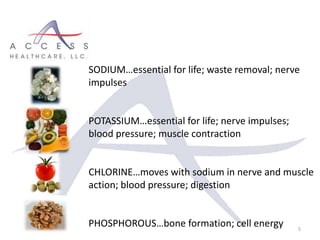
SODIUM…essential for life; waste removal; nerve
impulses
POTASSIUM…essential for life; nerve impulses;
blood pressure; muscle contraction
CHLORINE…moves with sodium in nerve and muscle
action; blood pressure; digestion
PHOSPHOROUS…bone formation; cell energy
6
CHROMIUM…blood sugar control
COBALT…needed for B12 formation
ZINC…needed for taste, smell; co-factor for 80+ enzyme
reactions; prostate health; antioxidant; anti-aging factor
SELENIUM…antioxidant/free-radical scavenger; thyroid function;
immune builds
COPPER…co-factor for hemoglobin formation; strengthens
arteries; immune builds
SILICON…co-factor in connective tissue strengthening; enzyme
actions
IRON…immune function and blood formation
16 TRACE MINERALS for BODY FUNCTIONS:
7
IODINE…essential for thyroid gland function; antioxidant in mammary
glands, salivary glands, prostate gland, gastric mucosa and immune
system
MOLYBDENUM…enzyme action
VANADIUM…blood sugar metabolism
FLOURINE…dental strength (NON-ESSENTIAL AND CONTROVERSIAL)
TIN…enzyme action
NICKEL…DNA synthesis; brain development; immunoregulator
MANGANESE…enzyme functions
BORON…reduces calcium excretion; activates vitamin D; bone health
STRONTIUM…assists in calcium utilization by bones; small dietary need
OTHER MINERALS UNDER INVESTIGATION…CADMIUM, ARSENIC both
may have roles in biological functions but this remains uncertain.
8
The above minerals are all CATALYSTS for biological processes. They are
involved in:
1) Body structures: formation of bones, teeth and ligaments
2) Electrolytes in blood that allow for transmission and
movement of molecules across membranes
3) Enzyme activity
4) Glandular function
5) Organ function
6) Energy production from the breakdown of food
7) Muscular action
8) Nerve impulses
These functions are all interrelated and a deficiency (or excess) of one
or more of the minerals can lead to multisystem illness or diseases.
9
KEY OR MACRONUTRIENTS are
**nitrogen, **potassium, **phosphorous,
**calcium, **sulfur, **magnesium
TRACE OR MICRONUTRIENT NEEDS are
Carbon, hydrogen, iodine, sulfur, magnesium, zinc, copper, boron,
manganese and molybdenum
**denotes that the plants require these in highest amounts
>>Nitrogen is not classified as a mineral. It is an Earth element that can be
solid, liquid or gas. It is abundant and essential for life. Plants and animals must
have nitrogen to live. It is not an element that needs emphasis in this
discussion since nitrogen is found in most living systems.
NOTE: PLANT GROWTH REQUIRES
THE FOLLOWING 15 NUTRIENTS…
10
AND, bacteria in the soil are the key players in converting
NITROGEN and SULFUR into usable forms for the plants!
Our bodies contain trillions of bacteria in the intestine
that, just like the plant world outside, help convert and
exchange nutrients for the benefit of the human body!!
So, keep in mind that our own colon microflora is very
important and they depend upon good minerals and
other nutrients for our survival.
11
The SOIL is our source of minerals for our dietary needs.
SOIL rich in nutrients (as indicated above) will provide plants
and all vegetation the raw materials.
The minerals in PLANT and ANIMAL foods come from the soil.
REMEMBER, AS STATED EARLIER,PLANTS AND ANIMALS
CANNOT MANUFACTURE MINERALS so they must be taken in
from another source.
If the soil content of a farm is rich in nutrients, the resulting
products will contain adequate dietary nutrients for humans.
DERIVATION OF MINERALS
FOR HUMAN CONSUMPTION…
12
Any deficits in soil, however, will not allow for a full
compliment of nutrients and consumption of added or
supplemental nutrients would be needed. Fortification
of food products with MINERALS and VITAMINS may be
needed. This process also MUST happen in the food
industry due to the PROCESSING of PLANTS- particularly
vegetables, fruits and grains.
SO WHERE DO THE ADDED MINERALS
ACTUALLY COME FROM?
13
Minerals are NATURALLY extracted from the soil. The
problem is that topsoil has been tampered with over
the past century with pesticides and other synthetic
chemicals bombarding the soil and depleting it of many
nutrients.
Labs are synthesizing products with minerals so that
naturally occurring minerals are not always the case.
The problem is that our bodies utilize nature’s
chemistry and can have trouble with “human-
manufactured” dietary items due to the lack of natural
interaction with the artificial chemistry.
14
WHAT ABOUT SUPPLEMENTS?
Natural vs Synthetic…
15
Our supplemental pills, i.e. vitamins, minerals, amino acids, fatty
acids, can be derived from whole foods or MANUFACTURED in labs.
Companies that use synthetic ingredients only with the least amount
of effectiveness for the average human being:
CENTRUM, NATURE MADE, NATURE’S WAY, SPRING VALLEY,
RITE AID, GERITOL, AVON, KROGER, 21ST CENTURY
16
Higher quality and higher effectiveness found in the following
companies. The criteria being composition, safety, bioavailability
and potency. The products are made with select plant sources and
may have some synthetic added ingredients:
GARDEN OF LIFE, LIFE EXTENSION, X-TEND- LIFE NATURAL
PRODUCTS, SOURCE NATURALS, OPTIMUM, METAGENICS, NEW
CHAPTER
17
The Garden of Life company uses raw foods in
its products.
These higher quality supplements are
available at most health-food shops and on-
line over the internet. You may contact any of
the companies for more information.
? SO NOW, WHAT BRANDS HAVE YOU BEEN USING?
18
Let’s look at the minerals a bit closer and what you should be looking
for to get the most…
Choose high quality only…
 Calcium: food sources are dairy, tofu, almonds, greens (kale and
collards are highest land plant sources), hijiki (a seaweed with the
highest calcium per ounce), soybeans, dried figs, parsley, sunflower
seeds, sesame seeds. Needed for: bones, teeth, muscle contraction,
heartbeat regulation, enzyme actions, cell division, blood clotting.
Use with magnesium and vitamin D3. You can use 50-500mg and
higher will NOT BE ABSORBED from the synthetic or processed
forms in a pill! AVOID calcium from oyster or eggshells. Body cannot
absorb calcium from these sources. We absorb about 12.5mg only.
19
 Magnesium: foods- dark leafy
greens, dark colored veggies, nuts,
seeds, avocados, apricots, meat,
dairy, seafood, millet, brown rice
and, if tolerated, whole wheat;
needed for proper heart function,
proper muscle function in general,
activates enzymes, DNA function; a
natural tranquilizer; May use up to
500mg or more if directed by a
doctor. Reduce or stop if diarrhea
happens.
20
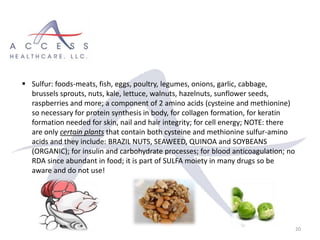
 Sulfur: foods-meats, fish, eggs, poultry, legumes, onions, garlic, cabbage,
brussels sprouts, nuts, kale, lettuce, walnuts, hazelnuts, sunflower seeds,
raspberries and more; a component of 2 amino acids (cysteine and methionine)
so necessary for protein synthesis in body, for collagen formation, for keratin
formation needed for skin, nail and hair integrity; for cell energy; NOTE: there
are only certain plants that contain both cysteine and methionine sulfur-amino
acids and they include: BRAZIL NUTS, SEAWEED, QUINOA and SOYBEANS
(ORGANIC); for insulin and carbohydrate processes; for blood anticoagulation; no
RDA since abundant in food; it is part of SULFA moiety in many drugs so be
aware and do not use!
21
 Sodium- food sources are all animal products and many veggies; found in
virtually ALL processed foods; need a healthy source for regulation of fluids,
acids and bases (pH); for muscle contraction and nerve impulses; for HCL
production in stomach thus DIGESTION! Keep added salt under control. Best to
use HIMALAYAN, CELTIC or GOOD QUALITY SEA SALT to add and balance foods.
Less than 3 grams is best. DO NOT OVERSALT ANYTHING. Caution with salt-
sensitive bodies, HTN and CHF.
 Potassium-abundant in most fruits and veggies, especially potatoes, broccoli,
oranges, bananas, apricots; needed by body for fluid and electrolyte balance;
synthesis of proteins; nerve conduction; for normal growth; normal muscle
contraction; NO NEED FOR SUPPLEMENTS UNLESS ON DIURETIC MEDICATION
OR HAVING FLUIDS LOST BY DISEASE; consult with doctor on any and all
supplements due to risks with taking too much.
22
 Chlorine- food sources are salt,
olives, celery, tomatoes; an
important part of digestive juices;
need for pH balance; clearance of
waste from liver; NOT TO BE
CONFUSED WITH ACTIVE CHLORINE
GAS OR BLEACH!! No supplements
needed in general.
 Phosphorous- found in meats, fish, dairy,
eggs; critical for bones, teeth, cell
function and health; protein synthesis,
growth and repair; muscles, heart and
nerve function; no supplements needed;
NOTE: must regulate levels in kidney
disease; no RDA or supplement needed.
23
 Trace minerals: Recommendation for healthy daily
supplemental trace elements… SELENIUM: up to 300mcg;
ZINC: 5-10mg max; COPPER: 500mcg; MANGANESE: 2mg:
IODINE: 150mcg- 15mg (consult with doctor before taking
larger doses of iodine); IRON: 15-18mg (check with doctor
on this due to iron overload problems that may occur post
menopause and in men)
24
BE ADVISED THAT SUPPLEMENTATION
WITH All OTHER MINERALS ARE
UNPROVEN SO USE WITH GUIDANCE
ONLY PLEASE!
25
FINAL NOTES
 BEST SOURCES OF MINERALS ARE FROM WHOLE FOODS.
 CHELATED MICRO- MINERALS NEED TO BE CHOSEN WELL. MOST
NATURALLY OCCURING MINERALS ARE CHELATED TOGETHER.
CHELATED PRODUCTS ARE USUALLY SAFE TO USE.
 IF YOUR DIET IS CONSISTING OF WHOLE FOODS DAILY WITH 5 OR
MORE SERVINGS OF QUALITY VEGETABELS/PLANTS WITH NO JUNK
ADDED, YOU LIKELY NEED NO ADDED MINERALS.
 DRUGS AND OTHER CHEMICAL EXPOSURES ON A DAILY/CONSTANT
BASIS WILL NECESSITATE SUPPLEMENTATION TO PROTECT THE BODY
 IF YOU HAVE A DEFICIENCY INVOLVING THYROID OR ADRENAL
GLAND, CONSULT A PROFESSIONAL FOR ALL SUPPLEMENTATION
 CONSULT WITH A PROFESSIONAL ON USE OF TRACE MINERALS DUE
TO THE UNCERTAINTIES OF EXCESSES AND POTENTIAL HARM
26
References & Recommended Reading:
1) Netzer, C. The Complete Book of Vitamin and Mineral Counts;
Delta, USA, 1997
2) Shane, Ellison. Over the Counter Natural Cures; Sourcebooks,
Inc., USA, 2009
3) WWW.GARDENOFLIFE.COM
4) WWW.LIVESTRONG.COM.MINERALS
5) WWW.WEBMD.COM.VITAMINS-AND-MINERAL-GOOD-FOOD-
SOURCES

Mineral

  • 1.
    By M. SCUNZIANO, MD,NMD 12/04/2014 1 MINERAL NUTRIENTS: VITAL SUBSTANCES FOR THE BODY… HOW TO REPLENISH
  • 2.
    2 Contents: 1) What isa mineral? 2) Essential minerals 3) Plant growth and minerals 4) Derivation of minerals 5) Where do minerals come from? 6) What about supplements? 7) Final notes 8) References & Recommended reading
  • 3.
    3 …a naturally occurringsubstance found in the Earth’s crust that has the following features: 1) It is not manufactured by the body OR a plant 2) It is crystalline with symmetrical geometric form 3) A solid that can be dissolved in solution 4) Inorganic that refers to a non-living/non-biological, non-plant substance 5) Metallic 6) Can form salts Out of 90 naturally occurring elements on the Earth, we have information from different sources that would agree on the NEED for the following minerals for the human body: What is a MINERAL?
  • 4.
    4 CALCIUM…muscle strength; bone building;blood vessel stabilization MAGNESIUM…muscle strength; co-factor with calcium; nerve action; heart; blood pressure control; anxiolytic; proper sleep; ATP formation SULFUR…bone and ligament strength; protein manufacture; collagen formation; immune protection 7 ESSENTIAL MACROMINERALS:
  • 5.
    5 SODIUM…essential for life;waste removal; nerve impulses POTASSIUM…essential for life; nerve impulses; blood pressure; muscle contraction CHLORINE…moves with sodium in nerve and muscle action; blood pressure; digestion PHOSPHOROUS…bone formation; cell energy
  • 6.
    6 CHROMIUM…blood sugar control COBALT…neededfor B12 formation ZINC…needed for taste, smell; co-factor for 80+ enzyme reactions; prostate health; antioxidant; anti-aging factor SELENIUM…antioxidant/free-radical scavenger; thyroid function; immune builds COPPER…co-factor for hemoglobin formation; strengthens arteries; immune builds SILICON…co-factor in connective tissue strengthening; enzyme actions IRON…immune function and blood formation 16 TRACE MINERALS for BODY FUNCTIONS:
  • 7.
    7 IODINE…essential for thyroidgland function; antioxidant in mammary glands, salivary glands, prostate gland, gastric mucosa and immune system MOLYBDENUM…enzyme action VANADIUM…blood sugar metabolism FLOURINE…dental strength (NON-ESSENTIAL AND CONTROVERSIAL) TIN…enzyme action NICKEL…DNA synthesis; brain development; immunoregulator MANGANESE…enzyme functions BORON…reduces calcium excretion; activates vitamin D; bone health STRONTIUM…assists in calcium utilization by bones; small dietary need OTHER MINERALS UNDER INVESTIGATION…CADMIUM, ARSENIC both may have roles in biological functions but this remains uncertain.
  • 8.
    8 The above mineralsare all CATALYSTS for biological processes. They are involved in: 1) Body structures: formation of bones, teeth and ligaments 2) Electrolytes in blood that allow for transmission and movement of molecules across membranes 3) Enzyme activity 4) Glandular function 5) Organ function 6) Energy production from the breakdown of food 7) Muscular action 8) Nerve impulses These functions are all interrelated and a deficiency (or excess) of one or more of the minerals can lead to multisystem illness or diseases.
  • 9.
    9 KEY OR MACRONUTRIENTSare **nitrogen, **potassium, **phosphorous, **calcium, **sulfur, **magnesium TRACE OR MICRONUTRIENT NEEDS are Carbon, hydrogen, iodine, sulfur, magnesium, zinc, copper, boron, manganese and molybdenum **denotes that the plants require these in highest amounts >>Nitrogen is not classified as a mineral. It is an Earth element that can be solid, liquid or gas. It is abundant and essential for life. Plants and animals must have nitrogen to live. It is not an element that needs emphasis in this discussion since nitrogen is found in most living systems. NOTE: PLANT GROWTH REQUIRES THE FOLLOWING 15 NUTRIENTS…
  • 10.
    10 AND, bacteria inthe soil are the key players in converting NITROGEN and SULFUR into usable forms for the plants! Our bodies contain trillions of bacteria in the intestine that, just like the plant world outside, help convert and exchange nutrients for the benefit of the human body!! So, keep in mind that our own colon microflora is very important and they depend upon good minerals and other nutrients for our survival.
  • 11.
    11 The SOIL isour source of minerals for our dietary needs. SOIL rich in nutrients (as indicated above) will provide plants and all vegetation the raw materials. The minerals in PLANT and ANIMAL foods come from the soil. REMEMBER, AS STATED EARLIER,PLANTS AND ANIMALS CANNOT MANUFACTURE MINERALS so they must be taken in from another source. If the soil content of a farm is rich in nutrients, the resulting products will contain adequate dietary nutrients for humans. DERIVATION OF MINERALS FOR HUMAN CONSUMPTION…
  • 12.
    12 Any deficits insoil, however, will not allow for a full compliment of nutrients and consumption of added or supplemental nutrients would be needed. Fortification of food products with MINERALS and VITAMINS may be needed. This process also MUST happen in the food industry due to the PROCESSING of PLANTS- particularly vegetables, fruits and grains. SO WHERE DO THE ADDED MINERALS ACTUALLY COME FROM?
  • 13.
    13 Minerals are NATURALLYextracted from the soil. The problem is that topsoil has been tampered with over the past century with pesticides and other synthetic chemicals bombarding the soil and depleting it of many nutrients. Labs are synthesizing products with minerals so that naturally occurring minerals are not always the case. The problem is that our bodies utilize nature’s chemistry and can have trouble with “human- manufactured” dietary items due to the lack of natural interaction with the artificial chemistry.
  • 14.
  • 15.
    15 Our supplemental pills,i.e. vitamins, minerals, amino acids, fatty acids, can be derived from whole foods or MANUFACTURED in labs. Companies that use synthetic ingredients only with the least amount of effectiveness for the average human being: CENTRUM, NATURE MADE, NATURE’S WAY, SPRING VALLEY, RITE AID, GERITOL, AVON, KROGER, 21ST CENTURY
  • 16.
    16 Higher quality andhigher effectiveness found in the following companies. The criteria being composition, safety, bioavailability and potency. The products are made with select plant sources and may have some synthetic added ingredients: GARDEN OF LIFE, LIFE EXTENSION, X-TEND- LIFE NATURAL PRODUCTS, SOURCE NATURALS, OPTIMUM, METAGENICS, NEW CHAPTER
  • 17.
    17 The Garden ofLife company uses raw foods in its products. These higher quality supplements are available at most health-food shops and on- line over the internet. You may contact any of the companies for more information. ? SO NOW, WHAT BRANDS HAVE YOU BEEN USING?
  • 18.
    18 Let’s look atthe minerals a bit closer and what you should be looking for to get the most… Choose high quality only…  Calcium: food sources are dairy, tofu, almonds, greens (kale and collards are highest land plant sources), hijiki (a seaweed with the highest calcium per ounce), soybeans, dried figs, parsley, sunflower seeds, sesame seeds. Needed for: bones, teeth, muscle contraction, heartbeat regulation, enzyme actions, cell division, blood clotting. Use with magnesium and vitamin D3. You can use 50-500mg and higher will NOT BE ABSORBED from the synthetic or processed forms in a pill! AVOID calcium from oyster or eggshells. Body cannot absorb calcium from these sources. We absorb about 12.5mg only.
  • 19.
    19  Magnesium: foods-dark leafy greens, dark colored veggies, nuts, seeds, avocados, apricots, meat, dairy, seafood, millet, brown rice and, if tolerated, whole wheat; needed for proper heart function, proper muscle function in general, activates enzymes, DNA function; a natural tranquilizer; May use up to 500mg or more if directed by a doctor. Reduce or stop if diarrhea happens.
  • 20.
    20  Sulfur: foods-meats,fish, eggs, poultry, legumes, onions, garlic, cabbage, brussels sprouts, nuts, kale, lettuce, walnuts, hazelnuts, sunflower seeds, raspberries and more; a component of 2 amino acids (cysteine and methionine) so necessary for protein synthesis in body, for collagen formation, for keratin formation needed for skin, nail and hair integrity; for cell energy; NOTE: there are only certain plants that contain both cysteine and methionine sulfur-amino acids and they include: BRAZIL NUTS, SEAWEED, QUINOA and SOYBEANS (ORGANIC); for insulin and carbohydrate processes; for blood anticoagulation; no RDA since abundant in food; it is part of SULFA moiety in many drugs so be aware and do not use!
  • 21.
    21  Sodium- foodsources are all animal products and many veggies; found in virtually ALL processed foods; need a healthy source for regulation of fluids, acids and bases (pH); for muscle contraction and nerve impulses; for HCL production in stomach thus DIGESTION! Keep added salt under control. Best to use HIMALAYAN, CELTIC or GOOD QUALITY SEA SALT to add and balance foods. Less than 3 grams is best. DO NOT OVERSALT ANYTHING. Caution with salt- sensitive bodies, HTN and CHF.  Potassium-abundant in most fruits and veggies, especially potatoes, broccoli, oranges, bananas, apricots; needed by body for fluid and electrolyte balance; synthesis of proteins; nerve conduction; for normal growth; normal muscle contraction; NO NEED FOR SUPPLEMENTS UNLESS ON DIURETIC MEDICATION OR HAVING FLUIDS LOST BY DISEASE; consult with doctor on any and all supplements due to risks with taking too much.
  • 22.
    22  Chlorine- foodsources are salt, olives, celery, tomatoes; an important part of digestive juices; need for pH balance; clearance of waste from liver; NOT TO BE CONFUSED WITH ACTIVE CHLORINE GAS OR BLEACH!! No supplements needed in general.  Phosphorous- found in meats, fish, dairy, eggs; critical for bones, teeth, cell function and health; protein synthesis, growth and repair; muscles, heart and nerve function; no supplements needed; NOTE: must regulate levels in kidney disease; no RDA or supplement needed.
  • 23.
    23  Trace minerals:Recommendation for healthy daily supplemental trace elements… SELENIUM: up to 300mcg; ZINC: 5-10mg max; COPPER: 500mcg; MANGANESE: 2mg: IODINE: 150mcg- 15mg (consult with doctor before taking larger doses of iodine); IRON: 15-18mg (check with doctor on this due to iron overload problems that may occur post menopause and in men)
  • 24.
    24 BE ADVISED THATSUPPLEMENTATION WITH All OTHER MINERALS ARE UNPROVEN SO USE WITH GUIDANCE ONLY PLEASE!
  • 25.
    25 FINAL NOTES  BESTSOURCES OF MINERALS ARE FROM WHOLE FOODS.  CHELATED MICRO- MINERALS NEED TO BE CHOSEN WELL. MOST NATURALLY OCCURING MINERALS ARE CHELATED TOGETHER. CHELATED PRODUCTS ARE USUALLY SAFE TO USE.  IF YOUR DIET IS CONSISTING OF WHOLE FOODS DAILY WITH 5 OR MORE SERVINGS OF QUALITY VEGETABELS/PLANTS WITH NO JUNK ADDED, YOU LIKELY NEED NO ADDED MINERALS.  DRUGS AND OTHER CHEMICAL EXPOSURES ON A DAILY/CONSTANT BASIS WILL NECESSITATE SUPPLEMENTATION TO PROTECT THE BODY  IF YOU HAVE A DEFICIENCY INVOLVING THYROID OR ADRENAL GLAND, CONSULT A PROFESSIONAL FOR ALL SUPPLEMENTATION  CONSULT WITH A PROFESSIONAL ON USE OF TRACE MINERALS DUE TO THE UNCERTAINTIES OF EXCESSES AND POTENTIAL HARM
  • 26.
    26 References & RecommendedReading: 1) Netzer, C. The Complete Book of Vitamin and Mineral Counts; Delta, USA, 1997 2) Shane, Ellison. Over the Counter Natural Cures; Sourcebooks, Inc., USA, 2009 3) WWW.GARDENOFLIFE.COM 4) WWW.LIVESTRONG.COM.MINERALS 5) WWW.WEBMD.COM.VITAMINS-AND-MINERAL-GOOD-FOOD- SOURCES