Are Your Vitamins killing
you?
Presented by
Scott A. Dubrul D.C.
“Let food be thy medicine, and let thy medicine be thy food.”
~Hippocrates
Health is not by chance, it is by choice.
Today’s Discussion
• What are Vitamins and Minerals?
• Do I even need to take Supplements?
• Are All Supplements Created Equal?
• How do I know what supplements I need to
take?
• Q&A
What is a Vitamin?
•An organic compound
(contains carbon).
•An “essential” nutrient the
body cannot produce
enough of on its own, so it
has to get it from “food”.
 A mineral is a naturally occurring,
inorganic solid, with a definite chemical
composition and ordered internal
structure.
Examples:
Calcium, Zinc, Magnesium, Phosphorous
 Many functions:
 Act as cofactors for enzyme reactions.
Enzymes don’t work without minerals. All cells
require enzymes to work & function. They give
us our vitality.
 Minerals actually facilitate the transfer of
nutrients across cell membranes.
 They maintain proper nerve conduction
 Minerals help to contract and relax muscles.
 They help to regulate our bodies tissue growth
 Minerals provide structural and functional
support for the body
Vitamins and minerals are found in food.
If you eat enough of the right foods, you should be good
But
Most people do not eat the right foods
Even people who do eat the right foods may come up
short
The Empty Harvest
Evidence that the fruits and vegetables available to most
people today don't contain the nutritional value they had about
40 or 50 years ago.
Donald Davis, Ph.D., University of Texas Biochemist
• 2004; U.S. Department of Agriculture report on 43 common garden fruits and
vegetables and found that almost half of the substances containing minerals
important to good health had lost some nutritional value.
•In plants considered as a group, we found that six out of 13 nutrients showed
apparently reliable declines between 1950 and 1999
•The study identified the plants as losing at least some measurable value were
protein, calcium, phosphorus, iron, riboflavin and ascorbic acid. The declines
ranged from 6 percent for protein to 38 percent for riboflavin.
The Empty Harvest
The Organic Consumers Association cites several other studies with similar
findings:
•A Kushi Institute analysis of nutrient data from 1975 to 1997 found that
average calcium levels in 12 fresh vegetables dropped 27 percent; iron levels
37 percent; vitamin A levels 21 percent, and vitamin C levels 30 percent.
•A similar study of British nutrient data from 1930 to 1980, published in the
British Food Journal,found that in 20 vegetables the average calcium content
had declined 19 percent; iron 22 percent; and potassium 14 percent
•Yet another study concluded that one would have to eat eight oranges today to
derive the same amount of Vitamin A as our grandparents would have gotten
from one.
Definition:
Something added to complete a diet or
to make up for a dietary deficiency
Supplements
ENVIRONMENTAL
Intense heat/cold
Noise
Toxic exposure
Disrupted light cycles
MENTAL
Fear/anxiety/worry
Depression
PHYSIOLOGICAL
Pain
Starvation
Infection
Poor sleep
Excess exercise
Hypoglycemia
Inflammation
 February 2009, a study involving 161,808
postmenopausal women in the Women's Health
Initiative (WHI) concluded that those who took
multivitamins did not have a lower death rate than
others and were just as likely to develop
cardiovascular disease or cancers of the lung,
colon/rectum, breast, and endometrium — the kinds
that are most common in women
 2006, the National Institutes of Health (NIH) said there
wasn't enough evidence for a recommendation about
taking multivitamins.
2008, a Cochrane Collaboration review:
• People in trials who were given supplements of vitamin A, vitamin E, and
beta carotene had a higher death rate.
• There's some evidence that excess folic acid (the synthetic version of
folate, a vitamin found abundantly in vegetables, fruits, and grains) may
be contributing to an uptick in colorectal cancer. A person taking a
multivitamin can easily exceed the recommended total intake, and maybe
even the safe upper limit of 1,000 mcg. (Excess isn't a problem with
folate found naturally in foods.)
Research Study:
Vitamin C Pills Linked To Artery Clogging
• Associated Press Headline, March 2000
• Vitamin C pills [ascorbic acid] may speed up hardening of
the arteries, researchers suggest in a new study they called a
disturbing surprise.
• Dr. James Dwyer, an epidemiologist who directed the study
and presented the findings at the meeting in San Diego of the
American Heart Association said : “When you extract one
component of food and give it at very high levels, you
just don't know what you are doing to the system, and
it may be adverse.”
So… To Supplement
or
Not To Supplement
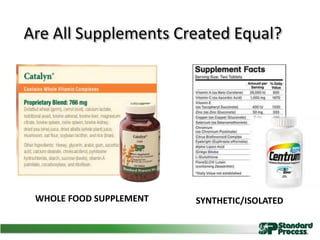
WHOLE FOOD SUPPLEMENT SYNTHETIC/ISOLATED
Are All Supplements Created Equal?
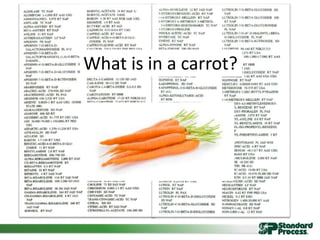
What is in a carrot?
1. Synthetic
• Artificial chemicals made in a factory from coal tar, petroleum
or GMO corn syrup
• Most are made by the same five pharmaceutical companies
• Have a pharmacological (not nutritional) effect on the body
• Lack essential co-factors which complete and balance the
nutrient complex
• Create nutritional deficiencies of missing co-factors
•Results in toxic “mega-dose” approach to therapeutics e.g.
ascorbic acid
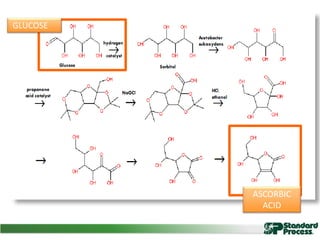
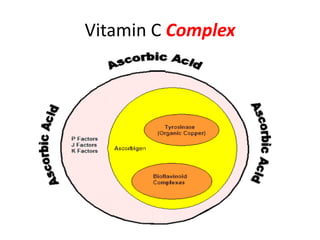
Making “Vitamin C”GLUCOSE
ASCORBIC
ACID
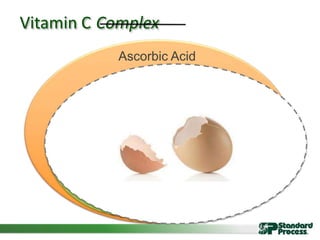
Ascorbic Acid
Vitamin C
Bioflavanoid
Complexes
(Rutin)
Tyrosinase
P factor
J factor
K factor
Complex
Vitamin C Complex
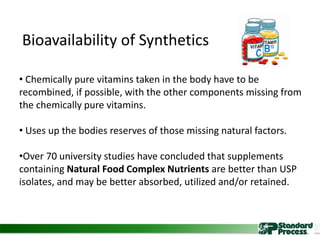
• Chemically pure vitamins taken in the body have to be
recombined, if possible, with the other components missing from
the chemically pure vitamins.
• Uses up the bodies reserves of those missing natural factors.
•Over 70 university studies have concluded that supplements
containing Natural Food Complex Nutrients are better than USP
isolates, and may be better absorbed, utilized and/or retained.
Bioavailability of Synthetics
Whole Food Concentrates
• Concentrated foods and plants that retain the total
complex family of micronutrients (known and unknown)
just as they are found in nature
• Made by removing water and fiber from the food or plant
• Quality determined by: Farming method (Soil, water and
sun) and Manufacturing process (low temp, high vacuum)
• Produce far fewer adverse reactions & interactions with
drugs
• Non-toxic
• Bioavailable
• Have a nutritional/rebalancing effect on the body
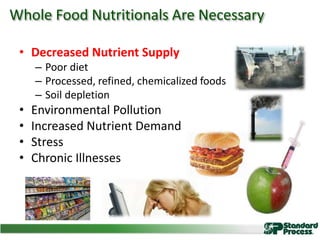
• Decreased Nutrient Supply
– Poor diet
– Processed, refined, chemicalized foods
– Soil depletion
• Environmental Pollution
• Increased Nutrient Demand
• Stress
• Chronic Illnesses
Whole Food Nutritionals Are Necessary
Standard Process
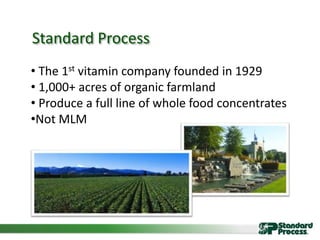
• The 1st vitamin company founded in 1929
• 1,000+ acres of organic farmland
• Produce a full line of whole food concentrates
•Not MLM
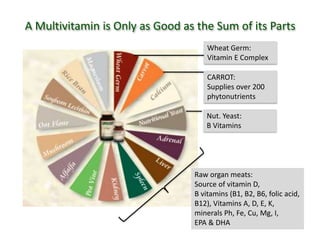
A Multivitamin is Only as Good as the Sum of its Parts
CARROT:
Supplies over 200
phytonutrients
Raw organ meats:
Source of vitamin D,
B vitamins (B1, B2, B6, folic acid,
B12), Vitamins A, D, E, K,
minerals Ph, Fe, Cu, Mg, I,
EPA & DHA
Nut. Yeast:
B Vitamins
Wheat Germ:
Vitamin E Complex
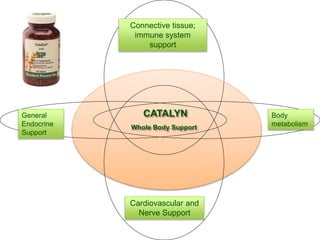
Connective tissue;
immune system
support
CATALYN
Whole Body Support
Cardiovascular and
Nerve Support
Body
metabolism
General
Endocrine
Support
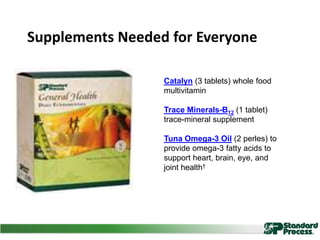
Supplements Needed for Everyone
Catalyn (3 tablets) whole food
multivitamin
Trace Minerals-B12 (1 tablet)
trace-mineral supplement
Tuna Omega-3 Oil (2 perles) to
provide omega-3 fatty acids to
support heart, brain, eye, and
joint health†
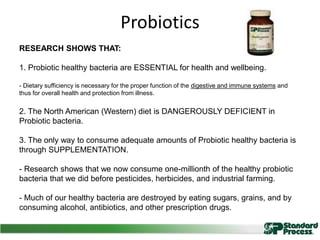
Probiotics
RESEARCH SHOWS THAT:
1. Probiotic healthy bacteria are ESSENTIAL for health and wellbeing.
- Dietary sufficiency is necessary for the proper function of the digestive and immune systems and
thus for overall health and protection from illness.
2. The North American (Western) diet is DANGEROUSLY DEFICIENT in
Probiotic bacteria.
3. The only way to consume adequate amounts of Probiotic healthy bacteria is
through SUPPLEMENTATION.
- Research shows that we now consume one-millionth of the healthy probiotic
bacteria that we did before pesticides, herbicides, and industrial farming.
- Much of our healthy bacteria are destroyed by eating sugars, grains, and by
consuming alcohol, antibiotics, and other prescription drugs.
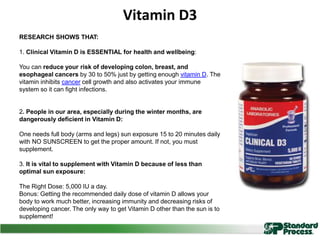
Vitamin D3
RESEARCH SHOWS THAT:
1. Clinical Vitamin D is ESSENTIAL for health and wellbeing:
You can reduce your risk of developing colon, breast, and
esophageal cancers by 30 to 50% just by getting enough vitamin D. The
vitamin inhibits cancer cell growth and also activates your immune
system so it can fight infections.
2. People in our area, especially during the winter months, are
dangerously deficient in Vitamin D:
One needs full body (arms and legs) sun exposure 15 to 20 minutes daily
with NO SUNSCREEN to get the proper amount. If not, you must
supplement.
3. It is vital to supplement with Vitamin D because of less than
optimal sun exposure:
The Right Dose: 5,000 IU a day.
Bonus: Getting the recommended daily dose of vitamin D allows your
body to work much better, increasing immunity and decreasing risks of
developing cancer. The only way to get Vitamin D other than the sun is to
supplement!
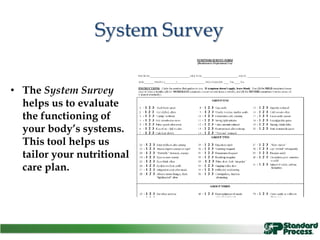
System Survey
• The System Survey
helps us to evaluate
the functioning of
your body’s systems.
This tool helps us
tailor your nutritional
care plan.
“Whole food nutrition
begins with the sun, water,
and fertile soil”
~ Dr. Royal Lee
Questions?

Are Your Vitamins Killing You?

  • 1.
    Are Your Vitaminskilling you? Presented by Scott A. Dubrul D.C. “Let food be thy medicine, and let thy medicine be thy food.” ~Hippocrates Health is not by chance, it is by choice.
  • 2.
    Today’s Discussion • Whatare Vitamins and Minerals? • Do I even need to take Supplements? • Are All Supplements Created Equal? • How do I know what supplements I need to take? • Q&A
  • 3.
    What is aVitamin? •An organic compound (contains carbon). •An “essential” nutrient the body cannot produce enough of on its own, so it has to get it from “food”.
  • 4.
     A mineralis a naturally occurring, inorganic solid, with a definite chemical composition and ordered internal structure. Examples: Calcium, Zinc, Magnesium, Phosphorous
  • 5.
     Many functions: Act as cofactors for enzyme reactions. Enzymes don’t work without minerals. All cells require enzymes to work & function. They give us our vitality.  Minerals actually facilitate the transfer of nutrients across cell membranes.  They maintain proper nerve conduction  Minerals help to contract and relax muscles.  They help to regulate our bodies tissue growth  Minerals provide structural and functional support for the body
  • 6.
    Vitamins and mineralsare found in food. If you eat enough of the right foods, you should be good But Most people do not eat the right foods Even people who do eat the right foods may come up short
  • 7.
    The Empty Harvest Evidencethat the fruits and vegetables available to most people today don't contain the nutritional value they had about 40 or 50 years ago. Donald Davis, Ph.D., University of Texas Biochemist • 2004; U.S. Department of Agriculture report on 43 common garden fruits and vegetables and found that almost half of the substances containing minerals important to good health had lost some nutritional value. •In plants considered as a group, we found that six out of 13 nutrients showed apparently reliable declines between 1950 and 1999 •The study identified the plants as losing at least some measurable value were protein, calcium, phosphorus, iron, riboflavin and ascorbic acid. The declines ranged from 6 percent for protein to 38 percent for riboflavin.
  • 8.
    The Empty Harvest TheOrganic Consumers Association cites several other studies with similar findings: •A Kushi Institute analysis of nutrient data from 1975 to 1997 found that average calcium levels in 12 fresh vegetables dropped 27 percent; iron levels 37 percent; vitamin A levels 21 percent, and vitamin C levels 30 percent. •A similar study of British nutrient data from 1930 to 1980, published in the British Food Journal,found that in 20 vegetables the average calcium content had declined 19 percent; iron 22 percent; and potassium 14 percent •Yet another study concluded that one would have to eat eight oranges today to derive the same amount of Vitamin A as our grandparents would have gotten from one.
  • 9.
    Definition: Something added tocomplete a diet or to make up for a dietary deficiency Supplements
  • 10.
    ENVIRONMENTAL Intense heat/cold Noise Toxic exposure Disruptedlight cycles MENTAL Fear/anxiety/worry Depression PHYSIOLOGICAL Pain Starvation Infection Poor sleep Excess exercise Hypoglycemia Inflammation  February 2009, a study involving 161,808 postmenopausal women in the Women's Health Initiative (WHI) concluded that those who took multivitamins did not have a lower death rate than others and were just as likely to develop cardiovascular disease or cancers of the lung, colon/rectum, breast, and endometrium — the kinds that are most common in women  2006, the National Institutes of Health (NIH) said there wasn't enough evidence for a recommendation about taking multivitamins.
  • 11.
    2008, a CochraneCollaboration review: • People in trials who were given supplements of vitamin A, vitamin E, and beta carotene had a higher death rate. • There's some evidence that excess folic acid (the synthetic version of folate, a vitamin found abundantly in vegetables, fruits, and grains) may be contributing to an uptick in colorectal cancer. A person taking a multivitamin can easily exceed the recommended total intake, and maybe even the safe upper limit of 1,000 mcg. (Excess isn't a problem with folate found naturally in foods.)
  • 12.
    Research Study: Vitamin CPills Linked To Artery Clogging • Associated Press Headline, March 2000 • Vitamin C pills [ascorbic acid] may speed up hardening of the arteries, researchers suggest in a new study they called a disturbing surprise. • Dr. James Dwyer, an epidemiologist who directed the study and presented the findings at the meeting in San Diego of the American Heart Association said : “When you extract one component of food and give it at very high levels, you just don't know what you are doing to the system, and it may be adverse.”
  • 13.
  • 14.
    WHOLE FOOD SUPPLEMENTSYNTHETIC/ISOLATED Are All Supplements Created Equal?
  • 15.
    What is ina carrot?
  • 16.
    1. Synthetic • Artificialchemicals made in a factory from coal tar, petroleum or GMO corn syrup • Most are made by the same five pharmaceutical companies • Have a pharmacological (not nutritional) effect on the body • Lack essential co-factors which complete and balance the nutrient complex • Create nutritional deficiencies of missing co-factors •Results in toxic “mega-dose” approach to therapeutics e.g. ascorbic acid
  • 17.
  • 18.
  • 19.
  • 20.
    • Chemically purevitamins taken in the body have to be recombined, if possible, with the other components missing from the chemically pure vitamins. • Uses up the bodies reserves of those missing natural factors. •Over 70 university studies have concluded that supplements containing Natural Food Complex Nutrients are better than USP isolates, and may be better absorbed, utilized and/or retained. Bioavailability of Synthetics
  • 21.
    Whole Food Concentrates •Concentrated foods and plants that retain the total complex family of micronutrients (known and unknown) just as they are found in nature • Made by removing water and fiber from the food or plant • Quality determined by: Farming method (Soil, water and sun) and Manufacturing process (low temp, high vacuum) • Produce far fewer adverse reactions & interactions with drugs • Non-toxic • Bioavailable • Have a nutritional/rebalancing effect on the body
  • 22.
    • Decreased NutrientSupply – Poor diet – Processed, refined, chemicalized foods – Soil depletion • Environmental Pollution • Increased Nutrient Demand • Stress • Chronic Illnesses Whole Food Nutritionals Are Necessary
  • 23.
    Standard Process • The1st vitamin company founded in 1929 • 1,000+ acres of organic farmland • Produce a full line of whole food concentrates •Not MLM
  • 24.
    A Multivitamin isOnly as Good as the Sum of its Parts CARROT: Supplies over 200 phytonutrients Raw organ meats: Source of vitamin D, B vitamins (B1, B2, B6, folic acid, B12), Vitamins A, D, E, K, minerals Ph, Fe, Cu, Mg, I, EPA & DHA Nut. Yeast: B Vitamins Wheat Germ: Vitamin E Complex
  • 25.
    Connective tissue; immune system support CATALYN WholeBody Support Cardiovascular and Nerve Support Body metabolism General Endocrine Support
  • 26.
    Supplements Needed forEveryone Catalyn (3 tablets) whole food multivitamin Trace Minerals-B12 (1 tablet) trace-mineral supplement Tuna Omega-3 Oil (2 perles) to provide omega-3 fatty acids to support heart, brain, eye, and joint health†
  • 27.
    Probiotics RESEARCH SHOWS THAT: 1.Probiotic healthy bacteria are ESSENTIAL for health and wellbeing. - Dietary sufficiency is necessary for the proper function of the digestive and immune systems and thus for overall health and protection from illness. 2. The North American (Western) diet is DANGEROUSLY DEFICIENT in Probiotic bacteria. 3. The only way to consume adequate amounts of Probiotic healthy bacteria is through SUPPLEMENTATION. - Research shows that we now consume one-millionth of the healthy probiotic bacteria that we did before pesticides, herbicides, and industrial farming. - Much of our healthy bacteria are destroyed by eating sugars, grains, and by consuming alcohol, antibiotics, and other prescription drugs.
  • 28.
    Vitamin D3 RESEARCH SHOWSTHAT: 1. Clinical Vitamin D is ESSENTIAL for health and wellbeing: You can reduce your risk of developing colon, breast, and esophageal cancers by 30 to 50% just by getting enough vitamin D. The vitamin inhibits cancer cell growth and also activates your immune system so it can fight infections. 2. People in our area, especially during the winter months, are dangerously deficient in Vitamin D: One needs full body (arms and legs) sun exposure 15 to 20 minutes daily with NO SUNSCREEN to get the proper amount. If not, you must supplement. 3. It is vital to supplement with Vitamin D because of less than optimal sun exposure: The Right Dose: 5,000 IU a day. Bonus: Getting the recommended daily dose of vitamin D allows your body to work much better, increasing immunity and decreasing risks of developing cancer. The only way to get Vitamin D other than the sun is to supplement!
  • 29.
    System Survey • TheSystem Survey helps us to evaluate the functioning of your body’s systems. This tool helps us tailor your nutritional care plan.
  • 30.
    “Whole food nutrition beginswith the sun, water, and fertile soil” ~ Dr. Royal Lee
  • 31.

Editor's Notes

  • #6 Theoretically then, persistent, low-level stress – which the body unfortunately interprets as warranting a “fight or flight” response – is destructive to health. In other words, being stuck in traffic for two hours a day, every day, is the equivalent of a serious survival threat to your as-yet “primal” brain, and the adrenals pump accordingly. Cortisol serves many important functions, including the rapid release of glycogen stores for immediate energy. But persistent cortisol release requires that other vital mechanisms effectively shut down – immunity, digestion, healthy endocrine function, and so on. Among other stress-health associations, the link between elevated cortisol and weight gain has already been established.
  • #8 “Buffalo Hump” of fat on shoulders. Stomach loose and hanging over waist. Unable to rest at night Tired around 10:00 Am, 2:00 PM, and 4:00 PM Excess Stress and Worry! Craving Salt Retaining Water, especially around ankles
  • #9 So what is the GAS. Based on animal experiments Selye recognized 3 phases. 1) The alarm phase - with the fast release of hormones from the adrenal cortex and adrenal medulla - a catabolic phase and therefore potentially harmful - the fight or flight response. 2) With repeated stress the body learns to resist the stressor in a more economical way - this is the resistance phase and homeostasis is maintained. 3) In the exhaustion phase the body’s adaptive capacity to resist the stress is exhausted and homeostasis is lost - death can result.
  • #17 Did you know that most vitamins on the market claiming to be natural only have to be 10% natural to make this claim! If you decide to spend your hard-earned money on natural, it is critically important you learn to read labels to assure receiving your money's worth. A product can even be 100% organic and not be natural at all. To be called organic a molecule need only have at least one carbon atom.
  • #18 The discoverer of Vitamin C noticed this difference when testing his discovery. In 1930's, Dr. Albert Szent Gyorgyi was awarded the Nobel Peace Prize in medicine for discovering Vitamin C.A friend of his who was suffering from a debilitating disease was given Vitamin C and did not recover, he did recover when he consumed food that contained a high vitamin C content. Dr. Albert Szent Gyorgyi would spend the rest of his life trying to discover why naturally produced Vitamin C worked and man-made did not.
  • #22 products that contain the total complex family of micro-nutrients (known and unknown) just as they are found in nature
  • #23 The foods you eat are stripped of nutrients through refining and processing. The foods you eat are laden with fats, sugars, and salts, and devoid of other essential nutrients. A USDA government survey of 21,500 people found that not one single person consumed 100% of the U.S. RDA, from the foods they ate. Due to the time it takes fresh foods to get from the farm to your table, 57% or more of the nutritional value can be lost. The foods you eat can be harmful from the use of pesticides, fungicides, sulfites, and preservatives.
  • #25 Many cultures use almost the entire animal for food, including the organs. The most often-used organs are the liver, tongue, kidneys, brains, heart, stomach, and intestines. If you take a look at our dietary history, it is obvious that organ meat was very common and eaten even more often than the muscle meat of animals. Well, organ meats are known to have some of the highest concentrations of naturally occuring vitamin D of any food source, and including a source of organ meats into your diet once or twice a week, can especially help people in the winter times that might otherwise get a vitamin D deficiency.